By The Numbers: The Gender Pay Gap

Equal Pay March (The Atlantic)

Equal Pay March (The Atlantic)

Everyone knows that women get paid less than men. (If you don’t know that by now, you’re welcome.) You may have heard that stat that women make 75 cents to every dollar a man makes.

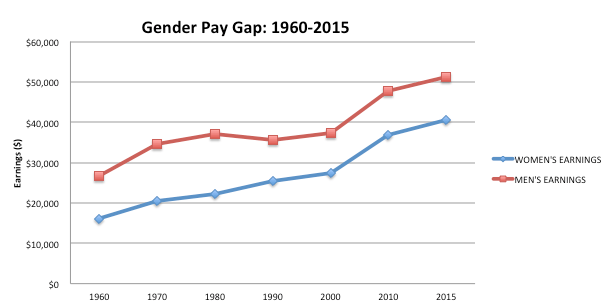
This got me curious to see what the pay gap has been throughout recent history. I found long-range pay gap data from Pay Equity Information. I then made a data table to cherry-pick my desired years:

Gender Pay Gap Data, 1960-2015 (Pay Equity Information)

Gender Pay Gap Data, 1960-2015 (Pay Equity Information)

Then I created a line graph to see the difference visually:

Gender Pay Gap: 1960-2015 chart (Pay Equity Information)

Gender Pay Gap: 1960-2015 chart (Pay Equity Information)

As you can see, the pay gap was worst in 1960-1980. Only after 1980 does the ratio start to approach 70 cents to a dollar. And there’s still so far to go.

#ThrowbackThursday: Gender Pay Gap by State, 2016

Gender Pay Gap by State (Business Insider)

Gender Pay Gap by State (Business Insider)

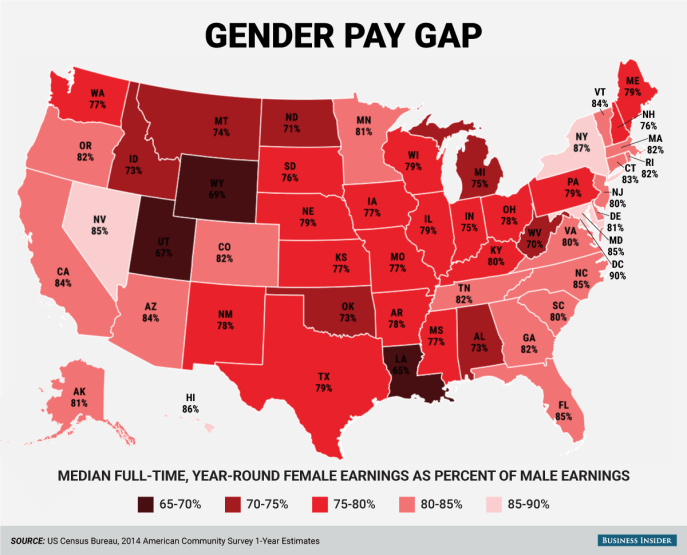
You know the old saying that women make 75 cents for every dollar a man makes? (Gah, that makes me want to punch something.) Well, it’s not strictly true. Yes, women on the whole make less than men, but it’s not always exactly 75 cents.

The above graphic comes from “Business Insider,” which broke down the gender pay gap by state. Notice from the key at the bottom of the map that no percentage range rises about 90%. So no state pays women 90 cents for every man’s dollar. The closest states are New York with 87% and Nevada with 85%.

This is just depressing, There’s so much more progress to be made.

The Academy’s New Class is 39% Female and 30% POC

Priyanka Chopra, Donald Glover, Naomie Harris, and John Cho (The Hollywood Reporter)

Priyanka Chopra, Donald Glover, Naomie Harris, and John Cho (The Hollywood Reporter)

The Academy of Motion Picture Arts and Sciences recently announced its new class of members. The 2017 class numbers 744, which is a new record. This breaks the 2016 number of invitees at 683, which had previously held the record.

This new class might also hold the distinction of being the most diverse (so far). Of the 744 members, 39% are women and 30% are people of color (POC).

Here’s how the new class will influence the gender makeup of the Academy:
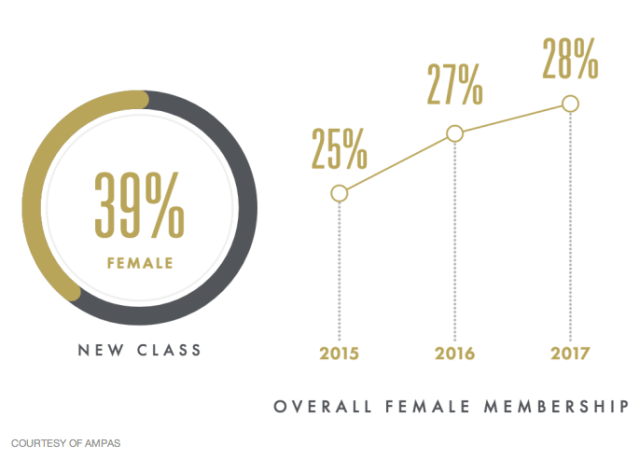
Overall Female Membership (Variety/AMPAS)

Overall Female Membership (Variety/AMPAS)

Notable women invited include “Wonder Woman” star Gal Gadot, comedian Amy Poehler, and French actress Charlotte Gainsbourg.

POC comprise 39% of this year’s class. Here’s what that looks like with respect to the Academy’s full voting body:

People of Color in Overall Membership (Variety/AMPAS)

People of Color in Overall Membership (Variety/AMPAS)

Notable POC invitees include Jordan Peele and Keegan-Michael Key of “Key & Peele,” Indian actor Salman Khan, and Hong Kong actor Tony Leung.

Of course, there’s a lot of intersectionality happening for women of color (WOC). Prominent WOC in this year’s Academy class include Priyanka Chopra, Sanaa Lathan, and Nazanin Boniadi.

The Academy’s new class is part of an effort to increase the numbers of women and POC members by 2020.

Hopefully the new influx of fresh faces and perspectives will allow more diverse and inclusive narratives to come to the forefront, and prevent another #OscarsSoWhite fiasco.
 

Trump Pays His Female Employees Like It’s 1980

Ivanka Trump (CNBC)

Ivanka Trump (CNBC)

The gender pay gap is alive and well in the Trump White House. Shocker! (Except not.) Instead of achieving pay parity with men, the women are losing ground in the fight.

(Incidentally, Ivanka Trump serves in an unpaid role.)

Economist Mark Perry of the American Enterprise Institute analyzed median wages, and found that the gender pay gap has more than tripled. In other words, the women are getting paid like it’s 1980.

What does this look like in salary terms?

The median female White House employee is drawing a salary of $72,650 in 2017, compared to the median male salary of $115,000. “The typical female staffer in Trump’s White House earns 63.2 cents per $1 earned by a typical male staffer,” Perry writes.

If you need that pay gap in visual form, you’re in luck:

White House gender pay gap graph (The Washington Post/Wonkblog)

White House gender pay gap graph (The Washington Post/Wonkblog)

Damn, that does not look good.

To put this further in perspective, the national pay gap is 17%. The Trump administration pay gap sits at 37%, more than double the national rate.

Something to note: using the median, and not averages, is the best way to determine pay parity. This is because averages include the outliers, both on the low and high ends of the scale.

Another note: The pay gap in Trump’s White House is higher than the pay gap in any White House since 2003. And

By The Numbers: Interracial Marriage Data

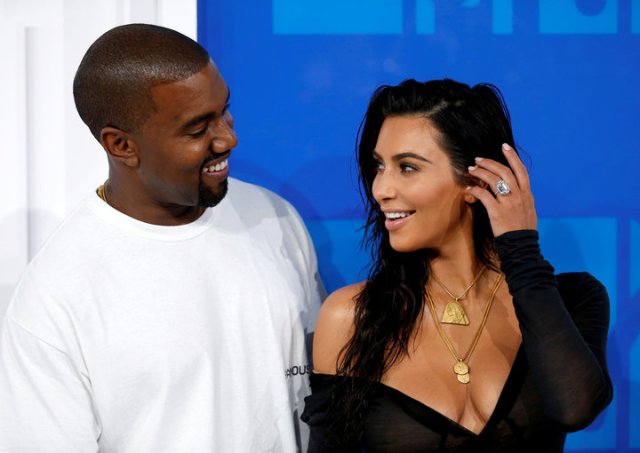
Kim Kardashian and Kanye West arrive at the 2016 MTV Video Music Awards in New York (The Huffington Post)

FILE PHOTO – Kim Kardashian and Kanye West arrive at the 2016 MTV Video Music Awards in New York, U.S., August 28, 2016. REUTERS/Eduardo Munoz/File Photo

The 50th anniversary of the Loving v. Virginia case is soon approaching. The case struck down bans on interracial marriage, and continues to resonate today. With that in mind, I was curious to see any data on interracial marriages: Has the number gone up? Has societal disapproval gone down?

Let’s take a look:

Who’s Marrying Out?

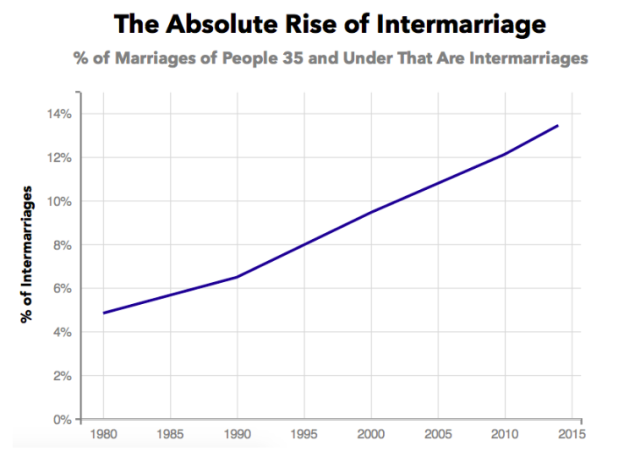
  • In 1970, less than 1% of all married couples were interracial.
  • In 1980, 6%+ of newlyweds were interracial, and only 3% of all marriages were interracial.
  • In 2013, 12% of newlyweds (a record high) married someone of a different race, and 6.3% of all marriages were interracial.
The Absolute Rise of Intermarriage (Priceonomics)

The Absolute Rise of Intermarriage (Priceonomics)

Who’s Down with Marrying Out?

  • In 1986, only 30% of survey respondents felt interracial marriage is acceptable for everyone. But that same percentage of respondents did not feel interracial marriage was acceptable for anyone.
  • In 2009, 83% of survey respondents were accepting of interracial marriage.
  • In 2012, 93% of people approve of interracial marriage.

And let’s end on one more noteworthy statistic that warms my heart and gives me hope for the future:

“More than four-in-ten Americans (43%) say that more people of different races marrying each other has been a change for the better in our society.”


#ThrowbackThursday: Loving v. Virginia, 1967

Mildred and Richard Loving (The New York Times)

Mildred and Richard Loving (The New York Times)

Virginia newlyweds Richard and Mildred Loving were arrested shortly after their wedding in 1958. The reason? As Life magazine would later put it, “the crime of being married.”

The Lovings had violated Virginia’s Racial Integrity Act of 1924, which banned interracial relationships and marriage. The couple avoided prison time be agreeing to leave Virginia and not come back for 25 years.

In 1964, the couple took their case to the American Civil Liberties Union (ACLU), which eventually went all the way to the Supreme Court. On June 12, 1967, the Supreme Court unanimously ruled that the Racial Integrity Act was unconstitutional. The decision made states’ anti-miscegenation laws unenforceable (though many of the laws remained on the books for years later).

Today, nearly 50 years later, the Loving v. Virginia case continues to resonate. In 2015, the decision was cited in Obergefell v. Hodges in arguments in favor of marriage equality to the case’s success. A documentary “The Loving Story” was released in 2011, and “Loving” was released in 2016 with Joel Edgerton and Ruth Negga as the historic couple.


#ThrowbackThursday: Jennifer Garner in ‘Elektra,’ 2005

Jennifer Garner in 'Elektra,' 2005 (Ouch Press)

Jennifer Garner in ‘Elektra,’ 2005 (Ouch Press)

Full disclosure: I haven’t seen the 2005 movie “Elektra,” but per IMDB, here’s the synopsis:

Elektra the warrior survives a near-death experience, becomes an assassin-for-hire, and tries to protect her two latest targets, a single father and his young daughter, from a group of supernatural assassins.

The movie, starring Jennifer Garner in the title role, was spun off from 2003’s “Daredevil”  (which starred Garner’s eventual ex-husband Ben Affleck). “Elektra” didn’t do well at the box office: It only grossed $56M+ worldwide on a budget of $43M+.

“Elektra” would ordinarily be a footnote in the history of superhero movies, except for one thing: It’s the most recent movie starring a female superhero.

Until “Wonder Woman.”


Trends: Slaying While Pregnant


Beyonce's performance at the 2017 Grammy Awards (The Fader)

Beyonce’s performance at the 2017 Grammy Awards (The Fader)

It seems like almost every female celebrity is pregnant right now (and that almost all of them are pregnant with twins). But instead of lying low and taking it easy during their pregnancies, many of these women are stepping it up, and making pregnant and non-pregnant women alike look like slackers.

First case in point: Beyonce. Leave it to Queen Bey to put us all to shame. The superstar performed a set during this year’s Grammy Awards. One portion featured her leaning back in a chair perched at a very precarious angle. (I don’t know about you, but my heart was in my throat for that whole portion. And I audibly exhaled when she got off that chair.)

Beyonce had also been scheduled to perform at Coachella before withdrawing. But we can’t fault her for that, considering she’s done more while pregnant than many people do in their lives.

Serena Williams is widely acknowledged to be the GOAT (Greatest Of All Time) tennis player in the world. Last month, she announced her pregnancy. When she announced the news, Williams was 20 weeks along. Someone very smart (and awesome) did the math and realized that Williams had recently played in a match while pregnant. And, as Laura Wagner at “Deadspin” put it, this wasn’t just any match:

Serena Williams won the 2017 Australian Open, her record-breaking 23rd major, without dropping a single set, while nine fucking weeks pregnant. She is the greatest of all time.

Elsewhere in entertainment, Gal Gadot has been preparing for her upcoming movie “Wonder Woman.” Last November, she shot reshoots for the movie…while also five months pregnant. And she was probably doing more than a few stunts. NBD.

It’s great that we’re seeing so many women dominate during a time in life when women traditionally have been relegated to the sidelines.

#ThrowbackThursday: Serena Williams Wins the Australian Open, 2017

Serena Williams at the 2017 Australian Open (Indian Express)

United States’ Serena Williams celebrates after winning the first set against Barbora Strycova of the Czech Republic during their fourth round match at the Australian Open tennis championships in Melbourne, Australia, Monday, Jan. 23, 2017. (AP Photo/Kin Cheung)

In January, tennis superstar Serena Williams beat her sister, fellow tennis star Venus Williams, in the final set of the Australian Open. The win was her seventh Australian Open title, and 23rd Grand Slam singles title. Williams is now back to being the #1-ranked tennis player in the world.

Williams was also in the early weeks of pregnancy during the Australian Open. So there’s that.

What Makes Someone Monogamous?

Wedding rings (BBC)

Wedding rings (BBC)

We can’t distill monogamy into a single magic formula. But some scientists have recently made strides in determining what factors might make a person monogamous.

One possible factor: genetics.

Researchers at Harvard University recently published a study examining the mating habits of deer mice and oldfield mice. In the wild, deer mice are promiscuous and oldfield mice are monogamous. Scientists first undertook an experiment to see how the two types of mice compare in parenting their young. Different parenting metrics were observed, such as building nests for the offspring.

After noting that the deer mice put in less parental efforts, the researchers wanted to see if the differences were down to genetics (ah, the old nature vs. nurture debate!). Five pairs of deer mice and oldfield mice were interbred, which produced 30 hybrid mice and later 769 (!) third-generation mice.

The parenting behaviors of these second- and third-generation hybrid mice ran the gamut from hardly involved to heavily-involved in their offsprings’ lives. In observing this, scientists were able to identify parts of DNA (termed loci) that determined parenting behaviors. The experiment’s abstract in scientific journal Nature explained the findings:

Using quantitative genetics, we identify 12 genomic regions that affect parental care, 8 of which have sex-specific effects, suggesting that parental care can evolve independently in males and females. Furthermore, some regions affect parental care broadly, whereas others affect specific behaviours, such as nest building.

The abstract also notes that a certain gene expression is primarily responsible for the level of nest-building. No word on how that would translate to humans (the gene for interior decorating?), but it’s exciting to see some strides made in genetic research.