Women in the Workplace Study 2016: By The Numbers

Joan Holloway and Peggy Olsen, 'Mad Men' (Mad Men Wiki)

Joan Holloway and Peggy Olsen, ‘Mad Men’ (Mad Men Wiki)

Sheryl Sandberg’s LeanIn.Org teamed up with consulting firm McKinsey & Co. to release the second annual Women in the Workplace study. The study bills itself as “a comprehensive study of the state of women in corporate America.” The study examined 132 companies with a combined total of 4.6M+ employees. Another 34K+ filled out a relevant survey about their experiences in the workplace.

You can read the full results, but here are some relevant stats:

Able to Participate Fully in Meetings:

  • Women: 67%
  • Men: 74%

Believe Their Contributions are Appropriately Valued:

  • Women: 49%
  • Men: 54%

Believe Their Gender Will Make It Hard to Advance:

  • Women: 33%
  • Men: 12%

Lobbied for a Promotion or New Assignment:

  • Women: 39%
  • Men: 36%

Asked for an Increase in Compensation:

  • Women: 29%
  • Men: 27%

Negotiated and Received Feedback They Were “Bossy”/”Aggressive”/”Intimidating”:

  • Women: 30%
  • Men: 23%


Trends: All-Female Reboots

"Ghostbusters," 2016 (Geek.com)

“Ghostbusters,” 2016 (Geek.com)

The 2011 movie “Bridesmaids” was very funny, no doubt about that. The film, which starred a cadre of funny women led by Kristen Wiig and Maya Rudolph, centered on the escapades of the titular group as they helped their friend (played by Rudolph) on the way to getting hitched. The movie was well-liked by audiences, and that showed in the revenue. At the end of the year, “Bridesmaids” ranked #14 at the domestic box office with $169M+ in revenue, and #20 in the worldwide box office with $289M+ in revenue.

But it also had an effect on movies that we’re still feeling: “Bridesmaids” convinced studios that audiences (both women and men, shocker) would see a movie with an all-woman cast. Well…duh. And now studios have sat up and taken notice.

The waves from “Bridesmaids” have hit an interesting formula: to remake a beloved movie with an all-female cast. The rationale goes that if the men liked the original, then the women will love the remake! (And there’s the assumption that the men will be dragged to the movie from their ladies, but it’s OK because it’s a nostalgic property.)

One high-profile all-female remake has already come out: this year’s “Ghostbusters.” The reboot has Kristen Wiig, Melissa McCarthy, Kate McKinnon and Leslie Jones investigate paranormal happenings in New York. The movie has a strong “Saturday Night Live” heritage: In addition to Wiig, McKinnon and Jones logging time on the show, the movie also featured current cast member Cecily Strong in a notable part. “Ghostbusters” debuted at #2 on opening weekend, and as thus far grossed $124M+ domestically and $208M+ worldwide.

Another all-female project announced recently was a reboot of the 2001 heist movie “Ocean’s 11” (which itself is a remake of the 1960 movie of the same name). Sandra Bullock, Cate Blanchett, Rihanna, Mindy Kaling, Anne Hathaway, Helena Bonham Carter, and Nora Lum (better known by her rap name Awkwafina) will make up the ensemble. No release date yet, but I know I’ll be seeing it in the theatre because I vote with my dollars.

It’s great to see so many movies getting made with all-female ensembles, but I can’t wait to get to the point where it’s not noteworthy anymore, but unremarkable and accepted.


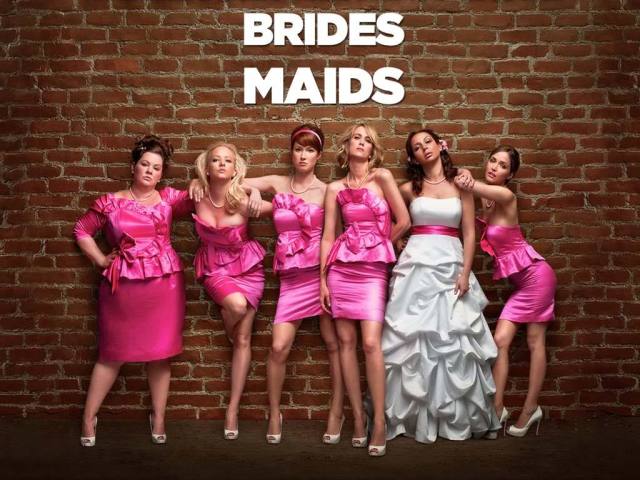
#ThrowbackThursday: “Bridesmaids,” 2011

"Bridesmaids," 2011 (Scoopify)

“Bridesmaids,” 2011 (Scoopify)

If you didn’t see “Bridesmaids” when it came out five years ago, you clearly hate women in comedy. As you might guess from the movie title, the story revolved around a group of bridesmaids, led by Kristen Wiig, and their antics leading up to their friend’s wedding day.

Before “Bridesmaids” premiered in May 2011, the movie had gotten a lot of press for being an all-female comedy. Lots of questions prevailed: Were women actually funny? Would women see it? More importantly (ha, in the eyes of Hollywood), would men see it?

The answer to these questions was a resounding “yes!” The movie did well at the box office, ranking #14 at the domestic box office with $169M+ in revenue and #20 worldwide with $289M+ in revenue. It also opened the door a little wider to allow more female-driven  movies and women in gross-out comedy (remember the bridal atelier scene?).

#ThrowbackThursday: Paid Maternity Leave Around the World

Paid Maternity Leave Around the World (Blogspot)

Paid Maternity Leave Around the World (Blogspot)

Yeah, this is a #TBT, but it’s relevant to today. In fact, it’s still happening today. The United States is one of the few countries left in the world that doesn’t pay for maternity leave. Crazy, right?!

This map just lays it out. I hope the U.S. comes to its senses soon, and enacts paid maternity leave for all new (and reoccurring) mothers.

Rome Considers Zone of Tolerance for Prostitutes

Italian prostitutes (The Telegraph)

Italian prostitutes (The Telegraph)

The Roman neighborhood of EUR is considering enacting various “zones of tolerance” around the city within which prostitution would be legal. Certain places would off-limits, such as public parks, churches and schools. This makes sense: A country-wide law dictates that cities can issue boundaries on where prostitution can and cannot occur. This is a bit of a legal loophole in Italy, where aiding prostitution is illegal (but restricting it to certain areas is fine), but paying for sex is totally cool.

Naturally, the prostitutes themselves are not happy with this, as it would cut into their business. The Catholic Church isn’t too pleased either, for obvious reasons.

There are precedents for these zones: In 2012, Montreal was mulling a similar thing, but wanted to restrict it to one street, away from the busy main thoroughfare. In 2006, the English town of Ipswich considered a tolerance zone after a spate of prostitute murders shook the community.

EUR hasn’t come (heh) to a conclusion yet, but it’ll be interesting to see what precedent this sets for the city, Italy and the rest of the world.


Auction Prices of “Playboy”‘s First Issue: By The Numbers

Marilyn Monroe cover for 'Playboy,' Dec. 1953 (NY Daily News)

Marilyn Monroe cover for ‘Playboy,’ Dec. 1953 (NY Daily News)

As I noted earlier today, a first issue of “Playboy” is scheduled to be auctioned off later at Nate D. Sanders in Los Angeles. (For all I know, it could’ve already happened.) The issue is expected to be sold for about $2.7K.

I wanted to see if this estimate was in line with how much previous first issues of the periodical sold for.

A 2011 “Icons and Idols Hollywood” auction held by Julien’s Auctions opened bidding for the “Playboy” first issue at $1K-1.5K. The winning bid was $7K+. I also checked eBay, but all the first issues listed were for reprints, not originals, so I didn’t count those.

If this auction proceeds (or proceeded) anything like Julien’s did four years ago, the issue could very well sell for a lot higher.

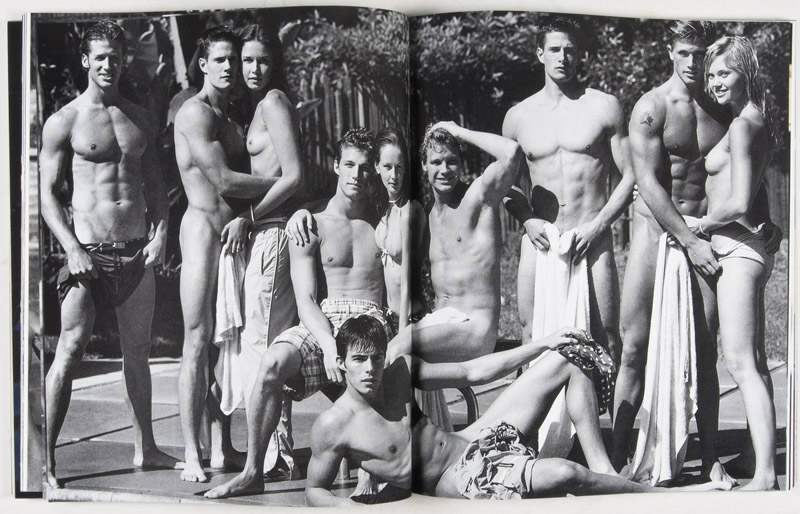
The New Abercrombie & Fitch Will Feature Less Sex (NSFW)

'A&F Quarterly' Spring Break Issue 2001 (Kline Books)

‘A&F Quarterly’ Spring Break Issue 2001 (Kline Books)

Happy Friday! If you’re in your mid-20s or older, you probably remember (and hell, wore) some Abercrombie & Fitch (A&F) back in the day. The stylishly distressed, yet massively overpriced, clothes were a status signifier back in middle and high school, when everyone wanted to be part of the cool crowd (which was comprised solely of all-American, apple-cheeked near-Aryans). And of course, who can forget those sex-drenched ads and catalogs?

The A&F of yore will now be changing that particular aspect. According to “The Washington Post,” the chain will no longer hire “models” (their term for sales associates) based on “body type or physical attractiveness.” They’ll also phase out the “sexualized marketing” (suggestive ads, shirtless models at storefront openings) by July.

This all comes as A&F tries to revamp its image, and project a more inclusive one. Former CEO Mike Jeffries was known for promoting the brand as exclusionary to everyone but his coveted “cool crowds,” and didn’t offer larger sizes. He stepped down from his post last December. The move came amid reports that the retailer’s shares have decreased 39% over the past year, and profits shrunk 5%+ last year.

It’ll be interesting to see if A&F can actually pull off this drastic brand reinvention, and if consumers will respond to it.

Dell Williams, Influential Sex Shop Entrepreneur, Has Died

Sex shop founder/entrepreneur Dell Williams (Refinery29)

Sex shop founder/entrepreneur Dell Williams (Refinery29)

Sad news from last week: Dell Williams, founder of the first woman-friendly sex shop Eve’s Garden, died at the age of 92.

Her origin story begins in the early ’70s, when she decided to purchase a Hitachi Magic Wand, “the Rolls-Royce of vibrators” after attending famed sex educator Betty Dodson’s “Body/Sex Workshop.” (Dodson was a huge proponent of the Magic Wand.) When Williams attempted to buy the device at a New York City Macy’s, she was shamed by a younger male sales associate.

She reported her lightbulb moment as follows:

Someone really ought to open up a store where a woman can buy one of these things without some kid asking her what she’s going to do with it.

This experience led Williams to build Eve’s Garden from her kitchen table, pursuing it as a side-hustle while working a 9-to-5 as an advertising executive. She was working on this at an interesting time: Discussions about female sexuality were beginning to bubble up, contrasting with the point that sex shops were run by, and catered pretty exclusively to men.

She showed an aptitude for entrepreneurship, as the thriving mail-order business (founded in 1974) grew into a storefront, and later went online. The site sells condoms, sex toys, and books, including Williams’ biography “Revolution in the Garden.”

Williams quickly became one of the go-to women to comment on sexuality changes amidst the larger society. In 1973, she organized a conference on women’s sexuality that received a lot of attention, and was consulted on sexual matters ranging from how to up the passion during Valentine’s Day to Britney Spears’ own ode to female masturbation “Touch of My Hand.”

But perhaps Williams was destined to go into the sex industry: Legend has it she was named for journalist Floyd Dell, who was an ardent supporter for Margaret Sanger’s work.

Williams started something that (thankfully) continues to thrive to this day: the woman-friendly sex shop, where women can go in and explore without fear of being shamed or side-eyed.

Above all, she knew the power of a sexually healthy and knowledgable woman (and how scared the rest of the world is of her). For her dedication in her biography, she wrote:

It has long been my unassailable belief that orgasmic women can change the world.  By this I mean that a woman who is unfettered sexually is unfettered politically, socially, economically and she is unstoppable.


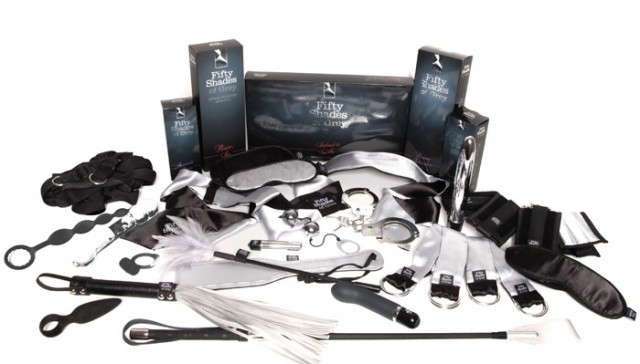
How Has “Fifty Shades of Grey” Impacted the Sex Toy Industry?

'Fifty Shades of Grey'-themed sex toys (Crushable)

‘Fifty Shades of Grey’-themed sex toys (Crushable)

With the recent “Fifty Shades of Grey” movie coming out last month (along with the requisite storm of thinkpieces), the sex toy industry is seeing an impact on the bottom line.

Different sex toy retailers are feeling an impact. “Variety” reports that Manhattan-based The Pleasure Chest was offering “Fifty Shades”-themed classes every night leading up to the movie’s premiere (though it doesn’t say for many weeks this went on).

Online retailer Adam & Eve, which holds the largest market share at 4%, has also gained a boost in sales. They’re also selling their own toy line “Scarlet Couture” pegged to the movie, in addition to the official “Fifty Shades”-inspired line.

“The Hollywood Reporter” has a piece which came out before the movie opened giving us some hard numbers. The U.K. sex toy brand Lovehoney made the line of “Fifty Shades”-inspired toys, which includes blindfolds, riding crops and feather ticklers. Demand for the “Inner Goddess” Ben Wa balls (or vaginal balls) sold out Europe in pre-orders. (Full disclosure: I was actually given a box of these when I attended a sexual health conference in January.)

THR reports that Lovehoney’s profits “tripled from $1.1 million the year before to $3.39 million by January 2014.” The “Fifty Shades” line has already sold 1.2M units worldwide, and is estimated to boost sales by 40% once the movie debuts.

If you’re looking for lingerie, Bluebella has you covered. The lingerie line has three “Fifty Shades”-inspired collections, and they anticipate a spike in sales not only from the movie, but also from Valentine’s Day.

“Inc.” also had a comprehensive article on this cultural phenomenon, and puts it in the larger context of a sea change. Market research firm IBISWorld found the following:

Between 2008 and 2013, sex toy sales in the U.S. increased by approximately 12.5 percent annually, raking in $610 million in 2013 overall.

The article notes that it’s more the smaller companies seeing a boon to their bottom line. But there’s also been a shift in who the sex toy industry’s customers are:

In 2013, women made up approximately 67 percent of U.S. industry patronage, which was a 12 percent increase from 2008.

It’ll be interesting to see if this is just a one-time sales spike, specifically in BDSM gear, or if this trend will continue, eventually making the practice almost, dare I say, vanilla.


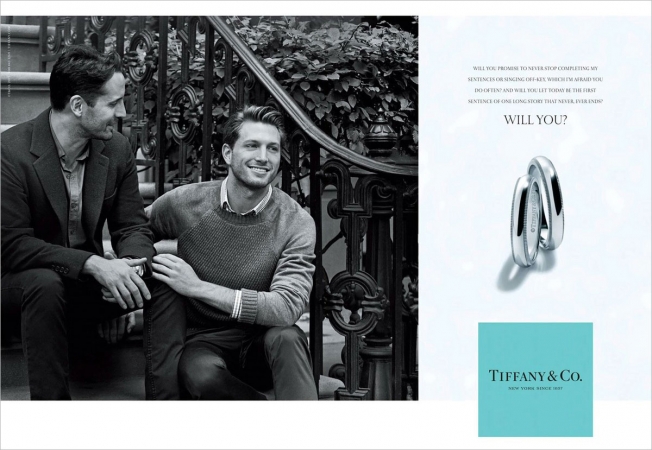
Thursday Trends: Same-Sex Couples Reflected in Advertising

Tiffany's first ad featuring a gay couple (Adweek)

Tiffany’s first ad featuring a gay couple (Adweek)

Advertisements are finally getting with the times, and featuring more diversity than your run-of-the-mill straight white couple.

Last month, jewelry giant Tiffany’s debuted a new print ad for their wedding rings. But this ad had one thing different: it prominently featured a gay couple. And apparently the two men are a couple in real life, and were photographed on their own New York stoop.

This was the first time Tiffany’s has used a same-sex couple in their advertising. But it won’t be the last: Just this week, the brand used the same couple in a TV-spot ad. (The ad also features straight and interracial couples.) It signals that the 178-year-old brand recognizes that love comes in many forms, and they want to be all-inclusive. (And it’s a smart business move.)

Other brands in recent years have featured same-sex couples. Preppy retailer J. Crew used a gay couple in their catalog in spring 2011, and Gap used another couple on a billboard the following year. Incidentally, neither sets of couples are professional models: In the case of the J. Crew couple, one of the men was a designer for the brand. (It seems there’s also a side-trend of using real people.)

Lesbian couples are also increasingly represented. In 2012, JC Penney featured a lesbian couple with their children in a catalog pegged to Mother’s Day. Last year, condom brand Durex used two women being playfully affectionate with each other in an ad for a massage gel. This year, Hallmark showed an ad featuring a real-life lesbian couple describing their feelings for each other in the run up to Valentine’s Day.

It’s clear that things are changing. Even “The Onion” got in the action, with a (mock) article claiming that jewelry company Zales created an ad featuring a polyamorous triad. (But the article did rightfully call out that we, as a whole society, aren’t quite there yet.)

Hopefully this follow its natural progression, and  will eventually lead to more ads featuring same-sex couples with families. It’d be great to see future print and online ads and commercials where we see a family with two dads or two moms, NBD.

After all, this would make complete economic sense for these companies: In 2012, “Adweek” reported that the LGBT market is estimated to be worth around $743B+.