Civil Rights Activist Viola Desmond Will Be the First Woman on the Canadian $10 Bill

Viola Desmond (The Canadian Encyclopedia)

Viola Desmond (The Canadian Encyclopedia)

Canada has always been on the progressive side of things, and now it’s extended to their money. The country has elected to put a black woman on one of their bills.

Desmond will be featured on the Canadian $10 bill:

According to the Bank of Canada, there are 132 million $10 bills in circulation right now. The number of new banknotes printed annually fluctuates from year to year.

Said woman Viola Desmond was a civil rights activist. In Dec. 1946, she bought a floor seat in the main house of a movie theater. The main house was reserved for whites, whereas Black movie-goers were supposed to sit upstairs in the balcony. Desmond was arrested and jailed, on account of not paying the tax difference between the two seats. The tax difference was…one cent. One. Cent.

In 1947, Desmond tried to appeal the charge and lost. She dies in 1965 at age 50, and was granted a public pardon and apology in 2010.

It’s important to note that Desmond’s act came nine years before Rosa Parks gave up her bus seat in the United States, setting off the U.S.’s civil rights movement.

As Ryerson’s Office of Equity, Diversity and Inclusion Staffer Darrell Bowden puts it:

“Viola was not the Rosa Parks of Canada. Rosa Parks was the Viola Desmond of America.”

Until this point, the only woman on Canadian money has been Queen Elizabeth of England. But Desmond is the first Canadian woman who will be on Canadian money. She’s also the first one who won’t be part of a group: Canada’s Famous Five suffragettes graved the $50 bill from 2004 until 2011.

Desmond beat out 26K+ submissions from the public. The bill with her face will go into circulation in 2018.

#ThrowbackThursday: Kim Kardashian West’s Kimoji Launch, 2015

Kim Kardashian West's Kimoji, 2015 (Kim Kardashian West)

Kim Kardashian West’s Kimoji, 2015 (Kim Kardashian West)

Kim Kardashian West’s set of custom emoji, dubbed “Kimoji,” launched on December 21, 2015. Nearly a year later, they continue to be a hit, and paved the way for other celebrities to launch their own custom emoji lines.

Kardashian West’s Kimoji references notable things about her which both hardcore and casual fans would recognize: her waist trainer corset, posing in her white swimsuit, and her notorious crying face.

Amy Schumer is Forbes’ Highest-Paid Female Comedian

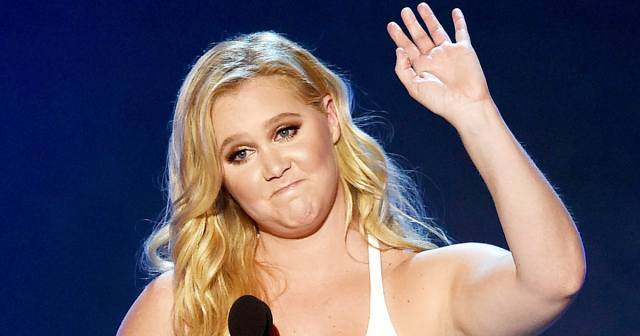
Amy Schumer (US Magazine)

Amy Schumer (US Magazine)

Love her or hate her, Amy Schumer is making bank. On this year’s version of Forbes‘ Highest-Paid Comedians, Schumer debuted at #4. The publication estimated her earning power at $17M. Counted within this figure are her Comedy Central show Inside Amy Schumer, her movie Trainwreck, her $8M advance for her book The Girl with the Lower Back Tattoo, commercial work and touring.

Forbes‘ Madeline Berg explains why Schumer’s inclusion in this list is so significant:

Not only is she the only female comic on this year’s list, Schumer is also the only woman to ever make the highest-paid comedians list—a big first as women have historically faced difficulty being taken seriously in the funny business.

In another significant feat, Schumer is the only woman to play, and sell out, Madison Square Garden.

For contrast, the highest-paid comedian on Forbes‘ list is Kevin Hart, who pulled in $87.5M.

The Newest CoverGirl Wears a Hijab

CoverGirl Nura Afia (Today)

CoverGirl Nura Afia (Today)

CoverGirl is making strides in inclusivity in their marketing outreach this year. Earlier, the brand announced beauty blogger James Charles as its first male spokesmodel. Now, CoverGirl has tapped beauty vlogger Nura Afia. Afia wears a hijab as part of her Muslim faith.

The 24-year-old will be the first spokesmodel to wear a hijab. Afia will appear in a commercial, and will serve as an ambassador for the So Lashy! Blast Pro Mascara. She hopes that her wearing hijab will normalize Muslims for the rest of America.

Afia began posting makeup tutorials on YouTube in 2011. She now has 215K subscribers and 13M video views. But this isn’t Afia’s first major brand partnership: she’s previously partnered with Revlon.

Beauty that’s inclusive to Muslims is massive, and poised to grow even bigger. According to Ogilvy Noor, by way of The New York Times:

The Muslim personal cosmetics and care market is now worth more than $54 billion, a figure that is expected to reach $80 billion by 2020.

Hasbro Reports Sales Boost in Q2 2016 with “Frozen” and Disney Princess Toys

Hasbro's Disney Princess line (Elena's Closet)

Hasbro’s Disney Princess line (Elena’s Closet)

Toymaking giant Hasbro recorded better-than-expected sales in Q3 2016. And they have the Disney Princesses and “Frozen” sisters to thank.

Hasbro won the global rights to make the aforementioned toys from Mattel earlier this year.

The two toy lines helped boost the girls category revenue by 35%, bringing the total to $172M+. The lines also helped partner brand revenue grow by 15% (which was also helped by “Star Wars” toys). And even before the most recent earning report came out, it was estimated that the Disney Princesses line would generate about $60M in Q3 2016.

This demonstrates that girls (and the men and women who buy their toys) have some massive purchasing power. Let’s hope that this is taken into account before “Star Wars: Rogue One” hits theaters, so we actually have some action figures of lady badass Jyn Erso.


Women in the Workplace Study 2016: By The Numbers

Joan Holloway and Peggy Olsen, 'Mad Men' (Mad Men Wiki)

Joan Holloway and Peggy Olsen, ‘Mad Men’ (Mad Men Wiki)

Sheryl Sandberg’s LeanIn.Org teamed up with consulting firm McKinsey & Co. to release the second annual Women in the Workplace study. The study bills itself as “a comprehensive study of the state of women in corporate America.” The study examined 132 companies with a combined total of 4.6M+ employees. Another 34K+ filled out a relevant survey about their experiences in the workplace.

You can read the full results, but here are some relevant stats:

Able to Participate Fully in Meetings:

  • Women: 67%
  • Men: 74%

Believe Their Contributions are Appropriately Valued:

  • Women: 49%
  • Men: 54%

Believe Their Gender Will Make It Hard to Advance:

  • Women: 33%
  • Men: 12%

Lobbied for a Promotion or New Assignment:

  • Women: 39%
  • Men: 36%

Asked for an Increase in Compensation:

  • Women: 29%
  • Men: 27%

Negotiated and Received Feedback They Were “Bossy”/”Aggressive”/”Intimidating”:

  • Women: 30%
  • Men: 23%


#ThrowbackThursday: Working Women, 1950s

Working women, 1950s (Minorities in the 1950s)

Working women, 1950s (Minorities in the 1950s)

According to the Bureau of Labor Statistics (BLS), women ages 16-55+ comprised 18K+, which was less than 30% of the labor force. (By contrast, working men numbered 43K+ and over 70%.) Out of the 12% of American women who worked outside the home, only 6% of women held management positions.

Today, things have changed…slightly. It’s still difficult for women to climb the corporate ladder and make it all the way to the C-suite.


Burkini Sales Rise by 200% After French Ban

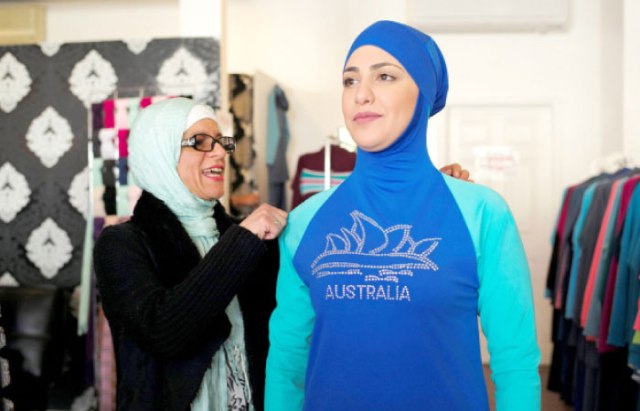
Burkini designer Aheda Zanetti (Saudi Gazette)

Burkini designer Aheda Zanetti (Saudi Gazette)

Earlier this summer, coastal French towns courted controversy when their respective mayors decided to ban burkinis on beaches. The burkini consists of a long-sleeved top with long pants and a head covering, and was developed for women who follow Islamic modesty standards so that they could go swimming while still covered. The term “burkini” comes from a portmanteau of the words “burqa” and “bikini.”

Despite the ban, burkini creator Aheda Zanetti says that online sales of now-famous swimwear have risen over 200%+ recently. (Now, we don’t know what her sales had been previously, or what the year-over-year change has proved to be, so unfortunately we have incomplete information.)

Zanetti says that her customers are not homogeneously Muslim. She reports that about 40% of her customers are from other faith traditions, such as Judaism and Mormonism, that adhere to modest dress standards.

The burkini ban stems from a stringent French view on separating religion from the state. The French government has banned religious symbols from government buildings since 2004. A ban specifically on burqas was passed in 2011.

Right now, about 30 French towns have instituted the ban, though the town of Villeneuve-Loubet has since overturned it.


Trends: All-Female Reboots

"Ghostbusters," 2016 (Geek.com)

“Ghostbusters,” 2016 (Geek.com)

The 2011 movie “Bridesmaids” was very funny, no doubt about that. The film, which starred a cadre of funny women led by Kristen Wiig and Maya Rudolph, centered on the escapades of the titular group as they helped their friend (played by Rudolph) on the way to getting hitched. The movie was well-liked by audiences, and that showed in the revenue. At the end of the year, “Bridesmaids” ranked #14 at the domestic box office with $169M+ in revenue, and #20 in the worldwide box office with $289M+ in revenue.

But it also had an effect on movies that we’re still feeling: “Bridesmaids” convinced studios that audiences (both women and men, shocker) would see a movie with an all-woman cast. Well…duh. And now studios have sat up and taken notice.

The waves from “Bridesmaids” have hit an interesting formula: to remake a beloved movie with an all-female cast. The rationale goes that if the men liked the original, then the women will love the remake! (And there’s the assumption that the men will be dragged to the movie from their ladies, but it’s OK because it’s a nostalgic property.)

One high-profile all-female remake has already come out: this year’s “Ghostbusters.” The reboot has Kristen Wiig, Melissa McCarthy, Kate McKinnon and Leslie Jones investigate paranormal happenings in New York. The movie has a strong “Saturday Night Live” heritage: In addition to Wiig, McKinnon and Jones logging time on the show, the movie also featured current cast member Cecily Strong in a notable part. “Ghostbusters” debuted at #2 on opening weekend, and as thus far grossed $124M+ domestically and $208M+ worldwide.

Another all-female project announced recently was a reboot of the 2001 heist movie “Ocean’s 11” (which itself is a remake of the 1960 movie of the same name). Sandra Bullock, Cate Blanchett, Rihanna, Mindy Kaling, Anne Hathaway, Helena Bonham Carter, and Nora Lum (better known by her rap name Awkwafina) will make up the ensemble. No release date yet, but I know I’ll be seeing it in the theatre because I vote with my dollars.

It’s great to see so many movies getting made with all-female ensembles, but I can’t wait to get to the point where it’s not noteworthy anymore, but unremarkable and accepted.


#ThrowbackThursday: “Bridesmaids,” 2011

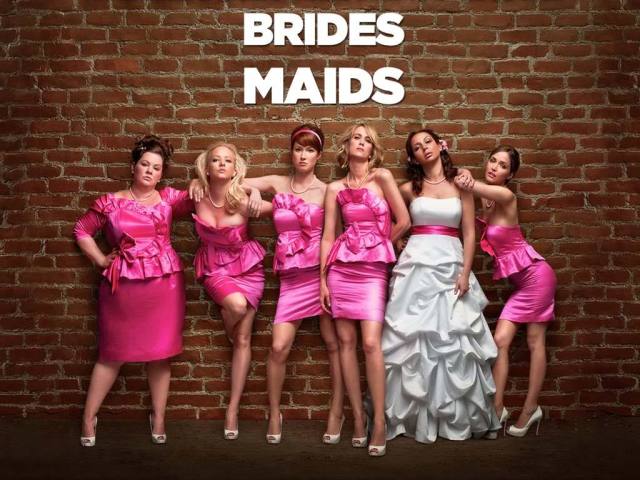
"Bridesmaids," 2011 (Scoopify)

“Bridesmaids,” 2011 (Scoopify)

If you didn’t see “Bridesmaids” when it came out five years ago, you clearly hate women in comedy. As you might guess from the movie title, the story revolved around a group of bridesmaids, led by Kristen Wiig, and their antics leading up to their friend’s wedding day.

Before “Bridesmaids” premiered in May 2011, the movie had gotten a lot of press for being an all-female comedy. Lots of questions prevailed: Were women actually funny? Would women see it? More importantly (ha, in the eyes of Hollywood), would men see it?

The answer to these questions was a resounding “yes!” The movie did well at the box office, ranking #14 at the domestic box office with $169M+ in revenue and #20 worldwide with $289M+ in revenue. It also opened the door a little wider to allow more female-driven  movies and women in gross-out comedy (remember the bridal atelier scene?).