Josh Duggar Scandal: How Much Child Sexual Abuse Occurs Within Religious Cults?

Josh and Anna Duggar and their children (E! Online)

Josh and Anna Duggar and their children (E! Online)

Last month, eldest son of the “19 Kids and Counting” Duggar clan Josh Duggar admitted he’d sexually molested five girls when he was 14 years old in 2002, some of which were his sisters. (When these incidents took place, Duggar had five sisters, who ranged in age from four to 12.)

More revelations came out over the days that followed: Duggar was sent away to a friend who had a home remodeling business after he admitted what he’d done; he didn’t receive any counseling, contrary to what had initially been stated, and Duggar was given a minor talking-to from Arkansas State Trooper Jim Hutchens, who’s now in prison for child pornography. After the allegations came to light, a judge ordered the incriminating documents be destroyed, apparently on behalf of one of the alleged victims.

The Duggar family is part of the Quiverfull movement, a worldview that purports to be about Christianity and living Biblically. Earmarks of being Quiverfull include having lots of children (supplying Christian soldiers to prepare for the upcoming spiritual battle), dressing modestly and shaming victims of sexual abuse.

Until now, the fact that the Quiverfull movement is a cult has flown under the radar. But now it’s come under the scrutiny of a full-fledged public spotlight.

I wanted to find some statistics on sexual abuse, especially child/incestual sexual abuse, within cults. Unsurprisingly, I was unable to find anything. No long-range studies have been done. This makes sense: Cults usually want to cover their tracks, and make themselves look like they aren’t cults at all and are completely normal. In terms of gathering information, it’d be very hard to infiltrate and gain members’ trust to get an accurate picture of what occurs within one. Even if a member did admit to something, they might see it as totally normal.

Unfortunately, the statue of limitations on Duggar’s heinous acts has now expired. But now we have some idea of the long-ranging detrimental effects of the Quiverfull movement. There are better ways to help victims of sexual abuse and molestation, regardless of their personal viewpoint.



How Many Wives Cheat?

Woman removing wedding ring (Mockridge Investigations)

Woman removing wedding ring (Mockridge Investigations)

I ran across an interesting article on “The Huffington Post” on cheating wives, and wanted to see what other numbers I could find on the topic.

The 2013 HuffPo piece cites a “Bloomberg Business” article (the link to which is now defunct) that supposedly goes into further detail about it. The findings were apparently taken from the National Opinion Research Center’s General Social Survey, and found that women “had more affairs in the past two decades then in previous years.” The article doesn’t clarify how long the “previous years” timespan is.

But the study apparently found that “the percentage of wives having affairs rose almost 40 percent … to 14.7 percent in 2010.” This seems a little suspect, especially since we can’t see the original source. We’re dealing with self-reporting, so there’s bound to be some wonky numbers. And I don’t understand this “rising 40% to 14.7%” business. I feel like something got lost there, because there’s sort of no way that can be true.

HuffPo’s article mentions that for women, greater economic freedom makes it easier to cheat, since a financially independent woman isn’t trapped by her husband making all the household income.

Another study excerpted from the book “The Normal Bar” puts the number of cheating women at 19%, but this might also included unmarried women. A feature from “Fox News Magazine” claims the number of cheating wives hovers around 50-60%.

But which of these is correct?

It’s pretty impossible to tell. But it’s probable that the actual numbers might be higher.

There are so many varying statistics on this due to self-reporting issues that we’ll probably never get a concrete number of wives who admit to cheating on their husbands.


#ThrowbackThursday: Abercrombie & Fitch Ad, 2012

Abercrombie and Fitch ad shot by Bruce Weber (Towleroad)

Abercrombie and Fitch ad shot by Bruce Weber (Towleroad)

Three years ago, acclaimed photographer Bruce Weber shot a promo for Abercrombie & Fitch that featured handsome male models doing things all guys do: wrestling, showering, and kissing.

That last one is depicted up top. Later, the clothing brand claimed that the video (and three related others) were part of an official A&F campaign, even though Weber had identified the video as such on his Facebook page.

Regardless, it’s still a cool image. Abercrombie will always be the first softcore your 13-year-old self squealed over, but it’s at least made some strides towards acceptance (certain other inflammatory comments from former CEO Mike Jeffries notwithstanding).

Thursday Trends: Plus-Size Models in Mainstream Media

Tess Munster (Bustle)

Tess Munster (Bustle)

It’s safe to say that plus-size models are having a moment in the spotlight right now. The fashion industry has finally cottoned on to the fact that most women are not a size -2 (which is rarely found in nature), but that more “normal”-sized women representative of the American public might want to see themselves depicted (and desired!). And the inclusion will also sell more for said fashion companies, so it’s a win-win all around.

We can trace this development to late last year, when the Pirelli calendar unveiled its 2015 edition. Candice Huffine made history as the first plus-size model to grace the legendary calendar’s pages. She broke a tradition stemming from 1964 of using the usual thin models to usher in a new year and a new outlook on beauty standards.

Speaking of beauty standards (more like #effyourbeautystandards), plus-size model/retro bombshell Tess Munster (now Tess Holliday) recently became the first plus-size model to sign with the U.K.’s MiLK Model Management. She’s now the first plus-size model signed to a mainstream agency, in the Curves division, and the first one within Curves above a size 20 (she’s a 22 and stands at 5 ft. 5 in.). Munster cuts a distinctive figure, with bright red wavy hair, alabaster skin and lots of tattoos. She’s been around for awhile, and was named a top plus-size model in the world by “Vogue Italia” in 2013. That same year, the “body positive activist” began the aforementioned hashtag to encourage women to love their bodies at any and every size. She also participated a video in which she and other plus-size models recreated Beyoncé’s music video for “***Flawless,” called “#everyBODYisflawless.”

Fashion blogger/model Nadia Aboulhosn was one of these models. She’s gained attention and press for her fashion prowess that’s all about the street style. The half-Lebanese stunner first drew notice when she won American Apparel’s XL Model Search in 2011.

Perhaps the most mainstream seal of approval, “Sports Illustrated” selected a plus-size model for this year’s Swimsuit Issue: Model Robin Lawley is a size 12. Lawley had previously been on the cover of Australian “Vogue,” as the first plus-size model, and was the first plus-size face of Ralph Lauren in 2012. But even though she’s plus-size by fashion industry standards, she still looks…well, like a normal tall, curvy girl. Like a model.

Let’s hope that plus-size women gaining visibility in the fashion world isn’t a one-time trend, and eventually becomes an unremarkable norm encompassing diverse shapes and sizes.

Brazil Will Pass Out Free Condoms During Carnival

Mardi Gras mask and beads (123 RF)

Mardi Gras mask and beads (123 RF)

Happy Mardi Gras! Known in English as Fat Tuesday (and just in time for National Condom Week), today celebrates casting off repression, upending social norms and indulging in vices before the Christian season of Lent begins (when enjoying all earthly pleasures ceases for 40 days). Much like Halloween, masks and costumes, dancing and lust in the air figure prominently.

Brazil has made Carnival an international destination, and it’s legendary for a reason. Several cities throw parades, led by various samba schools. Many foreigners fly in for the multi-day party (spanning the Friday before to Ash Wednesday at noon), making Carnival the country’s biggest tourism booster.

Naturally, when the shackles of convention are thrown aside, a lot more spontaneous sex occurs (because when in Rio…). But the Brazilian government is always prepared for this: they give out free condoms.

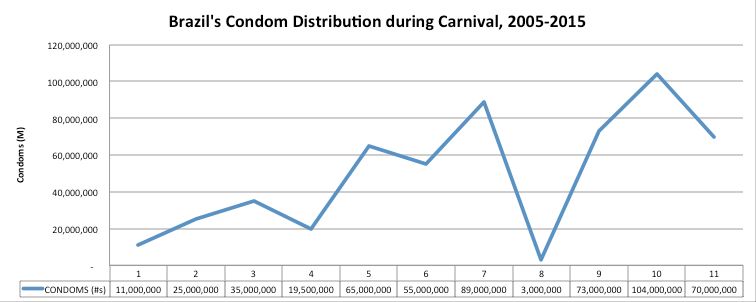
This year, they’ll hand out 70M condoms throughout the country. They’ve done this for years, handing out 65M in 2009, 55M in 2010, 89M in 2011, 3M in 2012, 73M in 2013 and 104M in 2014.

For visual learners, here’s a decade-long progression in line-graph form:

Brazil's Condom Distribution during Carnival, 2005-2015

Brazil’s Condom Distribution during Carnival, 2005-2015

As you can see, the number of condoms distributed during Carnival has tended to baseline around 70-75M in recent years (aside from 2012, whose 3M looks incorrect, to say the least).

Last year, the Brazilian government estimated that 2M+ people were on the streets at any given time during Carnival. Surely attendees can find at least one person to hook up with during the popular “blocos” (street-wide parties).


The Numbers Behind Stanford University’s Sexual Assault Problem

Stanford University (Stanford)

Stanford University (Stanford)

Last week, Stanford University swimmer Brock Allen Turner was charged with raping an intoxicated and unconscious woman in January. Allen was discovered by two men, who then chased after him. The men tackled and held Allen to prevent him from escaping, while a third man called the police.

Since then, Allen has “voluntarily withdrawn” from the university (more likely, it was either that or face expulsion), and won’t be allowed to re-enroll. His profile has also been removed from the nationally-ranked swim team’s website. Stanford will also conduct its own investigation of the crime.

This is notable for a few reasons. Rapes on college campuses have made headlines recently, notably the “Rolling Stone” UVA article, and subsequent fraternity scandal. But this is the first time we’ve recently seen a school take a hard line against rape. The university made a swift and decisive action, leaving no room for public outcry.

Specifically for Stanford, this is a pretty bold move. According to the “SF Gate,” the school has been one of the schools called out for their sexual assault policies (as in, they’re not stringent enough). Stanford Law professor Michele Landis Dauber prepared a report on sexual assaults at the school, and found the following:

Between 1997 and 2009, just four of 175 reported sexual assaults were formally adjudicated at Stanford, with two of the alleged attackers held responsible.

Doing the math, only 2.29% of reported sexual assaults were tried over a period of 12 years. (And, with what we know about the reporting of sexual assaults, it’s probable that the sheer number of them that occurred was much higher.) The alleged attackers were only held responsible 50% of the time. Pretty shameful.

Dauber noted that the numbers have improved since the report: The university has been “more welcoming” to victims and followed through on investigations (which could mean following through on more investigations, and/or following through more closely). But of course, there’s always room for improvement.

Let’s hope that Stanford’s actions incite other colleges to make the right decisions when, not if, they’re faced with similar situations.

Single Parents’ Sex Lives

Parent and child

Parent and child

A recent study jointly done by the University of Nevada and The Kinsey Institute examines the sex lives of single parents.

According to “The Huffington Post,” the study, which used data from the 2012 Singles in America findings, looked at 5K+ single Americans age 21 and over. Single parents comprised almost 39% of the sample size.

Participants were asked questions regarding the frequency of sexual thoughts and actually getting it on, as well as the number of people they’d dated and how many children they had. The timeframe appears to be limited to one year.

Researchers said that the single parents reported having the same amount of sex as singles without children. Also, single parents with children under age five had more sex than those with older children. These findings were published in the Journal of  Sex Research.

However, the study doesn’t tell us what baseline was used for “normal” frequency of sexual intercourse and sexual thoughts. So we can’t really extrapolate much here.