Why is There an Orgasm Gap in Hook-Ups vs. Relationships?

Orgasm (NYC Barstool Sports)

Orgasm (NYC Barstool Sports)

In honor of International Women’s Day yesterday, let’s examine a very real issue that a lot of women face: the orgasm gap in hookups vs. relationships.

There have been a few studies on this. A 2013 study by the Kinsey Institute at Indiana University found that “women were twice as likely to reach orgasm from intercourse or oral sex in serious relationships as in hookups.” The study surveyed 600 male and female college students. A study out of New York University found that only 40% of women achieved orgasm during their most recent hookup that included sex, where 80% of men reported climaxing. This study polled 24K students at 21 colleges.

But when a woman is in a committed relationship, their orgasm rate shoots up to 75%.

Why is this?

There are several reasons for this: more frequent and consistent practice with a steady partner, communication with a partner and/or feeling empowered and confident within one’s sexuality.

Dr. Debby Herbenick of The Kinsey Institute points out that men tend to report orgasms more than women, so the number of women having orgasms might well be higher. Also, the term “hook(ing) up” includes sexual acts that might not result in having an orgasm, such as kissing.

But women can have sex and get pregnant without climaxing. So why are we so worried about having one (or multiples)?

Dr. Elisabeth A. Lloyd, author of “The Case of the Female Orgasm: Bias in the Science of Evolution,” puts it best:

“The female orgasm is for fun.”

And she’s so totally right. So get out there and go get yours!

Obscenity Tests via Federal Standards: By The Numbers

Kim Kardashian in 'Playboy,' 2007 (The Trent)

Kim Kardashian in ‘Playboy,’ 2007 (The Trent)

I’ve never wanted to go into law (except when I watch “How to Get Away with Murder”), but if I did, there are two areas of the field that I’ve always found fascinating: intellectual property and obscenity laws. The first topic doesn’t apply here, but the second topic has all the business in the world of being covered here.

There are so many facets of obscenity, but today we’re looking at how federal standards define the term, as the First Amendment of free speech doesn’t extend to protect obscenity. A few different tests have been put in place from time to time to establish a baseline of what’s obscene and what isn’t.

Here’s how that’s changed over the years:

Number of obscenity tests: 3

The Hicklin Test, 1879 

This one was adapted from an 1860s British case. It became standard stateside when it was used in 1879 to prosecute D.M. Bennett, who was charged with obscenity when he tried to send out free-love information through the mail (this also upheld the Comstock Act).

The Hicklin test defined obscenity as material designed to corrupt impressionable minds (whether they were young or not).

– The Roth Test, 1957

This test overturned the Hicklin test, and set a new standard: Material would be considered obscene if the nature of the work deviated from a conventional norm and turned into “a prurient interest.” (Nerdy side note: in statistics terms, would that be two or three deviations from the mean? Would it be 95% or 97%? Would the prurient interests exist in the remaining 5% and/or the 2%?)

But exactly what a “prurient interest” was was never defined further.

Years later, this one was also responsible for Justice Potter Stewart’s now-famous quote on obscenity: “I’ll know it when I see it.”

– The Miller Test, 1973

Here, the Supreme Court Justices got slightly more specific as they struggled to define obscenity. Here are the three main points:

(a) whether “the average person, applying contemporary community standards” would find that the work, taken as a whole, appeals to the prurient interest

(b) whether the work depicts or describes, in a patently offensive way, sexual conduct specifically defined by the applicable state law

(c) whether the work, taken as a whole, lacks serious literary, artistic, political, or scientific value

In layman’s terms, this would be:

a) Is it creepy, disgusting and/or explicit (according to your vanilla friends and neighbors)?

b) Does it run afoul of state law?

c) Is it worth anything to the greater good/society?


I love how all of these descriptions are so vague. Seriously, no one can define obscenity. What’s “prurient” to one person may be perfectly standard to another. But then, studies have shown that there’s not really such a “normal” fantasy, but there are varying degrees along the spectrum. And I’m willing to bet it’s the same with defining obscenity.


#ThrowbackThursday: The Comstock Act, 1873

The New York Society for the Suppression of Vice seal (Loyno)

The New York Society for the Suppression of Vice seal (Loyno)

Praise be for mail-order sex toys. We wouldn’t have that option if the Comstock Act was enforced.

Enacted on Mar. 3, 1873, the Comstock Act (named after the bill’s cheerleader/goody-two-shoes Anthony Comstock) made it illegal to send sex toys, erotica, and items used in abortions, as well as information pertaining to said items, through the U.S. Postal Service. All of these things were classified as “obscene, lewd or lascivious.” The full title of the act was “The Act for the “Suppression of Trade in, and Circulation of, Obscene Literature and Articles of Immoral Use”. (What a mouthful, no wonder it was cut down to the Comstock Act.)

But what exactly was banned was a bit confusing. In some cases, medical textbooks showing basic human anatomy weren’t allowed to be sent through the mail. Because of this, the Act was understandably difficult to enforce. Though it remains on the books today, aspects of it have been torn down.

Thank god, because I can’t imagine a world where Adam & Eve, The Pleasure Chest and countless other retailers aren’t allowed to exist and flourish, and send us hours of pleasure packed in a brown-paper-wrapped box labeled with discreet shipping.

Google Trends: Was 2014 Really the Year of Eating Booty?

Nicki Minaj 'Anaconda' still (NY Daily News)

Nicki Minaj ‘Anaconda’ still (NY Daily News)

Last year, we heard all about how 2014 was the Year of Eating Booty (as termed by “Gawker”). Now we can’t go around and confirm this by asking randoms on the street if they got into anal play (come on, you expect everyone to tell the truth?), but we can check out Google Trends to see if anal terms were searched for more often.

I searched popular terms for the (somewhat-) transgressive sex act, and used a timeframe of January 2013-January 2015. I wanted to see how the entirety of 2014 compared to the year before for anal play-related search terms.

First, let’s start with the proper term for eating out your partner’s asshole:

Analingus:

Google Trends: 'Analingus' Search Term

Google Trends: ‘Analingus’ Search Term

There’s a bit of an increase, with a slightly steeper incline coming (heh) in the second half of last year.


Eating Booty:

Google Trends: 'Eating Booty' Search Term

Google Trends: ‘Eating Booty’ Search Term

Tyrone Palmer’s “Gawker” piece was published on Sept. 12. Those first initial rapid spikes occur in August, so we can’t argue that the “Gawker” piece had anything to do with that. It could’ve been responsible for the spikes throughout the rest of 2014 (not to mention that one huge spike at the end), but it’s pretty inconclusive.


Rimming:

Google Trends: 'Rimming' Search Term

Google Trends: ‘Rimming’ Search Term

This one stays pretty flat throughout. (I have to say, I never heard this term used much last year. It tended towards more colorful expressions for the act.)


Salad Tossing:

Google Trends: 'Tossing Salad' Search Term

Google Trends: ‘Tossing Salad’ Search Term

Like “analingus” and “eating booty,” this one started to get more active during the second half of 2014. My guess here is that it’s due to the popularity of Nicki Minaj’s single “Anaconda,” which was released on August 4th. (In it, she tells listeners that “this dude named Michael…tossed my salad like his name Romaine.”)


Conclusion:

2014 definitely showed an increase in Google search terms related to eating out one’s asshole, though these mainly took place during the second half of the year. I’d have to say that yes, 2014 was the year of eating booty, due to both “Gawker” and Nicki Minaj.

Lucy and Maria Aylmer: How Many Twins Look Racially Different?

Twin sisters Lucy and Maria Aylmer (BoredPanda)

Twin sisters Lucy and Maria Aylmer (BoredPanda)

This week, the Internet has been fascinated by a set of English fraternal twins Lucy and Maria Aylmer. But there’s something special about them: Lucy has pale skin and red hair, while Maria has brown skin and brown curly hair.

In other words, one twin looks white, and the other twin looks black.

Their parents have a mixed racial background: their mother is half Jamaican, and their father is white.

Occasionally, stories like theirs pop up every now and again. In 2009, another British mixed-race couple produced not one, but two, sets of identical twins who each looked very racially different from their sibling.

But how common is this?

Unfortunately, there are no statistics that track this. From “The Associated Press:”

The phenomenon is so uncommon that there are no statistics to illustrate its probability, although it is thought likely to become more common because of the growing number of mixed-race couples.

To give you an idea on exactly how uncommon this is (using numbers!), Dr. Sarah Jarvis of Britain’s Royal College of General Pracitioners, said in 2009 (though it still applies today):

“Even non-identical twins aren’t that common. Non-identical twins from mixed parents, of different races, less common still. To have two eggs fertilized and come out different colors, less common still. So, to have it happen twice must be one in millions.”

But that’s just a guess, though the BBC reported chances closer to 1 in 500 in 2011. We won’t know until we actually start tracking the numbers.

Harvard Bans Student-Teacher Relationships

Harvard University (Huffington Post)

Harvard University (Huffington Post)

Last month, Harvard University officially banned all sexual and/or romantic student-teacher relationships. They did so as part of reviewing the school’s Title IX policy, which prohibits sexual discrimination in education.

The Faculty of Arts and Sciences’ committee decided on three points: an undergraduate cannot date a professor, a graduate student cannot date a professor if the professor is supervising the student, and a grad student can’t date an undergrad if that student is working closely with the undergrad.

The university had previously banned relationships between faculty members and students only if they were in the same class. It had also classified any other student-teacher sexual or romantic relationships as “inappropriate.”

But why is Harvard acting now? Susan Svrluga at “The Washington Post” has the answer:

The new policy comes at a time when sex and gender issues — all the ways that people define themselves, their sexuality, their relationships, and how they interact with one another — are relentlessly discussed on college campuses.

Harvard is also in the middle of reviewing, and revising, its Title IX policy. It’s one of 55 schools that had previously gotten attention from the U.S. Department of Education due to its “handling of sexual assault cases.” (And we all know how that goes.)

Another aspect of the ban is that it prevents professors from abusing their power as educators by sleeping with students under their care. The measure ensures that exploitation and student favoritism doesn’t happen as a result. This makes sense, as many courts cases tried in the ’90s found universities liable for sexual assault cases.

Other schools already have measures in place regarding student-teacher relationships. Yale instituted their own ban in 2010, and the University of Connecticut put one in place in 2013. Arizona State University proposed a tougher measure on student-teacher relationships earlier this year.

It’ll be interesting to see if other schools follow their example in the coming months and/or years, or if this ban will remain an anomaly.


Emoji Users Have More Sex

Sexytime emojis (NY Mag)

Sexytime emojis (NY Mag)

Happy Friday! [Insert hallelujah hands emoji here!]

If you don’t use emojis in everyday text-speak, you might want to start. Science shows that emoji users have more sex. And don’t you want to be part of that group? [Winking emoji]

Dating site Match.com released a wide-ranging study, Singles in America 2015, earlier this year. The study surveyed 5.6K singles (none of whom, incidentally used Match) in their 20s, 30s and 40s that represented the U.S population according to the 2010 Census. It has some pretty interesting findings, but the emoji one is gold.

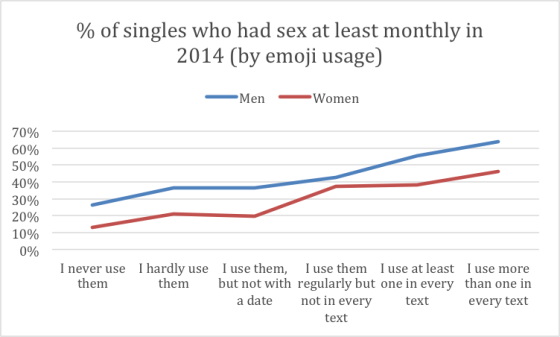
For real, the Match researchers found that singles who use emojis have more sex than singles who don’t.

Cultural anthropologist Dr. Helen Fisher, one of the leaders of the study, found that “54% of emoji users had sex in 2014 compared to 31% of singles who did not.” [Fist-bump emoji]

There was also a direct correlation between how many emojis a single person used and how much sex they had:

Match.com 'Singles in America 2015' Emoji Survey Graph ('Time' Magazine)

Match.com ‘Singles in America 2015’ Emoji Survey Graph (‘Time’ Magazine)

Another benefit to emojis: “women who use kiss-related emojis have an easier time achieving orgasms with a familiar partner.” [Eggplant (or banana) and fireworks emojis here] This suggests that these women value good communication.

As for the emojis themselves, it mentions that the most commonly used ones are the wink (53%), smiley face (38%) and the kiss (27%).

The study showed that people tend to use emojis to show personality, which 50% of single men and women agreed on. Thirty-five percent of singles said that emojis make “expressing feelings” easier.

Fisher has an idea as to why this is happening:

“Technology reduces our ability to express our emotions, and emotional expression is a huge part of communication, so we are reinventing ways to express ourselves”

What are you waiting for?! If this doesn’t convince you to use emojis, nothing will.

If anything, this could help spread the proliferation of emojis so we can all have more sex than ever. Maybe by that time, we’ll be able to switch between English and emoji keyboards on laptops. [Side-eye and prayer emojis]


Thursday Trends: Same-Sex Couples Reflected in Advertising

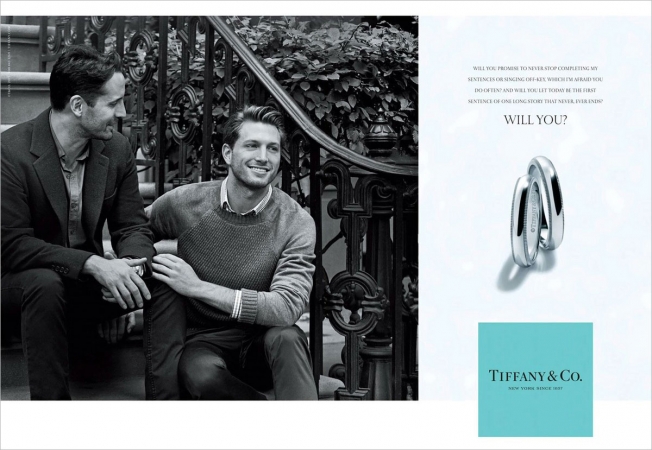
Tiffany's first ad featuring a gay couple (Adweek)

Tiffany’s first ad featuring a gay couple (Adweek)

Advertisements are finally getting with the times, and featuring more diversity than your run-of-the-mill straight white couple.

Last month, jewelry giant Tiffany’s debuted a new print ad for their wedding rings. But this ad had one thing different: it prominently featured a gay couple. And apparently the two men are a couple in real life, and were photographed on their own New York stoop.

This was the first time Tiffany’s has used a same-sex couple in their advertising. But it won’t be the last: Just this week, the brand used the same couple in a TV-spot ad. (The ad also features straight and interracial couples.) It signals that the 178-year-old brand recognizes that love comes in many forms, and they want to be all-inclusive. (And it’s a smart business move.)

Other brands in recent years have featured same-sex couples. Preppy retailer J. Crew used a gay couple in their catalog in spring 2011, and Gap used another couple on a billboard the following year. Incidentally, neither sets of couples are professional models: In the case of the J. Crew couple, one of the men was a designer for the brand. (It seems there’s also a side-trend of using real people.)

Lesbian couples are also increasingly represented. In 2012, JC Penney featured a lesbian couple with their children in a catalog pegged to Mother’s Day. Last year, condom brand Durex used two women being playfully affectionate with each other in an ad for a massage gel. This year, Hallmark showed an ad featuring a real-life lesbian couple describing their feelings for each other in the run up to Valentine’s Day.

It’s clear that things are changing. Even “The Onion” got in the action, with a (mock) article claiming that jewelry company Zales created an ad featuring a polyamorous triad. (But the article did rightfully call out that we, as a whole society, aren’t quite there yet.)

Hopefully this follow its natural progression, and  will eventually lead to more ads featuring same-sex couples with families. It’d be great to see future print and online ads and commercials where we see a family with two dads or two moms, NBD.

After all, this would make complete economic sense for these companies: In 2012, “Adweek” reported that the LGBT market is estimated to be worth around $743B+.


#ThrowbackThursday: Abercrombie & Fitch Ad, 2012

Abercrombie and Fitch ad shot by Bruce Weber (Towleroad)

Abercrombie and Fitch ad shot by Bruce Weber (Towleroad)

Three years ago, acclaimed photographer Bruce Weber shot a promo for Abercrombie & Fitch that featured handsome male models doing things all guys do: wrestling, showering, and kissing.

That last one is depicted up top. Later, the clothing brand claimed that the video (and three related others) were part of an official A&F campaign, even though Weber had identified the video as such on his Facebook page.

Regardless, it’s still a cool image. Abercrombie will always be the first softcore your 13-year-old self squealed over, but it’s at least made some strides towards acceptance (certain other inflammatory comments from former CEO Mike Jeffries notwithstanding).