Match.com Singles in America Data 2016: By The Numbers

Screen Shot 2016-02-10 at 8.57.39 PM

Singles in America study header (Match.com)

Man, I love delving into user data from websites (though I’m sure you’ve figured that out by now). Match.com recently released the results of their sixth annual “Singles In America” survey. You can find all their findings on their microsite. Let’s take a look at what insights came to light:

Number of singles surveyed: 5.5K+

Percentage that sushi increases your odds of getting a second date: 170% (!!)

Screen Shot 2016-02-10 at 8.50.11 PM

First-date length correlation with second-date chances diagram (Match.com)

Number of men who expect sex on the first date: 6%

Percentage of Millennials likely to have filmed sex: 165% (!)

Screen Shot 2016-02-10 at 8.53.29 PM

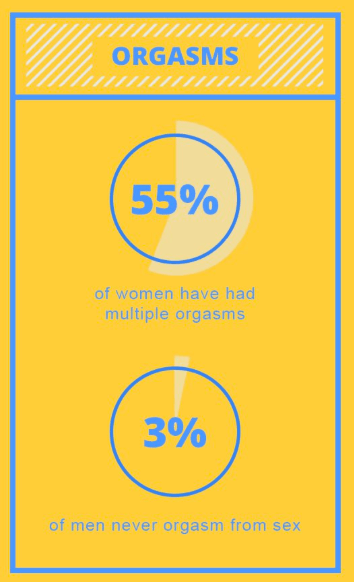
Orgasms data visualization (Match.com)

Percentage that using the phrase “Netflix and chill” gets you a second date: 99%

Percentage that using the phrase “on fleek” gets you a second date: -26%


#ThrowbackThursday: Pornhub Data during Winter Storm Jonas, 2015

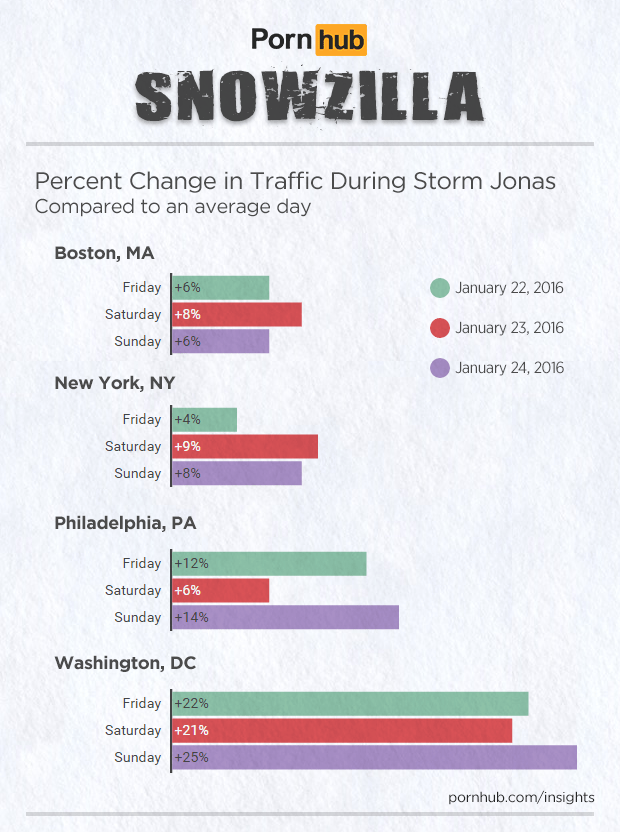
Pornhub Stats: Traffic during Winter Storm Jonas (Pornhub Insights)

Pornhub Stats: Traffic during Winter Storm Jonas (Pornhub Insights)

A few weeks ago, winter storm Jonas shut down a few cities on the East Coast. Naturally, people were going a little stir-crazy. The good people at Pornhub delved into the data, examining how the traffic was affected as opposed to a regular weekend. For the full report, hit Pornhub’s post on the site’s Insights blog (NSFW, as you probably guessed).

Trends: Opening Up About Miscarriages

Mark Zuckerberg and Priscilla Chan, 2015 (Business Insider)

Mark Zuckerberg and Priscilla Chan Zuckerberg (Business Insider)

When Facebook founder Mark Zuckerberg announced that his wife was pregnant with their first child last summer, he made another important statement: that his wife Priscilla had endured three miscarriages over the course of three years.

It’s a huge thing to acknowledge, especially since it seems that any narrative other than an easy pregnancy is given short shift. I applaud Zuckerberg for speaking up about what he and his wife went through, and what many more people work through.

But he hasn’t been the only one. Lately, many celebrities/people with social influence have been speaking up about that painful time in their lives.

Actress Eva Amurri Martino experienced a miscarriage as well, and spoke about it publicly two weeks after Zuckererg’s announcement. Martino’s miscarriage occurred around nine weeks after conception. Earlier this year, actress Kimberly McCullough revealed that she’d suffered a miscarriage last year, losing her baby at 22 weeks.

Shining a light on something helps to normalize it, and hopefully these confessions will encourage others to open up about their personal experiences. We need to keep talking about miscarriages to destigmatize them.

Trends: Interracial Couples on Broadcast TV, 2010-2015, Part 2

President Fitzgerald Grant (Tony Goldwyn) and Olivia Pope (Kerry Washington) in 'Scandal' (New York Post)

President Fitzgerald Grant (Tony Goldwyn) and Olivia Pope (Kerry Washington) in ‘Scandal’ (New York Post)

Happy Friday! Ready for Part 2? (If not, catch up on all the interracial couples of broadcast TV over the past five years, and then come on back!) Here’s the fun part: seeing the data play out in graphs!

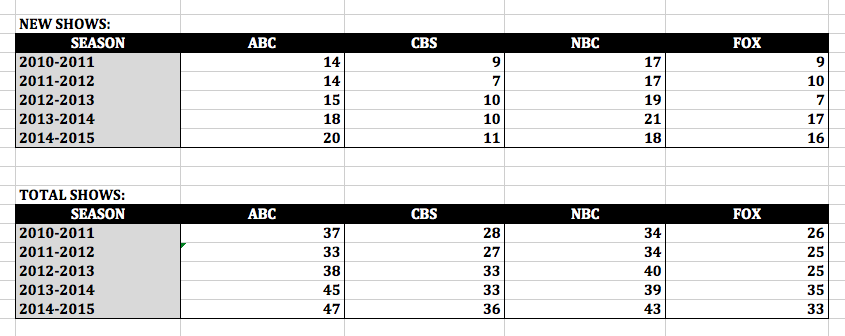
First off, here are the basic data tables. Here are the number of new shows and total shows per season per network:

New Shows and Total Shows per Season per Broadcast Network (Excel)

New Shows and Total Shows per Season per Broadcast Network (Sex & Stats)

Those look like relatively big numbers, right?

Here are the number of shows per network per season that featured interracial couples:

Number of Shows Featuring Interracial Couples per Season per Broadcast Network (Excel)

Number of Shows Featuring Interracial Couples per Season per Broadcast Network (Sex & Stats)

There are too many zeroes in that table.

And here’s how the numbers on the interracial couples translate for the percentages of new shows and total shows:
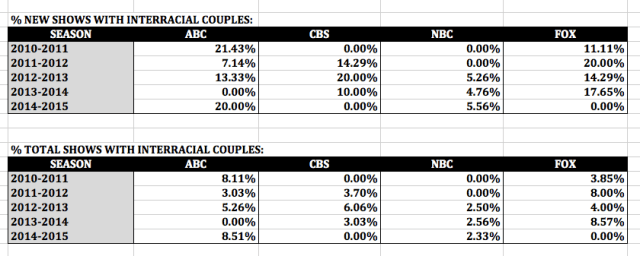
Percentage of New and Total Shows Featuring Interracial Couples per Season per Broadcast Network (Excel)

Percentage of New and Total Shows Featuring Interracial Couples per Season per Broadcast Network (Sex & Stats)

Interracial couples were never part of more than 25% of new shows, and 10% of total shows in any given season. Sad, right?

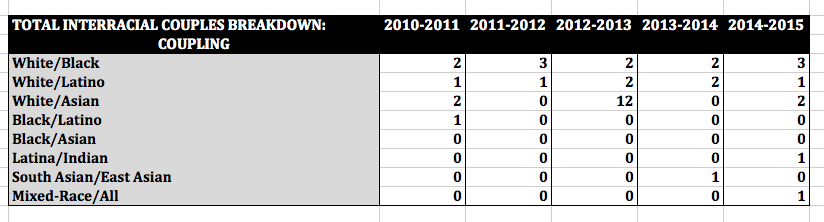
Next, I wanted to find the breakdown of interracial couplings by season, to see if any one season featured more of one coupling than for others. Here’s the table for that:

Interracial Couples Breakdown by Season, 2010-2015 (Excel)

Interracial Couples Breakdown by Season, 2010-2015 (Sex & Stats)

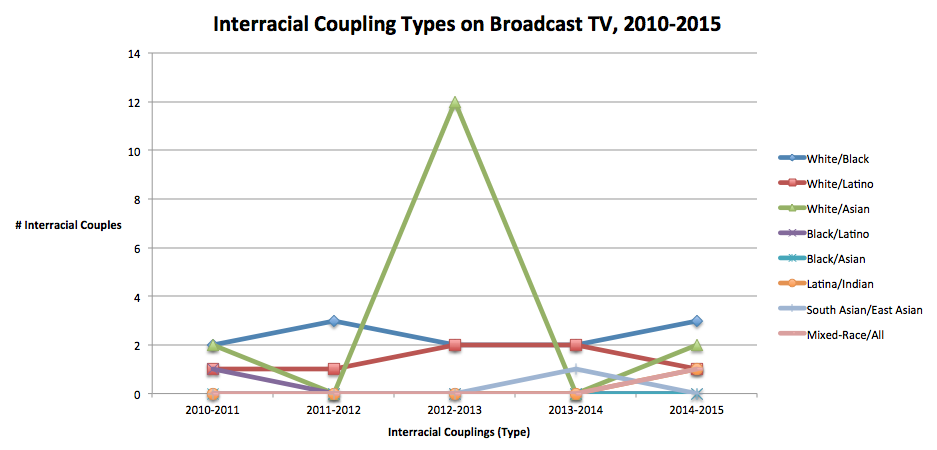
And the resulting line graph:
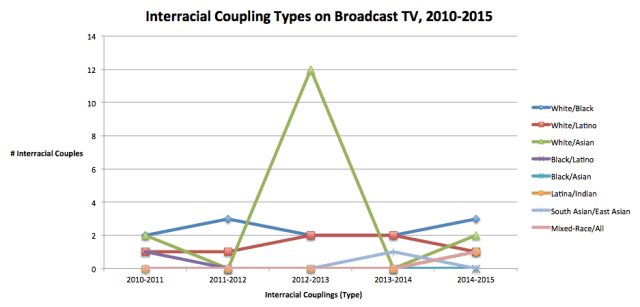
 

Interracial Coupling Types on Broadcast TV, 2010-2015 (Sex & Stats)

Interracial Coupling Types on Broadcast TV, 2010-2015 (Sex & Stats)

You may be wondering what that massive spike is at 2012-2013 (I know I was). That was when “The Mindy Project” debuted on Fox, and Mindy Lahiri dating all the white guys really skewed that sample.

Other than that, you can see that the most common racial combinations depicted were white and Black/African-American, and white and Latino/a. Without the spike, I’m betting that the white/Asian combination would’ve fallen somewhere in the middle. South Asian/East Asian couples were rare, as was one coupling with a mixed-race person. (Crazy that a mixed-race person on TV didn’t come around until Tracee Ellis Ross in “Black-ish.”)

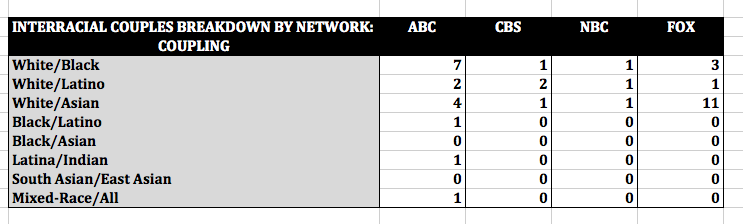
I was also curious to see how depictions of interracial couples broke down by network. Here’s that table:

Interracial Couples Breakdown by Network, 2010-2015 (Sex & Stats)

Interracial Couples Breakdown by Network, 2010-2015 (Sex & Stats)

And what it looks like in bar-graph form:
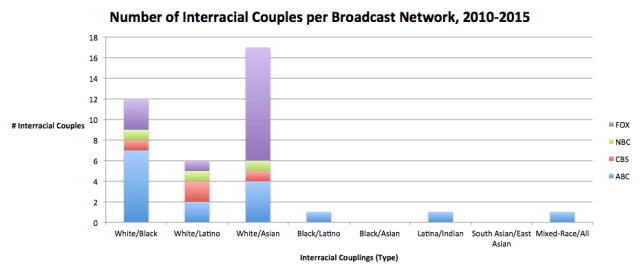
Number of Interracial Couples per Broadcast Network, 2010-2015 (Sex & Stats)

Number of Interracial Couples per Broadcast Network, 2010-2015 (Sex & Stats)

ABC led the charge with White/Black couples, and Fox clearly dominated with the White/Asian combination. ABC also had the broadest range of interracial relationships depicted. CBS showed the most White/Latino couples.

Even though strides have been made in depicting interracial relationships (in quantity, at least), there’s clearly still a long way to go in getting equal representation.

Trends: Interracial Couples on Broadcast TV, 2010-2015, Part 1

Olivia Pope (Kerry Washington) and President Fitzgerald Grant (Tony Goldwyn) in 'Scandal' (EW.com)

Olivia Pope (Kerry Washington) and President Fitzgerald Grant (Tony Goldwyn) in ‘Scandal’ (EW.com)

Fall TV is back! Ready for your favorite shows to return? Some of the cable companies have already begun to premiere new seasons of their fall shows, and now it’s time for the Big Four networks (ABC, CBS, NBC, and Fox) to follow suit.

The primetime premieres of shows new and old start this week, and it’s always interesting to see how much diversity makes it onto our screens. I was curious to see if the incidence of interracial couples on the Big Four networks had risen over the past five years (since trends are a bit slower to infiltrate there). I looked at incoming shows (i.e. those that started with pilots), and didn’t count returning ones. I was mainly looking for romantic couples, but noted platonic ones and love interests as well.

Part 1 explores the findings, and Part 2 (which will be published tomorrow) will show change-over-time trends with tables and graphs.

And now to the findings:

2010-2011:

Brad (Damon Wayans Jr.) and Jane (Eliza Coupe) in 'Happy Endings' (Oh No They Didn't)

Brad (Damon Wayans Jr.) and Jane (Eliza Coupe) in ‘Happy Endings’ (Oh No They Didn’t)

ABC: 3 shows/4 couples

  • Happy Endings: African-American man Brad Williams (Damon Wayans Jr.) is married to white woman Jane Kerkovich-Williams (Eliza Coupe).
  • My Generation: White guy Steven Foster (Michael Stahl-David) had a one-night-stand with Caroline Chung (Annie Son) in high school, which resulted in a child. Also, African-American Rolly Marks (Mehcad Brooks) is married to Dawn Barbuso (Kelli Garner), who’s white.
  • Off The Map: African-American man Dr. Otis Cole (Jason Winston George) has a relationship with Latina Zee Toledo Alvarez (Valeria Cruz).

CBS: 0 shows

For shame, CBS.

Fox: 1 show/0 couples

  • Breaking In: Melanie Garcia (Odette Annable) was the love interest to white guy Cameron Price (Bret Harrison).

NBC: 1 show/0 couples

  • Outsourced: The show implied a future between white Todd Dempsy (Ben Rappaport) and Indian woman Asha (Rebecca Hazlewood).


2011-2012:

President Fitzgerald Grant (Tony Goldwyn) and Olivia Pope (Kerry Washington) in 'Scandal' (New York Post)

President Fitzgerald Grant (Tony Goldwyn) and Olivia Pope (Kerry Washington) in ‘Scandal’ (New York Post)

ABC: 1 shows/1 couple

  • Scandal: Washington fixer Olivia Pope (Kerry Washington) starts/continues (spoiler?) a relationship with President Fitzgerald Grant (Tony Goldwyn).

CBS: 1 show/1 couple

  • Rob: White guy (Rob Schneider) marries Maggie (Claudia Bassols), and gets to know her Mexican-American family. (Incidentally, Schneider isn’t completely white, but is of partial Filipino descent.)

Fox: 2 shows/1 couple

  • I Hate My Teenage Daughter: White woman Nikki Miller (Kate Finneran) raises her biracial daughter Mackenzie (Aisha Dee), with help from her ex-husband Gary (Chad L. Coleman).
  • Touch: Kiefer Sutherland and British actress Gugu Mbatha-Raw’s characters’ relationship was strictly platonic.

NBC: 0 shows

This was the second season in a row that the network had no shows with interracial couples.


2012-2013:

Dr. Mindy Lahiri (Mindy Kaling) and Casey (Anders Holm) in 'The Mindy Project' (Fox)

Dr. Mindy Lahiri (Mindy Kaling) and Casey (Anders Holm) in ‘The Mindy Project’ (Fox)

ABC: 2 shows/4 couples

  • Mistresses: White woman Savi (Alyssa Milano) sleeps with her African-American coworker Dominic (Jason George). Asian-American Dr. Karen Kim (Yunjin Kim) sleeps with her patient, Thomas Grey (John Schneider). Latina single mom April (Rochelle Aytes) dates white man Richard (Cameron Bender).
  • The Neighbors: African-American woman Jackie Joyner-Kersee (Toks Olagundoye) is in a couple with white man/fellow alien Larry Bird (Simon Templeman).

CBS: 2 shows/2 couples

  • Elementary: Sherlock Holmes (Jonny Lee Miller) is white, and Dr. Joan Watson is Asian (Lucy Liu).
  • Golden Boy: Latino detective Christian Arroyo (Kevin Alejandro) has an affair with white fellow detective Deb McKenzie (Bonnie Somerville)

Fox: 1 show/9 couples

  • The Mindy Project: Indian OB-GYN Mindy Lahiri (Mindy Kaling) dates all the white guys: Dennis (Ed Helms), Matt (Seth Meyers), Josh (Tommy Dewey), Brendan (Mark Duplass), Jamie (B.J. Novak), Sam (Seth Rogen), Adam (Josh Meyers), and Casey (Anders Holm). She also flirts heavily with co-worker Danny (Chris Messina).

NBC: 1 show/0 couples

  • Do No Harm: Dr. Lena Solis (Alana de la Garza) was the love interest of Dr. Jason Cole (Steven Pasquale).


2013-2014:

Ichabod Crane (Tom Mison) and Abbie Mills (Nicole Beharie) in 'Sleepy Hollow' (The Chiefly)

Ichabod Crane (Tom Mison) and Abbie Mills (Nicole Beharie) in ‘Sleepy Hollow’ (The Chiefly)

ABC: 0 shows/0 couples

A rare no-show for interracial couples this season from ABC.

CBS: 1 show/1 couple

  • Extant: Astronaut Molly Woods (Halle Berry) is married to Dr. John Woods (Goran Visnjic).

Fox: 3 shows/3 couples

  • Brooklyn Nine-Nine: Jake Peralta (Andy Samberg) crushes on his Cuban-American partner Amy Santiago (Melissa Fumero).
  • Gang Related: Vee Dotsen (Inbar Levi) and Tae Kim (Sung Kang) are a couple.
  • Sleepy Hollow: Abbie Mills (Nicole Beharie) and Ichabod Crane (Tom Mison) work together to protect their town.

NBC: 1 show/1 couple

  • Welcome to the Family: A white girl (Ella Rae Peck) and her Latino boyfriend (Joey Haro) get pregnant right out of high school.


2014-2015:

Rebecca Sutter (Katie Findlay) and Wes Gibbins (Alfred Enoch) in 'How to Get Away with Murder' (World News)

Rebecca Sutter (Katie Findlay) and Wes Gibbins (Alfred Enoch) in ‘How to Get Away with Murder’ (World News)

ABC: 4 shows/7 couples

  • Black-ish: African-American advertising executive Andre Johnson (Anthony Anderson) is married to Rainbow (Tracee Ellis Ross), a mixed-race surgeon.
  • Cristela: A Latina attorney (Cristela Alonzo) spars with her white co-worker (Andrew Leeds).
  • How to Get Away with Murder: Too many to count! Annalise Keating (Viola Davis) is married to Sam Keating (Tom Verica). Law student Connor Walsh dates Oliver Ricamora (Jack Falahee). Law student Laurel Castillo (Karla Souza) dates Kan (Arjun Gupta). And main character/audience-surrogate Wes Gibbins (Alfred Enoch) sleeps with Rebecca Sutter (Katie Findlay).
  • Selfie: Marketing guru Henry Higgs (John Cho) tries to reform Eliza Dooley (Karen Gillan).

CBS: 0 shows/0 couples

No interracial couples from this network this year.

Fox: 0 shows/0 couples

Same as CBS.

NBC: 1 show/1 couple

  • The Slap: Hector Apostolou (Peter Sarsgaard) is in an interracial marriage with Aisha (Thandie Newton).


Looks like a lot, right? Check back tomorrow for Part 2 where I’ll look at the actual numbers!

Trends: Companies Expanding Maternity/Paternity Leave Policies

Netflix 2014 logo (Under Consideration)

Netflix 2014 logo (Under Consideration)

A very positive trend has sprung up recently: Companies are their expanding parental leave policies. The main goal is to recruit more women with work-life balance policies, and to retain talent by allowing time off for family matters. Because trouble at home often means distracted employees and lower productivity. (I feel like that’s on a modern-day Mather Work Incentive poster somewhere.)

Big strides have been made this year: Consulting powerhouse Accenture bumped up its maternity leave policy to 16 weeks in March, which applies to both full-time and part-time employees. In April, Johnson & Johnson announced a new eight-week paid leave policy. In June, major bank Goldman Sachs began offering new fathers and “non-primary caregivers” four weeks of paid leave. (The company currently offers 16 weeks of paid maternity leave.) The U.S. Navy and Marines mandated an 18-week maternity leave policy, effective immediately, in July.

This trend has become especially prevalent in the tech industry, with a lot of changes occurring just this past month. In August, Microsoft recently announced a new parental leave policy, in which employees would get paid at 100% of their salary for 12 weeks. New mothers will have eight weeks of paid maternity leave, which, combined with disability leave, could entitle them to 20 weeks of paid leave.

Adobe’s policy also changed: Mothers will now receive 26 weeks of paid leave, up from the nine weeks off from the previous policy. It’ll be a combination of medical leave (10 weeks) and paternal leave (16 weeks).

Netflix announced they’re bumping up their maternity and paternity leave policies to an unlimited amount of time. New mothers and fathers are allowed to take as much time off as they like during a child’s first year, whether though birth or adoption. (Netflix isn’t a stranger to expanding time off: Employees already get unlimited vacation time.) But the policy isn’t all inclusive: It only applies toward salaried employees, so hourly workers aren’t able to take advantage of it.

It’ll be interesting to see if (when) other companies follow suit, and if paid parental leave will eventually be federally mandated. These are definitely steps in the right direction.


Thursday Trends: Female Celebrities’ Fluid Sexuality

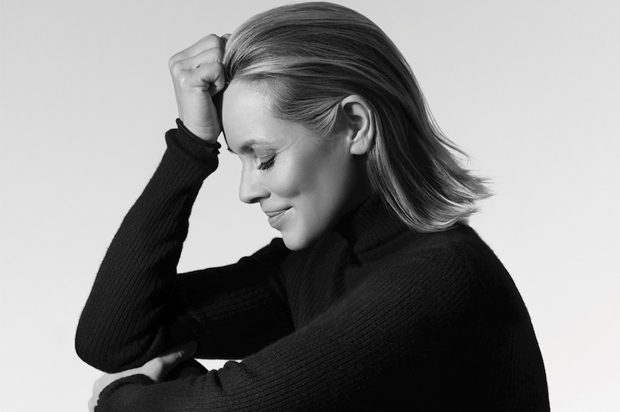
Maria Bello (Salon)

Maria Bello (Salon)

Last week, actress Maria Bello released her new memoir. “Whatever…Love Is Love” chronicles Bello’s journey as a single mom who self-identified as straight, but then unexpectedly fell in love with her female best friend. She penned a piece for “The New York Times” in 2013 that centered on worrying how her son would react to the news. (If you’re wondering, his response is her memoir title verbatim.) From there, Bello decided to redefine her relationships in a way that worked for her, and she now sexually identifies as a “whatever.”

Bello isn’t the only female public figure whose sexuality has shifted within the public eye. Oscar-winning actress Tatum O’Neal recently revealed that she likes and has been dating mostly women for some time now. O’Neal didn’t self-identify as lesbian or bisexual (she had previously been married to, and had children with, tennis ace John McEnroe), and says she’s “not one or the other.”

The millennial generation also has its share of sexually fluid women who eschew labels. Actress Amber Heard dated photographer Tasya van Ree before marrying actor Johnny Depp earlier this year. She also doesn’t label herself “one way or another.” Actress Lindsay Lohan famously had a volatile relationship with DJ Samantha Ronson, but then publicly self-identified as straight years after the relationship was over.

Though the majority of examples come from entertainment, the political sphere can claim on entrant. Chirlane McCray, wife of New York City mayor Bill de Blasio, self-identified as a lesbian when she met her now-husband in 1991. Years earlier in 1979, McCray had written an essay for “Essence,” titled “I Am A Lesbian,” which centered on gays and lesbians within the black community. McCray’s essay didn’t receive much attention until just before her husband decided to run for mayor in 2012.

What’s interesting about McCray’s case is how others in the media reacted to it: Many termed her some variation of “former lesbian.” But McCray never self-identified as anything remotely resembling that. Here’s how she responded in 2013 when asked if she self-identified as bisexual:

I am more than just a label. Why are people so driven to labeling where we fall on the sexual spectrum? Labels put people in boxes, and those boxes are shaped like coffins. Finding the right person can be so hard that often, when a person finally finds someone she or he is comfortable with, she or he just makes it work.

It’s fantastic how so many women (and people in general) are gaining the courage to step outside the box and do what works for them, especially in terms of sexuality and relationships. What I love about the above examples is that they’re all open to new experiences and don’t use labels to limit them. And that’s just beautiful.

Thursday Trends: Censorship of Cunnilingus on Film

'Black Swan' cunnilingus (That Just Won't Do)

‘Black Swan’ cunnilingus (That Just Won’t Do)

With the announced remake of the 1973 film “Don’t Look Now” on the horizon, there’s a good chance that one of the film’s most controversial scenes will once again make the cut: Laura Baxter receiving cunnilingus from her husband John. (Julie Christie and Donald Sutherland played the roles in the original film.) But this time, it might not raise much of an outcry.

Movies began to be bolder about depicting cunnilingus around the end of the last decade. In the 2009 movie “Away We Go,” the opening scene shows Burt (John Krasinski) going down on his partner Verona (Maya Rudolph). Two years later, “Blue Valentine” showed Dean (Ryan Gosling) pleasuring Cindy (Michelle Williams). However, this depiction led to some pushback on the part of the Motion Picture Association of America (MPAA), which tried to give the movie an NC-17 rating. Interestingly, the 2010 film “Black Swan” was in theaters, which also featured an oral sex scene, but with two women: Mila Kunis and Natalie Portman. “Blue Valentine” star Ryan Gosling spoke out against the hypocrisy of rating a film with an oral scene involving two women an R, while a film that depicts the act with a heterosexual couple (as well as within marriage) would get slapped with an NC-17. “Blue Valentine” eventually received an R rating.

Within the past two years, more films involving cunnilingus scenes have been released: “Wild,” “Charlie Countryman,” and “The Counselor.” A very notable example occurred in 2014’s “Gone Girl.” Amy (Rosamund Pike) ecstatically receives pleasure from Nick (Ben Affleck) after their first date, which occurs within the first 15 minutes of the film. There was no pushback from the MPAA regarding ratings for this one (presumably, they didn’t need to fight that battle twice).

It’s great to see cunnilingus depicted as normal within the smorgasbord of sexual acts. Let’s hope media depictions of the act continue to grow so more people become normalized to it.

Thursday Trends: Same-Sex Couples Reflected in Advertising

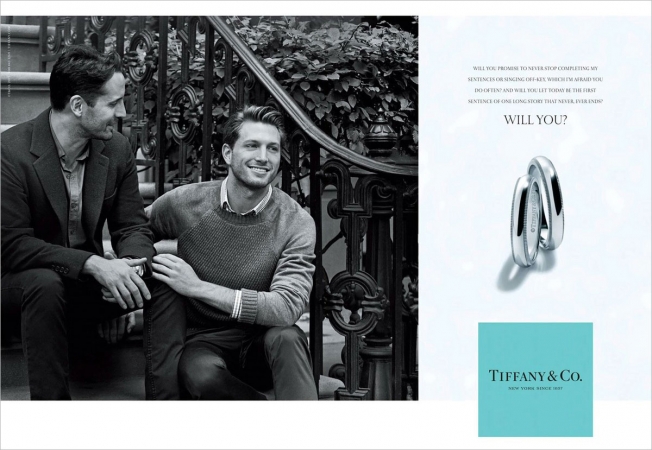
Tiffany's first ad featuring a gay couple (Adweek)

Tiffany’s first ad featuring a gay couple (Adweek)

Advertisements are finally getting with the times, and featuring more diversity than your run-of-the-mill straight white couple.

Last month, jewelry giant Tiffany’s debuted a new print ad for their wedding rings. But this ad had one thing different: it prominently featured a gay couple. And apparently the two men are a couple in real life, and were photographed on their own New York stoop.

This was the first time Tiffany’s has used a same-sex couple in their advertising. But it won’t be the last: Just this week, the brand used the same couple in a TV-spot ad. (The ad also features straight and interracial couples.) It signals that the 178-year-old brand recognizes that love comes in many forms, and they want to be all-inclusive. (And it’s a smart business move.)

Other brands in recent years have featured same-sex couples. Preppy retailer J. Crew used a gay couple in their catalog in spring 2011, and Gap used another couple on a billboard the following year. Incidentally, neither sets of couples are professional models: In the case of the J. Crew couple, one of the men was a designer for the brand. (It seems there’s also a side-trend of using real people.)

Lesbian couples are also increasingly represented. In 2012, JC Penney featured a lesbian couple with their children in a catalog pegged to Mother’s Day. Last year, condom brand Durex used two women being playfully affectionate with each other in an ad for a massage gel. This year, Hallmark showed an ad featuring a real-life lesbian couple describing their feelings for each other in the run up to Valentine’s Day.

It’s clear that things are changing. Even “The Onion” got in the action, with a (mock) article claiming that jewelry company Zales created an ad featuring a polyamorous triad. (But the article did rightfully call out that we, as a whole society, aren’t quite there yet.)

Hopefully this follow its natural progression, and  will eventually lead to more ads featuring same-sex couples with families. It’d be great to see future print and online ads and commercials where we see a family with two dads or two moms, NBD.

After all, this would make complete economic sense for these companies: In 2012, “Adweek” reported that the LGBT market is estimated to be worth around $743B+.


Thursday Trends: Plus-Size Models in Mainstream Media

Tess Munster (Bustle)

Tess Munster (Bustle)

It’s safe to say that plus-size models are having a moment in the spotlight right now. The fashion industry has finally cottoned on to the fact that most women are not a size -2 (which is rarely found in nature), but that more “normal”-sized women representative of the American public might want to see themselves depicted (and desired!). And the inclusion will also sell more for said fashion companies, so it’s a win-win all around.

We can trace this development to late last year, when the Pirelli calendar unveiled its 2015 edition. Candice Huffine made history as the first plus-size model to grace the legendary calendar’s pages. She broke a tradition stemming from 1964 of using the usual thin models to usher in a new year and a new outlook on beauty standards.

Speaking of beauty standards (more like #effyourbeautystandards), plus-size model/retro bombshell Tess Munster (now Tess Holliday) recently became the first plus-size model to sign with the U.K.’s MiLK Model Management. She’s now the first plus-size model signed to a mainstream agency, in the Curves division, and the first one within Curves above a size 20 (she’s a 22 and stands at 5 ft. 5 in.). Munster cuts a distinctive figure, with bright red wavy hair, alabaster skin and lots of tattoos. She’s been around for awhile, and was named a top plus-size model in the world by “Vogue Italia” in 2013. That same year, the “body positive activist” began the aforementioned hashtag to encourage women to love their bodies at any and every size. She also participated a video in which she and other plus-size models recreated Beyoncé’s music video for “***Flawless,” called “#everyBODYisflawless.”

Fashion blogger/model Nadia Aboulhosn was one of these models. She’s gained attention and press for her fashion prowess that’s all about the street style. The half-Lebanese stunner first drew notice when she won American Apparel’s XL Model Search in 2011.

Perhaps the most mainstream seal of approval, “Sports Illustrated” selected a plus-size model for this year’s Swimsuit Issue: Model Robin Lawley is a size 12. Lawley had previously been on the cover of Australian “Vogue,” as the first plus-size model, and was the first plus-size face of Ralph Lauren in 2012. But even though she’s plus-size by fashion industry standards, she still looks…well, like a normal tall, curvy girl. Like a model.

Let’s hope that plus-size women gaining visibility in the fashion world isn’t a one-time trend, and eventually becomes an unremarkable norm encompassing diverse shapes and sizes.