
Thanksgiving Turkey (THC Finder)
I’m taking a break due to the holiday tomorrow. Hope you have a great Thanksgiving!
Regular posting will resume on Monday, Dec. 1st.
Thanksgiving Turkey (THC Finder)
I’m taking a break due to the holiday tomorrow. Hope you have a great Thanksgiving!
Regular posting will resume on Monday, Dec. 1st.

Sexy Peach
Last week, probiotic supplement Sweet Peach was introduced at the DEMO Conference in San Jose, California. Unveiled by Cambrian Genomics founders (and men) Austen Heinz and Gilad Gome, the supplement was initially pitched as an artificial fragrance (like, say, a peach) for the vagina, replacing the organ’s natural scent.
Understandably, people were outraged. But this turned out to be incorrect. Audrey Hutchinson, the actual founder of Sweet Peach Probiotics (and a woman), described how Sweet Peach would work thusly:
“A user will take a sample of her vaginal microbiome and send it in for analysis. After determining the makeup of her microbiome–in effect, taking a census of the microorganisms that reside in her vagina–the company will supply a personalized regimen of probiotic supplements designed to promote optimal health.”
The ultimate goal is that using Sweet Peach would help women avoid health issues caused by microorganisms, such as yeast infections.
Sweet Peach’s goals parallels recent news and studies done about replacing “bad” gut with “good” bacteria in the digestive tract to ease gastrointestinal issues.
But could it work for the vagina as well?
It’s too early to tell. Right now, the National Center for Complementary and Alternative Medicine (NCCAM) Oral Probiotics page says that probiotics have mainly been used for oral and the aforementioned gastrointestinal issues. These probiotics are mostly taken in the form of oral pills or live cultures (such as yogurt).
The NCCAM notes that some probiotics studied have the potential to aid in healing, as a 2013 UCLA study shows. The study found that women who ingested probiotics through yogurt had more beneficial brain function during rest states and emotion-recognition tests.
But this study worked off the previously established gut-mind connection, which can responsible for stress and fight-or-flight responses.
As of now, there’s no known gut-vagina connection.
A recent op-ed by microbe expert Ed Yong in “The New York Times” recently alluded to the difficulty using microbes to boost vaginal health:
“The results would be hard to interpret and might be outdated by the time they arrived.”
In short, the NCCAM reminds us that we’re still pretty far from answering certain existing questions:
“The rapid growth in marketing and consumer interest and use has outpaced scientific research on the safety and efficacy of probiotics for specific health applications.”

Adore Me model (Image via Adore Me/Facebook)
This is pretty awesome: Lingerie company Adore Me A/B-tests photos of their models wearing their products to ensure maximum audience engagement that translates into maximum revenue.
For those not in the know, A/B testing is an experiment with two variants, noted as A and B. (Typically, A is the control and B is the variable.) Users are split into randomized groups, so that one will see version A and the other will see version B. (Who sees what version can sometimes change day-to-day due to the randomization.) Those who run the A/B testing are then able to see how users react to each option, and which one would be more impact for consumers over time.
(Companies can use A/B testing for basically any variable they have. For example, I used an A/B test in my last job to determine how email newsletter headlines affected click-thru rates. Control version A was the normal staid headline, while version B was more creative.)
In this “Fast Company” article that details Adore Me’s A/B testing process, writer Rebecca Greenfield details what variables the company tends to change:
“The distinctions between the pictures might include different models wearing the same set in the exact same position, or the same model in the same set in a different position, for example.”
If anything, this news reveals that analytics tools and approaches have crossed over into non-tech fields, and may soon take over more traditional processes of gathering consumer data.
It’ll also be interesting to see how sexuality stats cross over into Big Data. I feel we’re on the cusp of it right now.

Orgasm
Happy Friday! Here’s something to fun to keep mind as you head out for the weekend:
A new study claims that female orgasms influence beneficial mate choice: The more orgasms a woman has was directly correlated to her partner’s income, confidence and attractiveness. But it’s not all about quantity. Orgasm intensity was related to sexual satisfaction in terms of intercourse frequency and “how attracted they were to their partners.” Makes sense, right? (“Salon” breaks it down into less-scientific terms.)
The study analyzed “heterosexual female college students in committee relationships,” but doesn’t go into detail about these subjects. What was their average age? How long had the couples been together, on average? How times a week were the couples having sex on average?
Sounds like an excellent way to make a positive mate choice to me.

Eva Green, Campari Calendar 2015
We’re finally getting to see some images from the 2015 Campari calendar, starring French actress Eva Green.
Dressed in the brand’s signature red, Green is just the latest in the long line of gorgeous and talented women to model for the aperitif company. Each year, Campari choses one iconic woman (or the occasional man) to grace its calendar, which they then send out to “friends of Campari around the world.” This year is particularly special as the brand is celebrating its 150-year anniversary.
Let’s take a look at Campari calendar trends over the last 15 years, gleaned from the calendar’s history:
Year of first Campari Calendar: 2000
Number of calendars produced each year: 9,999
Total number of photographers used: 13
Number of repeat photographers: 3 (Adrian Hamilton in 2000 and 2002; Giovanni Gastel in 2005-2006; Mario Testino in 2007 and 2009)
Total number of cover girls: 15
Total number of cover men: 1 (Benicio del Toro in 2011)
Number of years no cover model was used: 1 ( in 2000)
Number of years with more than one cover girl: 1 (Brazilian model Magda Gomes and Marika Svensson in 2002)
Number of repeat cover girls: 1 (Magda Gomes in 2002-2003)
Year Campari began using Hollywood actresses: 2007 with Salma Hayek
Number of former Bond Girls used: 2 (Olga Kurylenko in 2010 and Eva Green in 2015, both from the Daniel Craig era)

“Star Trek”Interracial Kiss, 1968
Science fiction has long welcomed diversity. The genre has frequently depicted cultural and social mores ahead of the time, even in post-World War II prosperity.
On Nov. 22, 1968, “Star Trek” aired the “Plato’s Stepchildren” episode. While the episode plot centers on a race of telekinetic humanoids, it’s most remembered for depicting the first interracial kiss between a Caucasian man and an African-American woman on a scripted American TV show.
Capt. James T. Kirk (William Shatner) and Lt. Nyota Uhura (Nichelle Nichols) kissed while under alien telekinesis (probably to make it more palatable for the audiences) during the episode. Later, Nichols reported that there had been some pushback from viewers, but some were supportive.
It’s safe to say the episode might’ve opened people’s minds in regards to miscegenation. Nichols singled out one such letter from a white Southerner:
“I am totally opposed to the mixing of the races. However, any time a red-blooded American boy like Captain Kirk gets a beautiful dame in his arms that looks like Uhura, he ain’t gonna fight it.”

One image result from Googling ‘kinky sex’
I wanted to see how many times kinky sex was searched for online, so I decided to do a Google Trends comparison. I used “vanilla sex” as a search term since I figured that using plain “sex” would be too broad for my question. I searched only within the U.S. and used 2004-present as my timeframe.

Google Trends ‘Vanilla Sex’ vs. ‘Kinky Sex’
Surprisingly, the “vanilla sex” results (blue line) were much smaller than the “kinky sex” results (red line). My guess is that nobody really searches for vanilla sex (since you can get that pretty easily), and so people turn to the Internet to learn about kinky sex either for mere curiosity or are interested in pursuing it.
Let’s look at the results breakdown:
“Vanilla Sex” by Subregion:
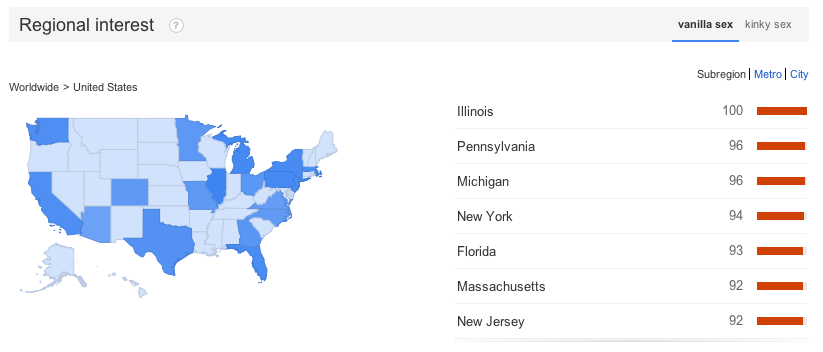
‘Vanilla Sex’ by Subregion
Illinois heads up this list, with Pennsylvania and Michigan tying for second with 96%, and Massachusetts and New Jersey tying for fifth with 92%. New York places third with 94%, while California achieves 89% in ninth place. Texas brings up the rear with 86%.
“Vanilla Sex” by Metro:
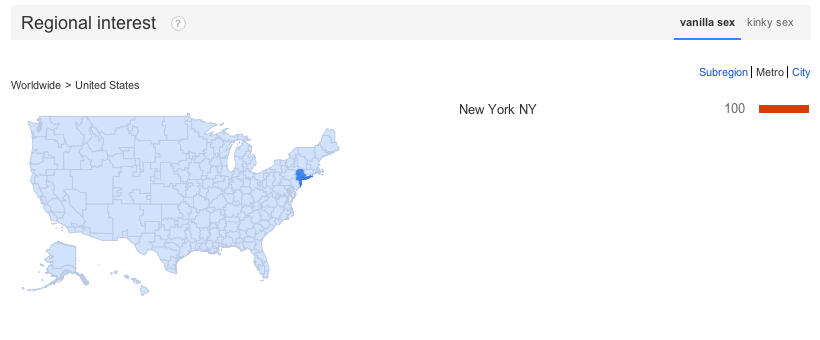
‘Vanilla Sex’ by Metro
Yeah, this doesn’t look comprehensive. I find it very hard to believe that New York is the only metro area Googling “vanilla sex,” considering I found that the same metro area was madly Googling sexy Halloween costumes last month.
Unless it’s a case where the numbers need to hit a certain threshold to become visible, this does not look viable. At all.
“Vanilla Sex” by City:
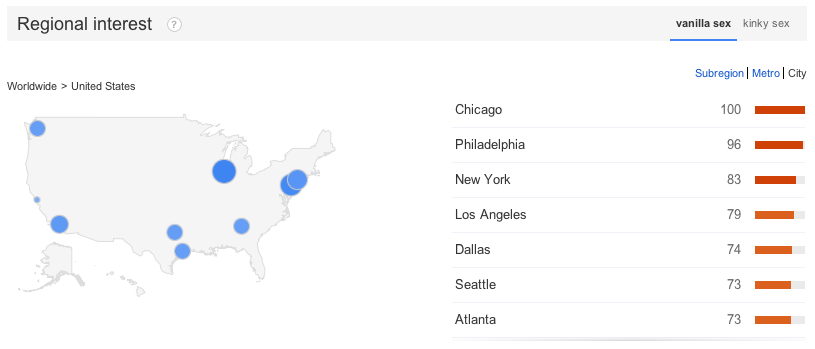
‘Vanilla Sex’ by City
Chicago unsurprisingly tops this list, considering how Illinois topped the subregion list. New York and Los Angeles sit at third with 83% and fourth with 79%, respectively. Seattle, Atlanta and Houston have a three-way (heh) tie with 73%. San Francisco closes out the list with 57%, the lowest I’ve seen so far in doing these Google Trends.
“Kinky Sex” by Subregion:

‘Kinky Sex’ by Subregion
Here’s where it gets interesting: All of the top states score at least 87%, which means these states have a big interest in kinky sex (nothing wrong with that, of course). Cueing the jokes about the South, Kentucky tops this list, with West Virginia a close second at 98%.
“Kinky Sex” by Metro:
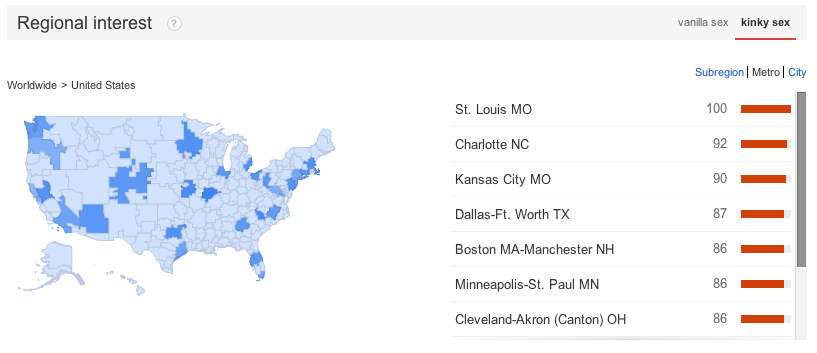
‘Kinky Sex’ by Metro
Missouri’s St. Louis and Kansas City appear at #1 with 100% and #3 with 90%, respectively. Charlotte, NC sits between them with 92%.
Aside from that, the rest of the metro areas are scattered among Texas, New Hampshire, Minnesota, Ohio, California, Michigan and Pennsylvania.
“Kinky Sex” by City:
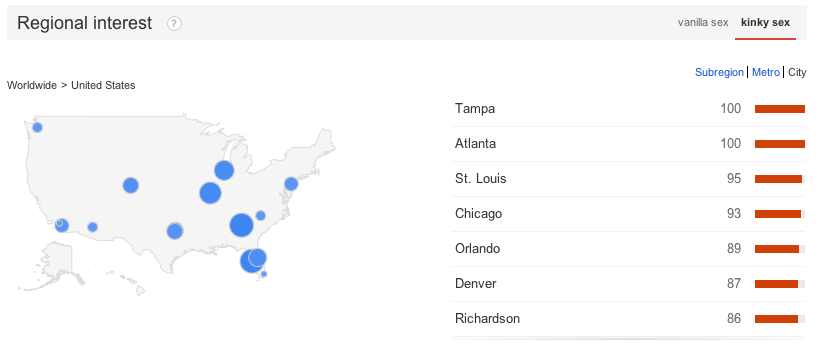
‘Kinky Sex’ by City
Southern cities Tampa and Atlanta tie for first, with St. Louis coming in at third with 95%. The rest of the lis is scattered geographically.
Conclusions:
It’s difficult to draw any concrete conclusions from the findings. It appears that Googling kinky sex is widespread and not limited to any particular region, metro area and/or city.

Purity ball
Sometimes, we get curious about the other side of sex education: the side where it pretty much doesn’t exist. Recently, I became curious about the popularity, or possible lack thereof, of purity balls.
For those who don’t know, Christian purity balls have popped up in the last decade as a way for young women (generally preteens and teens) to pledge to remain sexually pure until they marry. They usually take place within an evening event and dance, where fathers attend with their daughters. The fathers pledge to model an example of purity for their daughters, and to protect them from evil teenage boys and their desires.
The daughters, in turn, pledge their virginity to their father. Oh yeah, and the Lord.
Randy and Lisa Wilson created the first purity ball in 1998, and their website notes that balls have been held in 48 states since then. (According to their website, there have also been inquiries from 17 countries.)
In a “New York Times” article written in 2012, feminist writer Jessica Valenti reported 1K+ purity balls were held in 2006, for her 2010 book “The Purity Myth.” In a related stat, Leslee J. Uhruh, president of the National Abstinence Clearinghouse, claims she fielded 4K+ calls concerning holding purity balls “within a 12-month period,” though how this period is calculated isn’t defined.
Unfortunately, I couldn’t find any data on how fast the movement is growing, where it’s growing the most, how many attendees, and other points of interest.

Bee pollinating a flower
Wondering about the title? Read on!
Researchers at the University of East Anglia recently analyzed the long-term patterns, dating back to 1848, of male miner bees pollinating spider orchids. They’ve concluded that climate change has affected the bees’ pollination of the flowers, and could spell trouble in the future.
Here’s how it works: The male miner bee pollinates spider orchids because the flowers release a specific sex pheromone similar to that of a female miner bee. After hibernation, the male bees wake up before the females and, lured in by the orchids, pollinate with them (referred to as “pseudocopulation”). When the female miner bees wake up some days after that, the male bees find them and reproduce.
But because of global warming and its accompanying temperature increases, the female bees are emerging earlier than usual, (in one case, 15 days earlier). Naturally, the male bees are much more interested in the female bees compared to the orchids’ imitation pheromones.
The male bees are having so much sex with their female counterparts that they’re not pollinating (or pseudocopulating) with the orchids. And this could mean lower crop productivity down the line. As researcher Dr. Karen Robbirt puts it, “The orchids are likely to be outcompeted by the real thing.”
Who would’ve thought our future crop productivity might well depend on…bee sex? Not a lot of people, I’m guessing.
Now if you need a random fact to impress anyone/fill the silence, you’re all set!

Kim Kardashian, ‘Paper’ Magazine 2014
Happy Friday! When “Paper” magazine released its cover photos featuring Kim Kardashian, its stated goal was to “break the Internet” (well, mission accomplished). Naturally, both the magazine and Kardashian posted some of the shots on their respective Instagram accounts.
Since Instagram is the best app for sharing slice-of-life shots, this makes perfect sense. But they each seemed to take different approaches in doing so.
“Paper” Magazine:
The magazine, clearly excited about its work, shared all four of its photos. They also shared the photos in ascending order of nudity: First came Kardashian in her evening gown with the champagne glass balanced on her ass, next came Kardashian mooning the camera. The third photo showed her showing off her butt and boobs in profile, and the last one was her full-frontal. Both the third and fourth shots had back text bars obscuring her nipples and crotch where needed.
As of 10:30 p.m. Wednesday night, the magazine had 137K followers.
The number of likes per Kardashian photo are as follows:
Photo #1 (champagne glass): 9K+
This photo received likes from 6.57% of “Paper”‘s followers.
Photo #2 (full moon bare butt): 5K+
This photo received likes from 3.64% of “Paper”‘s followers.
Photo #3 (boobs and butt in profile): 2K+
This photo received likes from 1.46% of “Paper”‘s followers.
Photo #4 (full frontal): 3K+
This photo received likes from 2.19% of “Paper”‘s followers.
The Kardashian photos were the last photos posted.
Kim Kardashian:
By contrast to “Paper,” Kardashian only shared two photos: the champagne glass and the full moon, in ascending order of nudity.
As of 10:30 p.m. Wednesday night, Kardashian had 21M followers.
Photo #1 (champagne glass): 486K+
This photo received likes from 2.31% of Kardashian’s followers.
Photo #2 (full moon bare butt): 751K+
This photo received likes from 3.58% of Kardashian’s followers.
What’s interesting is that Kardashian posted four photos, all with husband Kanye West, afterwards. It appears that she sees the cover more matter-of-factly as part of her life, as contrasted with “Paper” for which this was a special event. The numbers bear that out.
 Sex & Stats: Where Numbers Come to Bang