Sex & The ’60s: Why Did Condom Usage Decline During the Decade?

Vintage condoms (Collectors Weekly)

Vintage condoms (Collectors Weekly)

This week, we’re examining sexuality data from the 1960s, in celebration of the upcoming final half-season of “Mad Men” beginning Apr. 5th.

Everyone knows that the 1960s was a game-changer in terming of blowing sexuality wide open, and that we still feel the reverberations today. But one aspect of sexuality was negatively impacted during that timeframe: condom usage.

But why? It comes down to the economic principle of substitution, which holds that when the price of one good rises, demand for a similar good rises. (Picture coffee and tea in this scenario: If the price of coffee goes up, fewer people will want, or can afford, to buy it, so they’ll want tea.) In the 1960s, other methods appeared on the scene, and they became more popular to use, so the substitution effect took hold. Though price didn’t play into it, the effects were unchanged.

One method majorly stood out. Enovid, the first birth control pill, was approved for use by the Food and Drug Administration (FDA) in 1960. (The contraceptive pioneered by Dr. Carl Djerassi, “the father of The Pill,” later got licensed under the trade name Ortho Novum.) Its popularity grew rapidly: 1.2M+ American women are on it in 1962, and then almost doubles to 2.3M+ the next year.

By the middle of the decade, 25% of couples used it, and 6.5M+ American women used it (but no data on the number of partnered versus single women who used it).

But that wasn’t the only birth control innovation. In 1968, the FDA also approved the first intrauterine devices (IUDs). Unlike today’s common T-shape, Dr. Hugh Davis’s Dalkon shield was egg-shaped with a number of dull spikes emanating from it. Within two years, the IUD had sold 600K+ in the U.S.

With these advances, it’s easy to see that the simple condom would’ve slipped out of public favor.


 

Sex & The ’60s: The Basic Stats

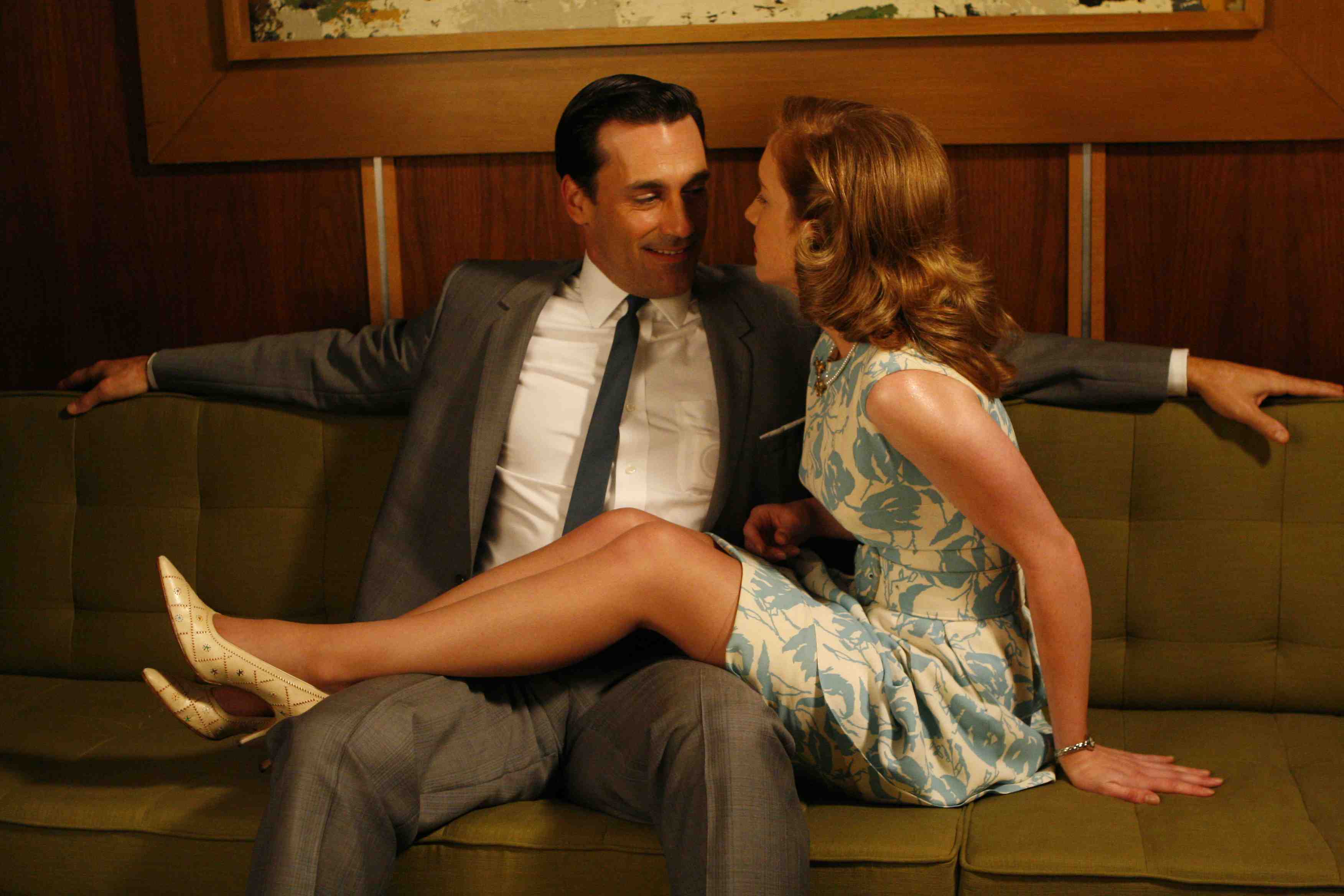
'Mad Men' cast photo (AMC)

‘Mad Men’ cast photo (AMC)

This week, we’re examining sexuality data from the 1960s, in celebration of the upcoming final half-season of “Mad Men” beginning Apr. 5th.

To kick off our series, let’s start by examining some basic background on 1960s population statistics. I looked at numbers from both the 1960 and 1970 Censuses to get a better idea of the decade’s growth. One caveat: the growth numbers are estimated, since the numbers I calculated would assume direct linear growth and that, in all likelihood, would not be the case due to varying factors (and the fact that population growth doesn’t happen within a vacuum).

I created some Excel tables to better show the data.

Overall Population:

1960-1970 population data (US Census)

1960-1970 population data (US Census)

As you can see, men experienced a 12%+ growth over the decade, while women grew at a faster pace of 14%+, averaging out to a total population growth of 13%+.


Population Breakdown by Sex per Census:

I wanted to see how the split changed in each iteration of the Census (or if it did at all).

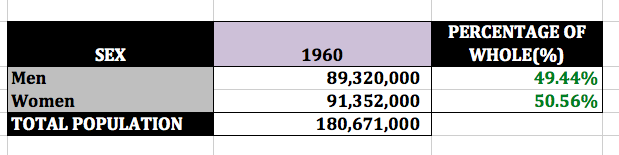
1960 population sex split (US Census)

1960 population sex split (US Census)

In 1960, women just barely made up more of the population than men.

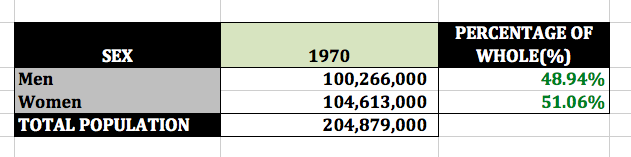
1970 population sex split (US Census)

1970 population sex split (US Census)

The scales tipped further in 1970, as men lost half a percentage point of their population to the women.


Median Age at First Marriage:

1960-1970 median age at first marriage by sex (US Census)

1960-1970 median age at first marriage by sex (US Census)

Throughout the decade, both men and women waited longer to get married for the first time. But even though women waited longer, they still married around age 20. (Contrast that to now, where the average age of women getting married stands at 27.)


Marital Status Breakdown by Sex:

Each of these breakdowns looks at respondents over the age of 14 (so no babies are skewing the data).

Here’s the 1960s:

1960 mens' marital status (US Census)

1960 men’s marital status (US Census)

Married men outnumbered single men by a near 1:3 ratio.

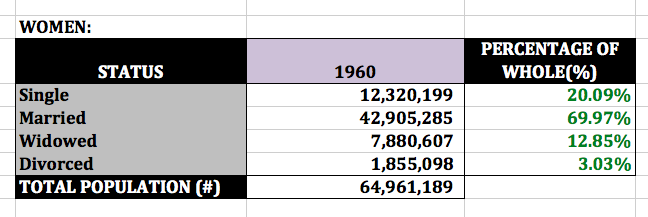
1960 women's marital status (US Census)

1960 women’s marital status (US Census)

Married women outnumbered single women by over a 1:3 ratio, and almost headed into 1:4 territory. There was also a much larger discrepancy between the number of widowed men and women (who reported as such, at least).

And here’s the 1970s:

1970 men's marital status (US Census)

1970 men’s marital status (US Census)

There are more single men, and more married men. Widowed and divorced men became virtually equal.

1970 women's marital status (US Census)

1970 women’s marital status (US Census)

The number of widowed women grew faster than the number of divorced women. The rate of growth between single men and single women, respectively, held steady throughout the decade.


Welcome to Sex & The ’60s Week!

'Mad Men' Season 1 still (Hollywire)

‘Mad Men’ Season 1 still (Hollywire)

Welcome to Sex & The ’60s Week here on Sex & Stats! In celebration of the last half of the final season of “Mad Men” starting Sunday (Apr. 5th!), we’re examining data on various aspects of sexuality during the decade, and some stats on the show itself.

As everyone knows, the 1960s was a very pivotal decade for sexuality, starting out all traditional, sweet and never-been-kissed innocent and ending up all about that free love. Ways of expressing love and desire through sex got completely up-ended and changed, paving the way for what we know today. “Mad Men” has noted these changes throughout its 7.5-season run, and we’ll be commenting on them throughout the week. Enjoy!


Smart Vibrators Will Data-Mine Your Pleasure

SmartBod vibrator prototype evolution (Angel.co)

SmartBod vibrator prototype evolution (Angel.co)

Happy Friday! We’ve talked about smart sex toys before, and also how Big Data is taking over sex. We’re ushering in a new era of sexual data and metrics, on a more minute level than ever before.

Enter the SmartBod, a vibrator that tracks its users’ data and aggregates it via a related app. While tracking arousal (and climax) patterns, the user will then be able to establish a baseline of usual trends. The app will also suggest ideas mined from the collected data. Call it sex-alytics, if you will.

UC Berkeley entrepreneurs Liz Klinger and James Wang aim to help women spark conversations regarding pleasure, since it can be an uncomfortable topic for most people. The user “would learn how their orgasm changes depending on how and when they use the vibrator.” It can also help women determine if they’re “normal” or not, in terms of their orgasms and arousal. So you can compete with others, or with yourself or both.

This counts as the second “smart” vibrator I’m aware of, next to the upcoming Una. As a both a sex geek and a data nerd, I can’t wait to use these and report my results. All in the name of science, of course!


CatalystCon East 2015: By The Numbers

CatalystCon East 2015 (HeyEvent)

CatalystCon East 2015 (HeyEvent)

It’s that time of year again! CatalystCon East 2015 starts tomorrow and runs through Sunday in Arlington, VA. It’s shaping up to be a good one, so here are some basic numbers to pique your interest:

Number of Days: 3

Number of Keynotes: 2

Number of Speakers: 81

Selected Speakers: Jillian Keenan, Ashley Manta, Ela Darling

Number of Sessions: 43

Selected Sessions: “Sex + Millennials: How We are Changing Sexual Landscape,” “Deconstructing Christian Erotophobia” “Sense & Shibari-a Re-Evalution of the Knowledge of Rope Bondage and the Possibilities of Researching Kink”


If you’re going, have fun! I’m jealous!

#ThrowbackThursday: Adam and Eve’s Phil Harvey, 1991

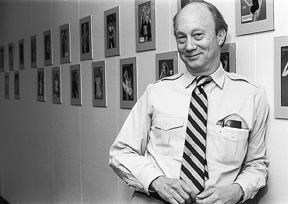
Phil Harvey, 1991 (IndyWeek)

Phil Harvey, 1991 (IndyWeek)

This year, Adam and Eve founder Phil Harvey will give CatalystCon East’s closing keynote address.

Harvey founded Adam and Eve while getting his master’s degree in family planning administration at the University of North Carolina-Chapel Hill (UNC). In 1970, he began a mail-order business selling condoms, flouting the Comstock Law.

Harvey has two businesses: Adam and Eve, the nation’s largest mail-order adult product business (headquartered in Hillsborough, North Carolina) and Phil Harvey Enterprises, Inc. The latter company is a non-profit devoted to bringing contraception to underserved countries. This led him to win the American Association of Sexuality Educators, Counselors and Therapists’ (AASECT) Humanitarian Award in 2006.

With that history, Harvey’s keynote should be a must-see.


Ariana Miyamoto is the First Mixed-Race Miss Japan

Ariana Miyamoto, Miss Japan 2015 (We Are Wakanda)

Ariana Miyamoto, Miss Japan 2015 (We Are Wakanda)

The newly-crowned Miss Japan Ariana Miyamoto has made history: She’s the first mixed-race woman to win the title. She had previously won the Miss Nagasaki title.

The 20-year-old Miyamoto, born to a Japanese mother and an African-American father, will go on to represent Japan at the Miss Universe 2015 pageant.

This is huge for Japan, as the country is known being very racially homogenous. According to a July 2014 estimate, those who self-identify as Japanese comprise 98.5% of the total population. By contrast, “other” races (under which African-American falls) holds onto only .6%. The estimate puts the country’s population at 127M+, so that would mean “other” races would number around 762K+. (To put that in context, self-identifying Japanese would number around 125M+.)

“Hafu” (mixed-race) marriages have grown steadily since 1980, when the Japanese government recorded 5K+ “international” marriages. In 2004, mixed-race marriages numbered 39K+, which represented 5%+ of all marriages within the country.

Though it’s clear that the number of interracial marriages, and multi-racial citizens, are rising, it’s difficult to find because racial data isn’t collected in Japan (only nationality is acknowledged). But Japanese filmmaker Megumi Nishikura found that “20K+ half-Japanese are born in Japan each year, including both multiethnic and multiracial people” through her documentary “Hafu: The Mixed-Race Experience in Japan.”

Though Miyamoto is already getting backlash for “not being Japanese enough,” she’ll now be seen by the world as the new face of Japan.

How Many College Sexual Assault Investigations Have Been Suspended?

UVA Campus (Brohammas)

UVA Campus (Brohammas)

Yesterday, the Charlottesville, Virginia police announced that they’re suspending their investigation of the UVA fraternity rape allegations due to lack of evidence. After reviewing records and conducting 70 interviews, investigators were unable to find key witnesses or a statement that the assault occurred.

This leads to the obvious question: How many sexual assault investigations have been suspended?

I was specifically interested in the topic in the context of colleges and universities, and searched for that. I was unable to find any conclusive data, which makes sense, as I don’t think schools would be eager to give those numbers out.

The police did say they’re leaving the investigation open, and that it could resume in the future. But I’m sure there are even fewer statistics on re-opened college sexual assault cases.


How Does BDSM Affect The Brain?

BDSM (GoodReads)

BDSM (GoodReads)

We know that people who are into BDSM are more sexually adventurous, less anxious, and more secure in themselves. Obviously, all of these are beneficial qualities. But research suggests that it affects the brain in positive ways as well.

According to a recent study, each partner in a D/s  scene enters into an “altered state of consciousness” due to a variation in blood flow pattern to the brain. For dominants, this is termed “topspace;” for sub missives, “subspace.”

A researcher at Northern Illinois University studied 14 subjects “to test whether pain from sexual experiences may cause blood flow to alter the region of the brain responsible for control and working memory.” Subjects were randomly assigned to either give or receive pain, and took the Strook test, which measures “cognitive function for color and word recognition,” and questionnaires before and after the test.

Those who received pain fared worse with focus and memory. What does this mean?

When there is a deficit in a person’s working memory, they have less abstract thinking, access to memory, self-reflective conscious, and cognitive function, which leads to an altered state of consciousness. In S&M, this altered state transcends to one of focus and enjoyment.

The end result is similar to a runner’s or a meditative high, in that it modulates pain perception. It’s caused by “a lack of blood flow to the area.”

Even though it might be perceived as dangerous, BDSM is actually quite safe if done correctly. And I’m willing to bet that for some people, it’s a lot more fun than running or yoga.


Do Musicians Get Laid More?

ACDC's Malcolm Young, 1970s (ACDC)

ACDC’s Malcolm Young, 1970s (ACDC)

Happy Friday! We’ve all heard that musicians get laid more than the average dude with no guitar skills. (Well, not just guitar, substitute any instrument here that you prefer.) It’s thought of as a evolutionary differentiator to allow potential partners to pick them on the basis that they’d be a good mate for life, or for just one night.

But is this true?

It turns out that this might not be the case. A recent study, published in “Evolution and Human Behavior,” surveyed 10K+ Swedish twins ages 27-54, both women and men, to determine this dilemma. The study examined benchmarks such as the age each person first had sex, number of sex partners reported and the number of kids they had.

Here’s what the study ultimately found:

Contrary to predictions, the majority of phenotypic associations between musical ability and music achievement with mating success were nonsignificant or significant in the other direction, with those with greater musical ability scoring lower on the measures of mating success.

Looks like every musician you crushed on in high school had some other stuff going on that you found attractive. Because it wasn’t evidently just that guitar.

The results follow two earlier Swedish studies that found that music doesn’t hold enough weight as a desirable-mate signifier to definitively say that the trait/skill alone attracts mates.

So if you’re debating treating yourself to music lessons after that hard-earned promotion, and if you’re looking for partners (short- or long-term), you might want to skip the lessons and just use that promotion as a talking point.