Trends: Historic Interracial Couples on Film

Ruth Negga and Joel Edgerton in 'Loving' (Evening Standard)

Ruth Negga and Joel Edgerton in ‘Loving’ (Evening Standard)

What a difference a year makes.

Last year, the conversation around movies in Hollywood centered around the fact that there was no diversity. #OscarsSoWhite gained prominence during the national conversation. It seems the entertainment industry listened, because movies with diverse casts and themes will be released. Even better, a couple of movies will tell stories from history that need to be more widely known than they are.

The story of Virginia couple Mildred and Richard Loving are featured in Jeff Nichols’ Loving. Mildred, a Black woman (played by Ruth Negga), and Richard (Joel Edgerton), a white man, were arrested in 1958 for the crime of being married when interracial marriage was a crime. The Lovings’ ordeal to have their union be legally recognized led to the landmark Loving v. Virginia Supreme Court case in 1967. The ruling struck down every anti-miscegenation law still on the books in 16 Southern states. (At least in theory; several states still tried to unofficially enforce the law.)

Too few people know this story, and I’m glad it’s gaining more recognition. The case is seen as a landmark in the struggle for civil rights, and can be regarded as the spiritual predecessor to the recent marriage equality fight and decision.

Loving isn’t the only historic interracial love story debuting this winter. Amma Asante’s A United Kingdom focuses on the story of Sir Seretse Khama (played by David Oyelowo), a member of the Bechuanaland Protectorate’s royal family, and Ruth Williams (played by Rosamund Pike), an English woman and Khama’s eventual wife. The Khamas’ romance and eventual marriage set off an international scandal which took years to rectify.

Director Asante’s previous feature was Belle, the true story of a mixed-race English woman in the 18th century. I enjoyed it, particularly because it was something I hadn’t seen before: a woman of color in a period costume drama. Asante won my attention and my dollars with that film, so I’m curious to see her new one as well.

Loving will be released on Nov. 4th, and A United Kingdom will be released Jan. 17, 2017.
 

The Cost of Kim Kardashian West’s Social Media Blackout: By The Numbers

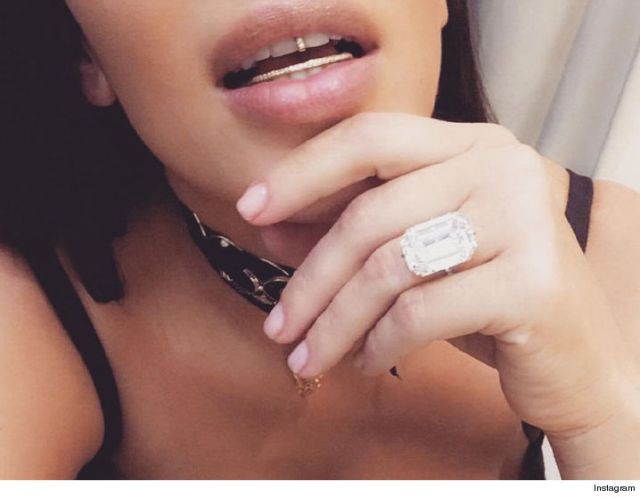
Kim Kardashian and her ring (TMZ)

Kim Kardashian and her ring (TMZ)

In light of getting robbed in Paris last week (losing $11M-worth of jewelry), Kim Kardashian West has decided to take a break from social media for a month to reassess her online presence. Prior to now, Kardashian West has had a far-reaching social media presence on various platforms. She’s reconsidering her use of social media to document her life because the Paris thieves were after the $4M ring gifted to her by husband Kanye West. How did the thieves know about the ring? Kardashian West had shown it off on Snapchat.

But Kardashian West also uses social media as an extension of her business: being a Kardashian. And she’s paid well to do so. But it’s estimated that her month-long social media hiatus could cost her.

Here are the projected numbers behind Kim Kardashian West’s self-imposed social media blackout:

Amount Kardashian West’s special event appearances make: $20-$30K

Amount Kardashian West’s personal posts are worth to her brand: $200-$300K

Amount Kardashian West makes on social media in a given month: $1M

Kardashian West’s estimated yearly salary: $50M

Kardashian West’s estimated net worth: $150M


Trends: Female Superheroes’ LGBT Sexuality

Wonder Woman in 'Justice League' (Pink News UK)

Wonder Woman in ‘Justice League’ (Pink News UK)

Last week, DC comics writer Greg Rucka gave voice to what a lot of people suspected for many years: Wonder Woman is queer.

Shocking. (That was sarcastic.)

So far, Rucka is the only person affiliated with DC to speak definitively on Wonder Woman’s sexuality. But he said it’s canon, so…it’s canon. Take it as gospel.

Previous to this “revelation” (if you can call it that), Wonder Woman’s sexuality had been on the table virtually since she debuted in 1941. Think about it: she lived on an island populated solely by women. Audiences can read between the lines.

Wonder Woman isn’t the only strong female protagonist in comics confirmed to be queer. In 2006, Batwoman’s alter ego Kate (also known as Kathy) Kane came out as a lesbian. Batwoman debuted in 1956. (Does this mean it took Kate/Batwoman 50 years to figure out her sexuality?) In 2007, it was announced that Batwoman would be part of DC’s graphic novel series 52, which aimed to depict modern times (relationships included) more accurately.

Batwoman received her own love story with detective Renee Montoya in 2016’s animated movie Batman: Bad Blood. As you might assume, Batwoman is most closely associated with Batman. (Fun fact: Batwoman was originally created to counteract public perception that Batman might be gay.) But thus far, Batwoman (with or without her sexuality) has not been featured in a big-budget live-action movie.

Though she isn’t part of DC or its main rival Marvel Comics, Xena from the TV series Xena: Warrior Princess counts as a superhero in my book. New Zealand actress Lucy Lawless starred as the titular character, a reformed warrior who travels the world doing good deeds for various civilizations. Her friend Gabrielle (Renee O’Connor) usually traveled with her. The two (and the show) quickly developed a cult following, especially amongst lesbians. Xena and Gabrielle were depicted as having a close (emotionally and physically) and mutually supportive relationship that many assumed was more than platonic. (There’s even a Tumblr devoted to this.)

In 2003, Lawless talked to Lesbian News (actually the name of a real publication) about Xena and Gabrielle’s relationship. She felt that Xena was “definitely gay,” and that the character and Gabrielle were married. Lawless gave this interview two years after the show ended. In 2015, it was announced that Javier Grillo-Marxuach, executive producer behind the CW’s The 100, would reboot Xena and explore her sexuality in greater depth than the original show. So that basically confirms the yes, the character, and Gabrielle by extension, is indeed gay.

It’s exciting that we’re seeing more and more superheroes depicted as LGBT+, and that their sexuality isn’t the main aspect of their personality. But I wonder which character will be next: Ms. Marvel? Black Canary? Black Widow?

Trends: Emmys 2016 Diversity

Rami Malek, Emmys 2016 (Telegraph UK)

Rami Malek, Emmys 2016 (Telegraph UK)

The Emmy Awards aired this past Sunday night, honoring the best in TV. The twin themes  that popped out from the night were diversity and inclusion. And they played out in many ways.

Mr. Robot actor Rami Malek won Best Actor in a Drama Series, becoming the first Egyptian-American to do so. Malek also became the first non-white actor to win the award since 1998, when Andre Braugher won for Homicide: Life on the Street. On the actress side, Black-ish lead Tracee Ellis Ross was nominated for Best Actress in a Comedy Series. Though she didn’t win, Ellis was the first Black woman to be nominated for the award in 30 years; Phylicia Rashad was nominated in 1986 for The Cosby Show. Ellis was only the fifth Black woman ever to be nominated for Best Actress in a Comedy Series.

Inclusivity also prevailed behind the camera. Comedian Aziz Ansari and Alan Yang won Best Writing for a Comedy Series for Ansari’s Netflix series Master of None. (Ansari was also nominated for Best Actor in a Comedy Series.) Women directors were honored: Jill Soloway won Best Directing for a Comedy Series for Amazon’s Transparent, and Susanne Bier won Best Directing for a Limited Series, Movie or Dramatic Special for AMC’s The Night Manager.

Diverse narratives are gaining more traction. Transparent actor Jeffrey Tambor won Best Actor in a Comedy Series for the second consecutive year for his role as a transwoman.

It was good to see some progress made this year in terms of inclusion, but there’s still a long way to go.


Trends: Latina Actress Firsts


Melissa Villasenor (Remezcla)

Melissa Villasenor (Remezcla)

Earlier this week, new additions to the “Saturday Night Live” cast were announced for the upcoming season. Among the three new cast members is comedian Melissa Villasenor. Villasenor’s hiring is significant because she’ll be the first Latina cast-member since “SNL” debuted 41 years ago.

How in the hell did it take Forty. One. Years?!?!?!

Villasenor’s hiring is just the latest achievement for Latinas in the entertainment industry, and she’s not the first to bust down a barrier.

Mexican actress Dolores del Rio worked in Hollywood from the 1920s until the ’40s, and achieved cross-over success with American audiences. She was the first Mexican actress to do so, and she worked with Hollywood luminaries such as Fred Astaire. (Fun fact: In the 1933 film “Flying Down to Rio,” del Rio danced with Astaire in the same film where he first paired with Ginger Rogers.)

Actress Rita Moreno overachieved with the firsts. Not only did she win the Best Supporting Actress Oscar in 1961, but she won the same award at the Tonys in 1975. Moreno went on to be the second person ever to get the EGOT honor (that is, she won an Emmy, Grammy, Oscar and Tony).

Villasenor’s hiring opens the door for more diversity at “SNL,” but more Latina achievement in entertainment.


Trends: The Bikini in 1960s Film

Ursula Andress in "Dr. No," 1962 (YouTube)

Ursula Andress in “Dr. No,” 1962 (YouTube)

This year, the bikini turns 70 years old. How can it be that old?! And love it or hate it, the iconic swimsuit isn’t not going anywhere anytime soon.

The bikini’s invention is credited to French engineer Louis Reard. When he went to the beach, he noticed women trying to get a better tan by adjusting their suits. Sensing a hole in the market, he designed the first bikini out of 30 square inches of fabric in 1946.

Though the bikini took some time to catch on with the average consumer, it caught fire on film in the 1960s. The decade featured some instantly iconic bikini moments, ensuring that the garment had earned its place in fashion and film history.

One of the first to appear was in 1962’s James Bond film “Dr. No.” Ursula Andress, playing shell diver Honey Ryder, appears from the ocean clad in a white bikini. Bikini sales rose after audiences saw the movie, and the bikini was later auctioned off for $61.5K in 2001.

After that head-turning debut, bikinis became a wardrobe staple of the beach party genre, starting with 1963’s “Beach Party” with Annette Funicello. In 1966’s “One Million Years B.C.,” actress Raquel Welch rocked a deerskin bikini.

But why were bikinis taking off during the 1960s? There are a few reasons. One is that women’s dress standards had somewhat relaxed due to the sexual revolution. While a woman might’ve felt a bikini was too revealing in the 1950s, many women grew comfortable showing their bodies (up to a point) in the 1960s.

Though the bikini gained popularity a good 15 years after its debut, the classic women’s swimwear item shows no signs of slowing down in the near or distant future.


Trends: All-Female Reboots

"Ghostbusters," 2016 (Geek.com)

“Ghostbusters,” 2016 (Geek.com)

The 2011 movie “Bridesmaids” was very funny, no doubt about that. The film, which starred a cadre of funny women led by Kristen Wiig and Maya Rudolph, centered on the escapades of the titular group as they helped their friend (played by Rudolph) on the way to getting hitched. The movie was well-liked by audiences, and that showed in the revenue. At the end of the year, “Bridesmaids” ranked #14 at the domestic box office with $169M+ in revenue, and #20 in the worldwide box office with $289M+ in revenue.

But it also had an effect on movies that we’re still feeling: “Bridesmaids” convinced studios that audiences (both women and men, shocker) would see a movie with an all-woman cast. Well…duh. And now studios have sat up and taken notice.

The waves from “Bridesmaids” have hit an interesting formula: to remake a beloved movie with an all-female cast. The rationale goes that if the men liked the original, then the women will love the remake! (And there’s the assumption that the men will be dragged to the movie from their ladies, but it’s OK because it’s a nostalgic property.)

One high-profile all-female remake has already come out: this year’s “Ghostbusters.” The reboot has Kristen Wiig, Melissa McCarthy, Kate McKinnon and Leslie Jones investigate paranormal happenings in New York. The movie has a strong “Saturday Night Live” heritage: In addition to Wiig, McKinnon and Jones logging time on the show, the movie also featured current cast member Cecily Strong in a notable part. “Ghostbusters” debuted at #2 on opening weekend, and as thus far grossed $124M+ domestically and $208M+ worldwide.

Another all-female project announced recently was a reboot of the 2001 heist movie “Ocean’s 11” (which itself is a remake of the 1960 movie of the same name). Sandra Bullock, Cate Blanchett, Rihanna, Mindy Kaling, Anne Hathaway, Helena Bonham Carter, and Nora Lum (better known by her rap name Awkwafina) will make up the ensemble. No release date yet, but I know I’ll be seeing it in the theatre because I vote with my dollars.

It’s great to see so many movies getting made with all-female ensembles, but I can’t wait to get to the point where it’s not noteworthy anymore, but unremarkable and accepted.


Trends: Latex Dresses

Beyoncé, Met Ball 2016 (US Magazine)

Beyoncé, Met Ball 2016 (US Magazine)

The 2016 Met Ball (that is, the Metropolitan Museum of Art Costume Institute Benefit’s annual swanky party) took place this past Monday, and all eyes were on the stars to see who wore what. The theme “Manus x Machina: Fashion in an Age of Technology” ensured that attendees and fashion obsessives would see some futuristic outfits.

And what could be more futuristic than latex?

Beyoncé wore a light-pink long-sleeved beaded latex dress. Model Bella Hadid wore a tight black spaghetti-strap bustier and pencil skirt, designed by custom latex couturier Atsuko Kudo, to the after party.

The latex dress trend isn’t limited to real life. Taylor Swift wore a white two-piece latex outfit in her “Bad Blood” video, and the aforementioned Beyoncé has a bright red minidress as one of her current “Formation” tour costumes. Both of these were Kudo pieces.

But neither of the aforementioned ladies started this trend. That honor goes to Kim Kardashian back in 2014. She wore a peachy-pink Kudo creation (can you tell he’s got the custom latex market on lock?) to the Australian launch of her fragrance. Incidentally, her outfit was the identical forerunner of Hadid’s (though Kardashian has also worn the black version of the outfit).

Bella Hadid and Kim Kardashian (Wetpaint)

Bella Hadid and Kim Kardashian (Wetpaint)

Why is latex having a moment right now?

It’s possible that this is part of the long-range ripple effect from “Fifty Shades of Grey” that began ramping up last year. Everybody remembers (and was intrigued/titillated by) the playroom scenes, whether they read the book(s), saw the movie or both.

The book and movie’s success can be traced to many women’s hidden desires to be more sexually daring. However, in real life, some women may not feel comfortable completely putting themselves out there, sexually-speaking, in all their freak-flag glory. Donning a latex dress (or any fetishwear) can feel liberating, as if a woman is letting her “bad” side out to play. But it’s also safe in that the wearer can take it off at the end of the night (or session).

“Fashion Police” co-host Tim Gunn (also of “Project Runway” fame) hit the nail on the head when critiquing Beyoncé’s Met Gala look: “It has S&M written all over it.”

Well, yes. That’s sort of the point.


China’s Sex Ratio: How Skewed Is It?

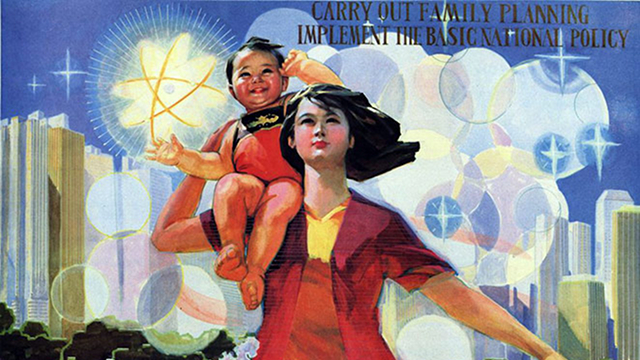
Chinese One-Child Policy poster (The Galloping Beaver)

Chinese One-Child Policy poster (The Galloping Beaver)

Late last year, China ended its one-child policy, where each family was only allowed to have…one child. (Bet you didn’t see that one coming.) Though its rules have relaxed in recent years, this is the first time the practice has been officially abolished. (But we’ll see how long it takes for the policy to actually die down, data-wise.)

We’ve all heard about how skewed China’s sex ratios are; we’ve heard about how the country overwhelmingly favors male children to the detriment of an equal sex ratio. But what are the numbers behind this phenomenon?

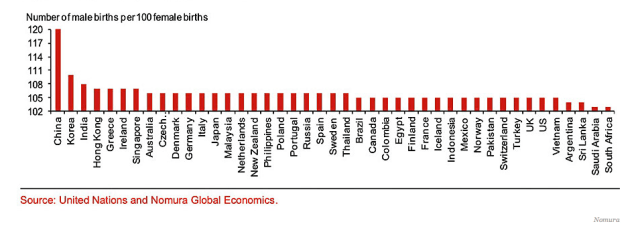
Consulting firm Nomura Research Institute, Ltd. released data in 2010 that revealed that Chinese women bear .71 of female births during their lifetime. That year, men outnumbered women by 50M+. The birth rate at that time was 120 boys per 100 girls, which works out to a sex ratio of 1.2.

If you’re a visual learner, here’s what that ratio looks like, especially in context with other countries:

China's male births compared to other countries' male births ('Business Insider')

China’s male births compared to other countries’ male births (‘Business Insider’)

As Business Insider notes:

That means lots of single, possibly angry males. Hard to imagine anything good coming out of this.

The policy was made into law in 1979, and abolished in 2015. That’s 36 years. Thirty-sex years of selected sex-selection in favor of boys at the expense of girls. (Fun fact: Kim Kardashian West participated in this when she was trying to get pregnant with her now-son.)

Scary, right? We’ll see how the new policy helps attempt to reverse this long-running trend.


No Shit: Entertainment Isn’t Diverse: By The Numbers

Hollywood sign (Mapping Megan)

Hollywood sign (Mapping Megan)

A new study released this week by the University of Southern California (USC) Annenberg School for Communication and Journalism once again stated the obvious: Entertainment isn’t diverse.

If you don’t want to read the full report (though I’d recommend it), here are some choice stats:

Percentage of female speaking roles in film: 28.7%

Percentage of female film directors: 3.4%

Percentage of female screenwriters: 28.9%

Percentage of cable TV shows that have no Asian characters: 51%

Percentage of cable TV shows that have no Black characters: 23%


Still not convinced the #OscarsSoWhite hashtag is needed?