#ThrowbackThursday: Lucille Ball and Desi Arnaz, “I Love Lucy”

Ricky (Desi Arnaz) and Lucy Ricardo (Lucille Ball) in 'I Love Lucy' (Bestwalle)

Ricky (Desi Arnaz) and Lucy Ricardo (Lucille Ball) in ‘I Love Lucy’ (Bestwalle)

“I Love Lucy” premiered on Oct. 15, 1951 and ran for almost six years. The iconic series followed Lucy (Lucille Ball) as she got into lovable scrapes and exasperated her husband Ricky (Desi Arnaz). Arnaz frequently played the straight man to heighten Ball’s screwball antics.

The show broke a barrier in a notable way: It was the first to feature an interracial couple, since Ball was white and Arnaz was Cuban. CBS initially was hesitant to cast them together, since they didn’t think America would believe that a white woman would marry a Hispanic man. But Ball put her foot down, and she and Arnaz created one of the most beloved couples in sitcom history.

“I Am Cait” Wins Big in Overnight Ratings

Caitlyn Jenner in 'I Am Cait' (New York Daily News)

Caitlyn Jenner in ‘I Am Cait’ (New York Daily News)

Last night, “I Am Cait” premiered on the E! network. The eight-part docuseries follows Caitlyn (born Bruce) Jenner as she transitions from a man to a woman, and how that changes affects her relationships with family and friends. The series was announced right after Jenner’s groundbreaking “20/20” interview with Diane Sawyer in which she revealed she’d be transitioning.

With the overnight ratings in, the premiere garnered a 2.1 household rating within Nielsen’s 56 metered markets. It tied with TNT’s “Falling Skies” for the most-watched cable program of the night. Prior similar ratings points to this share being equivalent to about 3M viewers.

These ratings suggest that the interest in Jenner’s story is there, and substantial. I’ll be looking forward to seeing how these ratings progress on a weekly basis.


Caitlyn Jenner Gets New E! Docuseries “I Am Cait”

Caitlyn Jenner, 'I Am Cait' (Skynews Australia)

Caitlyn Jenner, ‘I Am Cait’ (Skynews Australia)

That was quick: Caitlyn Jenner announced that she’ll star in a docuseries titled “I Am Cait” for E!. (E! is also home to “Keeping Up with the Kardashians” and its various iterations.) The docuseries will follow Jenner as she begins life as a woman.

The eight-part series will premiere on July 26th, and will air in 120 countries.

This is the second docuseries announced on the life of a transgender woman this year. The E! show follows TLC’s previously announced “All That Jazz,” which will focus on teen transgender activist Jazz Jennings.

Don Draper’s Conquests: By The Numbers UPDATED

'Mad Men' Don Draper, Midge Daniels, Megan Calvet Draper, Betty Draper, and Dr. Faye Miller (Vulture)

‘Mad Men’ Don Draper, Midge Daniels, Megan Calvet Draper, Betty Draper, and Dr. Faye Miller (Vulture)

Today’s post is an update of this post, in celebration/memoriam of last night’s “Mad Men” series finale. Now that the series has ended, we can make more definitive statements on what kind of women Don prefers. 

Everyone who watched the show knows that Don Draper (Jon Hamm) is a serial womanizer. Even when he’s married, he can’t stay faithful. It’s part of what makes him so intriguing: we know he’s wrong, but we couldn’t stop watching!

There’s been some ink spilled on the types of women he tends to bed, such as preferring docile women for marriage versus favoring strong-willed career women for affairs. But I was curious to find out if there were any other patterns, and so had some fun with Excel.

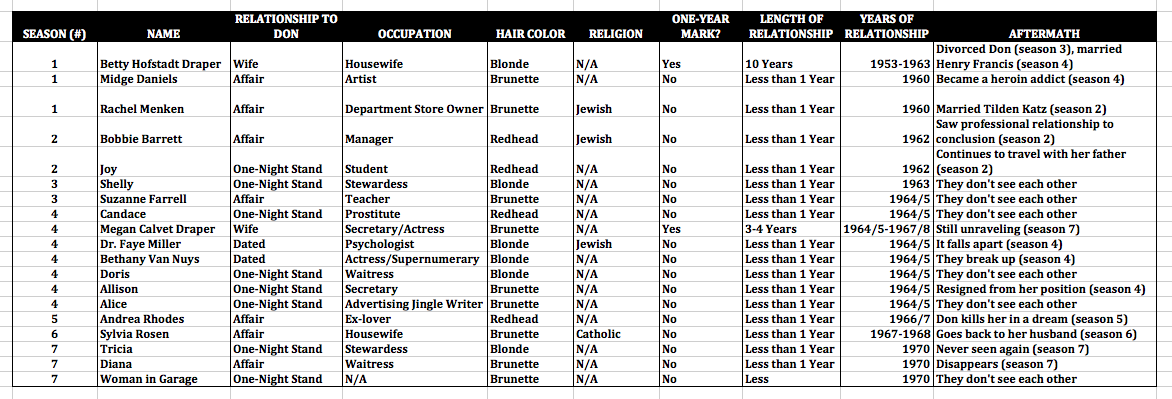
For fun, here’s what my entire Excel spreadsheet looked like:
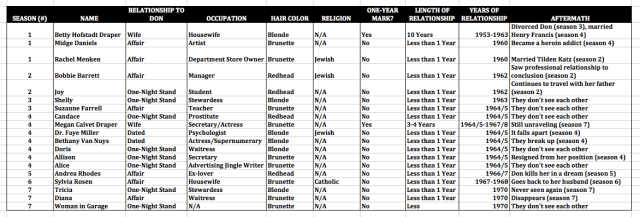
'Mad Men' Don Draper Conquests Excel Spreadsheet UPDATED

‘Mad Men’ Don Draper Conquests Excel Spreadsheet UPDATED

If you can’t see, I listed the names of Don’s 19 partners by season, their relationship to Don, occupation, hair color, religion, and overall length of the relationship. (Some of these metrics I didn’t end up using.) Some of these things I tried finding information as accurate as possible (such as the years each relationship spanned), but sometimes had to make a close guess. So if you see an error, please correct me and I’ll recalculate.

Now, let’s find some patterns via pivot tables.


Don’s Relationships by Type:

I broke down Don’s relationships into three types: wife, affair and one-night-stand. I defined affair as on-going with an emotional component, whereas I defined one-night stand as purely sexual, even though it may have happened more than once (as is the case with season 4’s Candace and season 7’s Tricia).

That being said, here’s the data:

'Mad Men' Don's Relationships by Type  Excel Pivot Table UPDATED

‘Mad Men’ Don’s Relationships by Type Excel Pivot Table UPDATED

We know he’s been married twice (I’m not counting Anna Draper, as she was never a conquest), so no surprise there. I figured Don has had more casual partners than serious ones, but I didn’t realize how much it would skew. Don’s had over three times as many affairs and one-night stands combined as he has married and dated partners combined. Interesting.


Partners’ Occupation:

I was interested to see if Don had any particular type in terms of career. Though every woman was different, four occupations reoccurred, and all of them roughly at the same rate.

Two of the 16 women (12.5%) were housewives, which were his first wife Betty and later season 6’s Sylvia Rosen. Another pattern that emerged were two actresses, who also held other jobs when Don knew them. These two were season 4’s Bethany Van Nuys (whose other job was a supernumerary) and his second wife Megan Calvet (who began as a secretary).

Don’s partners in season 7 made a couple more occupations a trend. Tricia was the second stewardess, with the first being season 3’s Shelly. Waitress Diana came after season 4’s Doris, also a waitress.


Partners’ Hair Color:

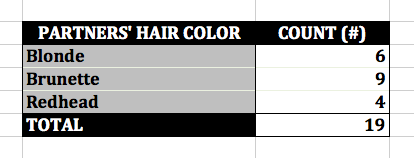
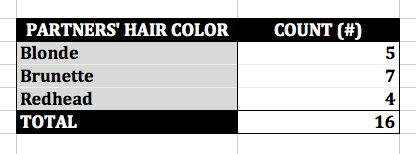
Gentlemen prefer blondes, but does Don? Let’s take a look:

'Mad Men' Don's Partners' Hair Color Excel Pivot Table UPDATED

‘Mad Men’ Don’s Partners’ Hair Color Excel Pivot Table UPDATED

No, Don’s more of a brunette man, with nearly half his partners sporting the color. He prefers blondes slightly more than redheads.


Religion:

I initially wanted to see how each partner’s religion broke down. Several did not mention or show any religious leanings, so I referred to their respective affiliations as “N/A,” because I didn’t want to automatically put partners into a “default Christian” category.

Only two of the 16 partners (12.5%) were overt about their religious affiliation: season 1’s Jewish department store heiress Rachel Menken, and the Catholic Sylvia Rosen (season 6, though she’s married to a Jewish man).

Other partners signaled their religious leanings indirectly. Season 4’s Dr. Faye Miller (Cara Buono), referenced her Jewish heritage in passing, using a Yiddish phrase. Season 2’s Bobbie Barrett was confirmed to be Jewish by none other than show creator Matthew Weiner himself.

What we can take from this is that while religion certainly isn’t a conscious preference of Don for his partners, he has selected distinctly Jewish women.


Duration of Relationship:

How long did each of Don’s dalliances last? Unsurprisingly for most of them, not very long:
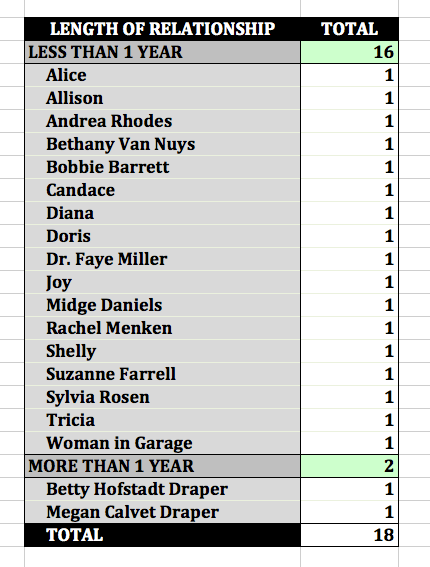
'Mad Men' Don's Length of Relationships Pivot Table UPDATED

‘Mad Men’ Don’s Length of Relationships Pivot Table UPDATED

I initially had assumed that some would’ve spanned more than a year, but the only partners with proven staying power have been his wives Betty and Megan.


Conclusion:

Delving into the metrics of Don’s sexual partners reveals some interesting findings: He prefers brunettes, doesn’t discriminate on the basis of religion or career, and has a short attention span when it comes to women.

Confirmed: Bruce Jenner Is Transitioning

Bruce Jenner (ABC News Go)

Bruce Jenner (ABC News Go)

This is shaping up to be an absolute gangbusters year for the trans community in terms of visibility and empowerment. In just the past two weeks alone, we saw “Orange is the New Black” actress Laverne Cox pose nude for “Allure,” and transman Aydian Dowling in the lead for the “Men’s Health” title of “Ultimate Guy.” As if that weren’t already an embarrassment of riches, Olympic decathlete/”Keeping Up with the Kardashians” patriarch Bruce Jenner confirmed what everyone had been speculating about in his ABC “20/20” interview with Diane Sawyer on Friday night: He’s transitioning to become a woman (but is totally cool using male pronouns for now).

It’s a fantastic interview; watch it if you haven’t already. Jenner is now the most publicly prominent transperson out there right now. He’s in a great position that has potential to educate millions of people on what being trans means. And he wants to use his newfound identity to help empower others who feel out of place in their own lives.

It’s fantastic that Jenner has finally decided to live his life the way he sees fit, and I can’t wait to see what’s next for him. Go Bruce!

Sex & The ’60s: Joan Holloway Inspires Brits to Get Boob Jobs

'Mad Men' season 1 still with Christina Hendricks (The Telegraph UK)

‘Mad Men’ season 1 still with Christina Hendricks (The Telegraph UK)

This week, we’re examining sexuality data from the 1960s, in celebration of the upcoming final half-season of “Mad Men” beginning Apr. 5th.

Happy Friday! Bombshell Joan Holloway (and the gorgeous actress behind the character, Christina Hendricks) has become well-known for her dangerous curves throughout the course of “Mad Men.” (That’s not editorializing, that’s a fact, and everyone agrees.) In Britain, Hendricks is credited with sparking an increase in breast implants.

In a 2011 article in “The Telegraph,” the British Association of Aesthetic Plastic Surgeons (BAAPS) found that the number of women having “breast augmentations” rose 10%+ in 2010 from the 2009 figure. This equals out to 9K+ British women per year.

The BAAPS estimates that overall plastic surgery procedures have tripled from 10.7K+ in 2003 to 36.4K+ in 2009.

A BAAPS source suggested that Hendricks was an influence, especially with the hourglass figure coming back into fashion. But the source wasn’t the only one to name-check Hendricks for her curves. Britain’s Equalities Minister and Liberal Democrat MP Lynne Featherstone proclaimed Hendricks to be “fabulous” while urging the need for more curvy role models. And she would know: Featherstone was voted the “most fanciable MP in Parliament” in 2010.


Sex & The ’60s: Don Draper’s Conquests By The Numbers

'Mad Men' Don Draper, Midge Daniels, Megan Calvet Draper, Betty Draper, and Dr. Faye Miller (Vulture)

‘Mad Men’ Don Draper, Midge Daniels, Megan Calvet Draper, Betty Draper, and Dr. Faye Miller (Vulture)

This week, we’re examining sexuality data from the 1960s, in celebration of the upcoming final half-season of “Mad Men” beginning Apr. 5th.

Everyone who watches the show knows that Don Draper (Jon Hamm) is a serial womanizer. Even when he’s married, he can’t stay faithful. It’s part of what makes him so intriguing: we know he’s wrong, but we can’t stop watching!

There’s been some ink spilled on the types of women he tends to bed, such as preferring docile women for marriage versus favoring strong-willed career women for affairs. But I was curious to find out if there were any other patterns, and so had some fun with Excel.

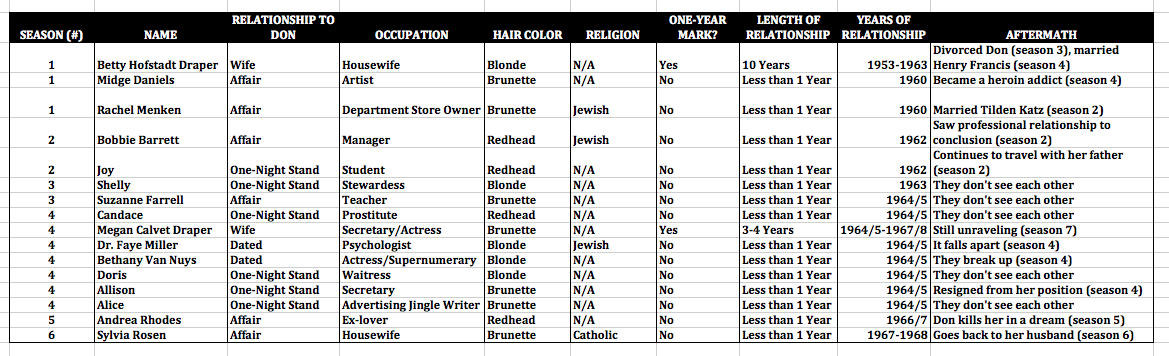
For fun, here’s what my entire Excel spreadsheet looked like:

'Mad Men' Don Draper Conquests Excel Spreadsheet

‘Mad Men’ Don Draper Conquests Excel Spreadsheet

If you can’t see, I listed the names of Don’s 16 partners by season, their relationship to Don, occupation, hair color, religion, and overall length of the relationship. (Some of these metrics I didn’t end up using.) Some of these things I tried finding information as accurate as possible (such as the years each relationship spanned), but sometimes had to make a close guess. So if you see an error, please correct me and I’ll recalculate.

Now, let’s find some patterns via pivot tables.


Don’s Relationships by Type:

I broke down Don’s relationships into three types: wife, affair and one-night-stand. I defined affair as on-going with an emotional component, whereas I defined one-night stand as purely sexual, even though it may have happened more than once (as is the case with Candace the prostitute).

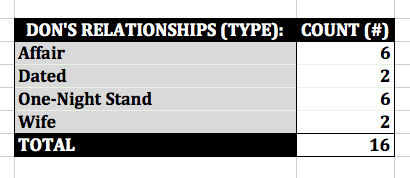
That being said, here’s the data:

'Mad Men' Don's Relationships by Type Excel Pivot Table

‘Mad Men’ Don’s Relationships by Type Excel Pivot Table

We know he’s been married twice (I’m not counting Anna Draper, as she was never a conquest), so no surprise there. I figured Don has had more casual partners than serious ones, but I didn’t realize how much it would skew. Don’s had three times as many affairs and one-night stands combined as he has married and dated partners combined. Interesting.


Partners’ Occupation:

I was interested to see if Don had any particular type in terms of career. But every woman was so different that only two things reoccurred. Two of the 16 women (12.5%) were housewives, which were his first wife Betty and later season 6’s Sylvia Rosen. Another pattern that emerged were two actresses, who also held other jobs when Don knew them. These two were season 4’s Bethany Van Nuys (whose other job was a supernumerary) and his second wife Megan Calvet (who began as a secretary).


Partners’ Hair Color:

Gentlemen prefer blondes, but does Don? Let’s take a look:

'Mad Men' Don's Partners' Hair Color Excel Pivot Table

‘Mad Men’ Don’s Partners’ Hair Color Excel Pivot Table

No, Don’s more of a brunette man, with nearly half his partners sporting the color. Blonde and redhead are nearly equal, with blonde pulling ahead by one partner.


Religion:

I initially wanted to see how each partner’s religion broke down. Several did not mention or show any religious leanings, so I referred to their respective affiliations as “N/A,” because I didn’t want to automatically put partners into a “default Christian” category.

Only two of the 16 partners (12.5%) were overt about their religious affiliation: season 1’s Jewish department store heiress Rachel Menken, and the Catholic Sylvia Rosen (season 6, though she’s married to a Jewish man).

Other partners signaled their religious leanings indirectly. Season 4’s Dr. Faye Miller (Cara Buono), referenced her Jewish heritage in passing, using a Yiddish phrase. Season 2’s Bobbie Barrett was confirmed to be Jewish by none other than show creator Matthew Weiner himself.

What we can take from this is that while religion certainly isn’t a conscious preference of Don for his partners, he has selected distinctly Jewish women.


Duration of Relationship:

How long did each of Don’s dalliances last? Unsurprisingly for most of them, not very long:

'Mad Men' Don's Length of Relationships Pivot Table

‘Mad Men’ Don’s Length of Relationships Pivot Table

I initially had assumed that some would’ve spanned more than a year, but the only partners with proven staying power have been his wives Betty and Megan.


Conclusion:

Delving into the metrics of Don’s sexual partners reveals some interesting findings: He prefers brunettes, doesn’t discriminate on the basis of religion or career, and has a short attention span when it comes to women.


#ThrowbackThursday: Don Draper and Bobbie Barrett’s BDSM Session, “Mad Men” 2008

'Mad Men' season 2 still (Live Auction Group)

‘Mad Men’ season 2 still (Live Auction Group)

This week, we’re examining sexuality data from the 1960s, in celebration of the upcoming final half-season of “Mad Men” beginning Apr. 5th.

Remember this scene? In season 2, Don (Jon Hamm) began sleeping with Bobbie Barrett (Melinda McGraw), the wife of a performer that Sterling Cooper hired for an Utz Potato Chips commercial. In the episode “Maidenform,” we learn she has a penchant for being tied up during sex. But she doesn’t get satisfied, as she tells Don she’s been discussing his sexual prowess. He abruptly leaves, and that’s the end of their affair.

It’s actually the first of two BDSM-tinged scenes the show has depicted. The second one occurred in the sixth season during one of Don’s sessions with Sylvia Rosen (Linda Cardellini). Each scene effectively ended its respective affair. While two instances aren’t enough data from which to extrapolate a pattern, it’s certainly worth noting.


Sex & The ’60s: How Many Live Births Occurred During the Decade?

'Mad Men' season 3 still (LA Times Blogs)

‘Mad Men’ season 3 still (LA Times Blogs)

This week, we’re examining sexuality data from the 1960s, in celebration of the upcoming final half-season of “Mad Men” beginning Apr. 5th.

On “Mad Men,” two significant female characters, Don’s wife Betty Draper (January Jones) and his subordinate Peggy Olson (Elisabeth Moss), gave birth to sons. (Oops, spoiler alert?) While each character made different decisions regarding their progeny, it became a pivotal moment for both of them.

Tracking the number of live births within a population is an essential checkpoint to determine how healthily a population is growing. We’ve already looked at population and marriage stats from the 1960s; now let’s look at birth stats from the decade.

I found a table put together by the Centers for Disease Prevention and Control (CDC) cataloging registered live births from 1933 to 1998, breaking down the data by the age and race of the mother. For our purposes, we’ll look at age only and narrow it down to mothers ages 15-49.

Here’s the data table:

1960s Live Births by Mother's Age and Year Data Table

1960s Live Births by Mother’s Age and Year Data Table

But the patterns are a little hard to see. So I made a line graph:

1960s Registered Live Births by Mother's Age and Year Line Graph

1960s Registered Live Births by Mother’s Age and Year Line Graph

Now we can begin to see some patterns.

It appears that 1964 was a tipping-point year, as some of the age-ranges pivoted from their determined patterns at that year. The number of mothers ages 20-24, the largest group in the series, dropped below 1.4M+ that year, and settled around 1.3M+-1.5M+ for the remainder of the decade. Likewise, the number of live registered births for the 25-29 cohort hit 1M+ that year for the last time that decade. For the rest of the 1960s, births for women ages 25-29 stayed within the six-figure range.

Previous to 1964, women ages 30-34 numbered around 600K+ live births. But 1964 began a drop into the 500K+ range for a couple of years, before ending the decade within the 400K+ range.

Women ages 15-19 (well, teens) stayed within the same range of births throughout the decade (585K+ to 605K+, with an outlier of 621K+ in 1966). But the line graph above makes it appear as if the cohort had a more dramatic rise, but that’s because it’s set off by the 30-34 range’s changes.

In terms of the “Mad Men” characters, Peggy Olson would’ve been 21 years old, and would’ve given birth around 1960. That places her in the largest age cohort of that year. (Ages 20-24 outstripped the next-highest range, ages 25-29, by 334K+ births.) Betty Draper was around 31 years old in 1963 when she gave birth. So she was within the largest of the age ranges that year which didn’t hit 1M+ live births, but still on the downswing of common pregnancies. (Women ages 30-34 registered 610K+ live births).

It seems that showrunner Matthew Weiner’s obsessiveness towards period accuracy extended even to birth ages of his female characters.


Thursday Trends: Recognizing Actors for Portraying Transpeople

Jeffrey Tambor as Maura Pfefferman in 'Transparent' (Business Insider)

Jeffrey Tambor as Maura Pfefferman in ‘Transparent’ (Business Insider)

Last week at the Golden Globe Awards, actor Jeffrey Tambor received the award for Best Actor in a Television Series, Musical or Comedy. Tambor plays Maura in Amazon Studios’ “Transparent,” a transgender woman who’s always identified as a woman, and how it affects her three adult children. (The series also won the Golden Globe for Best TV Series, Musical or Comedy.)

Tambor, who dedicated his award to the trans community, is the latest actor to be recognized for his work in playing a transperson. Though some actors before him have achieved recognition in portraying trans characters, the awards and nominations have come few and far between. But Tambor’s award comes less than a year since Jared Leto won the Best Supporting Actor Oscar for playing a transwoman in “Dallas Buyers Club.” This suggests that the trans community is rapidly gaining in visibility, and portrayals of the community members’ nuances are beginning to be normalized onscreen.

The first film actor to be nominated for portraying a trans person was Chris Sarandon for “Dog Day Afternoon” back in 1975. Sarandon played Leon Shermer, the pre-operative trans wife of bank robber Sonny Wortzik (Al Pacino). The character was based on the real-life Elizabeth Eden, initially born Ernest Aron. Sarandon received Golden Globe and Oscar nominations for his work.

The first film actor to win an award for playing a trans person was Hilary Swank, portraying Brandon Teena in 1999’s “Boys Don’t Cry.” Swank won the Best Actress in a Motion Picture, Drama Golden Globe and the Best Actress Oscar.

Last year, the Emmys made history when it nominated its first transgender acting nominee. Laverne Cox, who plays hairdresser/inmate Sophia Burset in Netflix’s “Orange Is the New Black,” was nominated for outstanding guest actress in a comedy series. (Though she didn’t win, Cox later scored another first as the first openly trans person to grace the cover of “Time” in June.)

It’s important to note that previous to Cox, all the actors nominated were cisgender, and this has occasionally become a point of contention. After Leto won the Oscar in 2014, discussions arose around transgender actors portraying trans characters.

With actors receiving recent recognition in portraying trans characters, the trans community’s visibility is rapidly rising. As more audiences watch trans stories, mainstream acceptance should spread.