How Many Asian Actors Have Been Nominated for Oscars?

Yul Brynner in 'The King and I,' 1956 (Gold Derby)

Yul Brynner in ‘The King and I,’ 1956 (Gold Derby)

The Oscars are this weekend (Sunday, Feb. 28th), and the big controversy this year has centered around the lack of non-white acting nominees (and continues last year’s #OscarsSoWhite hashtag). But when talked about in detail, the conversation has seemed to focus more on including Black nominees and narratives. And that’s great! But there are a wealth of other races and ethnicities that need to be included in the conversation and given a place at the table.

This led me to wonder: how many Asian acting nominees and winners have there been in the history of the Academy Awards? Spoiler alert: not all that many, sadly.

The Best Actor category has seen the most Asian men win the award: Yul Brynner in 1956, and Ben Kingsley in 1982. These two men comprise two-thirds of the category’s Asian nominees.

Actress Merle Oberon was the first Asian nominated for any Oscar, and the first nominated for Best Actress. (The category was called “Best Lead Actress” when she was nominated in 1935.) She remains the sole Asian woman nominee of the category.

Of the seven Asian men who received Best Supporting Actor nominations spanning 1957 to 2003, only one has won: Haing S. Ngor in 1984. Six Asian women have received Best Supporting Actress nominations, but only one has won: Miyoshi Umeki in 1957.

Considering that these categories have five nominees each, and the Academy Awards have been occurring since 1930, this nominations/wins-to-visibility ratio is…fucking pathetic.

I really hope this year teaches the Academy a lesson, and we’ll begin to see more diverse characters and stories not just on screen, but materially validated by the old guard as well.


Channing Dungey is the First Black Woman to Run ABC

Channing Dungey and ABC logo (Variety)

Channing Dungey and ABC logo (Variety)

Big news on the entertainment/broadcast networks front: Channing Dungey was named President of ABC Entertainment last week. She’s the first Black woman to run a broadcast network’s entertainment division.

Dungey replaces outgoing president Paul Lee.

Before her new role, Dungey ran development of ABC’s shows. She’s worked with the “Thank God It’s Thursday” (TGIT)-block of “Scandal,” “How to Get Away With Murder,” and “Grey’s Anatomy,” earning her nickname of “the Shonda Rhimes whisperer.”

I’m eager to see how ABC’s programming will change as a result of Dungey’s promotion. Based on her glowing history with show runners, it sounds like viewers are in for a treat.


Barbie Gets Three New Body Types

New Barbies (CNBC)

New Barbies (CNBC)

For decades, Barbies have been a constant presence in many girls’ toy boxes. Her body barely changed for over 50 years: tall, thin, big boobs, small waist (for that coveted 7:10 waist-to-hip ratio) and balancing on her tiptoes.

For many years, her physical assets have been a point of contention for feminists and activists for positive body image and acceptance. (I can confirm: I’ve been told my grandmother wouldn’t let my mom play with Barbies when she was growing up on the grounds that the doll was too “buxom.” I mean, she wasn’t exactly wrong.) It seems that their concerns have finally been acknowledged.

Barbie will be sold in three different body types: petite, curvy, and tall. Mattel, the company that’s made the doll since its inception in 1959, is also expanding the line in terms of ethnicity and race options:

Barbie dolls will come in seven skin tones, 22 eye colors, 24 hairstyles, and even a flat foot.

This move comes as consumers seek dolls that resemble themselves, or the little girls in their lives. For many women, Barbie is the first doll they could envision as themselves, and dreaming big. and it’s even better that now more dolls will resemble the consumer base’s diversity. Mattel has already begun diversifying their Barbies: the company broadened the range of “skin tones, eye colors and hair styles” available.

The new Barbies will debut this spring in stages. It’ll be interesting to see how the new dolls impact Mattel’s bottom line: Worldwide sales fell 4% in Q4 2015, and the company’s stock price has dropped 43% since a high in 2013.

Idris Elba Makes History at the 2016 SAG Awards

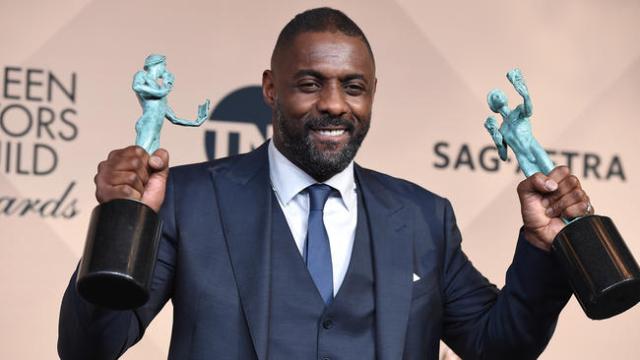
Idris Elba at the 2016 SAG Awards (LA Times)

Idris Elba at the 2016 SAG Awards (LA Times)

The world’s hottest man (not editorializing, this is a fact and everyone agrees) made history Saturday night at the annual Screen Actors Guild (SAG) Awards.

Idris Elba (you know him as Stringer Bell from “The Wire”) not only became the first man to win two SAG awards in one night; he became the first African-American man to do so. Elba won for Best Male Actor in a Supporting Role in a Motion Picture for “Beasts of No Nation,” and for Best Male Actor in a Television Movie or Mini Series for “Luther.” This is especially impressive as it’s the first year he was nominated for a solo acting award. Go Idris!

But Elba’s wins made a splash for another, more sobering reason: He’s the only film winner that wasn’t nominated for an Oscar. His fellow winners (Leonardo DiCaprio for “The Revenant,” Brie Larson for “Room,” and Alicia Vikander for “The Danish Girl“) are all nominated. With the conversation around the Oscars’ diversity occurring for the second year in a row (#OscarsSoWhiteRedux), it’s worth noting for the future.

With Queen Latifah (“Bessie“), Uzo Aduba (“Orange is the New Black“), and Viola Davis (“How to Get Away with Murder“) also winning awards, Elba welcomed us all into the future with the following words:

“Ladies and gentleman, welcome to diverse TV.”

I, for one, cannot wait to see how things progress.

All of the Oscar Acting Nominees Are White. WTF?


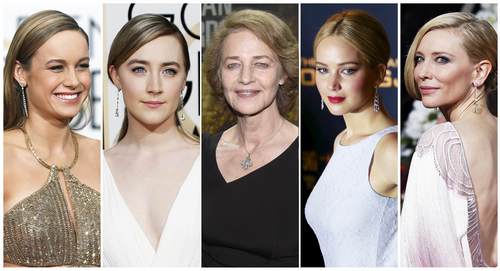
Oscars 2016 Best Actress Nominees (Reuters)

Oscars 2016 Best Actress nominees (Reuters)

Last week, the Oscar nominations were announced. Selected by the Academy of Motion Picture Arts and Sciences (AMPAS), the winners will be revealed Feb. 28. But this year continued a disturbing trend that began last year: Not one of the nominees in any of the acting categories (Best Actress, Best Actor, Best Supporting Actress, Best Supporting Actor) were people of color (POC).

I use the word “disturbing” as it seems the Academy is determined to ignore stories and narratives that don’t fit within their very narrow worldview. It’s becoming increasingly clear that non-white stories are not only valuable (as we knew already), but make bank, both in terms of box office and in social influence. (See this past year’s examples of TV smash “Empire,” and movies “Straight Outta Compton” and “Dope.”) The Academy needs to wake up and see that rewarding diverse stories can only help their bottom line.

In terms of the numbers, here are some of the most recent POC nominees (counted if they didn’t win) and winners:

Best Actress:

Winner: Halle Berry (“Monster’s Ball,” 2001)

Nominee: Quvenzhane Wallis (“Beasts of the Southern Wild,” 2012)

Best Actor:

Winner: Forest Whitaker (“The Last King of Scotland,” 2006)

Nominee: Chiwetel Ejiofor (“12 Years a Slave,” 2013)

Best Supporting Actress:

Winner: Lupita Nyong’o (“12 Years a Slave,” 2013)

Nominee: Taraji P. Henson (“The Curious Case of Benjamin Button,” 2008)

Best Supporting Actor:

Winner: Djimon Hounsou (“Blood Diamond,” 2006)

Nominee: Barkhad Abdi (“Captain Phillips,” 2013)


#ThrowbackThursday: Chinese One-Child Policy Propaganda Poster, 1986

Chinese One-Child Policy poster (The Galloping Beaver)

Chinese One-Child Policy poster (The Galloping Beaver)

As of Jan. 1, China’s one-child policy is officially history. Married couples are now allowed to have up to two children for the first time since 1979.

I’ve always thought propaganda posters were interesting, and here’s a great one for the one-child policy. It’s from 1986, and titled, “Carry out family planning, implement the basic national policy.” The image carries that can-do attitude made popular by Rosie the Riveter, and it’s easy to get swept up in the sentiment. Not to mention, the overall poster design’s pretty great too.


Viola Davis is the First African-American Woman to Win the Emmy for Outstanding Lead Actress

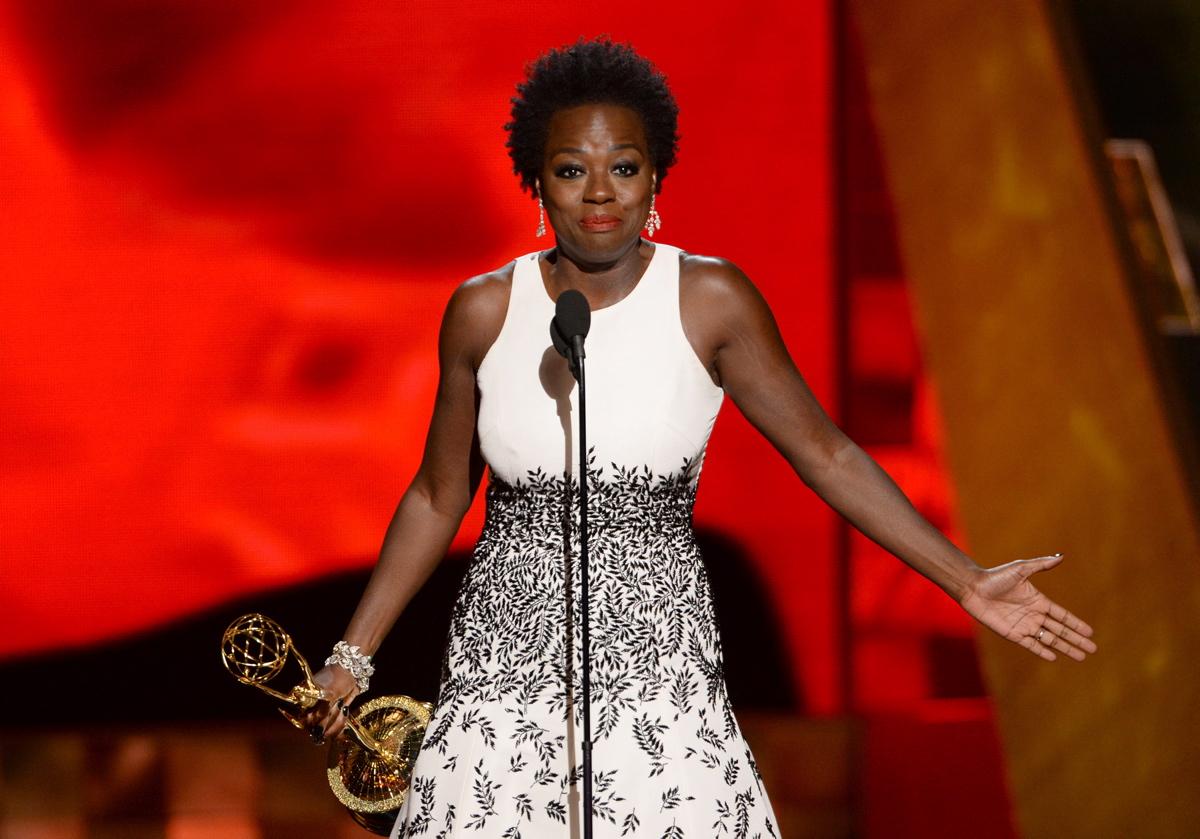
Emmy-winning actress Viola Davis (NY Daily News)

Emmy-winning actress Viola Davis (NY Daily News)

Acclaimed actress Viola Davis made history last night when she became the first African-American actress to win the Primetime Emmy Award for Outstanding Lead Actress in a Drama Series. Davis plays lawyer and law professor Annalise Keating in ABC’s “How to Get Away with Murder,” now in its second season.

The Academy of Television Arts & Sciences is finally beginning to recognize more diverse talent. Davis was up against Taraji P. Henson for “Empire,” which was the first time two Black women were nominated in the same category. Davis acknowledged Henson and 2013 and 2014 nominee Kerry Washington in her acceptance speech.

Some context for this win and occasion: The category has been awarded since 1953. Debbie Allen was the first Black woman nominated in the category in 1982. It begs the question: what took so long?!

Trends: Interracial Couples on Broadcast TV, 2010-2015, Part 2

President Fitzgerald Grant (Tony Goldwyn) and Olivia Pope (Kerry Washington) in 'Scandal' (New York Post)

President Fitzgerald Grant (Tony Goldwyn) and Olivia Pope (Kerry Washington) in ‘Scandal’ (New York Post)

Happy Friday! Ready for Part 2? (If not, catch up on all the interracial couples of broadcast TV over the past five years, and then come on back!) Here’s the fun part: seeing the data play out in graphs!

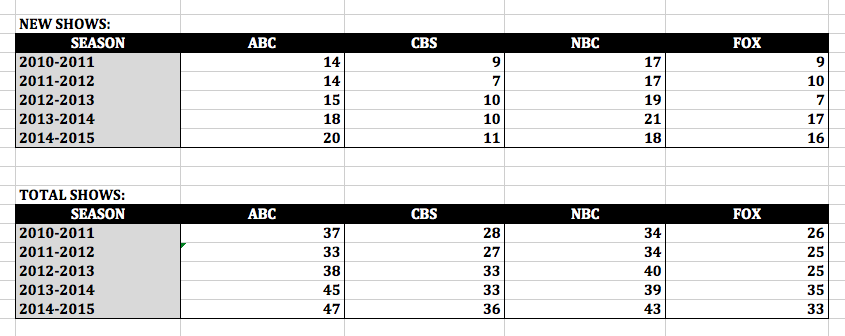
First off, here are the basic data tables. Here are the number of new shows and total shows per season per network:

New Shows and Total Shows per Season per Broadcast Network (Excel)

New Shows and Total Shows per Season per Broadcast Network (Sex & Stats)

Those look like relatively big numbers, right?

Here are the number of shows per network per season that featured interracial couples:

Number of Shows Featuring Interracial Couples per Season per Broadcast Network (Excel)

Number of Shows Featuring Interracial Couples per Season per Broadcast Network (Sex & Stats)

There are too many zeroes in that table.

And here’s how the numbers on the interracial couples translate for the percentages of new shows and total shows:

Percentage of New and Total Shows Featuring Interracial Couples per Season per Broadcast Network (Excel)

Percentage of New and Total Shows Featuring Interracial Couples per Season per Broadcast Network (Sex & Stats)

Interracial couples were never part of more than 25% of new shows, and 10% of total shows in any given season. Sad, right?

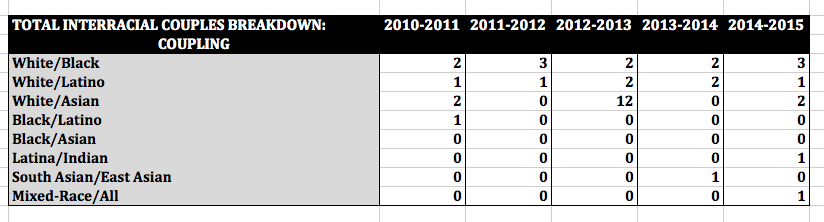
Next, I wanted to find the breakdown of interracial couplings by season, to see if any one season featured more of one coupling than for others. Here’s the table for that:

Interracial Couples Breakdown by Season, 2010-2015 (Excel)

Interracial Couples Breakdown by Season, 2010-2015 (Sex & Stats)

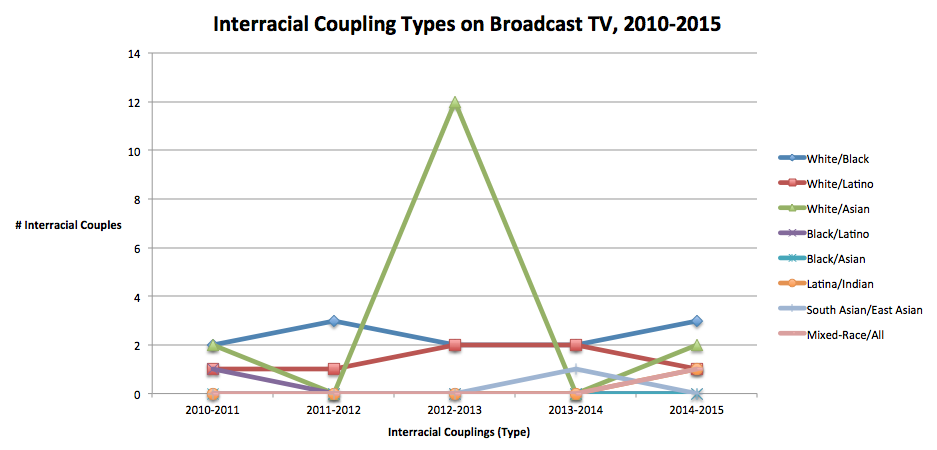
And the resulting line graph:


Interracial Coupling Types on Broadcast TV, 2010-2015 (Sex & Stats)

Interracial Coupling Types on Broadcast TV, 2010-2015 (Sex & Stats)

You may be wondering what that massive spike is at 2012-2013 (I know I was). That was when “The Mindy Project” debuted on Fox, and Mindy Lahiri dating all the white guys really skewed that sample.

Other than that, you can see that the most common racial combinations depicted were white and Black/African-American, and white and Latino/a. Without the spike, I’m betting that the white/Asian combination would’ve fallen somewhere in the middle. South Asian/East Asian couples were rare, as was one coupling with a mixed-race person. (Crazy that a mixed-race person on TV didn’t come around until Tracee Ellis Ross in “Black-ish.”)

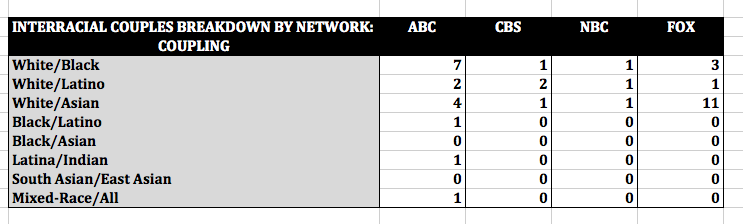
I was also curious to see how depictions of interracial couples broke down by network. Here’s that table:

Interracial Couples Breakdown by Network, 2010-2015 (Sex & Stats)

Interracial Couples Breakdown by Network, 2010-2015 (Sex & Stats)

And what it looks like in bar-graph form:

Number of Interracial Couples per Broadcast Network, 2010-2015 (Sex & Stats)

Number of Interracial Couples per Broadcast Network, 2010-2015 (Sex & Stats)

ABC led the charge with White/Black couples, and Fox clearly dominated with the White/Asian combination. ABC also had the broadest range of interracial relationships depicted. CBS showed the most White/Latino couples.

Even though strides have been made in depicting interracial relationships (in quantity, at least), there’s clearly still a long way to go in getting equal representation.

Trends: Interracial Couples on Broadcast TV, 2010-2015, Part 1

Olivia Pope (Kerry Washington) and President Fitzgerald Grant (Tony Goldwyn) in 'Scandal' (EW.com)

Olivia Pope (Kerry Washington) and President Fitzgerald Grant (Tony Goldwyn) in ‘Scandal’ (EW.com)

Fall TV is back! Ready for your favorite shows to return? Some of the cable companies have already begun to premiere new seasons of their fall shows, and now it’s time for the Big Four networks (ABC, CBS, NBC, and Fox) to follow suit.

The primetime premieres of shows new and old start this week, and it’s always interesting to see how much diversity makes it onto our screens. I was curious to see if the incidence of interracial couples on the Big Four networks had risen over the past five years (since trends are a bit slower to infiltrate there). I looked at incoming shows (i.e. those that started with pilots), and didn’t count returning ones. I was mainly looking for romantic couples, but noted platonic ones and love interests as well.

Part 1 explores the findings, and Part 2 (which will be published tomorrow) will show change-over-time trends with tables and graphs.

And now to the findings:

2010-2011:

Brad (Damon Wayans Jr.) and Jane (Eliza Coupe) in 'Happy Endings' (Oh No They Didn't)

Brad (Damon Wayans Jr.) and Jane (Eliza Coupe) in ‘Happy Endings’ (Oh No They Didn’t)

ABC: 3 shows/4 couples

  • Happy Endings: African-American man Brad Williams (Damon Wayans Jr.) is married to white woman Jane Kerkovich-Williams (Eliza Coupe).
  • My Generation: White guy Steven Foster (Michael Stahl-David) had a one-night-stand with Caroline Chung (Annie Son) in high school, which resulted in a child. Also, African-American Rolly Marks (Mehcad Brooks) is married to Dawn Barbuso (Kelli Garner), who’s white.
  • Off The Map: African-American man Dr. Otis Cole (Jason Winston George) has a relationship with Latina Zee Toledo Alvarez (Valeria Cruz).

CBS: 0 shows

For shame, CBS.

Fox: 1 show/0 couples

  • Breaking In: Melanie Garcia (Odette Annable) was the love interest to white guy Cameron Price (Bret Harrison).

NBC: 1 show/0 couples

  • Outsourced: The show implied a future between white Todd Dempsy (Ben Rappaport) and Indian woman Asha (Rebecca Hazlewood).


2011-2012:

President Fitzgerald Grant (Tony Goldwyn) and Olivia Pope (Kerry Washington) in 'Scandal' (New York Post)

President Fitzgerald Grant (Tony Goldwyn) and Olivia Pope (Kerry Washington) in ‘Scandal’ (New York Post)

ABC: 1 shows/1 couple

  • Scandal: Washington fixer Olivia Pope (Kerry Washington) starts/continues (spoiler?) a relationship with President Fitzgerald Grant (Tony Goldwyn).

CBS: 1 show/1 couple

  • Rob: White guy (Rob Schneider) marries Maggie (Claudia Bassols), and gets to know her Mexican-American family. (Incidentally, Schneider isn’t completely white, but is of partial Filipino descent.)

Fox: 2 shows/1 couple

  • I Hate My Teenage Daughter: White woman Nikki Miller (Kate Finneran) raises her biracial daughter Mackenzie (Aisha Dee), with help from her ex-husband Gary (Chad L. Coleman).
  • Touch: Kiefer Sutherland and British actress Gugu Mbatha-Raw’s characters’ relationship was strictly platonic.

NBC: 0 shows

This was the second season in a row that the network had no shows with interracial couples.


2012-2013:

Dr. Mindy Lahiri (Mindy Kaling) and Casey (Anders Holm) in 'The Mindy Project' (Fox)

Dr. Mindy Lahiri (Mindy Kaling) and Casey (Anders Holm) in ‘The Mindy Project’ (Fox)

ABC: 2 shows/4 couples

  • Mistresses: White woman Savi (Alyssa Milano) sleeps with her African-American coworker Dominic (Jason George). Asian-American Dr. Karen Kim (Yunjin Kim) sleeps with her patient, Thomas Grey (John Schneider). Latina single mom April (Rochelle Aytes) dates white man Richard (Cameron Bender).
  • The Neighbors: African-American woman Jackie Joyner-Kersee (Toks Olagundoye) is in a couple with white man/fellow alien Larry Bird (Simon Templeman).

CBS: 2 shows/2 couples

  • Elementary: Sherlock Holmes (Jonny Lee Miller) is white, and Dr. Joan Watson is Asian (Lucy Liu).
  • Golden Boy: Latino detective Christian Arroyo (Kevin Alejandro) has an affair with white fellow detective Deb McKenzie (Bonnie Somerville)

Fox: 1 show/9 couples

  • The Mindy Project: Indian OB-GYN Mindy Lahiri (Mindy Kaling) dates all the white guys: Dennis (Ed Helms), Matt (Seth Meyers), Josh (Tommy Dewey), Brendan (Mark Duplass), Jamie (B.J. Novak), Sam (Seth Rogen), Adam (Josh Meyers), and Casey (Anders Holm). She also flirts heavily with co-worker Danny (Chris Messina).

NBC: 1 show/0 couples

  • Do No Harm: Dr. Lena Solis (Alana de la Garza) was the love interest of Dr. Jason Cole (Steven Pasquale).


2013-2014:

Ichabod Crane (Tom Mison) and Abbie Mills (Nicole Beharie) in 'Sleepy Hollow' (The Chiefly)

Ichabod Crane (Tom Mison) and Abbie Mills (Nicole Beharie) in ‘Sleepy Hollow’ (The Chiefly)

ABC: 0 shows/0 couples

A rare no-show for interracial couples this season from ABC.

CBS: 1 show/1 couple

  • Extant: Astronaut Molly Woods (Halle Berry) is married to Dr. John Woods (Goran Visnjic).

Fox: 3 shows/3 couples

  • Brooklyn Nine-Nine: Jake Peralta (Andy Samberg) crushes on his Cuban-American partner Amy Santiago (Melissa Fumero).
  • Gang Related: Vee Dotsen (Inbar Levi) and Tae Kim (Sung Kang) are a couple.
  • Sleepy Hollow: Abbie Mills (Nicole Beharie) and Ichabod Crane (Tom Mison) work together to protect their town.

NBC: 1 show/1 couple

  • Welcome to the Family: A white girl (Ella Rae Peck) and her Latino boyfriend (Joey Haro) get pregnant right out of high school.


2014-2015:

Rebecca Sutter (Katie Findlay) and Wes Gibbins (Alfred Enoch) in 'How to Get Away with Murder' (World News)

Rebecca Sutter (Katie Findlay) and Wes Gibbins (Alfred Enoch) in ‘How to Get Away with Murder’ (World News)

ABC: 4 shows/7 couples

  • Black-ish: African-American advertising executive Andre Johnson (Anthony Anderson) is married to Rainbow (Tracee Ellis Ross), a mixed-race surgeon.
  • Cristela: A Latina attorney (Cristela Alonzo) spars with her white co-worker (Andrew Leeds).
  • How to Get Away with Murder: Too many to count! Annalise Keating (Viola Davis) is married to Sam Keating (Tom Verica). Law student Connor Walsh dates Oliver Ricamora (Jack Falahee). Law student Laurel Castillo (Karla Souza) dates Kan (Arjun Gupta). And main character/audience-surrogate Wes Gibbins (Alfred Enoch) sleeps with Rebecca Sutter (Katie Findlay).
  • Selfie: Marketing guru Henry Higgs (John Cho) tries to reform Eliza Dooley (Karen Gillan).

CBS: 0 shows/0 couples

No interracial couples from this network this year.

Fox: 0 shows/0 couples

Same as CBS.

NBC: 1 show/1 couple

  • The Slap: Hector Apostolou (Peter Sarsgaard) is in an interracial marriage with Aisha (Thandie Newton).


Looks like a lot, right? Check back tomorrow for Part 2 where I’ll look at the actual numbers!

#ThrowbackThursday: Lucille Ball and Desi Arnaz, “I Love Lucy”

Ricky (Desi Arnaz) and Lucy Ricardo (Lucille Ball) in 'I Love Lucy' (Bestwalle)

Ricky (Desi Arnaz) and Lucy Ricardo (Lucille Ball) in ‘I Love Lucy’ (Bestwalle)

“I Love Lucy” premiered on Oct. 15, 1951 and ran for almost six years. The iconic series followed Lucy (Lucille Ball) as she got into lovable scrapes and exasperated her husband Ricky (Desi Arnaz). Arnaz frequently played the straight man to heighten Ball’s screwball antics.

The show broke a barrier in a notable way: It was the first to feature an interracial couple, since Ball was white and Arnaz was Cuban. CBS initially was hesitant to cast them together, since they didn’t think America would believe that a white woman would marry a Hispanic man. But Ball put her foot down, and she and Arnaz created one of the most beloved couples in sitcom history.