China’s Sex Ratio: How Skewed Is It?

Chinese One-Child Policy poster (The Galloping Beaver)

Chinese One-Child Policy poster (The Galloping Beaver)

Late last year, China ended its one-child policy, where each family was only allowed to have…one child. (Bet you didn’t see that one coming.) Though its rules have relaxed in recent years, this is the first time the practice has been officially abolished. (But we’ll see how long it takes for the policy to actually die down, data-wise.)

We’ve all heard about how skewed China’s sex ratios are; we’ve heard about how the country overwhelmingly favors male children to the detriment of an equal sex ratio. But what are the numbers behind this phenomenon?

Consulting firm Nomura Research Institute, Ltd. released data in 2010 that revealed that Chinese women bear .71 of female births during their lifetime. That year, men outnumbered women by 50M+. The birth rate at that time was 120 boys per 100 girls, which works out to a sex ratio of 1.2.

If you’re a visual learner, here’s what that ratio looks like, especially in context with other countries:
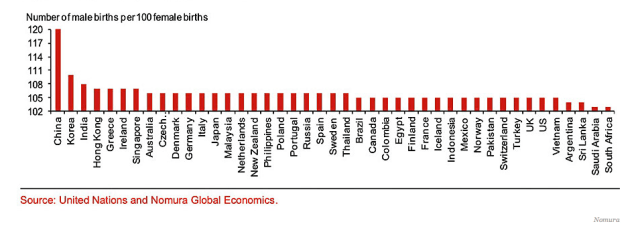
China's male births compared to other countries' male births ('Business Insider')

China’s male births compared to other countries’ male births (‘Business Insider’)

As Business Insider notes:

That means lots of single, possibly angry males. Hard to imagine anything good coming out of this.

The policy was made into law in 1979, and abolished in 2015. That’s 36 years. Thirty-sex years of selected sex-selection in favor of boys at the expense of girls. (Fun fact: Kim Kardashian West participated in this when she was trying to get pregnant with her now-son.)

Scary, right? We’ll see how the new policy helps attempt to reverse this long-running trend.

 

No Shit: Entertainment Isn’t Diverse: By The Numbers

Hollywood sign (Mapping Megan)

Hollywood sign (Mapping Megan)

A new study released this week by the University of Southern California (USC) Annenberg School for Communication and Journalism once again stated the obvious: Entertainment isn’t diverse.

If you don’t want to read the full report (though I’d recommend it), here are some choice stats:

Percentage of female speaking roles in film: 28.7%

Percentage of female film directors: 3.4%

Percentage of female screenwriters: 28.9%

Percentage of cable TV shows that have no Asian characters: 51%

Percentage of cable TV shows that have no Black characters: 23%


Still not convinced the #OscarsSoWhite hashtag is needed?

Channing Dungey is the First Black Woman to Run ABC

Channing Dungey and ABC logo (Variety)

Channing Dungey and ABC logo (Variety)

Big news on the entertainment/broadcast networks front: Channing Dungey was named President of ABC Entertainment last week. She’s the first Black woman to run a broadcast network’s entertainment division.

Dungey replaces outgoing president Paul Lee.

Before her new role, Dungey ran development of ABC’s shows. She’s worked with the “Thank God It’s Thursday” (TGIT)-block of “Scandal,” “How to Get Away With Murder,” and “Grey’s Anatomy,” earning her nickname of “the Shonda Rhimes whisperer.”

I’m eager to see how ABC’s programming will change as a result of Dungey’s promotion. Based on her glowing history with show runners, it sounds like viewers are in for a treat.


Pornhub Data of 2015: By The Numbers

Pornhub Insights 2015 Year in Review (Pornhub Insights)

Pornhub Insights 2015 Year in Review (Pornhub Insights)

I always love it when certain tech companies release their user data for the general public’s education/amusement. Last week, we learned about OkCupid stats. This week, it’s Pornhub.

Pornhub is pretty good about releasing user insights (see their recent post on activity during winter storm Jonas), and their year-end data, released last month, is no exception. The following numbers are just what I found most interesting, and you can read the full report on Pornhub’s Insights blog (NSFW, BTW).

Amount of bandwidth used: 1,892 petabytes (PBs)

  • Context: 1 PB = 1,000 terabytes (TB) = 1,000,000 gigabytes (GB), i.e. that’s a hell of a lot of data

Average visit duration (U.S. only): 9 minutes, 51 seconds

Pornhub 2015 Year in Review: Hourly Traffic Worldwide (Pornhub Insights)

Pornhub 2015 Year in Review: Hourly Traffic Worldwide (Pornhub Insights)

Most popular search term worldwide: lesbian

Top pornstar: Kim Kardashian

Top term searched more in 2015 than in 2014: giantess (+1,091%)

Pornhub 2015 Year in Review: Women - Worldwide Traffic (Pornhub Insights)

Pornhub 2015 Year in Review: Women – Worldwide Traffic (Pornhub Insights)

Country with highest proportion of female users: Jamaica (44%)

Country with highest proportion of female users: Japan (17%)

Average age of Pornhub users: 35.3 years

Pornhub 2015 Year in Review: Traffic by Device Worldwide (Pornhub Insights)

Pornhub 2015 Year in Review: Traffic by Device Worldwide (Pornhub Insights)

Most popular mobile operating system (OS): Android (49.7%)

Most popular desktop browser: Chrome (48.9%)


This is all so fascinating to me, and I hope you feel the same!


All of the Oscar Acting Nominees Are White. WTF?


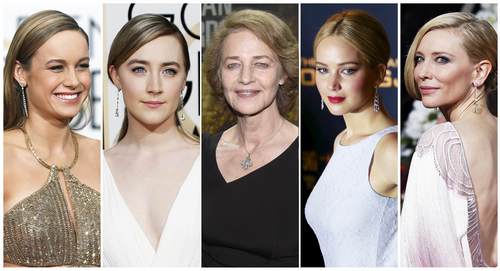
Oscars 2016 Best Actress Nominees (Reuters)

Oscars 2016 Best Actress nominees (Reuters)

Last week, the Oscar nominations were announced. Selected by the Academy of Motion Picture Arts and Sciences (AMPAS), the winners will be revealed Feb. 28. But this year continued a disturbing trend that began last year: Not one of the nominees in any of the acting categories (Best Actress, Best Actor, Best Supporting Actress, Best Supporting Actor) were people of color (POC).

I use the word “disturbing” as it seems the Academy is determined to ignore stories and narratives that don’t fit within their very narrow worldview. It’s becoming increasingly clear that non-white stories are not only valuable (as we knew already), but make bank, both in terms of box office and in social influence. (See this past year’s examples of TV smash “Empire,” and movies “Straight Outta Compton” and “Dope.”) The Academy needs to wake up and see that rewarding diverse stories can only help their bottom line.

In terms of the numbers, here are some of the most recent POC nominees (counted if they didn’t win) and winners:

Best Actress:

Winner: Halle Berry (“Monster’s Ball,” 2001)

Nominee: Quvenzhane Wallis (“Beasts of the Southern Wild,” 2012)

Best Actor:

Winner: Forest Whitaker (“The Last King of Scotland,” 2006)

Nominee: Chiwetel Ejiofor (“12 Years a Slave,” 2013)

Best Supporting Actress:

Winner: Lupita Nyong’o (“12 Years a Slave,” 2013)

Nominee: Taraji P. Henson (“The Curious Case of Benjamin Button,” 2008)

Best Supporting Actor:

Winner: Djimon Hounsou (“Blood Diamond,” 2006)

Nominee: Barkhad Abdi (“Captain Phillips,” 2013)


“I Am Cait” Wins Big in Overnight Ratings

Caitlyn Jenner in 'I Am Cait' (New York Daily News)

Caitlyn Jenner in ‘I Am Cait’ (New York Daily News)

Last night, “I Am Cait” premiered on the E! network. The eight-part docuseries follows Caitlyn (born Bruce) Jenner as she transitions from a man to a woman, and how that changes affects her relationships with family and friends. The series was announced right after Jenner’s groundbreaking “20/20” interview with Diane Sawyer in which she revealed she’d be transitioning.

With the overnight ratings in, the premiere garnered a 2.1 household rating within Nielsen’s 56 metered markets. It tied with TNT’s “Falling Skies” for the most-watched cable program of the night. Prior similar ratings points to this share being equivalent to about 3M viewers.

These ratings suggest that the interest in Jenner’s story is there, and substantial. I’ll be looking forward to seeing how these ratings progress on a weekly basis.


Siri Corrects Bruce Jenner to Caitlyn Jenner

Siri's response to Bruce Jenner questions (Daviesha/Last November 4 Tumblr)

Siri’s response to Bruce Jenner questions (Daviesha/Last November 4 Tumblr)

Happy Friday! Here’s a great example of how technology is adapting to the changing times. Tumblr user Daviesha found that Apple iPhone’s Siri corrects the name of Bruce Jenner to Caitlyn Jenner. Daviesha asked Siri, “how tall is Bruce Jenner?” and “What is Bruce Jenner’s real name?” You can see the results in the screenshot above.

This aspect of Siri began gaining attention earlier this month. Jenner came out as a transwoman in April of this year, and debuted her new name and look on the cover of “Vanity Fair” in the publication’s June issue. She recently received the Arthur Ashe Courage Award during the ESPYs this year, and her docuseries “I Am Cait” premieres Sunday night on E! (home to the Kardashian empire).

It’s fantastic that it took Apple absolutely no time to adjust Siri to account for this momentous event. After all, Jenner is now the most recognizable trans person in the world right now. The tech giant is showing they’re capable to changing as societal mores do, and updating their technology to reflect those changes.

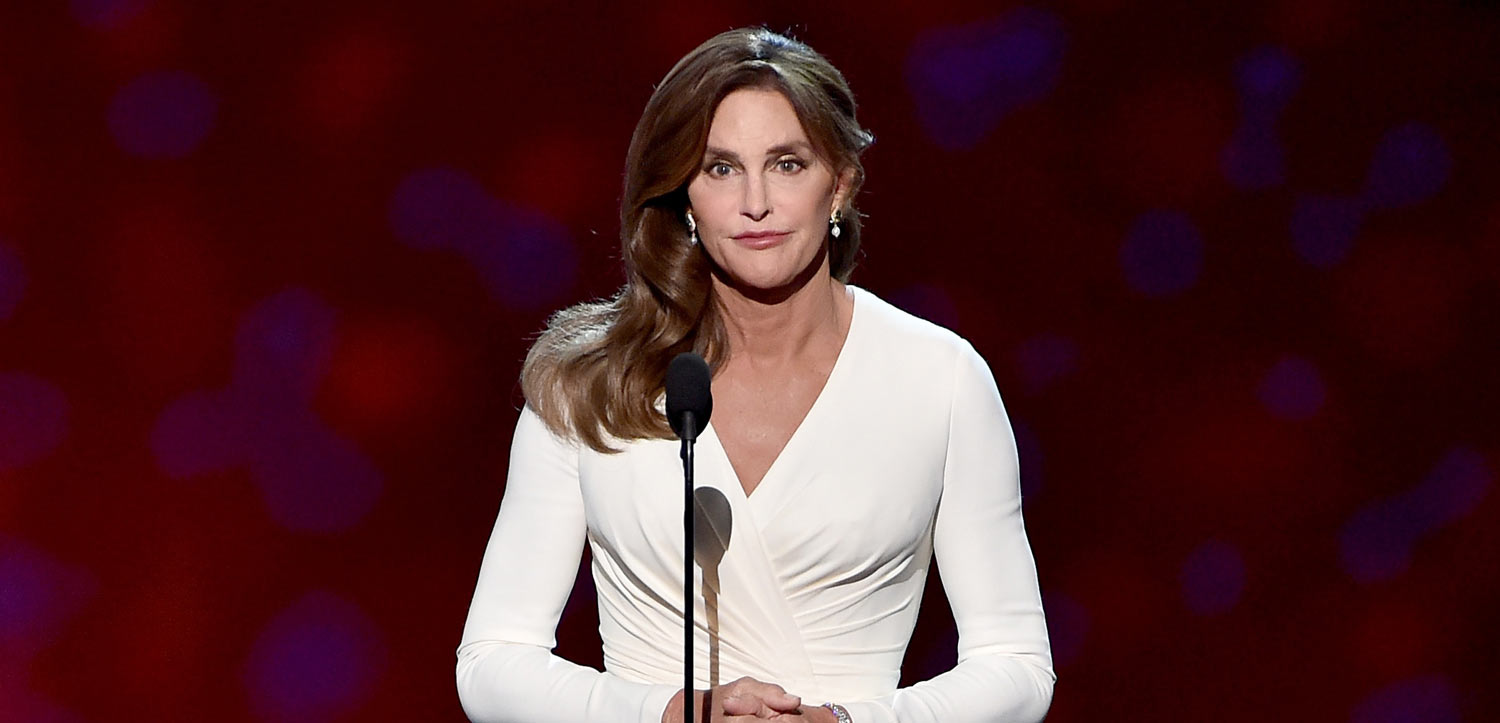
Caitlyn Jenner Receives the ESPYs’ Arthur Ashe Courage Award

Caitlyn Jenner, 2015 ESPYs (JustJared)

Caitlyn Jenner, 2015 ESPYs (JustJared)

Happy Friday! The ESPYs aired last night, and all anyone can talk about is Caitlyn Jenner receiving the Arthur Ashe Courage Award. Named for tennis great/AIDS victim Ashe, the award is given to individuals whose actions “transcend sports,” and has been awarded since 1993.

It was her first public appearance at a major awards event, and she killed. Jenner gave a speech that highlighted her personal journey to self-acceptance as a transwoman. She also talked about her fellow athletes’ responsibility to crew the change:

How do we start? We start with education. I was fortunate to meet Arthur Ashe a few times, and I know how important education was to him. Learn as much as you can about another person to understand them better.

Jenner later spoke about how her transition felt, and what the trans community needs from larger society:

But this transition has been harder on me than anything I could imagine. And that’s the case for so many others besides me. For that reason alone, trans people deserve something vital. They deserve your respect. And from that respect comes a more compassionate community, a more empathetic society and a better world for all of us.

Jenner is the first transwoman to receive the award.

Kim Kardashian West’s Implanted Male Embryos: How Common Is It?

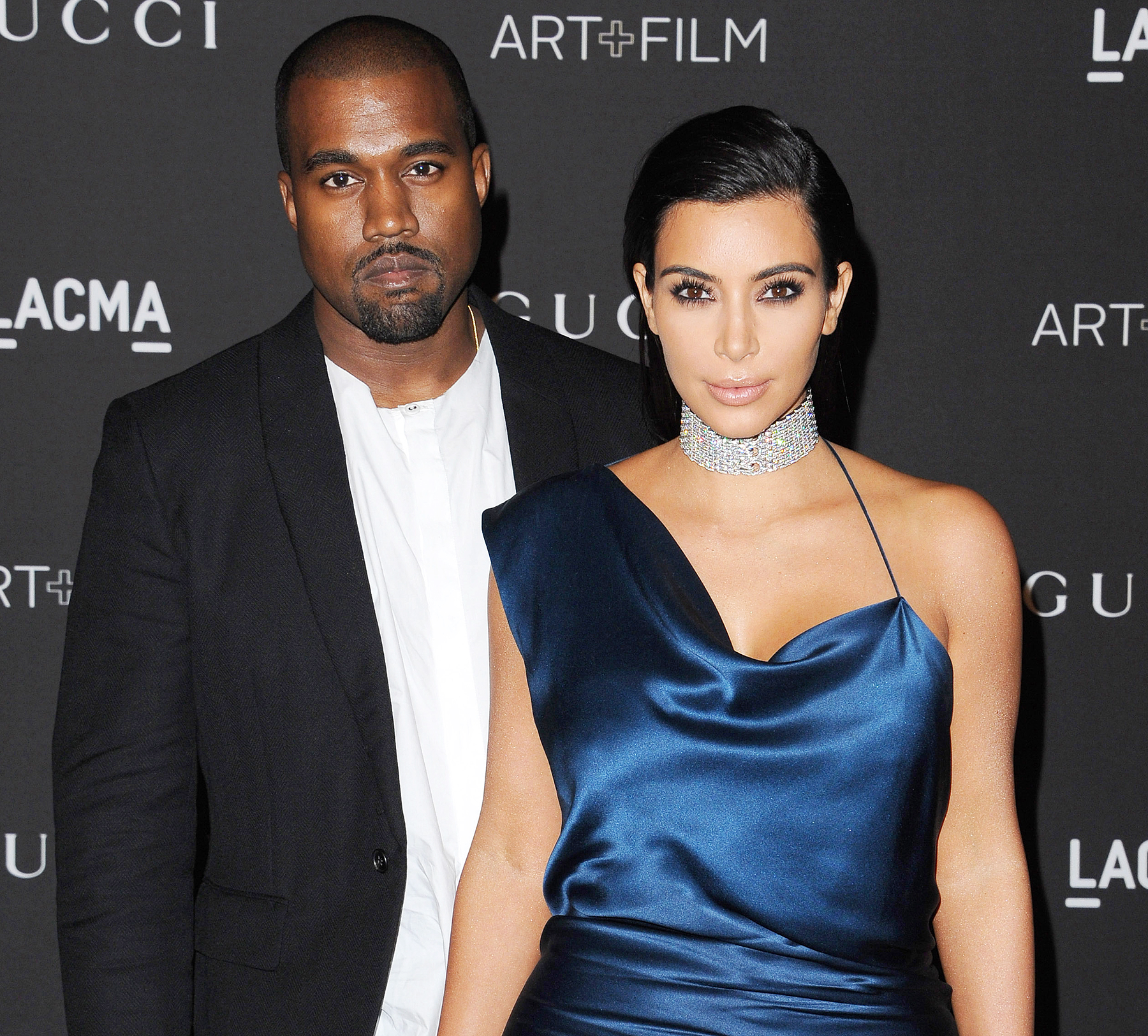
Kanye West and Kim Kardashian West (US Weekly)

Kanye West and Kim Kardashian West (US Weekly)

As the whole world knows by now, Kim Kardashian is pregnant with her second child, a boy, through in-vitro fertilization (IVF). Apparently, her husband Mr. Kim Kardashian (a.k.a. Kanye West) wanted a boy, or, as he calls it, “an heir.”

To achieve the desired result, Kardashian chose to only implant male embryos (and evidently, it worked). She most likely underwent preimplantation genetic diagnosis (PGD), a procedure which screens embryos for sex characteristics, looking for XX (a girl) or XY (a boy).

In 2012, it was estimated that PGD was used for 4K-6K procedures per year. In 2014, fertility treatment procedures, including but not limited to IVF, were estimated at around 165K+ per year. PGD is used with IVF, so PGD cases comprise between 2%-3% of total fertility treatments.

Interestingly, the U.S. is one of the only countries in the world within which PGD may used for “prenatal sex selection.” In many countries, its use is restricted to medical and chromosome-related issues.

Nobody can yet say if this will become a widespread practice. It does raise some questions about the ethics of calling the shots on choosing your child’s sex. But this isn’t a new concern: New York University’s Director of the Bioethics Program S. Matthew Liao wrote a paper on the subject in 2004 for the “Journal of Medical Ethics” while at Johns Hopkins University. About halfway through the paper, he acknowledges, “As far as I know, no one has tried to use genetic engineering for sex selection.” Things have certainly changed in 11 years. Welcome to your brave new world.

How Many Husbands Take Their Wives’ Last Names?

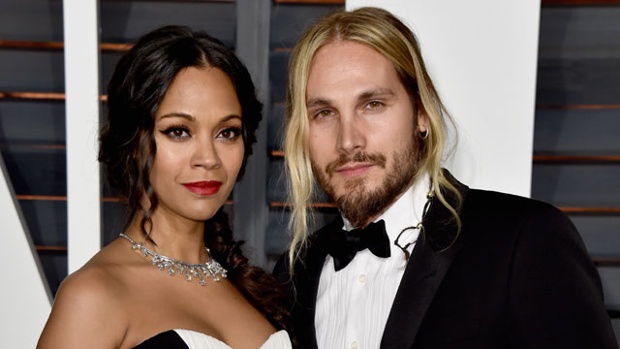
Zoe and Marco Saldana (KCCI)

Zoe and Marco Saldana (KCCI)

Happy Friday! Earlier this week, actress Zoe Saldana told “InStyle” that her husband Marco Perego wanted to take her last name, instead of having her take his. Saldana was initially hesitant:

I tried to talk him out of it. I told him, ‘If you use my name, you’re going to be emasculated by your community of artists, by your Latin community of men, by the world.’ But Marco looks up at me and says [in his Italian accent], ‘Ah, Zoe, I don’t give a sheet.’

Now, that’s a true man right there. Husbands taking their wife’s last name isn’t too common, at least anecdotally. But what about the data? Has it been tracked?

No, it hasn’t, at least not yet. I found several articles profiling couples who did it, but each article mentioned in some way that statistics weren’t tracked. Oh well. On the other hand, it’s a topic ripe for picking for a Ph.D. thesis. Any takers?

But Mr. Saldana (né Perego) made a huge impact. Meghan Blalock of “Who What Wear” puts his decision in context:

The storied history of women taking men’s last names in marriage is not just a trend or a matter of practicality—it’s a long-existing symptom of the patriarchal society in which we live, in which a marriage means that a woman is little more than a man’s property.

So his decision shows that he’s not just a traditionally masculine man, but that he has a sensitive side towards women and feminism, and isn’t afraid to show it. Pretty badass, right? Maybe we’ll see more men follow suit!