How Many Media Company Employees Had Ashley Madison Accounts?

Ashley Madison homepage (Ashley Madison)

Ashley Madison homepage (Ashley Madison)

Happy Friday! Ashley Madison: It’s the hack that keeps on giving. Every day brings a new joy. And here’s this one: The good people at “Gawker” (who’ve been doing a great job covering this whole thing) took a deep-dive into the data, all 9.7 GBs of it. Why? Well, to see how was dumb enough to use a work email as their AM registration email. (Personally, I’m surprised that nobody got called on the carpet after their network got wind of that verification email in their inbox.)

Now, you’d think that most people would know to use a throwaway email for this kind of thing, right? You’d think that, and you’d be wrong. At the time of the data dump, “Wired” reported that 15K+ domains belonging to the government and military were found, comprising .04% of the total emails found.

Here’s what Sam Biddle at “Gawker” found. (Incidentally, no emails registered to the Gawker domain were found).

'Gawker' Ashley Madison Email Data Analysis (Gawker)

‘Gawker’ Ashley Madison Email Data Analysis (Gawker)

So yeah, have some common sense as to when to use your work email. Have a great holiday weekend!


#ThrowbackThursday: Paid Maternity Leave Around the World

Paid Maternity Leave Around the World (Blogspot)

Paid Maternity Leave Around the World (Blogspot)

Yeah, this is a #TBT, but it’s relevant to today. In fact, it’s still happening today. The United States is one of the few countries left in the world that doesn’t pay for maternity leave. Crazy, right?!

This map just lays it out. I hope the U.S. comes to its senses soon, and enacts paid maternity leave for all new (and reoccurring) mothers.

How Many Active Female Users did Ashley Madison Have?

Ashley Madison homepage (Ashley Madison)

Ashley Madison homepage (Ashley Madison)

I’m loving this Ashley Madison hack for the sheer volume of data it’s bringing to light! It makes a numbers nerd like me very happy.

This may not come as a shock (well, hopefully it doesn’t), but Ashley Madison didn’t have a whole lot of active female users. The site claimed to have around 31M+ male users and 5M+ female users. So already, the women on the site are outnumbered by the men at a 6:1 ratio. This wouldn’t be a promising sign for any man who was a registered user. (Side note: Do you think any of the men knew to what degree they were competing with the other men? I’m really curious about this.)

But wait, there’s more: Annalee Newitz at “Gizmodo” crunched some numbers on on-site interaction between members (and made some fun bar graphs), and the results trumpeted the sex ratios loud and clear. Some examples: For every woman that checked her messages, 20 men did. For every two women that used the online chat system, 11 men did.

With those numbers in mind, how many of these men interacted with a bot? My guess is quite a few.

Female/POC Video of the Year Winners at the MTV VMAs: By The Numbers

Singer Rihanna performs "Umbrella" at the 2007 MTV Video Music Awards in Las Vegas September 9, 2007. Rihanna won the award for Monster Single of the Year for the song. REUTERS/Mike Blake (UNITED STATES)

Singer Rihanna performs “Umbrella” at the 2007 MTV Video Music Awards in Las Vegas September 9, 2007. Rihanna won the award for Monster Single of the Year for the song. REUTERS/Mike Blake (UNITED STATES)

When the nominees for MTV’s Video Music Awards (VMAs) were announced earlier this summer, acclaimed rapper Nicki Minaj pointed out the glaring absence of women of color in the Video of the Year category. She had a point: The video for her song “Anaconda” broke VEVO viewing records, racking up 19.6M+ views in 24 hours, and propelled a huge cultural impact. (I know you know of at least one person who dressed in one of Nicki’s outfits for Halloween.) To have Minaj’s video snubbed ignores all of those not-insignificant achievements.

I had a sneaking suspicion that the numbers were pretty dismal, not just for women performers of color, but also for women performers in general. I wanted to see exactly how skewed the numbers were, so I looked up the data.

First, some context:

31: Years the Video of the Year Award has been presented (this year will be the 32nd)

69: Number of solo musicians who’ve been nominated

16: Number of solo musicians who’ve won

67: Number of groups who’ve been nominated (including feature artists, not counting 2015 nominees)

15: Number of groups who’ve won (including feature artists)


Let’s look at the stats of the women:

13: years where women solo artists or groups won

0: years after the award began that the first woman artist was nominated (Cyndi Lauper in 1984, nominated during the Award’s first year)

6: years after the Award began that the first woman artist won (Sinead O’Connor in 1990)

4: times Madonna has been nominated

1: time Madonna has won (1998)


And the stats of women of color:

9: years after the Award began that a female group of color was nominated (En Vogue in 1993)

11: years after the Award began that a female group of color won (TLC in 1995)

1: times a women of color group won (TLC in 1995)

  • If you counted the “Lady Marmalade” group who won in 2001, which had Lil’ Kim, Missy Elliott, and Mya, the number goes up to 2.

1: time Missy Elliott has been a double-nominee in the category (2001)

2: winners that have won twice (Missy Elliott in 2001 and 2003, Rihanna in 2007 and 2012)

1: time that Beyoncé has won (2009)

2: times that Beyoncé has been nominated, not counting her 2015 nomination (2007 and 2009)


You don’t have to be a math genius to see that Minaj was correct about the institutional bias in the music industry with regards to awards, and that this should not be tolerated.

This year’s VMAs will air on Sunday, Aug. 30th.

Ashley Madison Hackers Post the Site’s User Data

Ashley Madison homepage (Ashley Madison)

Ashley Madison homepage (Ashley Madison)

Happy Friday! Remember when cheating site Ashley Madison was hacked last month? And how the hackers threatened to release user data to the whole Internet?

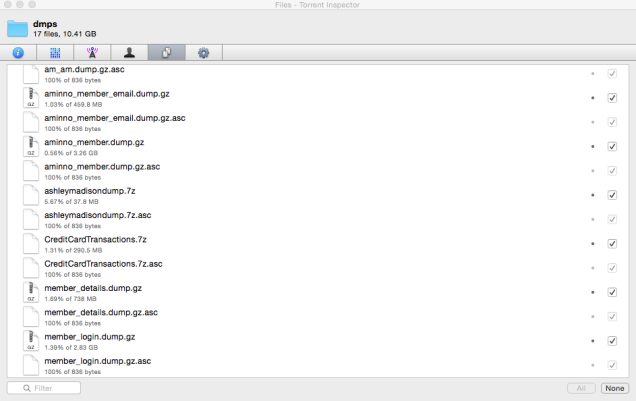
Well, they’ve finally done it. The Impact Team, as the group of hackers is known, put the data online on the Dark Web, which can only be reached using specialized equipment. They dumped a jaw-dropping 9.7 GigaBytes (GBs) of data that went back to 2008.

(For context/scale, I have a 4 TeraByte (TB) external hard drive that I keep old school projects and work on. I’ve had that thing for over 6 years, and still haven’t filled it up. One TB is equal to .001 GBs. So you can imagine how voluminous this data breach truly is.)

There seems to be some disagreement over exactly how many users had data leaked. “CNN Money” claims 32M, while “Wired” and “Engadget” put the number closer to 37M.

As of July, Ashley Madison claimed to have 40M+ users.

Ashley Madison data dump (Gizmodo)

Ashley Madison data dump (Gizmodo)

Among the metrics leaked were users’  names, addresses and phone numbers. “Wired” looked into some initial data analysis:

A sampling of the data indicates that users likely provided random numbers and addresses, but files containing credit card transactions will yield real names and addresses, unless members of the site used anonymous pre-paid cards. One analysis of email addresses found in the data dump also shows that some 15,000 are .mil. or .gov addresses.

Passwords were broken by “hashing,” or breaking into the algorithm a site would use to protect passwords. The hackers used the “bcrypt” algorithm used in web development language PHP. This is usually a secure measure to protect passwords. But hey, at least Ashley Madison tried:

It’s notable, however, that the cheating site, in using the secure hashing algorithm, surpassed many other victims of breaches we’ve seen over the years who never bothered to encrypt customer passwords.

Have a great weekend, and go change your passwords!

Smart Vibrators Will Data-Mine Your Pleasure

SmartBod vibrator prototype evolution (Angel.co)

SmartBod vibrator prototype evolution (Angel.co)

Happy Friday! We’ve talked about smart sex toys before, and also how Big Data is taking over sex. We’re ushering in a new era of sexual data and metrics, on a more minute level than ever before.

Enter the SmartBod, a vibrator that tracks its users’ data and aggregates it via a related app. While tracking arousal (and climax) patterns, the user will then be able to establish a baseline of usual trends. The app will also suggest ideas mined from the collected data. Call it sex-alytics, if you will.

UC Berkeley entrepreneurs Liz Klinger and James Wang aim to help women spark conversations regarding pleasure, since it can be an uncomfortable topic for most people. The user “would learn how their orgasm changes depending on how and when they use the vibrator.” It can also help women determine if they’re “normal” or not, in terms of their orgasms and arousal. So you can compete with others, or with yourself or both.

This counts as the second “smart” vibrator I’m aware of, next to the upcoming Una. As a both a sex geek and a data nerd, I can’t wait to use these and report my results. All in the name of science, of course!


Trojan 2014 Sexual Health Report Card: By The Numbers

Trojan 2014 Sexual Health Report Card (via Twitter)

Trojan 2014 Sexual Health Report Card (via Twitter)

Earlier this year, Trojan (the condom brand, duh) released its 2014 Sexual Health Report Card. Now in its ninth year, the Report Card measures sexual health resources for 140 colleges selected from the Bowl Championship Series. Scoring categories include student health centers’ access to quality information, STI and HIV testing and condom and contraceptive availability, among other points.

This year, PAC-12 school Oregon State wrested the #1 spot from Princeton University. As the Report Card notes, the top spot has typically vacillated between the Ivy League and the Big Ten. The PAC-12 also took spots #4 (University of Arizona) and #5 (Stanford) in the top 10.

I wanted to see if there were any discernible patterns within the data, so I crunched some numbers and played with some pivot tables.

By College Conference:

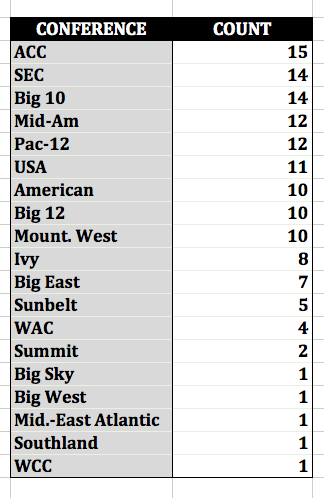
Trojan Sexual Health Report Card 2014: College Conferences

Trojan Sexual Health Report Card 2014: College Conferences

The Atlantic Coast Conference (ACC) took the top spot for conferences with 15 entries, and the Southeastern Conference (SEC) came in tied second with the Big Ten with 14 entries each. The Mid-American and PAC-12 conferences each have 12. Conference USA boasts 11 schools, and the American, Big 12 and Mountain West schools each have 10 schools.

The ACC, SEC and Ivy League all had each of its schools place within the rankings.


By School Type:
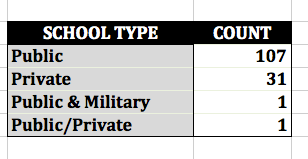
Trojan Sexual Health Report Card 2014: School Type

Trojan Sexual Health Report Card 2014: School Type

Over 76% of ranked schools were public schools, and 22% of schools were private. Ivies comprised over 25% of private schools listed.

Virginia Tech was categorized as public and military, and University of Pittsburgh was public and private.


By State:
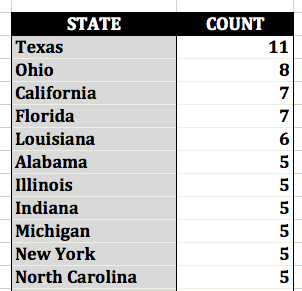
Trojan Sexual Health Report Card 2014: States

Trojan Sexual Health Report Card 2014: States

Texas boasts 11 schools ranked, while Ohio has eight schools for second place. California and Florida tie with seven schools each. Louisiana has six, and Alabama, Illinois, Indiana, Michigan, New York and North Carolina each have five schools represented.

On the other end of the scale, several states are one-hit wonders: Hawaii, Maryland, Minnesota, Missouri, Nebraska, New Hampshire, Washington D.C., and Wyoming.

By Region:
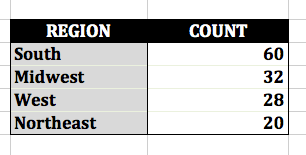
Trojan Sexual Health Report Card 2014: Region

Trojan Sexual Health Report Card 2014: Region

Here’s something interesting: The South makes up 42%+ of the report’s regional breakdown. I didn’t expect that considering the region’s traditionally rocky relationship with sex education.

By contrast, the Northeast comprises only 14%+.


Past Winners:

In the report card’s nine years of age, Ivy League schools have taken the crown four times: Yale (2006, inaugural year), Columbia (2010 and 2011), and Princeton (2013).

Columbia and Princeton have previously topped the list despite not having school-wide Sex Weeks.

Some previous winners have precipitously descended the list since their banner year. University of Minnesota-Twin Cities made #1 in 2007, but has since slid to #24, a rate of 2.8+ spots per year. University of South Carolina-Columbia topped the list in 2009, and is now 29, sliding down the list at a much faster 5+ spots a year. Yale descended to #44 this year, sliding the fastest at 5.3+ spots per year.


Interesting Outliers:

Despite Trojan’s claim to show schools from all 50 states in their report, Alaska is conspicuously absent.

Only one HBCU (historically black college or university) made the cut: Savannah State University in Savannah, Georgia. The school came in at #133. Savannah State has made the list before, ranking #134 in 2013.

Indiana University-Bloomington checks in at #36. This wouldn’t be weird except the university houses the Kinsey Institute. You’d think sexual health would be a priority considering it’s apparently lucrative research.


Methodology:

Trojan outlined the criteria they look for within the report (and even leave room for extra credit), and they’ve ranked schools on a 4.0 scale before. I’d like to learn more transparency about how the different factors were selected and weighted in terms of priority.

One weird thing was that the University of Alabama was listed twice, ranked both #30 and #120. This was confusing and will need to be corrected for future report cards.


Final Thoughts:

I’d love to see more diversity of school represented. It’d be great to see other HBCUs (Spelman, Morehouse, etc.) and art schools (Pratt Institute, RISD, etc.). The National Center for Education Statistics puts the number of four-year colleges at 2.8K+ (as of 2010-2011), and it’d be fantastic to see a wider swath of schools surveyed.