#ThrowbackThursday: Margaret Sanger’s “The Woman Rebel”

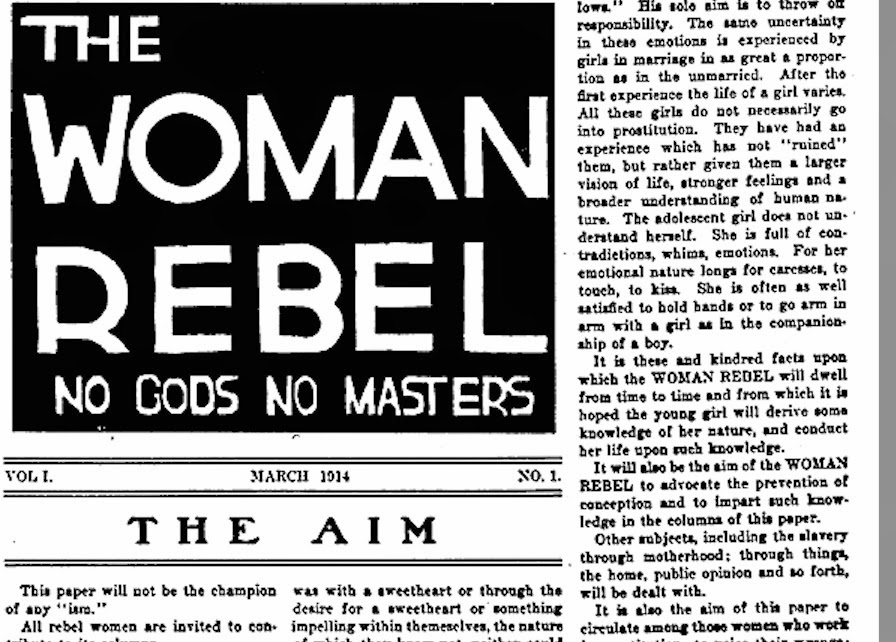
'The Woman Rebel' Volume I, Page 1

‘The Woman Rebel’ Volume I, Page 1

One hundred years ago, Margaret Sanger launched “The Woman Rebel,” a monthly newsletter that promoted contraception. (Tagline: “No Gods, No Masters.”) The newsletter popularized the now-common term “birth control” (the popular euphemism of the day was “family limitation”), and proclaimed that “each woman should be the absolute mistress of her own body.” Obviously, Sanger was way ahead of her time.

Seven issues were published before Sanger was indicted on violating postal obscenity laws in August 1914 (at the time, it was illegal to send obscene materials by mail). But this was part of her plan: Sanger wanted to provoke a legal challenge to spreading information about birth control by mail. Once indicted, she fled to England, while prepping “Family Limitation,” a more radical approach to birth control. The birth control cause stole the spotlight the next year when her estranged husband was thrown in jail for giving a copy of “Family Limitation” to a representative of anti-vice crusader Anthony Comstock.

Though Sanger’s ideas were inflammatory at the time, they laid the groundwork for modern feminism. And thank God for that.

Google Trends: “Feminism” and “Feminist” (and Beyoncé)

'***Flawless' Still, 2013 (Huffington Post)

‘***Flawless’ Still, 2013 (Huffington Post)

On Dec. 13, 2013, Beyoncé’s self-titled studio album unexpectedly dropped, leading to rave critical reviews (and setting an iTunes record in the process). It quickly became apparent that Beyoncé was launching new sexual and feminist identities (particularly in “***Flawless”), and the world eagerly embraced her and feminism.

We have the anecdotal and cultural evidence. But do Google searches show this?

Leading up to its first anniversary, we look at how interest in feminism has changed over the past year, and how Beyoncé might have impacted that. All trends are for the United States.

First, some long-run patterns:

Google Trends: 'Feminism' and 'Feminist,' 2004-Present

Google Trends: ‘Feminism’ and ‘Feminist,’ 2004-Present

The above shows search term “feminism” (blue line) and “feminist” (red line) tracking from January 2004 to present. Throughout the decade, both terms parallel each other in terms of popularity, and hit the same peaks and lows: Each term’s most popular month occurred in April 2004, and the least popular month was August 2010.

It’s interesting to see how each term started out strong and then dipped down, and is now climbing back up.


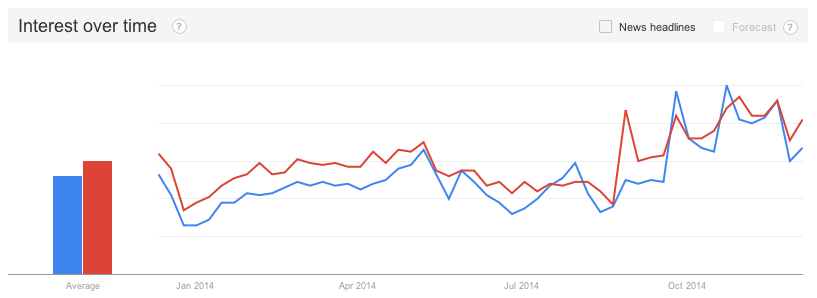
Let’s look at how each term performed within the last 12 months (“Feminism” is the blue line, and “feminist” is the red line):

Google Trends: 'Feminism' and 'Feminist,' Last 12 Months (Dec. 2013-Dec. 2014)

Google Trends: ‘Feminism’ and ‘Feminist,’ Last 12 Months (Dec. 2013-Dec. 2014)

Searches for each term grew the week from Dec. 22-28, 2013. There are some spikes, the first of which occurs the week of Aug. 24-30, 2014. Beyoncé performed a medley of songs from her self-titled album at the MTV Video Music Awards (VMAs), which aired on Aug. 25. More notably, she performed “***Flawless” in front of a giant lit marquee claiming her as a “FEMINIST.”

The last baby spike in traffic for the terms occurred during Nov. 16-22, 2014, which was the week before Beyoncé released the Platinum Edition.


But how many people were searching for “feminism” and “feminist” in conjunction with Beyoncé? Let’s take a look:

Google Trends: 'Beyoncé Feminism' and 'Beyoncé Feminist,' Last 12 Months (Dec. 2013-Dec. 2014)

Google Trends: ‘Beyoncé Feminism’ and ‘Beyoncé Feminist,’ Last 12 Months (Dec. 2013-Dec. 2014)

This trend shows searches for “beyoncé feminism” (blue line) and “beyoncé feminist” (red line) over the past 12 months. She released her album on Dec. 13, which accounts for the notable spike occurred the week of Dec. 15-21, 2013. After that, both terms go relatively quiet during spring 2014 (and completely dormant during summer 2014), before “beyoncé feminist” makes an astronomical comeback the week of her VMAs performance.


Clearly, Beyoncé and her self-titled blockbuster album had an effect on basic terms “feminism” and “feminist.” We’ll have to see if this is a one-time thing, or will endure over time.


First Person Convicted Under California’s Revenge Porn Law

Facebook (Huffington Post)

Facebook (Huffington Post)

Last week, Los Angeles man Noe Iniguez became the first person to be convicted under California’s Revenge Porn law. The law, enacted in October 2013, forbids “unauthorized posting of nude or sexual images of an individual with the purpose of causing emotional distress.”

In December 2013, Iniguez posted degrading comments and a topless photo of his ex-girlfriend on her company’s Facebook page in a bid to get her fired. He will serve one year in jail and three years’ probation.

As of now, California is one of 13 states that have enacted laws against revenge porn since 2013. (No word on if any of the other states have convicted anyone yet.) Let’s hope other states will follow suit.

UVA Sexual Assault: Rape Punishments on College Campuses

UVA Rotunda (Hoo Stories)

UVA Rotunda (Hoo Stories)

On Nov. 19, “Rolling Stone” published a harrowing article on a UVA student’s 2012 gang rape, and its eventual social and political fallout and complications around the campus. The article goes into depth in detailing UVA’s culture of avoiding the topic of sexual assault, and terming any assaults mere “bad experiences.”

The article cites UVA’s honor code culture that also functions to keep sexual assault quiet. It points out that 183 students have been expelled for violating the honor code since 1998, but there have been no expulsions resulting from reporting sexual assault (which is arguably more prevalent, from anecdotal data).

This isn’t just a UVA issue. Last year, Yale allowed five students guilty of “nonconsensual sex” to continue their education at the Ivy institution without suspension or expulsion. (The sixth one was suspended and future probation.) Instead, they were given punishments ranging from sensitivity training to a reprimand.

The “Rolling Stone” article notes that one in five women will be sexually assaulted during their time in college, but only 12% will report an assault to the police. So it’s clear that the actual numbers are much higher than those being reported. Hopefully, this UVA case will spur on more open discussions on sexual assault, particularly on college campuses, and urge universities to hand out heavier punishments for assailants.

Women’s Opposite-Sex Friends Leads to More Sex in Relationships

Woman and Men At Work (via Black Enterprise)

Woman and Men At Work (via Black Enterprise)

Happy Friday! A recent study from the Journal of Comparative Psychology revealed something interesting: Attractive, heterosexual women who report more male friends also report more sex within their relationships.

The study surveyed 393 men in committed sexual relationships who described their partners as attractive. The more male friends their female partner had, the more sex they had in their own relationship. The men clearly were subconsciously reacting to competing with other (platonic) males.

As the abstract notes:

“This research is the first to empirically investigate the number of potential male rivals in the local environment as a cue to sperm competition risk in humans.”

Too bad the self-reporting didn’t extend to finding out who generally tended to initiate sex within the relationship.

Ivy League Sex Weeks: By The Numbers

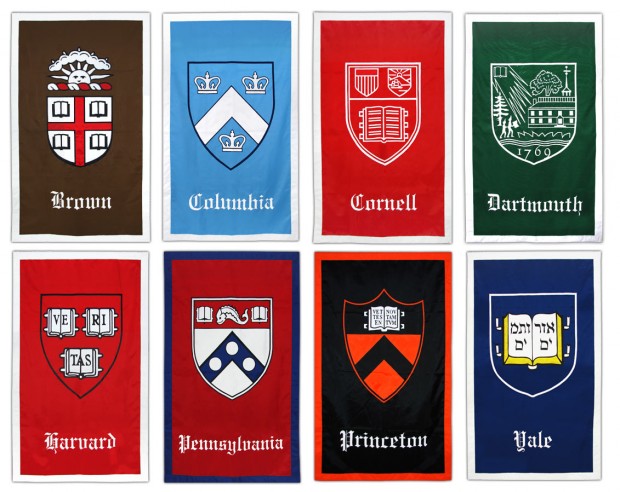
Ivy League university crests

Ivy League university crests

“Russia Today” recently reported that Ivy League university Harvard would offer a class on anal sex during their upcoming annual Sex Week. This isn’t the first time the class has been offered; that back in Fall 2012. Harvard’s Sex Week focuses on providing comprehensive sex education to students with a sex-positive outlook and shedding light on aspects that might not be ordinarily covered.

Yale holds the most famous Sex Week, which began in 2002 and was coordinated at the time by students Eric Rubenstein and Jacqueline Farber. But the program has now spread to other schools.

As the program takes root at other schools, let’s take a look at other Ivy League Sex Weeks:

Brown University: 

Site: Sextion: ***Sex Week 2014 (related article)

Started: N/A

Coordinated by: Sexual Health Education and Empowerment Council (SHEEC)

Most Recent Sex Week: Mar. 31-Apr. 6, 2014

Notable Classes: “Dirty Talk,” “The Ultimate Guide to Prostate Pleasure” (2013)

Notable Guests: sex educator Charlie Glickman, activist Katee Stewart (2013)

Awards: N/A


Columbia University:

N/A

Columbia doesn’t have a Sex Week.


Cornell University:

Site: Cornell Sex Week Facebook page

Started: 2014

Coordinated by: Sex Week committee

Most Recent Sex Week: Mar. 7-19, 2014

Frequency: N/A

Notable Classes: “Combating Stigma: A Panel Discussion on HIV/AIDS,” “Introduction to Kink (with Pictures)” (2014)

Notable Guests: feminist sex writer Susie Bright, activist Urvashi Vaid (2014)

Awards: N/A


Dartmouth College:

N/A

Dartmouth doesn’t have a Sex Week.


Harvard University: 

Site: Sex Week at Harvard

Started: 2010

Coordinated by: Sexual Health Education & Advocacy throughout Harvard College (SHEATH)

Most Recent Sex Week: Nov. 2-8, 2014

Frequency: Held twice every school year, once during each fall and spring semester

Notable Classes: “Love, Sex and Faith,” “Sexing the Body in Art and Media,” “#FutureSex: How technology will change your sex life” (Fall 2013)

Notable Guests: filmmaker Therese Schechter (Spring 2013), sexologist Jill McDeavitt (Fall 2012)

Awards: N/A


Princeton University:

N/A

Awards: Despite the fact that the school doesn’t have its own Sex Week, Princeton took top honors in Trojan’s Sexual Health Report Card in 2013.


University of Pennsylvania:

Site: Upenn Sex Week | All about sex

Started: 2013

Coordinated by: N/A

Most Recent Sex Week: Apr. 2-6, 2013

Frequency: N/A

Notable Classes: Erotica writing, “Asexuality 101” (Spring 2013)

Notable Guests: Cindy Gallop, “Make Love Not Porn” (Spring 2013)

Awards: N/A


Yale University:

Site: N/A

Started: 2002

Coordinated by: Sex Week committee

Most Recent Sex Week: 2014

Frequency: Held every other year in February on the week running up to Valentine’s Day

Notable Classes: “Fornication 101 with Oh Megan!,” “BDSM and Alternative Sexualities”

Notable Guests: porn director Steven Hirsch, porn star Sasha Grey

Awards: 2004 Collegiate Network Campus Outrage Award, First Place; 2006 Trojan Sexual Health Report Card, First Place and only school with a perfect score
#ThrowbackThursday: Brown University’s Sex Week 2014

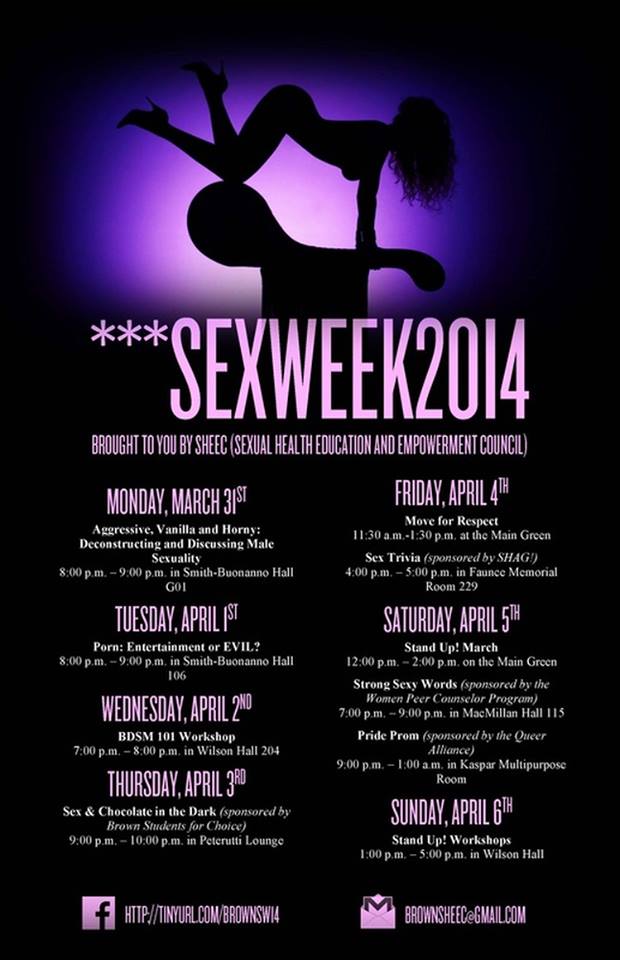
Brown Sex Week 2014 Poster

Brown Sex Week 2014 Poster

WOW! I was researching for this afternoon’s blog post (it’s live in a few hours!), and stumbled on this fantastic art for Brown University’s Sex Week 2014.

Or should I say, ***Sex Week 2014. Est-ce tu aimes le sexe?

Beyoncé + sex education = Win. Every time.

Carry on.


The Pirelli Calendar Shoots Candice Huffine, Its First Plus-Size Model

Candice Huffine, 2015 Pirelli Calendar shoot

Candice Huffine, 2015 Pirelli Calendar shoot

Last month, Pirelli unveiled its long-awaited 2015 calendar, with a very notable first: Candice Huffine became the first plus-size model to grace the calendar’s legendary pages since it began in 1964. So what took so long? According to their website, the Pirelli calendar is devoted to “pioneering innovation to staying ahead of the game.” This remark was made by Pirelli Chairman and CEO Marco Tronchetti Provera, and is displayed prominently on the calendar’s history page. It’s not as if Pirelli has shied away from doing something out of the norm for its calendar before. In 1987, photographer Terence Donovan used only black models (including a young Naomi Campbell) within its pages. It’s very sad that only after approaching 500 models over the course of 52 years, we’re only beginning to see plus-size women represented in one of the most well-known calendars. Now if only she was represented on the 2015 Pirelli Calendar site itself…

Shia LaBoeuf “Dazed” Interview: Male Rape Stats

Shia LaBeouf (MoviePilot)

Shia LaBeouf (MoviePilot)

Actor Shia LaBoeuf recently gave an interview to “Dazed” magazine writer Aimee Cliff. Within the interview transcript, he alleges that he was raped by a female visitor during his performance art run earlier this year at Los Angeles’ Cohen Gallery.

Men getting raped isn’t discussed nearly as much as men instigating rape, so I was curious to see if there were any stats available on the subject.

According to the Rape Abuse & Incest National Network (RAINN) website, men comprise around 10% of sexual assault victims. (In this case, sexual assault refers to anything from “unwanted sexual touching to forced penetration”). Other stats on the site say that about 1 in every 33 American men (about 3% of total men) will go through “an experienced or attempted rape in their lifetime.” The page also notes that one out of every 10 rape victims were men in 2003.

But there are more recent stats to dig into. In 2013, the National Crime Victimization Survey found that 38% of sexual violence in households was directed towards men. (To put this in perspective, sexual violence and rape against men had accounted for 5-14% in past years.) Researcher Lara Stemple had wondered if the stats had previously been underreported, and it certainly seems they had.

Maybe LaBoeuf’s coming out as a victim will embolden other victims to come out and be counted. Culturally, it makes sense that these numbers have been traditionally underreported, as men wouldn’t want to look like they’re “less than” a full man. But hopefully this will make some progress.

Gallup’s 2013 Interracial Marriage Approval Rates

Gallup 2013 Interracial Marriage Results

Gallup 2013 Interracial Marriage Results

Within the past few years, there’s been a lot of talk about the changing face of America (as “National Geographic” called it last year), in terms of racial demographics. It’ll change a lot more in the coming generations. In 2013, Gallup conducted a poll to find how Americans felt about interracial marriage.

The 2013 Minority Rights and Relations poll found that 87% of American adults approve of interracial marriage, with 84% of whites and 96% of non-Hispanic blacks approving. (This latter distinction is important because Hispanics were counted 1968-2003.) The survey comprised 4K+ Americans, with 1K+ identifying as non-Hispanic blacks. Interracial marriage was defined as one between “whites and non-whites.”

Since the 2011 poll taken two years prior, whites’ approval crept up one percentage point to 84%, while non-Hispanic blacks’ approval held steady at 96%.

The study also examined how the approval broke down by age and geographic location. Unsurprisingly, the Millennials and Generation Z (18-29 age range) lead the charge, approving by 96%. The 30-49-year-olds approval rate tracks closely behind at 93%. For the older groups, there’s less approval (which makes sense as they reflect the times in which they grew up): Ages 50-64 approve at 84%, and ages 65+ approve at 70%.

In terms of geographic region, the West wins out with approval ratings of 93%. Next up, the East and Midwest tie with 86%. With the South, old habits die hard, and it brings up the rear with approval ratings of 83%.

I’m now interested to see how approval of other interracial relationships shake out, such Caucasian/Hispanic, Asian/Black, etc. I think Gallup needs to examine these next.

But it’s very interesting to see how things have changed over almost 60 years: When the study was first produced in 1958, only 4% of Americans approved of interracial marriage. Now, the percentage is heading that way for those who disapprove. The trends are positive for Team Love!