Sex Worker Documentaries: By The Numbers

Belle Knox

Porn star Belle Knox

“The Cut” reported earlier this week that there’s a documentary in the works about the student/porn star from Duke University. For those just tuning in/forgot, Miriam Weeks (nom de porn Belle Knox) got outed as a performer earlier this year when a classmate recognized her from one of her videos.

Months later, Conde Nast has decided to capitalize on her story and turn it into a docuseries through its Conde Nast Entertainment branch. The series follows Knox as she works hard both in school and on set.

Belle Knox’s story is just the latest in a line of documentaries focused on sex workers.

But how many are sex-worker documentaries are there? I looked at two official sources: Wikipedia and IMDb.

Wikipedia:

Within the category “Documentary films about prostitution,” 38 pages are listed.

Of these 38 films:

Single-subject portraits (focusing on one notable person): 5

Multi-subject portraits (focusing on a few people): 13

General subject (focusing on an overall subject, e.g. trafficking): 20

Since Wikipedia is user-edited, it’s possible that some films got left off, and some didn’t completely fit the category.

IMDb:

The entertainment industry’s database has a helpful list: Highest Rated “Prostitution” Documentaries. The list numbers 434 films.

Of these 434 documentaries:

Single-subject portraits (focusing on one notable person): 17

Multi-subject portraits (focusing on a few people): 20

General subject (focusing on an overall subject, e.g. trafficking; included TV episodes): 331

Unrelated (only tangentially related, e.g. part of a stand-up act, etc.; included TV episodes): 66


Clearly, documentaries about sex workers are alive and well, and will continue to be good for business.


#ThrowbackThursday: Vintage Vibrators

1928 Polar Cub Vibrator

1928 Polar Cub Vibrator

The first vibrator was invented in 1734 in France (shocker). No word on who first used it, but my money’s on someone in Louis XV’s court, and was probably pretty blinged out.

In honor of its birth 280 years ago, here’s one from almost 200 years later: a 1928 Polar Cub vibrator from The Antique Vibrator Museum.

Period Sex: Who’s Doing It?

Splattergore

Splattergore

“The Cut” published an article yesterday on period sex. While the overall excellent article was long on anecdotes, it lacked what I love: hard stats!

How many women are having period sex? It’s the thing we dread will ruin our steady dates and hot hookups, but some women have figured out that it doesn’t have to be that way.

In 2011, menstrual cup company Softcup released a survey that uncovered, among other things, how much a woman’s perdio affects her sex life. The survey found that 60% of all women are uncomfortable with period sex. It showed an age disparity: 70% of older women (ages 45-54) were uncomfortable, while only 51% of younger women (ages 18-34) were.

(I don’t know where women ages 35-44 disappeared to.)

It’s clear that the majority of women haven’t gotten into period sex. But based on the “NYMag” article, the men are having more fun than ever.


Orgasms During Sex: French Women vs. American Women

Eiffel Tower

Eiffel Tower

We all know the stereotype that the French are having way more sex than anyone, particularly Americans. But are they actually having more pleasure?

A 2012 study of 3K+ French women ages 15 to 80 reveals that 74% have no trouble achieving orgasm (but it’s not specified whether it’s alone or with a partner). Within that percentage, 55% climax often, 16% come every time, 21% climaxed rarely and 5% never do.

How does that stack up to American women?

A 2009 article from ABC News notes that 75% of women can’t reach orgasm solely from sexual intercourse. It’s unclear a) how large the study was, in terms of quantity and age range, and b) for the women who were reaching orgasm, the frequency there.

It’s not a pure comparison, but it appears in this case, the stereotype is true: French women are having better sex (measured here by orgasm frequency).

Gymnophobes/Never Nudes: How Common Are They?

Tobias Funke, Never Nude

Tobias Funke, Never Nude

Gymnophobia is a fear of nudity, whether it’s that person or someone else’s naked body. This fear might come alive most in dreams, but sometimes it might spill over into waking life.

A cultural example is Tobias Funke (played by David Cross) from “Arrested Development,” who was shown to be a “never nude:” He had serious problems stripping down, even for a shower. (The term has unofficially become the slang definition for the condition over a decade later. Seriously, ask your friends if they know what gymnophobia is, and then what a never nude is.)

But what percentage of the population are actually gymnophobes/never-nudes?

Unfortunately, there’s not any hard (heh) data on it. My guess is that since most sex-related data is self-reported (short of measuring blood flow to the genitals), people aren’t going to come forward to admit that they have this phobia. It makes logical sense, but hardly satisfies my curiosity.


Google Trends: “Sex” vs. “Gay Sex”

Internet searches can reveal so much. I’m interested in finding what light they can shed on the world’s sexual mores and appetites.

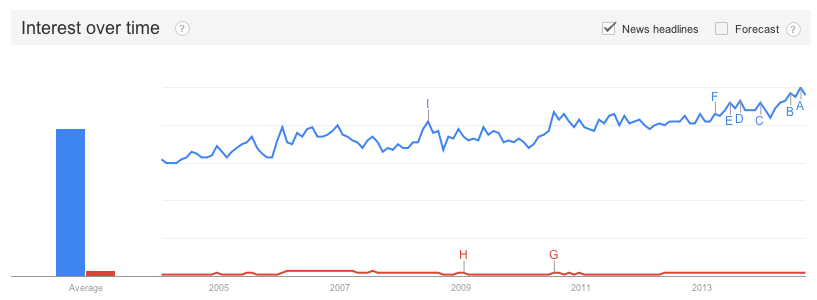
I used Google Trends to compare “sex” and “gay sex” search terms against each other, using 2004-present as my timeframe. The long-term results are below, with “sex” in blue and “gay sex” in red:

Google Trends - Sex vs. Gay Sex

Google Trends – Sex vs. Gay Sex

As we can see, there are any more searches for “sex” than “gay sex.” As a function of the world’s LGBT population (estimated to be as high as 20%), this seems very low. One explanation is that the “sex” search encompasses the “gay sex” hits, whereas the “gay sex” results logically only contain the one specific category.

Now to break it down by region and city:

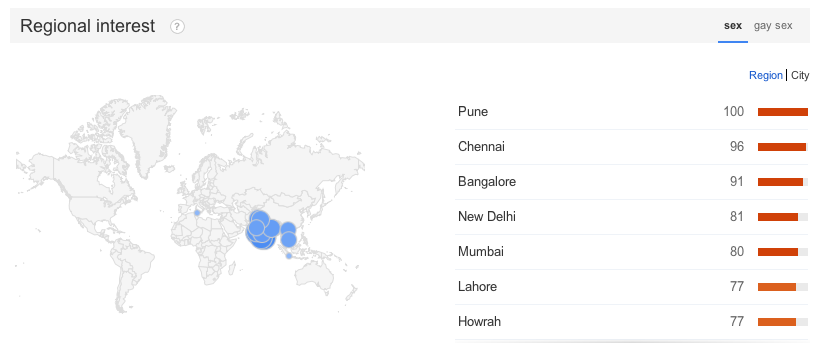
“Sex:” Region:

Google Trends terms countries as regions, and shows the top 10 countries. South Asia makes a strong showing, with Sri Lanka (100%) and India (85%) grabbing the top two spots. Southeast Asian countries Vietnam (67%) and Cambodia (64%) also appeared as well.

'Sex' Regional Breakout

‘Sex’ Regional Breakout

“Sex:” City:

India dominates this category, taking 9 spots in the top 10. The only non-Indian cities are Lahore, Pakistan’s second-largest city, which clocks in at #6.

The strong showing in India speaks to its population, now estimated to be around 1.27 billion. So it makes sense that it’s overwhelming the data set due to sheer quantity.

'Sex' City Breakout

‘Sex’ City Breakout


“Gay Sex:” Region:

Cambodia takes the top spot here, paving the way for other Southeast Asian countries: Laos (92%, #3) and Vietnam (77%, #4).

'Gay Sex' Regional Breakout

‘Gay Sex’ Regional Breakout

“Gay Sex:” City:

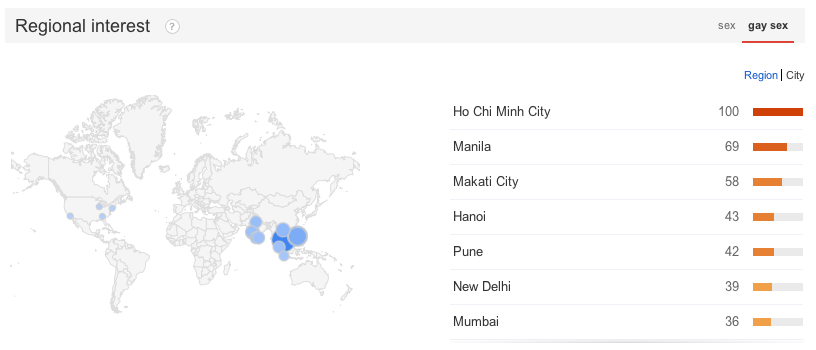
Ho Chi Minh City, capital of Vietnam, took the top spot here. Hanoi placed fourth with 43%.

The Philippines grabbed the second and third spots with Manila (69%) and Makati (58%).

Indian cities comprised #5-#9 of the top 10 spots, with Malaysia’s Kuala Lumpur taking the last spot at 35%.

'Gay Sex' City Breakout

‘Gay Sex’ City Breakout

Conclusion:

South and Southeast Asian countries are robustly represented with these searches. This could point to large populations leading to larger quantities of searches. There’s also the fact that many of these countries have culturally conservative sexual mores, so any interest piqued gets some play online.


Stay tuned for more! Any specific trends you’d like to see? Let me know!

CatalystCon West 2014: By The Numbers

CatalystCon West 2014

CatalystCon West 2014

CatalystCon West gears up today and runs through Sept. 14th in Los Angeles. The four-day conference, founded by Dee Dennis in 2012, aims to “inspire exceptional conversations about sexuality.”

Here’s how it’ll break down via numbers:

Number of Meetups (prior to opening): 2

Number of Films in CatalystCon Film Series: 2

Keynotes: 2 (opening and closing)

Pre-Conference Workshops: 3

Number of Days: 4

Podcasts Recording: 5

Conference Rooms: 6

Number of Workshops: 40 (!!!)

Number of Speakers: 87 (!!!)

Are you attending? I’ll be there Saturday and Sunday!

Sex Ratios: Males vs. Females, 1950s

Blue Man, Pink Woman

Blue Man, Pink Woman

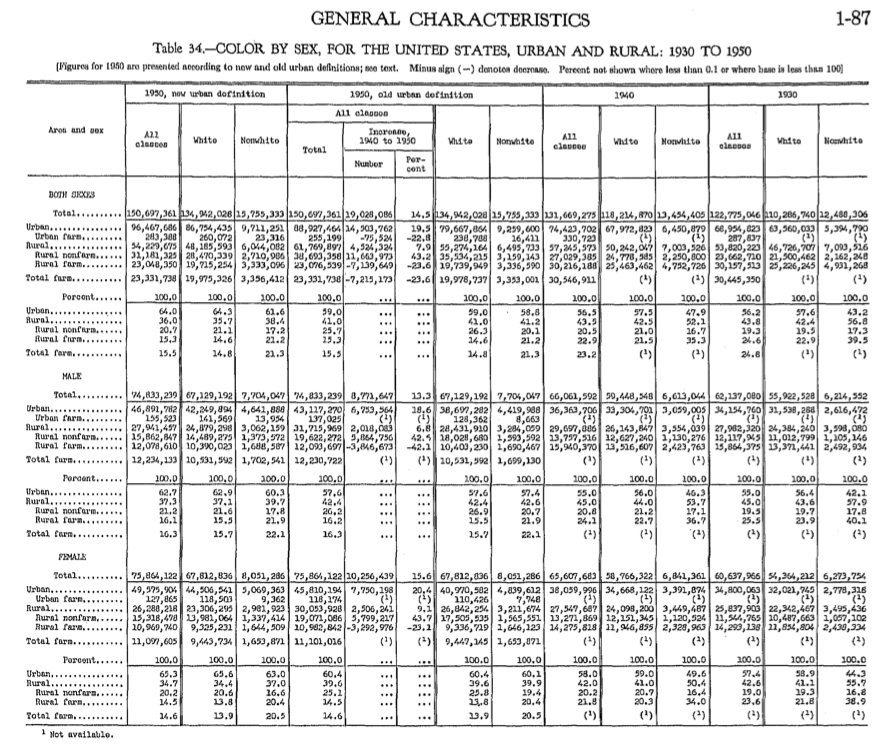
One interesting data point (among the many) the Census has is that of the sex ratio: the number of males for every 100 females. The 1950 Census finds a 98.6 sex ratio, i.e. 98.6 men for every 100 women, within the total U.S. population for all ages.

The ratio actually hits over 100 for a few categories, starting in childhood: Under 5 years, 5-9, 10-14 and 15-19 all registered high ratios. It begins to dip into the high 90s from age 20 to age 54. Ages 54-59 and 60-64 move back up to ratios over 100.

The next two age brackets (65-69 and 70-74) go back into the high 90s. But the last two brackets decrease more dramatically than any of the previous ones: Ages 75-84 has a sex ratio of 85.1 and ages 85+ has a 69.6 ratio. This makes sense, as men usually pass away earlier in life than women.

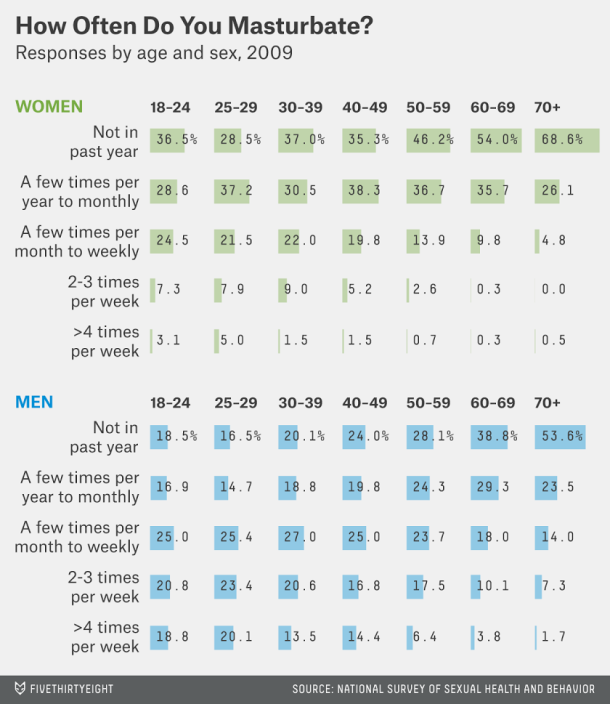
Masturbation Data: Age, Gender and Frequency

FiveThirtyEight NSSHB Masturbation Results 2009

FiveThirtyEight NSSHB Masturbation Results 2009

Indiana’s National Survey of Sexual Health and Behavior (NSSHB) recently crunched some data that allows us a few insights into the nation’s masturbation, broken down by age, gender and frequency. Their methodology: 5K+ Americans, ages 14-94, with data collected March to May 2009. (Data science site FiveThirtyEight made a fun graphic illustrating the results, pictured above.)

Here’s what we can glean from the findings:

Women:

Around age 40, the number of women who haven’t masturbated within the past year begins to exceed 35%, and keeps climbing up. (The 30-39 bracket topped out at 37%, but then sank to 35% for the 40-49 bracket.) The older brackets grow between 8-12 percentage points. Why is this? This could point to the fact that women of earlier generations were conditioned to think that masturbation was dirty, and don’t touch themselves on a regular basis, if at all.

Across the board, women in the 2-3 times a week and over 4 times a week fall into the minority. This could indicate achieving a comfort level with their bodies, resulting in knowing exactly which buttons to push (so to speak), and/or a higher-than-average libido.

Men:

The numbers for me only hit single digits with men ages 70+ masturbating 2-3 times a week, and men ages 50-59, 60-69, and 70+ masturbating over 4 times a week. It’s probable that the decreases are inversely correlated with age.

What’s surprising is that the highest percentages weren’t in the 18-24 age range: We hear so much in popular culture that boys masturbate most frequently (at least from anecdotal evidence of any mom with at least one son). But this study shows that the largest percentages for frequency are really falling within the 30-39 and 40-49 age brackets.