Thursday Trends: Young Women and #GrannyHair

Rihanna (Her Interest)

Rihanna (Her Interest)

Kylie Jenner did it. So did Rihanna and Kelly Osbourne. Of course, Lady Gaga, trendsetter that she is, rocked it back in 2010.

Grey hair.

Once upon a time, it was unseemly for women to go out sporting anything other than a full mane of brown, black, red or blonde hair. Grey was seen as unnatural and, at the same time, a little too natural. It was shoved to the side, to the back of the mind, ignoring the tell-tale side of aging.

Right now, women are embracing the color whole-heartedly, and running towards the grey instead of away from it. A recent BuzzFeed post shows how young women are riding the trend, especially seen on Instgram with the hashtag #GrannyHair.

But why now? Why is this grey hair’s big moment?

We seem to be in the midst of a “revering our elders” moment. (Real talk, though: that needs to happen every day. Call your grandparents, people!) The fashion world has been pioneering this lately. French fashion house Céline tapped 80-year-old essayist Joan Didion to be their latest model, and Saint Laurent is using 71-year-old Joni Mitchell. The major beauty players are doing the same, with 64-year-old Jessica Lange for Marc Jacobs and 69-year-old Helen Mirren for L’Oreal Paris. In this year’s Milan Fashion Week, trends skewed towards something your grandmother might don for a social event.

This makes total sense in terms of how current demographics are shifting. The baby boomer generation, born between 1946 and 1964, are turning officially “old” at a rapid clip. As of 2011, they numbered 77M+ and are “the largest generation in American history.” Baby boomers began turning 65 in 2011, and won’t stop until the end of 2029.

Here’s how CNN puts this demographic’s strength in numbers in terms of future projected growth:

The 65+ population segment is projected to double to 71.5 million by 2030 and grow to 86.7 million by 2050.

With this projected growth will come a lot of societal changes (I’ve always said that this isn’t a generation that’ll age quietly). We’re beginning to see initial impacts with how we view that generation and the ones before. For example, It used to be that you couldn’t be seen as a sexual being after a certain age, that you were out of the running in the race to make babies. And while that second part might be true, the first has been proven false by many women over “a certain age.” Case in point: see every instance where a late-night talk show host jokes about Helen Mirren. They’re always saying she’s hot (and she is!). Society has long seen older men with grey hair as sexy, and is now (finally!) coming around to the idea that older women are hot too.

Young women coloring their hair grey even has a historical precedent. In her book “Seductress: Women Who Ravished the World and Their Lost Art of Love” author Betsy Prioleau mentions that young women in the French court used to powder their hair grey to emulate their elders. (If you’ve seen Sofia Coppola’s “Marie Antoinette,” the director subtly includes this detail, noticeable in some shots.)

Overall, this trend really points to a shift in how we’re seeing aging. People seem to be more open to the fact that life doesn’t stop after a certain age. And young women are celebrating their elders with their grey hair, natural or not.
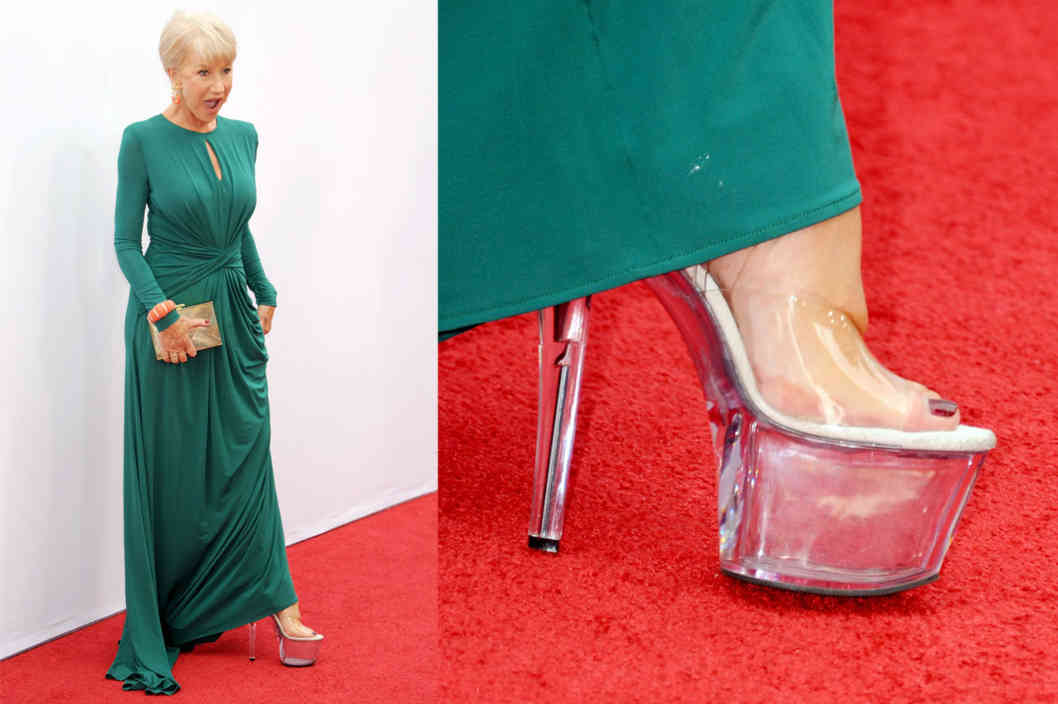
#ThrowbackThursday: Helen Mirren’s Stripper Shoes, 2013

Helen Mirren's stripper shoes (The Cut)

Helen Mirren’s stripper shoes (The Cut)

In 2013, Academy Award-winning actress Helen Mirren showed up to the LA premiere of “Red 2” wearing an elegant emerald dress…and clear, extremely high stripper shoes. She referred to the shoes as her personal leg-lengthening trick, and has apparently owned them for years.

I love seeing an older woman who hasn’t been shoved aside and told that she’s irrelevant, and is instead living her life with gusto and enthusiasm. (Also, I love Helen Mirren.) It’s rare to see, but I always hope more people follow suit.


Pregnant Girls Banned from Sierra Leone Schools

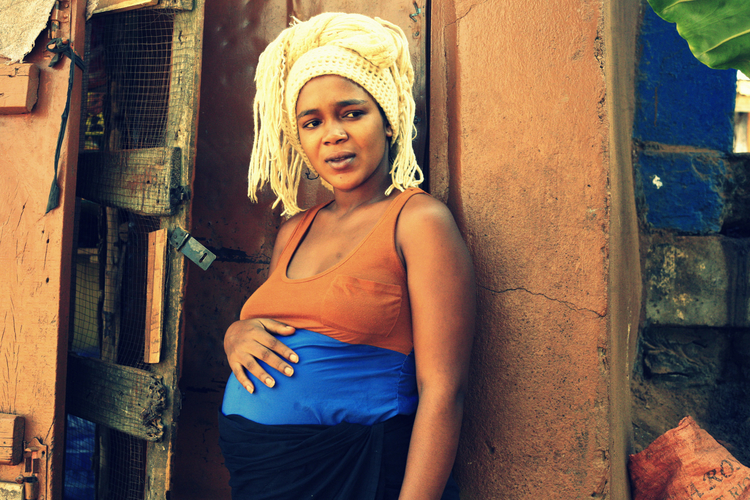
Pregnant Sierra Leone woman (The Fatou Blog)

Pregnant Sierra Leone woman (The Fatou Blog)

Schools in Sierra Leone closed during the Ebola epidemic are scheduled to re-open today, welcoming children eager to learn again. But the country’s Minister of Education Minkailu Bah has banned one group from returning: pregnant teen girls, claiming they’re a distraction to their peers and would hinder learning.

Incidentally, this ban isn’t new, having been in place since 2010. But it’s making headlines now.

Whether or not this qualifies as a “distraction” is another debate entirely, but teenage pregnancies within the country are becoming more common. A recent long-term study by the UNESCO HIV and Health Education Clearing House found that 33%+ of all Sierran Leonian pregnancies involve teen girls, and nearly 40%+ are involved in a “maternal death.” For context relative to the size of the country’s population, 41% of Sierra Leone citizens are under age 18. Those are some scary stats.

Sierra Leone isn’t the only country battling this issue. As a whole, Africa has the highest rates of teenage pregnancies, taking 18 of the top 20 spots in a 2013 United Nations Population Fund (UNFPA) rankings report.

The recent teenage pregnancy epidemic has been attributed to Ebola, in that girls who might otherwise be attending school are now more vulnerable to sexual violence. They may also have to survive and provide, and do so via prostitution. So there might be a bit of a substitution effect at play here.

But human rights governing bodies have taken note of Bah’s stance. The United Nations issued a statement in which stated that “education is a fundamental human right that Sierra Leone has committed itself to uphold.” The UN also reminded the country of its own Education Act, passed in 2004, which barred discrimination of those seeking education.

We’ll see how Bah’s proposed idea pans out. But the words of UNFPA’s Executive Director Babatunde Osotimehin ring true here:

Adolescent pregnancy is intertwined with issues of human rights. A pregnant girl who is pressured or forced to leave school, for example, is denied her right to education.

President Obama Supports Ending Conversion Therapy for LGBT Youth

President Barack Obama (Politico)

President Barack Obama (Politico)

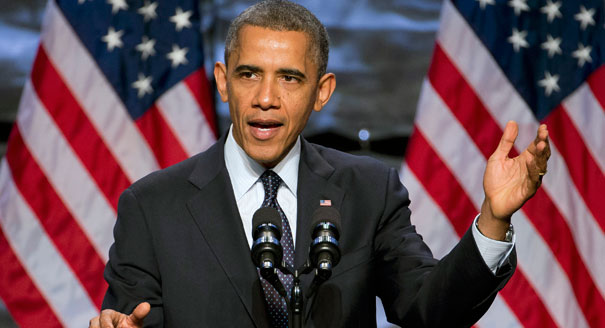
Big news last week: President Obama publicly stated that he supports banning conversion therapy for LGBT youth. The announcement came in response to an online petition urging the president to take action after transgender teen Leelah Alcorn’s suicide late last year. (Before her death, Alcorn’s parents had forced her to attend conversion therapy in hopes of getting their “son” back.)

Right now, it’s unclear what form Obama’s support will take. White House officials say that it’s unlikely that the president would push for a national law, but instead would “support the efforts to ban the practice at the state level.” It’s important to note that is a far cry from how Obama started his political career: At the time, he didn’t support gay marriage.

But the president’s views on LGBT issues are rapidly evolving, paving the way for the rest of America to follow suit. And change starts at home: The White House recently created an “all-gender” restroom for transmen and transwomen who may feel uncomfortable using the traditional facilities.


UVA Rape Story Retracted: Has It Happened Before?

UVA (Brohammas)

UVA (Brohammas)

Last week, “Rolling Stone” released an investigative report on its now-infamous piece “A Rape on Campus.” The report, produced jointly with the Columbia Graduate School of Journalism, delved into fact-checking the narrative. Ultimately, the investigation found many fact-checking and methodology errors (overall termed a “systematic failing”), and “Rolling Stone” retracted the piece.

I was interested to see if any other investigative journalism pieces, specifically on rape cases, had been retracted at any time. But I wasn’t able to find any. The closest things I could find were examples of victims later recanting their stories.

This has proven to be a first for the journalism world in that such an expansive feature (on such a timely, hot-button issue, no less) has been so thoroughly demolished by its fabrications. Though the story initially drew awareness to rape victims on college campuses, it ultimately ended up casting more negative light on the publication and journalist who covered it. Let’s hope that future journalists covering sexual assault stories will be scared into performing their due diligence to get all the facts right.


Sex & The ’60s: Joan Holloway Inspires Brits to Get Boob Jobs

'Mad Men' season 1 still with Christina Hendricks (The Telegraph UK)

‘Mad Men’ season 1 still with Christina Hendricks (The Telegraph UK)

This week, we’re examining sexuality data from the 1960s, in celebration of the upcoming final half-season of “Mad Men” beginning Apr. 5th.

Happy Friday! Bombshell Joan Holloway (and the gorgeous actress behind the character, Christina Hendricks) has become well-known for her dangerous curves throughout the course of “Mad Men.” (That’s not editorializing, that’s a fact, and everyone agrees.) In Britain, Hendricks is credited with sparking an increase in breast implants.

In a 2011 article in “The Telegraph,” the British Association of Aesthetic Plastic Surgeons (BAAPS) found that the number of women having “breast augmentations” rose 10%+ in 2010 from the 2009 figure. This equals out to 9K+ British women per year.

The BAAPS estimates that overall plastic surgery procedures have tripled from 10.7K+ in 2003 to 36.4K+ in 2009.

A BAAPS source suggested that Hendricks was an influence, especially with the hourglass figure coming back into fashion. But the source wasn’t the only one to name-check Hendricks for her curves. Britain’s Equalities Minister and Liberal Democrat MP Lynne Featherstone proclaimed Hendricks to be “fabulous” while urging the need for more curvy role models. And she would know: Featherstone was voted the “most fanciable MP in Parliament” in 2010.


Sex & The ’60s: Don Draper’s Conquests By The Numbers

'Mad Men' Don Draper, Midge Daniels, Megan Calvet Draper, Betty Draper, and Dr. Faye Miller (Vulture)

‘Mad Men’ Don Draper, Midge Daniels, Megan Calvet Draper, Betty Draper, and Dr. Faye Miller (Vulture)

This week, we’re examining sexuality data from the 1960s, in celebration of the upcoming final half-season of “Mad Men” beginning Apr. 5th.

Everyone who watches the show knows that Don Draper (Jon Hamm) is a serial womanizer. Even when he’s married, he can’t stay faithful. It’s part of what makes him so intriguing: we know he’s wrong, but we can’t stop watching!

There’s been some ink spilled on the types of women he tends to bed, such as preferring docile women for marriage versus favoring strong-willed career women for affairs. But I was curious to find out if there were any other patterns, and so had some fun with Excel.

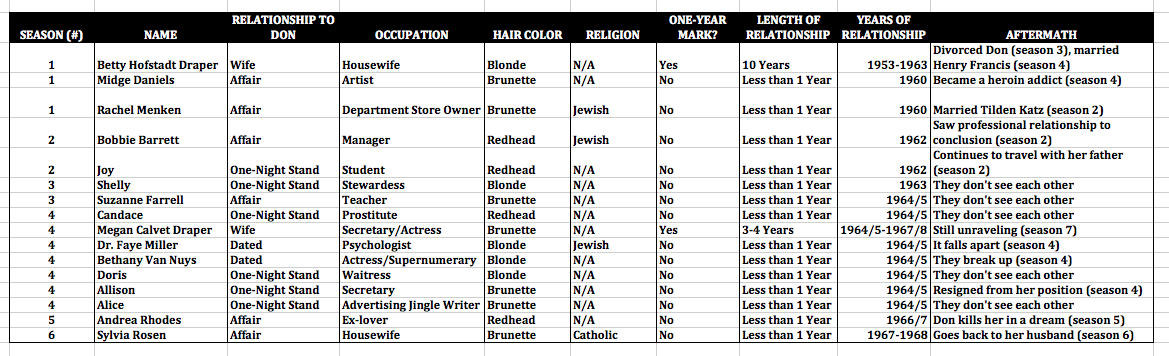
For fun, here’s what my entire Excel spreadsheet looked like:

'Mad Men' Don Draper Conquests Excel Spreadsheet

‘Mad Men’ Don Draper Conquests Excel Spreadsheet

If you can’t see, I listed the names of Don’s 16 partners by season, their relationship to Don, occupation, hair color, religion, and overall length of the relationship. (Some of these metrics I didn’t end up using.) Some of these things I tried finding information as accurate as possible (such as the years each relationship spanned), but sometimes had to make a close guess. So if you see an error, please correct me and I’ll recalculate.

Now, let’s find some patterns via pivot tables.


Don’s Relationships by Type:

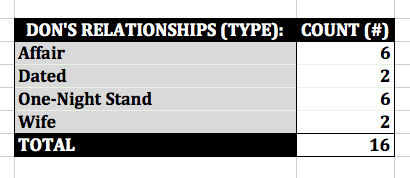
I broke down Don’s relationships into three types: wife, affair and one-night-stand. I defined affair as on-going with an emotional component, whereas I defined one-night stand as purely sexual, even though it may have happened more than once (as is the case with Candace the prostitute).

That being said, here’s the data:

'Mad Men' Don's Relationships by Type Excel Pivot Table

‘Mad Men’ Don’s Relationships by Type Excel Pivot Table

We know he’s been married twice (I’m not counting Anna Draper, as she was never a conquest), so no surprise there. I figured Don has had more casual partners than serious ones, but I didn’t realize how much it would skew. Don’s had three times as many affairs and one-night stands combined as he has married and dated partners combined. Interesting.


Partners’ Occupation:

I was interested to see if Don had any particular type in terms of career. But every woman was so different that only two things reoccurred. Two of the 16 women (12.5%) were housewives, which were his first wife Betty and later season 6’s Sylvia Rosen. Another pattern that emerged were two actresses, who also held other jobs when Don knew them. These two were season 4’s Bethany Van Nuys (whose other job was a supernumerary) and his second wife Megan Calvet (who began as a secretary).


Partners’ Hair Color:

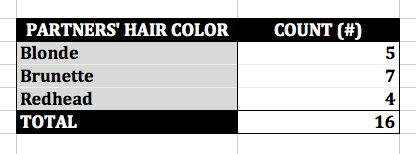
Gentlemen prefer blondes, but does Don? Let’s take a look:

'Mad Men' Don's Partners' Hair Color Excel Pivot Table

‘Mad Men’ Don’s Partners’ Hair Color Excel Pivot Table

No, Don’s more of a brunette man, with nearly half his partners sporting the color. Blonde and redhead are nearly equal, with blonde pulling ahead by one partner.


Religion:

I initially wanted to see how each partner’s religion broke down. Several did not mention or show any religious leanings, so I referred to their respective affiliations as “N/A,” because I didn’t want to automatically put partners into a “default Christian” category.

Only two of the 16 partners (12.5%) were overt about their religious affiliation: season 1’s Jewish department store heiress Rachel Menken, and the Catholic Sylvia Rosen (season 6, though she’s married to a Jewish man).

Other partners signaled their religious leanings indirectly. Season 4’s Dr. Faye Miller (Cara Buono), referenced her Jewish heritage in passing, using a Yiddish phrase. Season 2’s Bobbie Barrett was confirmed to be Jewish by none other than show creator Matthew Weiner himself.

What we can take from this is that while religion certainly isn’t a conscious preference of Don for his partners, he has selected distinctly Jewish women.


Duration of Relationship:

How long did each of Don’s dalliances last? Unsurprisingly for most of them, not very long:

'Mad Men' Don's Length of Relationships Pivot Table

‘Mad Men’ Don’s Length of Relationships Pivot Table

I initially had assumed that some would’ve spanned more than a year, but the only partners with proven staying power have been his wives Betty and Megan.


Conclusion:

Delving into the metrics of Don’s sexual partners reveals some interesting findings: He prefers brunettes, doesn’t discriminate on the basis of religion or career, and has a short attention span when it comes to women.


#ThrowbackThursday: Don Draper and Bobbie Barrett’s BDSM Session, “Mad Men” 2008

'Mad Men' season 2 still (Live Auction Group)

‘Mad Men’ season 2 still (Live Auction Group)

This week, we’re examining sexuality data from the 1960s, in celebration of the upcoming final half-season of “Mad Men” beginning Apr. 5th.

Remember this scene? In season 2, Don (Jon Hamm) began sleeping with Bobbie Barrett (Melinda McGraw), the wife of a performer that Sterling Cooper hired for an Utz Potato Chips commercial. In the episode “Maidenform,” we learn she has a penchant for being tied up during sex. But she doesn’t get satisfied, as she tells Don she’s been discussing his sexual prowess. He abruptly leaves, and that’s the end of their affair.

It’s actually the first of two BDSM-tinged scenes the show has depicted. The second one occurred in the sixth season during one of Don’s sessions with Sylvia Rosen (Linda Cardellini). Each scene effectively ended its respective affair. While two instances aren’t enough data from which to extrapolate a pattern, it’s certainly worth noting.


Sex & The ’60s: How Many Live Births Occurred During the Decade?

'Mad Men' season 3 still (LA Times Blogs)

‘Mad Men’ season 3 still (LA Times Blogs)

This week, we’re examining sexuality data from the 1960s, in celebration of the upcoming final half-season of “Mad Men” beginning Apr. 5th.

On “Mad Men,” two significant female characters, Don’s wife Betty Draper (January Jones) and his subordinate Peggy Olson (Elisabeth Moss), gave birth to sons. (Oops, spoiler alert?) While each character made different decisions regarding their progeny, it became a pivotal moment for both of them.

Tracking the number of live births within a population is an essential checkpoint to determine how healthily a population is growing. We’ve already looked at population and marriage stats from the 1960s; now let’s look at birth stats from the decade.

I found a table put together by the Centers for Disease Prevention and Control (CDC) cataloging registered live births from 1933 to 1998, breaking down the data by the age and race of the mother. For our purposes, we’ll look at age only and narrow it down to mothers ages 15-49.

Here’s the data table:

1960s Live Births by Mother's Age and Year Data Table

1960s Live Births by Mother’s Age and Year Data Table

But the patterns are a little hard to see. So I made a line graph:

1960s Registered Live Births by Mother's Age and Year Line Graph

1960s Registered Live Births by Mother’s Age and Year Line Graph

Now we can begin to see some patterns.

It appears that 1964 was a tipping-point year, as some of the age-ranges pivoted from their determined patterns at that year. The number of mothers ages 20-24, the largest group in the series, dropped below 1.4M+ that year, and settled around 1.3M+-1.5M+ for the remainder of the decade. Likewise, the number of live registered births for the 25-29 cohort hit 1M+ that year for the last time that decade. For the rest of the 1960s, births for women ages 25-29 stayed within the six-figure range.

Previous to 1964, women ages 30-34 numbered around 600K+ live births. But 1964 began a drop into the 500K+ range for a couple of years, before ending the decade within the 400K+ range.

Women ages 15-19 (well, teens) stayed within the same range of births throughout the decade (585K+ to 605K+, with an outlier of 621K+ in 1966). But the line graph above makes it appear as if the cohort had a more dramatic rise, but that’s because it’s set off by the 30-34 range’s changes.

In terms of the “Mad Men” characters, Peggy Olson would’ve been 21 years old, and would’ve given birth around 1960. That places her in the largest age cohort of that year. (Ages 20-24 outstripped the next-highest range, ages 25-29, by 334K+ births.) Betty Draper was around 31 years old in 1963 when she gave birth. So she was within the largest of the age ranges that year which didn’t hit 1M+ live births, but still on the downswing of common pregnancies. (Women ages 30-34 registered 610K+ live births).

It seems that showrunner Matthew Weiner’s obsessiveness towards period accuracy extended even to birth ages of his female characters.