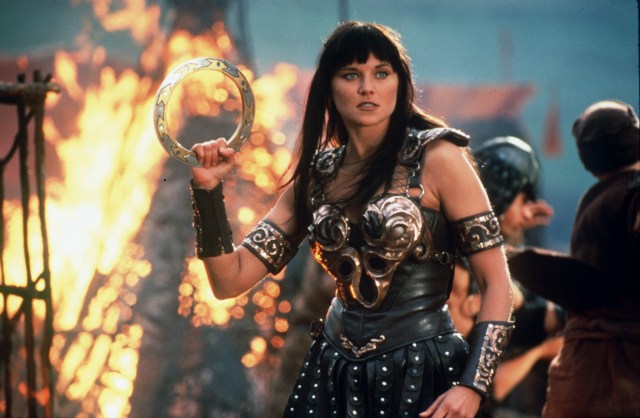
#ThrowbackThursday: Lucy Lawless in “Xena: Warrior Princess”

Lucy Lawless in "Xena: Warrior Princess" (Beyond The Marquee)

Lucy Lawless in “Xena: Warrior Princess” (Beyond The Marquee)

Who remembers this show? Originally a spinoff of Hercules: The Legendary Journeys, Xena: Warrior Princess quickly made a mark of its own. Lucy Lawless starred as the titular character, a warrior princess (obviously) who travels around the world throughout various civilizations to redeem her destructive past. Her friend Gabrielle (Renee O’Connor) often accompanies her in her adventures.

The TV series ran from 1995 to 2001, and ranked in the top five shows for ratings each year. It’s now seen as a major cult show. A rebooted series was announced in 2015; no word on who’ll take over the role of Xena.

Women Taking The Pill More Likely to be Treated for Depression

Birth Control Pill Container (The Holy Kale)

Birth Control Pill Container (The Holy Kale)

Do you feel depressed? Are you on The Pill? There might be a correlation.

A new study published in the Journal of the American Medical Association (JAMA) followed 1M+ women ages 15-34, with average age of 24. The longitudinal study followed Danish women from 1995 to 2013 who had no prior history of depression. The average time between follow-ups was 6+ years.

Women who were on a combination of oral contraceptives were “23% more likely to be prescribed an antidepressant,” usually within the first six months after beginning the Pill’s regimen. But women on the progestin-only pills (a synthetic form of the progesterone hormone) were “34% more likely to take antidepressants or get a first diagnosis of depression” than women who didn’t take the hormonal contraceptive.

The risk primarily targets teenagers, and the risk inversely correlates with age (i.e. the risk decreases as one gets older).

It’s suggested that higher levels of progesterone may lower mood (which is controlled by estrogen). But researchers noted that women are twice as likely to be diagnosed with depression than men within their lifetime, so the study’s findings are something to consider. It should be noted that the researchers have called for more follow-up studies to corroborate these findings.

It’s Canon: Wonder Woman Is Queer

Wonder Woman (The Mary Sue)

Wonder Woman (The Mary Sue)

Last week, the bisexual community gained heightened mainstream visibility through a Golden Age of Comics-era character: Wonder Woman.

DC comics writer Greg Rucka said that it’s “logical” that Wonder Woman is queer, given that she comes from an island inhabited solely by women warrior princesses. Wonder Woman’s homeland of Themyscira is supposed to be paradise, where inhabitants can have fulfilling relationships. But Rucka points out that despite the only options for romantic/sexual/emotional relationships, the concept of queerness doesn’t exist.

How would Rucka know this? He writes DC’s Wonder Woman: Year One series. So this revelation is obviously canon. But Rucka says that this revelation will continue to be subtle, and doesn’t feel the need to scream it at readers or make that Wonder Woman’s defining characteristic. (Real talk: I am such a fan of this line of reasoning.)

So far, Rucka is the only DC writer to speak definitively on Wonder Woman’s sexuality. As for whether the character has had same-sex relationships:

As [artist Nicola Scott] and I approach it, the answer is obviously yes. And it needs to be yes for a number of reasons.

Though this is big news, it’s not so shocking: Wonder Woman officiated a same-sex wedding in a story released last year.

The character, who’s also known as Diana Prince in her civilian life and Princess Diana of Themyscira in her homeland, debuted in Dec. 1941. The big-screen movie adaptation starring Gal Gadot will arrive in theaters on Jun. 2, 2017. It will be the first movie centered on a female superhero for the DC universe.

At this time, it’s unclear whether the upcoming movie will include this aspect of Wonder Woman.

Which U.S State Has the Highest Maternal Mortality Rate?

Pregnant woman (SLO County)

Pregnant woman (SLO County)

You wouldn’t necessarily guess that *any* state in the U.S. has a high maternal mortality rate (i.e. mothers who die due to pregnancy- and birth-related complications), but one has that dubious honor. And that is the great state of Texas.

In the September issue of medical journal Obstretics and Gynecology, a report found the following:

The maternal mortality rate in the United States increased between 2000 and 2014, even while the rest of the world succeeded in reducing its rate. Excluding California, where maternal mortality declined, and Texas, where it surged, the estimated number of maternal deaths per 100,000 births rose to 23.8 in 2014 from 18.8 in 2000 – or about 27%.

Bet you didn’t expect that, right? (I certainly didn’t.) But how bad is it really?

From 2000 to the end of 2010, Texas’s estimated maternal mortality rate hovered between 17.7 and 18.6 per 100,000 births. But after 2010, that rate had leaped to 33 deaths per 100,000, and in 2014 it was 35.8. Between 2010 and 2014, more than 600 women died for reasons related to their pregnancies.

Texas is part of the developed world, so the maternal mortality rate surge cannot be explained by “war, natural disaster, or severe economic upheaval.” So what is it?

In recent years, Texas has severely decreased women’s access to spaces that offer medical services for reproductive health. In 2011, “the Texas state legislature cut $73.6M from the state’s family planning budget of $111.5M.” This measure resulted in 80 clinics closing across the state. Planned Parenthood clinics were also completely eliminated, which cut off access to reproductive health measures for lower-income women especially. Planned Parenthood had previously served 130K+ women across the state.

While Texas restored the family planning budget to its original level in 2013, the damage was already done: Many clinics are still struggling to provide the same level of care and service they provided before the cut. But Texas clinics are now offering free IUDs, so there’s some hope they’ll be flourishing soon.


Women in the Workplace Study 2016: By The Numbers

Joan Holloway and Peggy Olsen, 'Mad Men' (Mad Men Wiki)

Joan Holloway and Peggy Olsen, ‘Mad Men’ (Mad Men Wiki)

Sheryl Sandberg’s LeanIn.Org teamed up with consulting firm McKinsey & Co. to release the second annual Women in the Workplace study. The study bills itself as “a comprehensive study of the state of women in corporate America.” The study examined 132 companies with a combined total of 4.6M+ employees. Another 34K+ filled out a relevant survey about their experiences in the workplace.

You can read the full results, but here are some relevant stats:

Able to Participate Fully in Meetings:

  • Women: 67%
  • Men: 74%

Believe Their Contributions are Appropriately Valued:

  • Women: 49%
  • Men: 54%

Believe Their Gender Will Make It Hard to Advance:

  • Women: 33%
  • Men: 12%

Lobbied for a Promotion or New Assignment:

  • Women: 39%
  • Men: 36%

Asked for an Increase in Compensation:

  • Women: 29%
  • Men: 27%

Negotiated and Received Feedback They Were “Bossy”/”Aggressive”/”Intimidating”:

  • Women: 30%
  • Men: 23%


#ThrowbackThursday: Working Women, 1950s

Working women, 1950s (Minorities in the 1950s)

Working women, 1950s (Minorities in the 1950s)

According to the Bureau of Labor Statistics (BLS), women ages 16-55+ comprised 18K+, which was less than 30% of the labor force. (By contrast, working men numbered 43K+ and over 70%.) Out of the 12% of American women who worked outside the home, only 6% of women held management positions.

Today, things have changed…slightly. It’s still difficult for women to climb the corporate ladder and make it all the way to the C-suite.


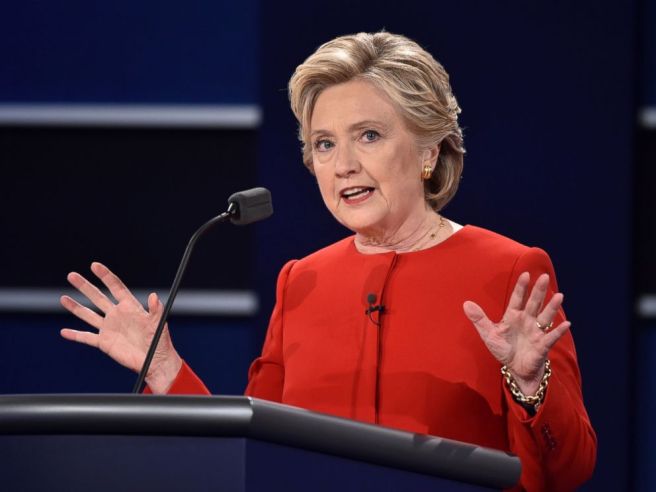
Hillary Clinton Spoke 38% of the Time During the First Presidential Debate

Hillary Clinton (ABC News)

Hillary Clinton (ABC News)

The first presidential debate aired this past Monday night between Democratic nominee Hillary Clinton and Republican nominee Donald Trump. It was clear that Trump interrupted Clinton many times (51 times, to be exact), but his talking time massively negatively impacted Clinton’s.

Clinton spoke only 38% of the debate running time.

How do we know this? Twitter crunched some numbers surrounding the frequency of the hashtag #debates, and possibly how many times the two nominees’ names (and maybe quotes) were mentioned. (I couldn’t find the methodology behind Twitter’s data, so I couldn’t delve into it. Sad.)

By contrast, Trump spoke for 62% of the time. Given his verbose tendencies, this hardly comes as a surprise.

California Will Now Offer Picking Up a Year’s Worth of Birth Control Pills in One Prescription

Birth control pills (Salon)

Birth control pills (Salon)

Once again, California blazes the way for the rest of the nation. Last week, Governor Jerry Brown signed a bill into law that states that women will be able to pick up a year’s supply of birth control pills at one time. Before this law passed, pharmacists were only able to dispense birth control in three-month supplies. (And I know I’ve had trouble with even that.)

Worried about if your insurance will cover it? No need: the new law also requires that the new year-at-once be covered in healthcare plans.

The new law goes into Jan. 1, 2017.

The Fifty Shades Darker Trailer Is the Most-Viewed Trailer Ever in Its First 24 Hours

Jamie Dornan, 'Fifty Shades Darker' (EW.com)

Jamie Dornan, ‘Fifty Shades Darker’ (EW.com)

Guess who’s back? Back again?

Not Slim Shady. Everyone’s favorite telecommunications boy-genius/BDSM enthusiast/master manipulator Christian Grey and blank slate/everygirl/victim Ana Steele. Jamie Dornan and Dakota Johnson reprise their roles as the aforementioned twosome in the installment based on E.L. James’ second book Fifty Shades Darker.

The first trailer for the movie debuted on Wednesday, Sept. 14th and has already become notable for setting a new record: The trailer became the most-viewed trailer within 24 hours of its release.

The Fifty Shades Darker trailer was viewed 114M times within the first day of its release. It performed well across digital platforms, and received 2.5M views on the movie’s Facebook page only in the U.S. Internationally, the trailer was viewed 74.6M times, over double the number of domestic views.

The previous record for most-viewed trailer in the 24-hour period after its debut was 2015’s Star Wars: The Force Awakens. That trailer received 112M views.

With these viewing numbers for an initial trailer, I think we can reasonably expect that the second movie will do fairly well in box office take when released. If past trends are anything to go by, the first movie sold a lot of advance tickets and became the “sixth R-rated movie to gross more than $500 million.”

Fifty Shades Darker will be released Feb. 10, 2017.


Trends: Emmys 2016 Diversity

Rami Malek, Emmys 2016 (Telegraph UK)

Rami Malek, Emmys 2016 (Telegraph UK)

The Emmy Awards aired this past Sunday night, honoring the best in TV. The twin themes  that popped out from the night were diversity and inclusion. And they played out in many ways.

Mr. Robot actor Rami Malek won Best Actor in a Drama Series, becoming the first Egyptian-American to do so. Malek also became the first non-white actor to win the award since 1998, when Andre Braugher won for Homicide: Life on the Street. On the actress side, Black-ish lead Tracee Ellis Ross was nominated for Best Actress in a Comedy Series. Though she didn’t win, Ellis was the first Black woman to be nominated for the award in 30 years; Phylicia Rashad was nominated in 1986 for The Cosby Show. Ellis was only the fifth Black woman ever to be nominated for Best Actress in a Comedy Series.

Inclusivity also prevailed behind the camera. Comedian Aziz Ansari and Alan Yang won Best Writing for a Comedy Series for Ansari’s Netflix series Master of None. (Ansari was also nominated for Best Actor in a Comedy Series.) Women directors were honored: Jill Soloway won Best Directing for a Comedy Series for Amazon’s Transparent, and Susanne Bier won Best Directing for a Limited Series, Movie or Dramatic Special for AMC’s The Night Manager.

Diverse narratives are gaining more traction. Transparent actor Jeffrey Tambor won Best Actor in a Comedy Series for the second consecutive year for his role as a transwoman.

It was good to see some progress made this year in terms of inclusion, but there’s still a long way to go.