Asian-Americans Shifting Away from the Republican Party

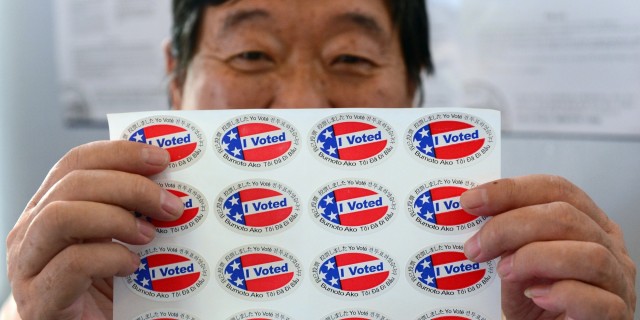
Asian-American voter (The Huffington Post)

Asian-American voter (The Huffington Post)

Recent data shows that Asian-Americans are leaving the Republican party to vote Democrat.

Through the 1990s, Asian-Americans were more likely to vote Republican. It’s thought that Asian-American generally voted for the Republican candidate due to connecting with fiscally and socially conservative platforms. Asian-Americans voted Republican around 55% of the time during the 1992 presidential election between Republican George H.W. Bush and Democrat Bill Clinton (who ended up winning). The 2000 election became a turning point when more Asian-Americans began supporting the Democrat candidate. In 2012, Barack Obama won with Asian voters by “nearly 50 percentage points.” Karthick Ramakrishnan of the National Asian American Survey attributes this outcome to Democrats actively trying to win the Asian-American vote.
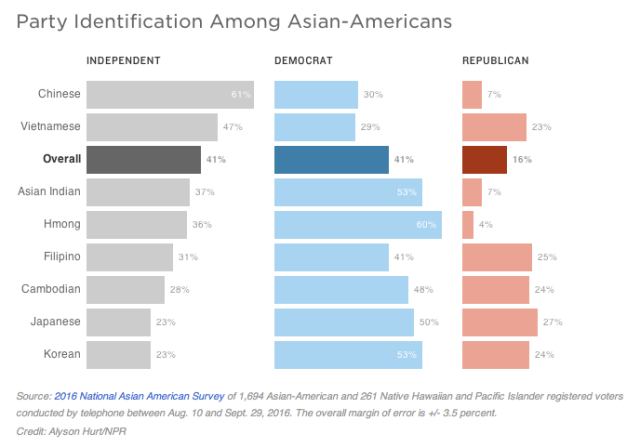
Party Identification Among Asian-Americans (NPR)

Party Identification Among Asian-Americans (NPR)

Over time, Asian-Americans gravitating towards the Democrats doesn’t seem like a big deal, and more like a natural shift over time. Except that it might not be. This fact becomes more important in this election where surveys have shown Asian-Americans rejecting many points of Republican presidential candidate Donald Trump’s platform: keeping out and deporting immigrants, diplomacy with China, among other aspects.

But it’s too early to tell whether this shift for Asian-Americans toward the Democrats is a blip on the radar or foretelling a larger, more long-term trend. According to Ramakrishnan, it’s too early to tell. In 2015, 47% of Asian-Americans identified as politically independent.

In October 2016, a survey found that registered Asian-American voters supported Hillary Clinton over Trump by a 4-to-1 lead.

 

California Will Vote to Require Condoms on Porn Shoots

Condoms (StyleCaster)

Condoms (StyleCaster)

This year, California residents will head to the polls, and be asked to vote on something unique to the Golden State: what happens on a porn shoot.

Proposition 60, a.k.a. the Condoms in Pornographic Films Initiative, proposes that adult performers wear condoms during scenes where they “actually engage in vaginal or anal penetration by a penis.” (Side note: can we just appreciate that this language made it into a ballot measure?) Aside from that essential fact, the measure requires producers of pornographic films to pay for medical vaccinations and testing related to sexually transmitted diseases (STDs), and to obtain the state health license.

This measure would cover the San Fernando Valley, where the majority of the porn industry’s films are shot. The measure is not without precedent: In 2012, 56% of voters approved a similar measure, called Measure B, that covered Los Angeles County.

A recent University of Southern California Dornsife/LA Times poll showed that 55% of respondents would support the measure if they had to vote that day. Over 1K people were surveyed.

But Prop 60 also has the potential to harm one of California’s booming industries. Right now, perfumers get tested regularly for STDs, and shooting shuts down if an outbreak occurs. It’s pretty self-governed. But passing the measure might open up liability for independent producers and private companies that distribute porn films.

One reason behind opposing Prop 60 hinges on the fact that it could drive the business elsewhere, to a place that has less stringent (or no) regulations. This concern also has precedent in data: In 2012, the year Measure B passed in Los Angeles, FilmLA reported that there were 480 permits pulled for shoots involving “nonsimulated sex.” In 2013, that number plummeted drastically to 40 permits, and has been dropping year-over-year since. Implementing Prop 60 would also cost the state around $1M to “license and regulate film production, and an additional several million dollars in lost taxes if the industry flees California.”

As you can see, there are many aspects to consider whether you’re for or against Prop. 60. Californians, make sure you do your research before you vote!


Single Women are the Most Powerful Voting Demographic

A single lady's ring finger (NY Mag The Cut)

A single lady’s ring finger (NY Mag The Cut)

Single women are a force.

Granted, they’ve always been a force to be reckoned with. But now they’re becoming a powerful voting bloc that could decide this election.

This hasn’t gone unnoticed. Author Rebecca Traister’s book All the Single Ladies: Unmarried Women and the Rise of an Independent Nation focused on this demographic and how its members are shaping and redefining social norms when the book was released earlier this year. One of Traister’s sources, Page Gardner, predicted that “there could be more unmarried women in the electorate this year than married women — and they vote super left.”

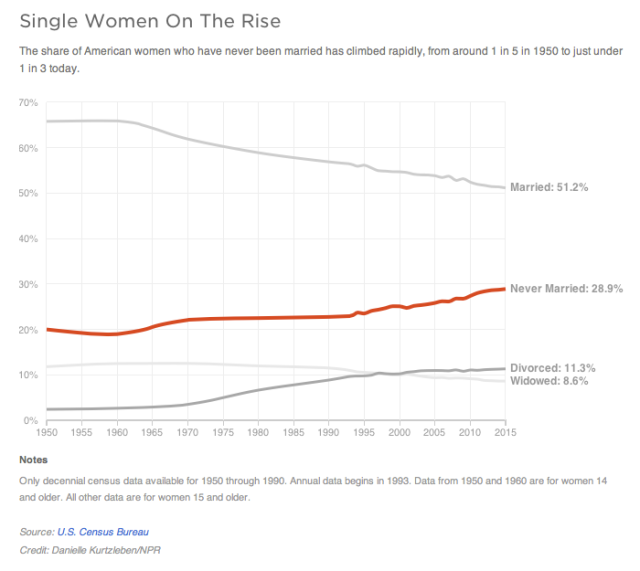
Single Women On The Rise (NPR)

Single Women On The Rise (NPR)

This trend gained steam in 2012. Single women comprised 53% of the voting population, and supported President Barack Obama at around 55%. Compare this to men, who supported Obama at around 45%.

And beware, these single ladies are selective with their votes: The results of the American Women Web survey in the Elle March 2016 issue found that 86% of single women, and 84% of overall women, would not vote for a candidate that was anti-women. This wasn’t partisan, since 73% of Republican women agreed with that statement.

Welcome to Sex & Election 2016 Week!

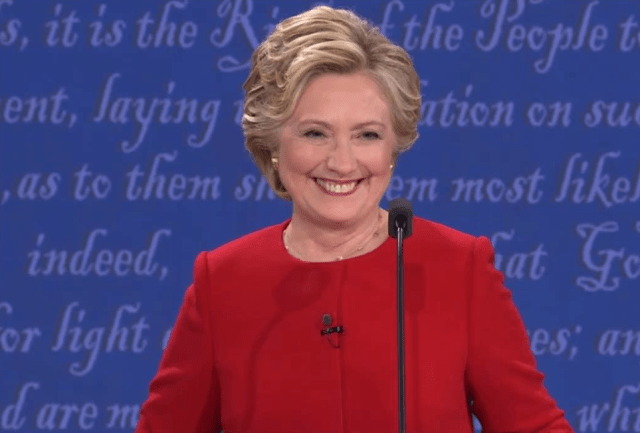
Hillary Clinton (YouTube)

Hillary Clinton (YouTube)

Welcome to Sex & Election 2016 Week on Sex & Stats! From now until Tuesday, Nov. 8th (Election Day for those in the U.S.), I’m bringing you the best in political-themed statistics that intersect with sexuality, gender, race, etc. And this presidential race has been a veritable GOLD MINE for this shit. I’m not even joking (as you’ll find out this week).

Until 11:59 p.m. PST, you’ll get two posts a day on this topic. (Yes, even on Friday!) Get ready for 11 more posts that will make you laugh, cry, and possibly weep for the state of the country, all using data.


Trends: Historic Interracial Couples on Film

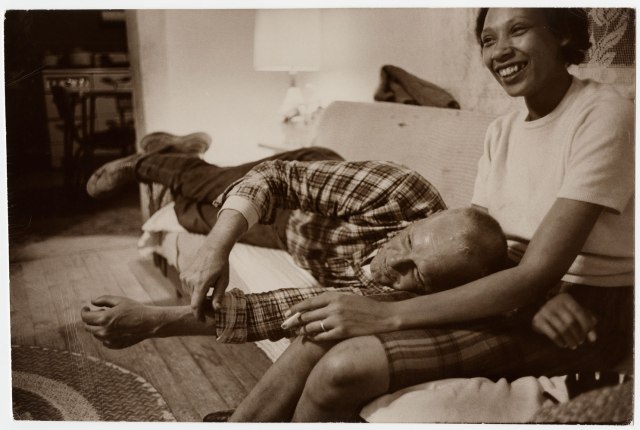
Ruth Negga and Joel Edgerton in 'Loving' (Evening Standard)

Ruth Negga and Joel Edgerton in ‘Loving’ (Evening Standard)

What a difference a year makes.

Last year, the conversation around movies in Hollywood centered around the fact that there was no diversity. #OscarsSoWhite gained prominence during the national conversation. It seems the entertainment industry listened, because movies with diverse casts and themes will be released. Even better, a couple of movies will tell stories from history that need to be more widely known than they are.

The story of Virginia couple Mildred and Richard Loving are featured in Jeff Nichols’ Loving. Mildred, a Black woman (played by Ruth Negga), and Richard (Joel Edgerton), a white man, were arrested in 1958 for the crime of being married when interracial marriage was a crime. The Lovings’ ordeal to have their union be legally recognized led to the landmark Loving v. Virginia Supreme Court case in 1967. The ruling struck down every anti-miscegenation law still on the books in 16 Southern states. (At least in theory; several states still tried to unofficially enforce the law.)

Too few people know this story, and I’m glad it’s gaining more recognition. The case is seen as a landmark in the struggle for civil rights, and can be regarded as the spiritual predecessor to the recent marriage equality fight and decision.

Loving isn’t the only historic interracial love story debuting this winter. Amma Asante’s A United Kingdom focuses on the story of Sir Seretse Khama (played by David Oyelowo), a member of the Bechuanaland Protectorate’s royal family, and Ruth Williams (played by Rosamund Pike), an English woman and Khama’s eventual wife. The Khamas’ romance and eventual marriage set off an international scandal which took years to rectify.

Director Asante’s previous feature was Belle, the true story of a mixed-race English woman in the 18th century. I enjoyed it, particularly because it was something I hadn’t seen before: a woman of color in a period costume drama. Asante won my attention and my dollars with that film, so I’m curious to see her new one as well.

Loving will be released on Nov. 4th, and A United Kingdom will be released Jan. 17, 2017.


#ThrowbackThursday: “The Loving Story,” 2011

Richard and Mildred Loving, 'The Loving Story' (Documentary Daze)

Richard and Mildred Loving, ‘The Loving Story’ (Documentary Daze)

Documentary “The Loving Story” was released in 2011, and examined the lives of Richard and Mildred Loving. An interracial couple from Virginia, they were arrested for violating Virginia’s anti-miscegenation law shortly after their wedding in 1958. The film examines their struggle to remain married and able to live in Virginia, which led to the historic Loving v. Virginia Supreme Court decision of 1967.

The film was directed by Nancy Buirski, premiered in 2012, and won a Peabody Award.

Season 2 of Netflix’s “Jessica Jones” Will Only Feature Woman Directors

Krysten Ritter as Jessica Jones (IndieWire)

Krysten Ritter as Jessica Jones (IndieWire)

Hey Hollywood, you know all that bluster about how you can’t find female directors/writers, etc.? You know how you keep saying you want to diversify but you just can’t? Even though you’re trying really hard? Well, “Jessica Jones” is calling your bluff and raising it.

The Netflix series, which focuses on the Marvel character of the same name (played by Krysten Ritter), has been praised for its depictions of sexual assault and female friendship, among other aspects. And now showrunner Melissa Rosenberg has thrown down the gauntlet and declared that no one shall sit in the director’s chair unless their chromosomes are of the XX variety.

This isn’t the first time a TV series has hired solely women directors to direct its episodes. That would be “Queen Sugar,” co-produced and written by Ava DuVernay (who’s the first Black woman to direct a $100M movie). And that happened earlier this year.

No word yet on who’ll be gracing the director’s chair for the second season of “Jessica Jones” (and also no release date), but I can’t wait to find out.

But one thing’s for certain: Your move, Hollywood.


Hasbro Reports Sales Boost in Q2 2016 with “Frozen” and Disney Princess Toys

Hasbro's Disney Princess line (Elena's Closet)

Hasbro’s Disney Princess line (Elena’s Closet)

Toymaking giant Hasbro recorded better-than-expected sales in Q3 2016. And they have the Disney Princesses and “Frozen” sisters to thank.

Hasbro won the global rights to make the aforementioned toys from Mattel earlier this year.

The two toy lines helped boost the girls category revenue by 35%, bringing the total to $172M+. The lines also helped partner brand revenue grow by 15% (which was also helped by “Star Wars” toys). And even before the most recent earning report came out, it was estimated that the Disney Princesses line would generate about $60M in Q3 2016.

This demonstrates that girls (and the men and women who buy their toys) have some massive purchasing power. Let’s hope that this is taken into account before “Star Wars: Rogue One” hits theaters, so we actually have some action figures of lady badass Jyn Erso.


“Loving” Film Releases Interracial Emoji Couples

Love-Moji ('Glamour' en Espanol)

Love-Moji (‘Glamour’ en Espanol)

Given our current obsession with all things tech, Focus Features has found a fitting way to promote the company’s upcoming film “Loving:” custom emojis.

The Love-Mojis feature a variety of emojis of interracial couples in about every combination you could think of. So if you’re in an interracial couple, and you haven’t yet felt your coupling properly represented by the Unicode Consortium, your time has finally come!

Why is this important? Let’s start with the film itself: “Loving” follows Richard and Mildred Loving, a Virginia couple who got married in 1958. This wouldn’t be so remarkable except that Richard was white and Mildred was black. Their marriage happened during a time where interracial dating, much less marriage, was frowned upon, to put it lightly. Interracial marriage could bring a charge of miscegenation (race mixing, in plain terms).

The Lovings were arrested after their marriage for the crime of their relationship, and forced to leave Virginia. Once in D.C., they began legal proceedings. The Loving v. Virginia case went all the way to the U.S. Supreme Court. In 1967, the Supreme Court ruled anti-miscegenation laws unconstitutional, which struck down said laws that were on the books of sixteen states. (All sixteen states were in the South. Shocker.)

Needless to say, this was a landmark case.

But why use emojis to promote it?

Since emojis debuted, the options for emoji couples were pretty stark. They didn’t show the breadth of real-life relationships in terms of race and also sexual preference. The new Love-Moji take this into account, and rectify the oversight.

There’s also the fact that using emojis has become a convenient visual shorthand for emotions we don’t particularly feel like typing out in words.

You can get the Love-Moji via app stores and at VoteLoving.com.

“Loving” comes out on Friday, Nov. 4th.

Beyonce and Solange’s #1 Albums: By The Numbers

Beyonce and Solange Knowles (ET Online)

Beyonce and Solange Knowles (ET Online)

Musicians/performers/all-around FLAWLESS women Beyonce and her sister Solange each have achieved something many artists dream of: cracking the Billboard 200 chart. And now each have achieved the distinction of having an album reach #1.

But they also sit in a rarefied strata: Beyonce and Solange are only the third pair of siblings to make the Billboard 200 chart. They’re also the only sisters to achieve this feat.

Since this is such an impressive distinction for the Knowles sisters, here are some numbers that put their joint accomplishment in perspective:

Number of Siblings Who’ve Also Scored #1 Albums: 2

  • Michael and Janet Jackson
  • Master P and Silkk the Shocker

Number of Siblings Who’ve Also Hit #1 in a Calendar Year: 1

  • Michael and Janet Jackson, 2001

Number of Times the Knowles Sisters’ Albums Have Hit #1: 

  • Beyonce: 6
  • Solange: 1

Number of Times Beyonce Hit #1 With Destiny’s Child Albums: 2

Number of Solo Albums Each Knowles Sister Has Released:

  • Beyonce: 6
  • Solange: 3

2016 Album that Hit #1 for Each Knowles Sister:

  • Beyonce: Lemonade
  • Solange: A Seat at the Table

Number of Units Consumed Within First Week of 2016’s Album Release (includes full albums, streaming- and track-equivalents):

Number of Sales Within First Week of 2016’s Album Release:

Best-Selling Album for Each Knowles Sister: