How Female Orgasms Influence Mate Choice

Orgasm

Orgasm

Happy Friday! Here’s something to fun to keep mind as you head out for the weekend:

A new study claims that female orgasms influence beneficial mate choice: The more orgasms a woman has was directly correlated to her partner’s income, confidence and attractiveness. But it’s not all about quantity. Orgasm intensity was related to sexual satisfaction in terms of intercourse frequency and “how attracted they were to their partners.” Makes sense, right? (“Salon” breaks it down into less-scientific terms.)

The study analyzed “heterosexual female college students in committee relationships,” but doesn’t go into detail about these subjects. What was their average age? How long had the couples been together, on average? How times a week were the couples having sex on average?

Sounds like an excellent way to make a positive mate choice to me.

How Many People Have Affairs?

Showtime's "The Affair"

Showtime’s “The Affair”

After watching the pilot of Showtime’s new series “The Affair,” I became curious about finding stats on affairs.

A 2012 “Psychology Today” article cites a study that claims 10-13% of adults cheat, with the percentage peaking at 20% in the 40s age range. It doesn’t break down whether this includes both married and otherwise committed couples, and doesn’t break the data down by gender.

Will you watch “The Affair?”


At What Age Do Women Begin to Menstruate?

Teenage Girl

Teenage Girl

Getting your period for the first time is a huge milestone for every young girl. It’s exciting and a little scary all at the same time, and you’re wondering if you got yours earlier or later than normal, or right on time.

The National Survey of Family Growth (part of the Centers for Disease Control and Prevention) surveyed women ages 15-44 years old, both in 2002 and from 2006-2010. The mean time of first menstruation has decreased slightly from 12.6 years in 2002 to 12.5 years in 2006-2010. No doubt this will continue to decrease, as many are noting that puberty in girls is occurring earlier than ever before.

Faking It: Who’s Doing It?

Maybe she will, maybe she won't.

Maybe she will, maybe she won’t.

Women faking orgasms have been a staple of pop culture for, well, probably forever. (I’m sure there’s a cave painting illustrating this somewhere that’s yet to be discovered.) But just how common is it?

A recent study finds that 80% of women fake their Os. At first glance, this seems high, doesn’t it?

Like many sex stats, the data is self-reported. I’m wondering if even more women fake it, but didn’t admit to it during the study. Of course, there’s no way to confirm this, short of doing another survey, since some women might (understandably) lie.

There’s also the issue that the majority of women can’t come purely from vaginal intercourse. Did the study ask women if they can (by which I mean physically able to) come from vaginal penetration? The study’s abstract doesn’t elaborate on this point, but it might be within the whole study.

Either way, a large number of women are faking it for a variety of reasons.

Period Sex: Who’s Doing It?

Splattergore

Splattergore

“The Cut” published an article yesterday on period sex. While the overall excellent article was long on anecdotes, it lacked what I love: hard stats!

How many women are having period sex? It’s the thing we dread will ruin our steady dates and hot hookups, but some women have figured out that it doesn’t have to be that way.

In 2011, menstrual cup company Softcup released a survey that uncovered, among other things, how much a woman’s perdio affects her sex life. The survey found that 60% of all women are uncomfortable with period sex. It showed an age disparity: 70% of older women (ages 45-54) were uncomfortable, while only 51% of younger women (ages 18-34) were.

(I don’t know where women ages 35-44 disappeared to.)

It’s clear that the majority of women haven’t gotten into period sex. But based on the “NYMag” article, the men are having more fun than ever.


Orgasms During Sex: French Women vs. American Women

Eiffel Tower

Eiffel Tower

We all know the stereotype that the French are having way more sex than anyone, particularly Americans. But are they actually having more pleasure?

A 2012 study of 3K+ French women ages 15 to 80 reveals that 74% have no trouble achieving orgasm (but it’s not specified whether it’s alone or with a partner). Within that percentage, 55% climax often, 16% come every time, 21% climaxed rarely and 5% never do.

How does that stack up to American women?

A 2009 article from ABC News notes that 75% of women can’t reach orgasm solely from sexual intercourse. It’s unclear a) how large the study was, in terms of quantity and age range, and b) for the women who were reaching orgasm, the frequency there.

It’s not a pure comparison, but it appears in this case, the stereotype is true: French women are having better sex (measured here by orgasm frequency).

Sex Ratios: Males vs. Females, 1950s

Blue Man, Pink Woman

Blue Man, Pink Woman

One interesting data point (among the many) the Census has is that of the sex ratio: the number of males for every 100 females. The 1950 Census finds a 98.6 sex ratio, i.e. 98.6 men for every 100 women, within the total U.S. population for all ages.

The ratio actually hits over 100 for a few categories, starting in childhood: Under 5 years, 5-9, 10-14 and 15-19 all registered high ratios. It begins to dip into the high 90s from age 20 to age 54. Ages 54-59 and 60-64 move back up to ratios over 100.

The next two age brackets (65-69 and 70-74) go back into the high 90s. But the last two brackets decrease more dramatically than any of the previous ones: Ages 75-84 has a sex ratio of 85.1 and ages 85+ has a 69.6 ratio. This makes sense, as men usually pass away earlier in life than women.

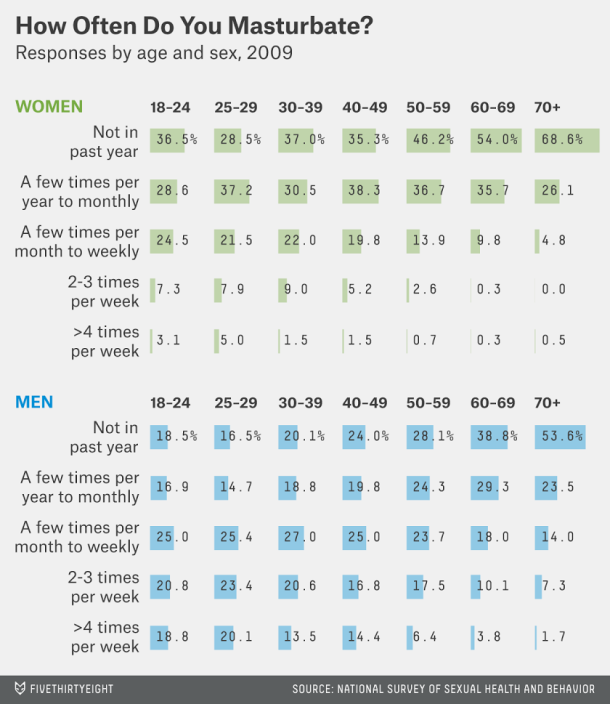
Masturbation Data: Age, Gender and Frequency

FiveThirtyEight NSSHB Masturbation Results 2009

FiveThirtyEight NSSHB Masturbation Results 2009

Indiana’s National Survey of Sexual Health and Behavior (NSSHB) recently crunched some data that allows us a few insights into the nation’s masturbation, broken down by age, gender and frequency. Their methodology: 5K+ Americans, ages 14-94, with data collected March to May 2009. (Data science site FiveThirtyEight made a fun graphic illustrating the results, pictured above.)

Here’s what we can glean from the findings:

Women:

Around age 40, the number of women who haven’t masturbated within the past year begins to exceed 35%, and keeps climbing up. (The 30-39 bracket topped out at 37%, but then sank to 35% for the 40-49 bracket.) The older brackets grow between 8-12 percentage points. Why is this? This could point to the fact that women of earlier generations were conditioned to think that masturbation was dirty, and don’t touch themselves on a regular basis, if at all.

Across the board, women in the 2-3 times a week and over 4 times a week fall into the minority. This could indicate achieving a comfort level with their bodies, resulting in knowing exactly which buttons to push (so to speak), and/or a higher-than-average libido.

Men:

The numbers for me only hit single digits with men ages 70+ masturbating 2-3 times a week, and men ages 50-59, 60-69, and 70+ masturbating over 4 times a week. It’s probable that the decreases are inversely correlated with age.

What’s surprising is that the highest percentages weren’t in the 18-24 age range: We hear so much in popular culture that boys masturbate most frequently (at least from anecdotal evidence of any mom with at least one son). But this study shows that the largest percentages for frequency are really falling within the 30-39 and 40-49 age brackets.


Losing It: Average Age of Virginity Loss in the U.S.

Kissing Couple 9.2.14

According to a 2006 study, men and women in the United States first experienced sexual intercourse at age 17 on average.

A 2007 study by Mathmatica Policy Research for The Kinsey Institute notes that 49% of women lose it by age 17, while 46% of men lose it by the same age.

Assuming this holds true with the population recorded in the 2010 Census, here’s how that would break down:

Women:

The 2010 census recorded over 10M women ages 10-14, and over 10.7M women ages 15-19. If we assumed that each age spreads equally (i.e. the same number of 10-year-olds as the number of 19-year-olds), there would be approximately 2M women for each age 10-14, and 2.140M women for each age 15-19.

Let’s also assume that virginity loss commences at adolescence, at age 13. Within the two age brackets, ranging ages 13-17, approximately 10.42M women have lost their virginities during this timeframe.

Putting the 10.42M over the combined age brackets totaling approximately 20.7M yields approximately 50%.

Men:

The 2010 census recorded over 10.5M men ages 10-14, and over 11.3M men ages 15-19. Again, we’re assuming that the various ages spreads equally: Approximately 2.1M men for each age 10-14, and 2.26M men for each age 15-19.

Again taking the 13-17 age range, approximately 10.98M men lose their virginities during this period. This amounts to approximately 50% of the combined age bracket range.


While the average age for virginity loss in women has stayed relatively flat in the three years since 2007 to 2010, men’s average age for the same rite of passage has risen slightly. This could be due to the fact that men are losing it slightly earlier within the age spread, or that there are simply more men within this age range.