American Ballet Theatre Promotes Filipina-American Stella Abrera to Principal Dancer

Stella Abrera (Ballet UK)

Stella Abrera (Ballet UK)

By now, I’m sure you’ve heard that New York City’s American Ballet Theatre (ABT) recently promoted dancer Misty Copeland to principal, making her the first Black principal in the company’s 75-year history. But that wasn’t the only important promotion that was made.

Stella Abrera became the first Filipina-American to ascend to the rank of principal. (Two promotions, two history-makers this round for the ABT, if you’re keeping track.) She was born in the Philippines and moved to the U.S. when she was four years old. Beginning in Pasadena, Abrera also studied ballet in San Diego and Sydney, Australia. She joined ABT in 1996, and became a soloist in 2001. Abrera’s various roles have included the titular role in “Cinderella,” Emilia in “Othello,” and Clara and The Snow Queen in different versions of “The Nutcracker.”

Ballet is an art form notorious for having little diversity. I hope Abrera’s promotion (and Copeland’s) opens the door for more non-white dancers.


How Do Most Women Feel About Their Abortions?

Pregnant woman (SLO County)

Pregnant woman (SLO County)

The popular media image of a woman who has had an abortion is that she regrets it. She sighs with longing whenever she sees a child around the age of her unborn one, thinking that it could have been them.

While the emotional aspect might pop up now and again, many women who’ve had abortions feel that they’ve made the right choice for themselves. A recent study followed women who’ve undergone the procedure and followed up with them for years to determine their emotional wellbeing.

From 2008 to 2010, researchers looked at 667 women across 30 U.S. clinics, and divided them into two groups: women who terminated a pregnancy within the first trimester, and women who terminated within two weeks of the mandated limit. The researchers then called the women every six months afterwards for three years to identify negative and positive emotions associated with the act.

Overall, women felt that they had made the right decision 99% of the time, and experienced “decreased emotional intensity” over time. Those who felt negative emotions were likely to have had a planned pregnancy, and/or difficulty in making the decision to undergo an abortion. There was virtually no difference between how the two groups of women processed the experience.

This is very important information, as it overturns a popularly-held misconception. Hopefully, these results will act as a catalyst so that the Supreme Court will stop basing abortion rulings on “abortion regret.”

Misty Copeland is American Ballet Theatre’s First Black Principal Dancer

Misty Copeland in 'Swan Lake' (Vanity Fair)

Misty Copeland in ‘Swan Lake’ (Vanity Fair)

Last week, the American Ballet Theatre (ABT) in New York City promoted dancer Misty Copeland to principal. Copeland is the first Black woman to attain the level of principal (the highest level possible for a dancer) in ABT’s 75-year history. (ABT has previously had one Black man reach principal: Desmond Richardson, who achieved the level in 1997.) Since she’s considered a classical ballet dancer, this is all the more rare.

Copeland is considered to be a ballet prodigy since she began studying at age 13, and began dancing in pointe shoes a mere three months (!) later. She came to the larger public’s attention when she starred in the now-famous UnderArmour 2014 ad spot “I Will What I Want,” which featured her dancing. Since then, Copeland has written a biography and a children’s book, appeared on the cover of “Time” for their 2015 Top 100 list, and was the subject of a documentery, “A Ballerina’s Tale,” that premiered at the Tribeca 2015 Film Festival.

Copeland’s notable roles include the titular role in “The Firebird,” Swanhilda in “Coppélia,” and the dual roles of Odette/Odile in “Swan Lake.” The “Swan Lake” roles were significant for Copeland, and the rest of the ballet world:

It was a symbolically significant moment in American arts, in which a black woman danced the role of ballet’s famed white swan—and sold out all of her performances from the moment tickets went on sale months earlier.

Copeland became a member of ABT’s corps de ballet in 2001, and was promoted to soloist in 2007. She’ll start as principal dancer on August 1st.

Google Trends: How Many People Are Searching for a Female Viagra?

Little pink pill (Stuff NZ)

Little pink pill (Stuff NZ)

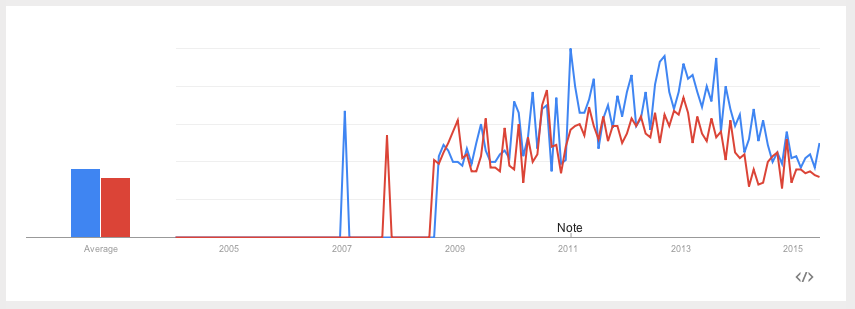
Hot on the heels of the news that a female Viagra is edging closer to public consumption, I wanted to see how often U.S. Internet users (which would be basically everyone) were searching for information related to female Viagra. I used “2004-present” as my timeframe.

First, here’s how often “female viagra” (red line) against “viagra” (blue line):

Google Trends: 'Female Viagra' vs. 'Viagra,' U.S. 2004-Present

Google Trends: ‘Female Viagra’ vs. ‘Viagra,’ U.S. 2004-Present

As you can see, there’s a lot less searching for the former term versus the latter.

Now, let’s look at “female Viagra” on its own:
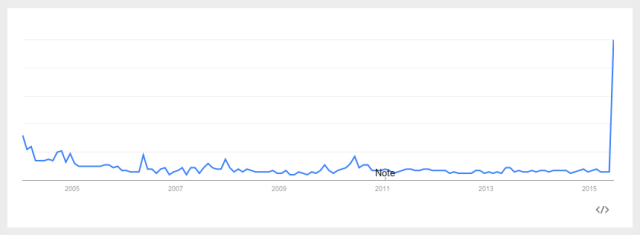
Google Trends: 'Female Viagra,' U.S. 2004-Present

Google Trends: ‘Female Viagra,’ U.S. 2004-Present

It’s hard to ignore that huge spike at the end of the timeframe. That occurred this month. It’s no coincidence: Sprout Pharmaceuticals announced that their female desire pill Flibanserin/ADDYI was recommended for Food & Drug Administration (FDA) approval on Jun. 5th.

Flibanserin/ADDYI will treat women with low libidos, known medically as hypoactive sexual desire disorder (HSDD). I wanted to see how common Google searches for low sex drives appeared.

First, I searched “low sex drive in women,” which was the first specific option Google autofilled for me:
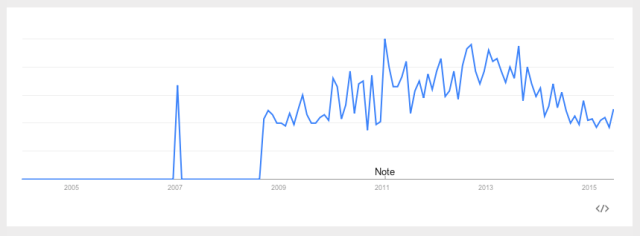
Google Trends: 'Low Sex Drive in Women,' U.S. 2004-Present

Google Trends: ‘Low Sex Drive in Women,’ U.S. 2004-Present

Interesting. It appears that the term hit its peak (ha) around a spike in 2011, and then crested in 2013. It’s dipped since then, but is starting to come back up. (Also, I’d love to know what happened in 2007.)

But let’s put this in context. Here’s “low sex drive in women” (blue line) versus “low sex drive” (red line):
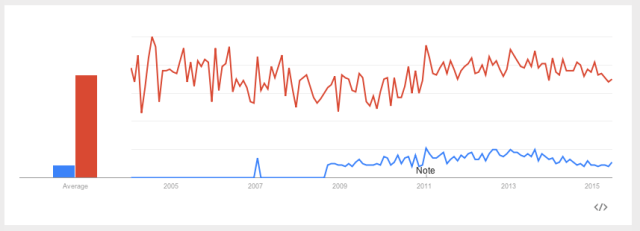
Google Trends: 'Low Sex Drive in Women' vs. 'Low Sex Drive,' U.S. 2004-Present

Google Trends: ‘Low Sex Drive in Women’ vs. ‘Low Sex Drive,’ U.S. 2004-Present

It’s interesting that the female-specific searches don’t make up that much of the overall searches.

Now let’s find out how many men are searching for information on low desire. Here’s “low sex drive in women” (blue line) versus “low sex drive in men” (red line):

Google Trends: 'Low Sex Drive in Women' vs. 'Low Sex Drive in Men,' U.S. 2004-Present

Google Trends: ‘Low Sex Drive in Women’ vs. ‘Low Sex Drive in Men,’ U.S. 2004-Present

OK, now we can see that low libidos in women are an issue, insofar as they’re being Googled.

So a lot of people (we could probably reasonably assume women) are searching for information on low sex drives in women. But how many are searching for a solution? Maybe a cure, call it “female viagra” (red line)?

Google Trends: 'Low Sex Drive in Women' vs. 'Female Viagra,' U.S. 2004-Present

Google Trends: ‘Low Sex Drive in Women’ vs. ‘Female Viagra,’ U.S. 2004-Present

Holy shit, this is amazing. Sure, users are searching for (presumably) information on women having low sex drives, but they’re searching a lot more for a solution. At no point in this graph are there more searches for “low sex drive in women” than there are for “female viagra.” Also, note how the “female viagra” searches spike at the end, halfway through 2015. As noted above, that’s when Sprout announced their “little pink pill.”

Conclusion:

The evidence here points to the fact that people are actively searching for solutions to cure women’s low sex drives. This certainly warrants a female Viagra pill to be brought to market, but why the hell wasn’t this developed sooner?!


Thursday Trends: Plus-Size Models in Mainstream Media

Tess Munster (Bustle)

Tess Munster (Bustle)

It’s safe to say that plus-size models are having a moment in the spotlight right now. The fashion industry has finally cottoned on to the fact that most women are not a size -2 (which is rarely found in nature), but that more “normal”-sized women representative of the American public might want to see themselves depicted (and desired!). And the inclusion will also sell more for said fashion companies, so it’s a win-win all around.

We can trace this development to late last year, when the Pirelli calendar unveiled its 2015 edition. Candice Huffine made history as the first plus-size model to grace the legendary calendar’s pages. She broke a tradition stemming from 1964 of using the usual thin models to usher in a new year and a new outlook on beauty standards.

Speaking of beauty standards (more like #effyourbeautystandards), plus-size model/retro bombshell Tess Munster (now Tess Holliday) recently became the first plus-size model to sign with the U.K.’s MiLK Model Management. She’s now the first plus-size model signed to a mainstream agency, in the Curves division, and the first one within Curves above a size 20 (she’s a 22 and stands at 5 ft. 5 in.). Munster cuts a distinctive figure, with bright red wavy hair, alabaster skin and lots of tattoos. She’s been around for awhile, and was named a top plus-size model in the world by “Vogue Italia” in 2013. That same year, the “body positive activist” began the aforementioned hashtag to encourage women to love their bodies at any and every size. She also participated a video in which she and other plus-size models recreated Beyoncé’s music video for “***Flawless,” called “#everyBODYisflawless.”

Fashion blogger/model Nadia Aboulhosn was one of these models. She’s gained attention and press for her fashion prowess that’s all about the street style. The half-Lebanese stunner first drew notice when she won American Apparel’s XL Model Search in 2011.

Perhaps the most mainstream seal of approval, “Sports Illustrated” selected a plus-size model for this year’s Swimsuit Issue: Model Robin Lawley is a size 12. Lawley had previously been on the cover of Australian “Vogue,” as the first plus-size model, and was the first plus-size face of Ralph Lauren in 2012. But even though she’s plus-size by fashion industry standards, she still looks…well, like a normal tall, curvy girl. Like a model.

Let’s hope that plus-size women gaining visibility in the fashion world isn’t a one-time trend, and eventually becomes an unremarkable norm encompassing diverse shapes and sizes.

Dr. Carl Djerassi, Father of The Pill, Has Died

Dr. Carl Djerassi (Rutgers News)

Dr. Carl Djerassi (Rutgers News)

Modern contraception pioneer Dr. Carl Djerassi died last Friday in San Francisco. He was 91 years old, and had suffered from complications of liver and bone cancer.

Often called the father of The Pill, Djerassi found an essential component of the now-common family planning product. In 1951, while working as a researcher at Syntex in Mexico City, he and two others successfully synthesized norethindrone, a progestin that later provided the base of the modern birth control pill. Djerassi and his team received a patent for their discovery.

Initially, the scientists thought that norethindrone would help fertility, but they soon realized that it served another purpose. The team knew that progesterone inhibited ovulation during pregnancy. They modified the progestin’s basic structure and added ethisterone, a compound thought to be devoid of medical value. (Warning: science-speak ahead.)

Djerassi’s team found that they could change the structure of progesterone to increase its potency eightfold. This progesterone analogue was strong enough to work when injected, but lost its potency when administered orally…Djerassi’s group made the same chemical modification in ethisterone that they had earlier made in progesterone.

(Interesting side note: At the time, Djerassi wasn’t researching anything to do with conception when he and his team made his famous discovery. He was actually looking for a compound that could be used to treat cancer. Happy accident, as they say.)

After five years of clinical trials, the birth control pill began reached the mass market, and cracked 1960s sexual norms wide open. (And we’re still feeling the effects of it today.)

This wasn’t his only big discovery: Djerassi also patented the first antihistamine, the drug that prevents allergy symptoms.

During his lifetime, Djerassi received 34 honorary doctorates. He was also the recipient of the National Medal of Science for chemistry in 1973, and the National Medal of Technology and Innovation in 1991. The two awards are the U.S.’s highest science and technology honors, respectively.

In addition to his scientific accomplishments, Djerassi also wrote plays (some performed off-Broadway) and science-fiction, founded a company to control insect growth, and started an artists’ colony in his property in California.

Dr. Djerassi’s contributions to family planning were, and continue to be, a boon to women the world over, and his work will continue to hold great value for the coming generations.

Thank you, Dr. Djerassi. Thank you.


What’s the Most Dangerous Sex Position?

Girl on top (Ethnic Health Court)

Girl on top (Ethnic Health Court)

Happy Friday! Time for a Sex & Stats PSA: This weekend, as you’re getting it on with your partner(s), remember that some positions are more dangerous than others. (But that makes them more exciting, right?) Scientists have recently discovered that girl-on-top sex is the most dangerous position for men.

How did they discover this, you ask? Scientists in Campinas, Brazil (a city northwest of Sao Paolo) examined patients from three local hospitals to study penile fractures and their long-term influence on potential future deformities and erectile and voiding issues.

According to “Advances in Urology,” 42 of the 44 “suspicious cases” (95%+ of the total) were confirmed to be penile fractures. The mean age of the men was 34+ years.

The abstract notes that many of the men presented certain, um, signs of fracture:

Half presented the classical triad of audible crack, detumescence (i.e. becoming flaccid), and pain.

(I totally grimaced just typing that. And I’m a woman.)

The researchers found that most penile fractures resulted from heterosexual intercourse, which happened in 66%+ of the subjects. By contrast, homosexual sex brought on fractures only with 9%+ of subjects.

Now, the good stuff: With heterosexual couples, “woman on top” was the most common position, with 14 participants, exactly 50% of the pool. “Doggy style” was the next most common, with a sample size of eight participants, at 28%+. Four subjects reported that the cause of fracture was “unclear,” which sounds like they did a variety of things that, combined, led to the fracture, or were just too embarrassed to report their activities.

The researchers’ hypothesis on why cowgirl is so dangerous boils down to the fact that women can better control the movement, with her body weight resting on the penis. In this position, men are more liable to injury since they can’t control or stop the movement, and they have the potential for greater injury as a result of “wrong-way penetration.”

Let’s review: 42 cases of penile fracture. 28 people/14 couples participating in heterosexual coitus. “Woman on top” has a full 50% chance of resulting in penile fractures.

So go out and have fun, but don’t end up in the emergency room.

#ThrowbackThursday: Margaret Sanger’s Birth Control Clinical Research Bureau, 1923

Margaret Sanger's Birth Control Clinical Research Bureau (BCCRB) (The Margaret Sanger Papers Project)

Margaret Sanger’s Birth Control Clinical Research Bureau (BCCRB) (The Margaret Sanger Papers Project)

I found this photo on The Margaret Sanger Papers Project. One post notes that Sanger founded America’s first legal birth control clinic on Jan. 2, 1923. By the 1930s, the Birth Control Clinical Research Bureau (BCCRB) served 10K+ patients per year, and “trained thousands of doctors and nurses.”

In the undated photo above, a nurse teaches other women…I assume birth control and/or family planning. I can’t say definitely if they were doctors, nurses or patients, but I’m confident they received the most accurate information of the day.

Sex & Stats’ 2014 Year in Review

Beyonce's 'Flawless' performance at the 2014 MTV Video Music Award

Beyoncé’s ‘Flawless’ performance at the 2014 MTV Video Music Awards

We’re almost done with 2014, so let’s take a look back at some important movements in the world of sexuality.

Trans Issues:

After a long time, the trans community has come into the spotlight.

It started back in early March, when Jared Leto took home the Best Supporting Actor Oscar for playing trans woman Rayon in “Dallas Buyers Club.” This was the first time an actor won an Oscar for a trans role, and the second time an actor playing a trans character had been nominated for an Academy Award. (The first time was when Felicity Huffman played a trans woman in 2005’s “Transamerica,” and garnered a Best Actress nomination.) The film also sparked a dialogue about cisgendered actors playing trans roles.

The community has been making strides on a local level as well. This fall, a Texas high school elected its first trans homecoming king.


Anal Play:

“We’ve been experimenting with the butt,” a good friend of mine said recently. Though she was referring to what she and her partner were getting up to, this statement also applies to our culture’s newfound fascination with anal play.

Ever since a stripper alleged that Drake enjoyed having his salad tossed, it seems like anal play and rappers  are having a major intersectionality moment. Nicki Minaj has proven this most frequently with her singles “Anaconda” and “Only,” positing herself in the power position of receiving, and greatly enjoying, having her asshole eaten out.

Anal sex also appeared on our broadcast TV screens in mainstream American homes this fall. The “How To Get Away With Murder” pilot and an episode of “The Mindy Project” both featured the formerly taboo act (the former more explicitly than the latter). Bonus points for both featuring interracial couples as well.


Feminism:

This is technically a holdover from 2013, but feminism continued to stake its claim in culture this year.

“Harry Potter” actress Emma Watson gave an inspiring speech to the United Nations launching the HeForShe campaign, mobilizing men to do their part for feminism. Chanel designer Karl Lagerfeld ended his spring 2015 runway show with models holding up signs painted with feminist slogans. Singer John Legend declared that society would be better if all men were be feminists.

Of course, Beyoncé also had a hand in this. (No surprise there, as her 2013 self-titled album sampled Chiamanda Ngozi Adichie’s now-famous TED talk on feminism.) She started it off strong in January authoring an essay on workplace inequality for “The Shriver Report: A Woman’s Nation Pushes Back From the Brink.”

But that was small compared to what was to come: During the 2014 MTV Video Music Awards, Beyoncé performed “***Flawless” in front of a giant lit marquee, branding herself as a FEMINIST. IN ALL CAPS. It certainly raised consciousness for many people, because Google searches for “feminist” and “beyonce feminist” majorly spiked that week.


2014 has been very eventful, and let’s hope society keeps making sex-positive strides forward in 2015. See you next year!

The Pirelli Calendar Shoots Candice Huffine, Its First Plus-Size Model

Candice Huffine, 2015 Pirelli Calendar shoot

Candice Huffine, 2015 Pirelli Calendar shoot

Last month, Pirelli unveiled its long-awaited 2015 calendar, with a very notable first: Candice Huffine became the first plus-size model to grace the calendar’s legendary pages since it began in 1964. So what took so long? According to their website, the Pirelli calendar is devoted to “pioneering innovation to staying ahead of the game.” This remark was made by Pirelli Chairman and CEO Marco Tronchetti Provera, and is displayed prominently on the calendar’s history page. It’s not as if Pirelli has shied away from doing something out of the norm for its calendar before. In 1987, photographer Terence Donovan used only black models (including a young Naomi Campbell) within its pages. It’s very sad that only after approaching 500 models over the course of 52 years, we’re only beginning to see plus-size women represented in one of the most well-known calendars. Now if only she was represented on the 2015 Pirelli Calendar site itself…