The Pentagon Will Pay to Freeze Troops’ Sperm and Eggs

Military troops (The Political Insider)

Military troops (The Political Insider)

Family-friendly policies have been proliferating workplace culture within the past year, and now there’s another company to add to that list: the Pentagon.

The Defense Department will a pilot program that allows troops to freeze sperm and eggs in an effort to retain service members. This policy is especially aimed at women: After 10 years of service (which would place a woman in her late 20s, assuming she enlisted when she was 18), women’s retention rate is 30% less than that of men’s. The cost is estimated to be around $150M for five years, or  $30M per year.

The move comes as the Defense Department noted changing policies that allowed for longer maternity leaves and “improved child care.” After creating a plan, the Defense Department will outline a plan, and will evaluate two years after implementation. The Defense Department is following in the footsteps of certain Silicon Valley companies such as Facebook, which recently began offering female employees the option of freezing their eggs.

So far, the Defense Department is the only government agency that will allow freezing sperm and eggs within their healthcare policy.

It’ll be interesting to see how the pilot program goes, and how it changes the quality of life for military members.

Are “3-Parent Babies” Ethical?

Human embryos (Bloomberg)

Human embryos (Bloomberg)

The genetic engineering future is here, and we’ve come to an important initial step: Is it ethical to create babies using DNA from three parents?

Scientists say “yes,” provided there are certain conditions. Said conditions were laid out in a report put out last week by the National Academies of Sciences, Engineering and Medicine:

Scientists would have to perform extensive preliminary research in the laboratory and with animals to try to make sure it is safe. And then researchers should initially try to make only male babies, because they would be incapable of passing their unusual amalgamation of DNA on to future generations.

The main goal of creating a “three-parent baby” would be to make a “genetically related child without risk of passing on a disease.” This would be done using mitochondrial replacement technique (MRT), which combines genetic material from two women and one man. Mitochondrial disorders are only passed down by women, so one women’s genetic material would substitute for the other one’s. (The defective material would be completely removed.)

Naturally, there are many implications (social, sexual, medical) for these experiments, and it’ll be interesting to see how things proceed. The UK introduced a bill on this same subject last year, and recently received approval to begin mitochondrial transplants.


Yahoo CEO Marissa Mayer is Pregnant with Twin Girls

Yahoo CEO Marissa Mayer (The New Yorker)

Yahoo CEO Marissa Mayer (The New Yorker)

Last week, Marissa Mayer, best-known as Yahoo’s CEO (one of the most-well known female CEOs in tech, if not the world), announced that she’s pregnant with twin girls. She made the announcement in a way befitting her industry: on Yahoo’s Tumblr.

The twins will be the second and third children for Mayer and her husband, Zachary Bogue. Mayer gave birth to her first child, her son Macallister, in September 2012. (That year was a momentous one for her: She became CEO of Yahoo earlier in July.) Mayer announced her pregnancy the same day that Yahoo announced her as their new CEO.

Mayer has said she’ll work through her pregnancy before her due date in December. She also worked through most of her first pregnancy.

After her son’s birth, Mayer famously didn’t take a break for maternity leave, returning to work only two week after giving birth. She also installed a nursery right next door to her office.

It’ll be interesting to see if having to care for two babies at once slows her down at all, and if she changes her views on feminism and working from home.


How Many Media Company Employees Had Ashley Madison Accounts?

Ashley Madison homepage (Ashley Madison)

Ashley Madison homepage (Ashley Madison)

Happy Friday! Ashley Madison: It’s the hack that keeps on giving. Every day brings a new joy. And here’s this one: The good people at “Gawker” (who’ve been doing a great job covering this whole thing) took a deep-dive into the data, all 9.7 GBs of it. Why? Well, to see how was dumb enough to use a work email as their AM registration email. (Personally, I’m surprised that nobody got called on the carpet after their network got wind of that verification email in their inbox.)

Now, you’d think that most people would know to use a throwaway email for this kind of thing, right? You’d think that, and you’d be wrong. At the time of the data dump, “Wired” reported that 15K+ domains belonging to the government and military were found, comprising .04% of the total emails found.

Here’s what Sam Biddle at “Gawker” found. (Incidentally, no emails registered to the Gawker domain were found).

'Gawker' Ashley Madison Email Data Analysis (Gawker)

‘Gawker’ Ashley Madison Email Data Analysis (Gawker)

So yeah, have some common sense as to when to use your work email. Have a great holiday weekend!


Twitter Announces Diversity Goals for 2016

Twitter logo (Design Trend)

Twitter logo (Design Trend)

Last week, Twitter announced its goals to diversify the company’s employees in 2016. The goals focused on increasing the presence of female and non-white employees. For the women, this includes reaching 35% women overall in the company, with 16% of tech roles going to women and 25% of leadership roles getting filled by women. For minorities, the goals are bringing the number to 11% in the overall company, with 9% of tech roles and 6% of leadership roles. Interestingly, the goals for minorities are marked with a literal asterisk, and apply to within the US only. (I’d like to know the reasoning behind that, and I’m sure I’m not the only one.)

This follows Twitter’s identifying and committing to diversity as a workplace issue. Last year, the company shared its diversity numbers. Spoiler alert (or not): it’s a whole lotta white dudes. While the company overall is about 70% male/30% female, it skews more guy-heavy in the tech section. Ethnically speaking, white and Asian employees comprise the largest portions, at nearly 60% and 30% respectively. Employees who self-identify as Hispanic or Latino or as Black or African-American make up only about 5% of the Twitter workforce.

Even though it looks like Twitter’s taking some big steps forward, Julia Greenberg at “Wired” points out that these steps are actually pretty small:

As it stands now, the company already has 34 percent women on its staff, with 13 percent in tech roles and 22 percent in leadership roles—not too far off from its goals. With 4,100 employees worldwide currently, the difference would be adding at least 41 women to reach its overall gender goal (though it would depend on the company’s growth).

Twitter is just the latest in a line of tech companies who’ve released their not-so-diverse data (following Facebook and Google, among others). It’ll be interesting to see how these goals will change due to supply and demand over time.

Ashley Madison Hackers Post the Site’s User Data

Ashley Madison homepage (Ashley Madison)

Ashley Madison homepage (Ashley Madison)

Happy Friday! Remember when cheating site Ashley Madison was hacked last month? And how the hackers threatened to release user data to the whole Internet?

Well, they’ve finally done it. The Impact Team, as the group of hackers is known, put the data online on the Dark Web, which can only be reached using specialized equipment. They dumped a jaw-dropping 9.7 GigaBytes (GBs) of data that went back to 2008.

(For context/scale, I have a 4 TeraByte (TB) external hard drive that I keep old school projects and work on. I’ve had that thing for over 6 years, and still haven’t filled it up. One TB is equal to .001 GBs. So you can imagine how voluminous this data breach truly is.)

There seems to be some disagreement over exactly how many users had data leaked. “CNN Money” claims 32M, while “Wired” and “Engadget” put the number closer to 37M.

As of July, Ashley Madison claimed to have 40M+ users.

Ashley Madison data dump (Gizmodo)

Ashley Madison data dump (Gizmodo)

Among the metrics leaked were users’  names, addresses and phone numbers. “Wired” looked into some initial data analysis:

A sampling of the data indicates that users likely provided random numbers and addresses, but files containing credit card transactions will yield real names and addresses, unless members of the site used anonymous pre-paid cards. One analysis of email addresses found in the data dump also shows that some 15,000 are .mil. or .gov addresses.

Passwords were broken by “hashing,” or breaking into the algorithm a site would use to protect passwords. The hackers used the “bcrypt” algorithm used in web development language PHP. This is usually a secure measure to protect passwords. But hey, at least Ashley Madison tried:

It’s notable, however, that the cheating site, in using the secure hashing algorithm, surpassed many other victims of breaches we’ve seen over the years who never bothered to encrypt customer passwords.

Have a great weekend, and go change your passwords!

Ashley Madison Hacked: Is Your Data Safe?

Ashley Madison homepage (Ashley Madison)

Ashley Madison homepage (Ashley Madison)

Earlier this month, online dating/cheating site Ashley Madison had its data breached by a group called The Impact Team. The group is lobbying for completely shutting down the site, and has been threatening to release users’ sensitive information if their demands aren’t met. Their demands are aimed at Avid Life Media (ALM), Ashley Madison’s parent company head-quartered in Toronto.

The hackers have leaked personal information from only two people so far. Considering that the site has around 37M-40M registered users, this is miniscule. The group is specifically targeting Ashley Madison’s “full delete” feature, where a user must pay to get his information scrubbed from the site. According to The Impact Team, the feature “netted ALM $1.7M in revenue in 2014.”

This is significant because it’s the second online dating site that’s encountered a massive data breach within a few months: Adult Friend Finder went through a similar situation back in May. But this case is unique in that it’s the only one that’s fallen prey to what ‘Time” calls “data kidnapping:” the hackers won’t leak the data unless they get what they want.

Ashley Madison is ranked #18 in adult sites, and received 124K+ visits on desktop since January 2015.

Siri Corrects Bruce Jenner to Caitlyn Jenner

Siri's response to Bruce Jenner questions (Daviesha/Last November 4 Tumblr)

Siri’s response to Bruce Jenner questions (Daviesha/Last November 4 Tumblr)

Happy Friday! Here’s a great example of how technology is adapting to the changing times. Tumblr user Daviesha found that Apple iPhone’s Siri corrects the name of Bruce Jenner to Caitlyn Jenner. Daviesha asked Siri, “how tall is Bruce Jenner?” and “What is Bruce Jenner’s real name?” You can see the results in the screenshot above.

This aspect of Siri began gaining attention earlier this month. Jenner came out as a transwoman in April of this year, and debuted her new name and look on the cover of “Vanity Fair” in the publication’s June issue. She recently received the Arthur Ashe Courage Award during the ESPYs this year, and her docuseries “I Am Cait” premieres Sunday night on E! (home to the Kardashian empire).

It’s fantastic that it took Apple absolutely no time to adjust Siri to account for this momentous event. After all, Jenner is now the most recognizable trans person in the world right now. The tech giant is showing they’re capable to changing as societal mores do, and updating their technology to reflect those changes.

Google Trends: How Many People Are Searching for a Female Viagra?

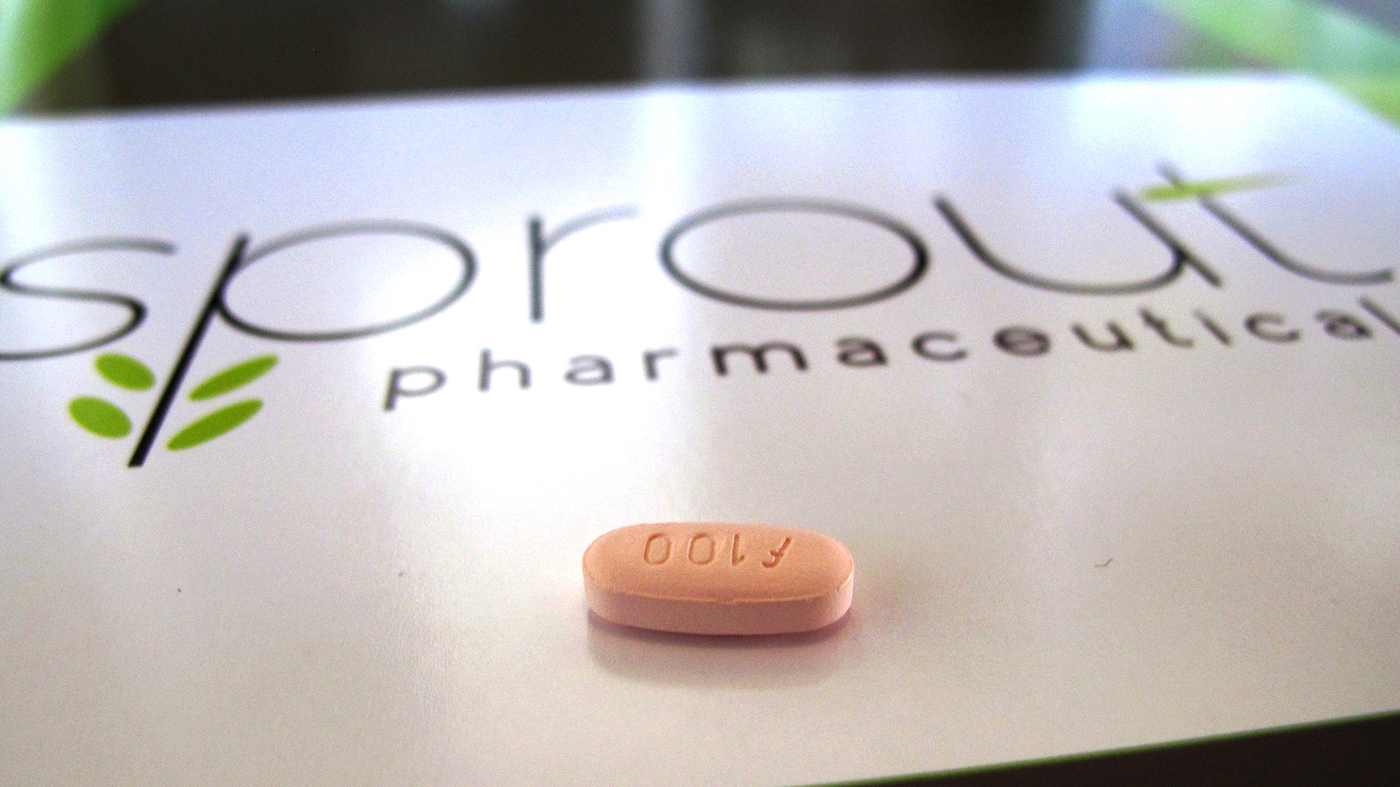
Little pink pill (Stuff NZ)

Little pink pill (Stuff NZ)

Hot on the heels of the news that a female Viagra is edging closer to public consumption, I wanted to see how often U.S. Internet users (which would be basically everyone) were searching for information related to female Viagra. I used “2004-present” as my timeframe.

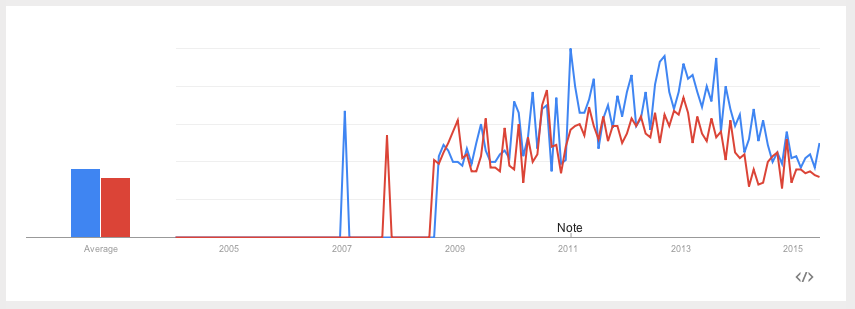
First, here’s how often “female viagra” (red line) against “viagra” (blue line):

Google Trends: 'Female Viagra' vs. 'Viagra,' U.S. 2004-Present

Google Trends: ‘Female Viagra’ vs. ‘Viagra,’ U.S. 2004-Present

As you can see, there’s a lot less searching for the former term versus the latter.

Now, let’s look at “female Viagra” on its own:
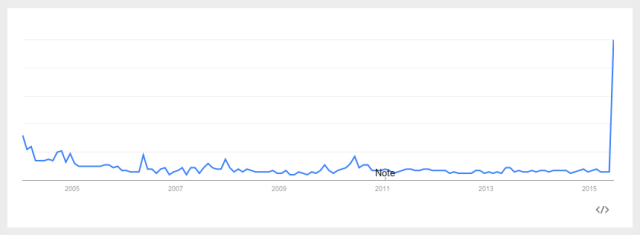
Google Trends: 'Female Viagra,' U.S. 2004-Present

Google Trends: ‘Female Viagra,’ U.S. 2004-Present

It’s hard to ignore that huge spike at the end of the timeframe. That occurred this month. It’s no coincidence: Sprout Pharmaceuticals announced that their female desire pill Flibanserin/ADDYI was recommended for Food & Drug Administration (FDA) approval on Jun. 5th.

Flibanserin/ADDYI will treat women with low libidos, known medically as hypoactive sexual desire disorder (HSDD). I wanted to see how common Google searches for low sex drives appeared.

First, I searched “low sex drive in women,” which was the first specific option Google autofilled for me:
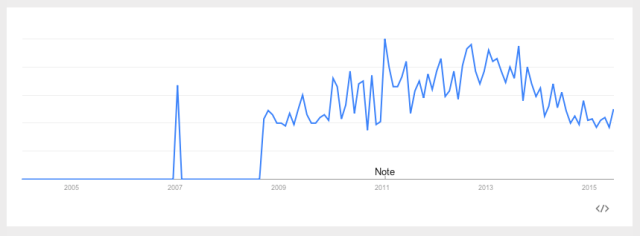
Google Trends: 'Low Sex Drive in Women,' U.S. 2004-Present

Google Trends: ‘Low Sex Drive in Women,’ U.S. 2004-Present

Interesting. It appears that the term hit its peak (ha) around a spike in 2011, and then crested in 2013. It’s dipped since then, but is starting to come back up. (Also, I’d love to know what happened in 2007.)

But let’s put this in context. Here’s “low sex drive in women” (blue line) versus “low sex drive” (red line):
Google Trends: 'Low Sex Drive in Women' vs. 'Low Sex Drive,' U.S. 2004-Present

Google Trends: ‘Low Sex Drive in Women’ vs. ‘Low Sex Drive,’ U.S. 2004-Present

It’s interesting that the female-specific searches don’t make up that much of the overall searches.

Now let’s find out how many men are searching for information on low desire. Here’s “low sex drive in women” (blue line) versus “low sex drive in men” (red line):

Google Trends: 'Low Sex Drive in Women' vs. 'Low Sex Drive in Men,' U.S. 2004-Present

Google Trends: ‘Low Sex Drive in Women’ vs. ‘Low Sex Drive in Men,’ U.S. 2004-Present

OK, now we can see that low libidos in women are an issue, insofar as they’re being Googled.

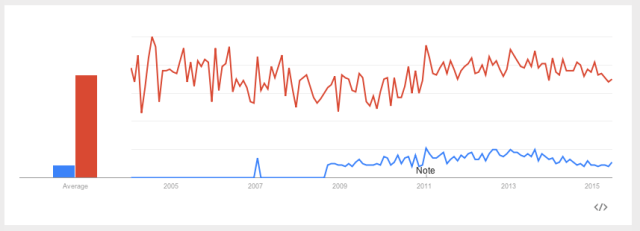
So a lot of people (we could probably reasonably assume women) are searching for information on low sex drives in women. But how many are searching for a solution? Maybe a cure, call it “female viagra” (red line)?

Google Trends: 'Low Sex Drive in Women' vs. 'Female Viagra,' U.S. 2004-Present

Google Trends: ‘Low Sex Drive in Women’ vs. ‘Female Viagra,’ U.S. 2004-Present

Holy shit, this is amazing. Sure, users are searching for (presumably) information on women having low sex drives, but they’re searching a lot more for a solution. At no point in this graph are there more searches for “low sex drive in women” than there are for “female viagra.” Also, note how the “female viagra” searches spike at the end, halfway through 2015. As noted above, that’s when Sprout announced their “little pink pill.”

Conclusion:

The evidence here points to the fact that people are actively searching for solutions to cure women’s low sex drives. This certainly warrants a female Viagra pill to be brought to market, but why the hell wasn’t this developed sooner?!

Sprout Pharmaceuticals’ Female Viagra Closer to Becoming Publicly Available

The experimental drug flibanserin, made by Sprout Pharmaceuticals, is at the center of a regulatory controversy.

The experimental drug flibanserin, made by Sprout Pharmaceuticals, is at the center of a regulatory controversy.

Sprout Pharmaceuticals has developed what they’re calling the Viagra for women. The new drug, named Flibanserin, purports to treat hypoactive sexual desire disorder (low sex drive, in other words) in pre-menopausal women. So far, $50M has been raised in preparation for the drug’s launch, and the Food & Drug Administration (FDA) has approved its benefits/risk profile.

The drug, now known as ADDYI, has had a long road thus far:  The drug was first rejected in 2010, when it was determined that the risks outweighed the dubious (at the time) benefits. Sprout began working on the drug in 2011, after being sold by the drug’s initial developer Boehringer Ingelheim. In December 2013, the FDA had rejected the drug for the second time.

In February 2014, the FDA wanted to see more tests done, specifically how the drug behaved when used with other medications. (Almost 10% of women taking the pill reported sleepiness during the trial.) The company resubmitted New Drug Application (NDA) this past February. The “little pink pill” was approved by an FDA advisory committee (done one step before final FDA approval), provided that more safety restrictions were added.

So far, Flibanserin/ADDYI has been tested on 11K+ women, and claims to be the “one of the most studied women’s health products in history.” Here’s what Sprout found after some recent trials:

In three 24-week randomized Phase 3, six-month, double-blind, placebo-controlled, parallel-group North American studies of premenopausal women with a mean age of 36 years, ADDYI consistently demonstrated a highly statistically significant difference over placebo on three key endpoints, including increase in sexual desire, decrease in distress from the loss of sexual desire and increase in the frequency of satisfying sex. Women treated with ADDYI showed significant improvements at every point of measurement in all pivotal clinical trials, with benefits seen as early as four weeks and sustained over the 24-week treatment period.

It’s too early to know when the drug will hit the public market. But it’ll be interesting to see how it performs (haha).