Google Trends: Hillary Clinton vs. Donald Trump

Hillary Clinton and Donald Trump (CNN)

Hillary Clinton and Donald Trump (CNN)

With all the craziness surrounding this election, I’ve gotten more and more curious about how the Google Trends numbers stack up for both Hillary Clinton and Donald Trump. Let’s take a look!

First, here’s a Google Trends graph of searches for the presidential candidates within the past week (Oct. 24-Oct. 31):

National search interest in the candidates, past week (Google Trends)

National search interest in the candidates, past week (Google Trends)

Here’s the long-term trend of Google users searching “hillary clinton” over the past five years:

Search term 'hillary clinton' interest over time (Google Trends)

Search term ‘hillary clinton’ interest over time (Google Trends)

Check out those spikes!! That first large spike is from Jul. 24-30, 2016. The second spike is Sept. 11-17, 2016.

And here’s the same for “donald trump:”

Search term 'donald trump' interest over time (Google Trends)

Search term ‘donald trump’ interest over time (Google Trends)

Here’s how searches for the two candidates look over time (fittingly, Clinton’s in blue, Trump’s in red):

Search terms 'hillary clinton' and 'donald trump' over time (Google Trends)

Search terms ‘hillary clinton’ and ‘donald trump’ over time (Google Trends)

Here’s “hillary clinton” and “donald trump” searched over the past 12 months only in the U.S.:

Search terms 'hillary clinton' and 'donald trump' over the past 12 months in the U.S. (Google Trends)

Search terms ‘hillary clinton’ and ‘donald trump’ over the past 12 months in the U.S. (Google Trends)

To be honest, I really don’t know how to parse this data. It seems that people who are searching for Trump…Google him more often? Needless to say, we won’t get any clear answers here.

#ThrowbackThursday: Hillary Rodham Clinton, 1969

Hillary Rodham in 'Life' magazine, 1969 (Iowa Public Radio)

Hillary Rodham in ‘Life’ magazine, 1969 (Iowa Public Radio)

Hillary Clinton became nationally known early on, when she was still a college student. In 1969, she was elected to be Wellesley College’s first student commencement speaker at graduation. During her speech, Clinton (then known as Hillary Rodham, her maiden name) addressed remarks made by Massachusetts Republican Senator Edward W. Brooke, who’d previously spoken about the rise of student protests on university campuses. Rodham Clinton then spoke off the cuff in favor of the protests, reasoning that they had a place in public discourse.

Later, she was featured in a Life magazine spread called, “The Class of ’69,” with her commencement speech reprinted. Clinton was also photographed lounging at the Rodham family home.

Asian-Americans Shifting Away from the Republican Party

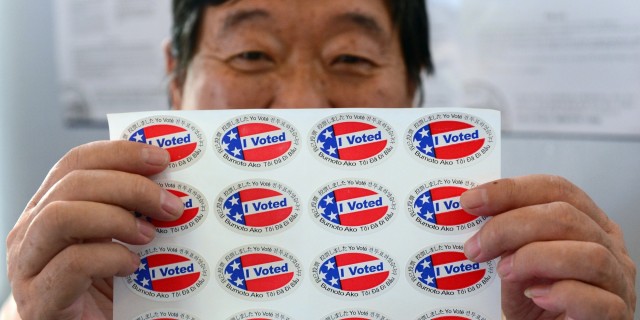
Asian-American voter (The Huffington Post)

Asian-American voter (The Huffington Post)

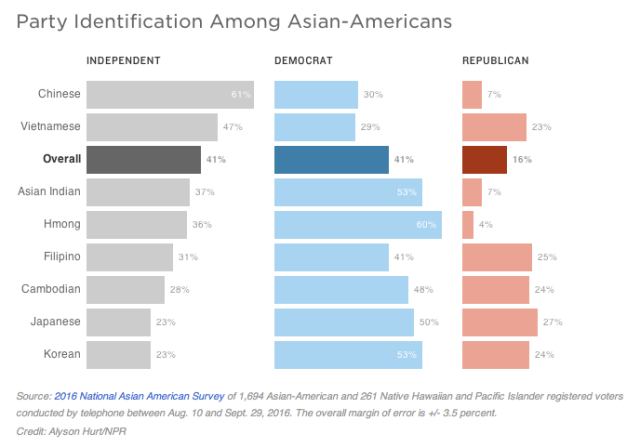
Recent data shows that Asian-Americans are leaving the Republican party to vote Democrat.

Through the 1990s, Asian-Americans were more likely to vote Republican. It’s thought that Asian-American generally voted for the Republican candidate due to connecting with fiscally and socially conservative platforms. Asian-Americans voted Republican around 55% of the time during the 1992 presidential election between Republican George H.W. Bush and Democrat Bill Clinton (who ended up winning). The 2000 election became a turning point when more Asian-Americans began supporting the Democrat candidate. In 2012, Barack Obama won with Asian voters by “nearly 50 percentage points.” Karthick Ramakrishnan of the National Asian American Survey attributes this outcome to Democrats actively trying to win the Asian-American vote.

Party Identification Among Asian-Americans (NPR)

Party Identification Among Asian-Americans (NPR)

Over time, Asian-Americans gravitating towards the Democrats doesn’t seem like a big deal, and more like a natural shift over time. Except that it might not be. This fact becomes more important in this election where surveys have shown Asian-Americans rejecting many points of Republican presidential candidate Donald Trump’s platform: keeping out and deporting immigrants, diplomacy with China, among other aspects.

But it’s too early to tell whether this shift for Asian-Americans toward the Democrats is a blip on the radar or foretelling a larger, more long-term trend. According to Ramakrishnan, it’s too early to tell. In 2015, 47% of Asian-Americans identified as politically independent.

In October 2016, a survey found that registered Asian-American voters supported Hillary Clinton over Trump by a 4-to-1 lead.


California Will Vote to Require Condoms on Porn Shoots

Condoms (StyleCaster)

Condoms (StyleCaster)

This year, California residents will head to the polls, and be asked to vote on something unique to the Golden State: what happens on a porn shoot.

Proposition 60, a.k.a. the Condoms in Pornographic Films Initiative, proposes that adult performers wear condoms during scenes where they “actually engage in vaginal or anal penetration by a penis.” (Side note: can we just appreciate that this language made it into a ballot measure?) Aside from that essential fact, the measure requires producers of pornographic films to pay for medical vaccinations and testing related to sexually transmitted diseases (STDs), and to obtain the state health license.

This measure would cover the San Fernando Valley, where the majority of the porn industry’s films are shot. The measure is not without precedent: In 2012, 56% of voters approved a similar measure, called Measure B, that covered Los Angeles County.

A recent University of Southern California Dornsife/LA Times poll showed that 55% of respondents would support the measure if they had to vote that day. Over 1K people were surveyed.

But Prop 60 also has the potential to harm one of California’s booming industries. Right now, perfumers get tested regularly for STDs, and shooting shuts down if an outbreak occurs. It’s pretty self-governed. But passing the measure might open up liability for independent producers and private companies that distribute porn films.

One reason behind opposing Prop 60 hinges on the fact that it could drive the business elsewhere, to a place that has less stringent (or no) regulations. This concern also has precedent in data: In 2012, the year Measure B passed in Los Angeles, FilmLA reported that there were 480 permits pulled for shoots involving “nonsimulated sex.” In 2013, that number plummeted drastically to 40 permits, and has been dropping year-over-year since. Implementing Prop 60 would also cost the state around $1M to “license and regulate film production, and an additional several million dollars in lost taxes if the industry flees California.”

As you can see, there are many aspects to consider whether you’re for or against Prop. 60. Californians, make sure you do your research before you vote!


Welcome to Sex & Election 2016 Week!

Hillary Clinton (YouTube)

Hillary Clinton (YouTube)

Welcome to Sex & Election 2016 Week on Sex & Stats! From now until Tuesday, Nov. 8th (Election Day for those in the U.S.), I’m bringing you the best in political-themed statistics that intersect with sexuality, gender, race, etc. And this presidential race has been a veritable GOLD MINE for this shit. I’m not even joking (as you’ll find out this week).

Until 11:59 p.m. PST, you’ll get two posts a day on this topic. (Yes, even on Friday!) Get ready for 11 more posts that will make you laugh, cry, and possibly weep for the state of the country, all using data.


“Loving” Film Releases Interracial Emoji Couples

Love-Moji ('Glamour' en Espanol)

Love-Moji (‘Glamour’ en Espanol)

Given our current obsession with all things tech, Focus Features has found a fitting way to promote the company’s upcoming film “Loving:” custom emojis.

The Love-Mojis feature a variety of emojis of interracial couples in about every combination you could think of. So if you’re in an interracial couple, and you haven’t yet felt your coupling properly represented by the Unicode Consortium, your time has finally come!

Why is this important? Let’s start with the film itself: “Loving” follows Richard and Mildred Loving, a Virginia couple who got married in 1958. This wouldn’t be so remarkable except that Richard was white and Mildred was black. Their marriage happened during a time where interracial dating, much less marriage, was frowned upon, to put it lightly. Interracial marriage could bring a charge of miscegenation (race mixing, in plain terms).

The Lovings were arrested after their marriage for the crime of their relationship, and forced to leave Virginia. Once in D.C., they began legal proceedings. The Loving v. Virginia case went all the way to the U.S. Supreme Court. In 1967, the Supreme Court ruled anti-miscegenation laws unconstitutional, which struck down said laws that were on the books of sixteen states. (All sixteen states were in the South. Shocker.)

Needless to say, this was a landmark case.

But why use emojis to promote it?

Since emojis debuted, the options for emoji couples were pretty stark. They didn’t show the breadth of real-life relationships in terms of race and also sexual preference. The new Love-Moji take this into account, and rectify the oversight.

There’s also the fact that using emojis has become a convenient visual shorthand for emotions we don’t particularly feel like typing out in words.

You can get the Love-Moji via app stores and at VoteLoving.com.

“Loving” comes out on Friday, Nov. 4th.

Obama Signs Bill That Requires Babies’ Changing Tables in Every Public Bathroom

U.S. President Barack Obama and baby (Winwes)

U.S. President Barack Obama and baby (Winwes)

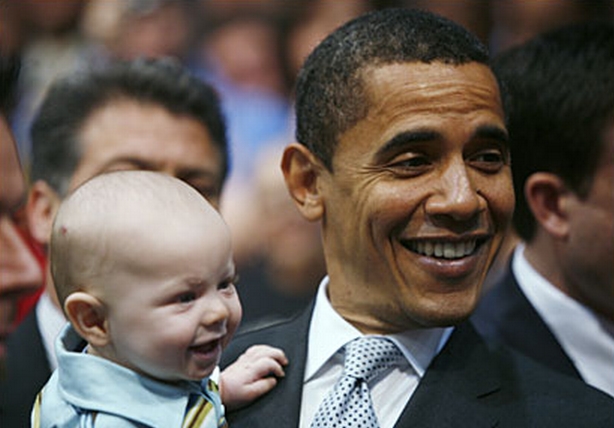
Earlier this month, President Obama signed a very important bill. The Bathrooms Accessible in Every Situation (BABIES) Act requires government and federally-run buildings to provide babies’ changing tables in every restroom on the the premises. That’s right, babies’ changing tables will now be in both women’s and men’s bathrooms.

Previously, there was no such act that mandated changing tables in public bathrooms. And it’s common knowledge that changing tables are a much more common sight in women’s bathrooms than in men’s.

The BABIES Act was proposed in April by Rhode Island Democratic Representative David Cicilline. The measure was co-sponsored by 26 fellow Democrats and one Republican.

It’s fitting that the act was introduced and passed now: The move comes as parental leave, gender equality and division of household labor (which includes childcare) have become top of mind to many people, and a hot topic during this election season.

The new changing tables must be added within the next two years.

The FDA Approves New Breast Implants

Silicone gel breast implant (Fox News)

Silicone gel breast implant (Fox News)

If you’re considering getting breast implants, you now have another option to research.

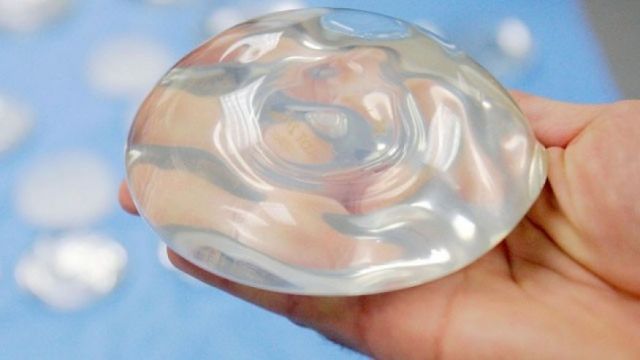
In late September, Allergan plc announced that it had received approval from the Food and Drug Administration (FDA) to market their Natrelle Inspira cohesive implants. These new implants combine “a high gel fill ratio and Allergan’s highly cohesive gel.”The implants have a “gummy” texture, and are best for women interested in having fuller breasts.

These new implants have more gel than previous ones. This allows the implants to attach more firmly to your body. The new implants will also enhance breast projection, which is how far your chest sticks out from your body.

The new implants will be best for basic breast augmentation and reconstruction.

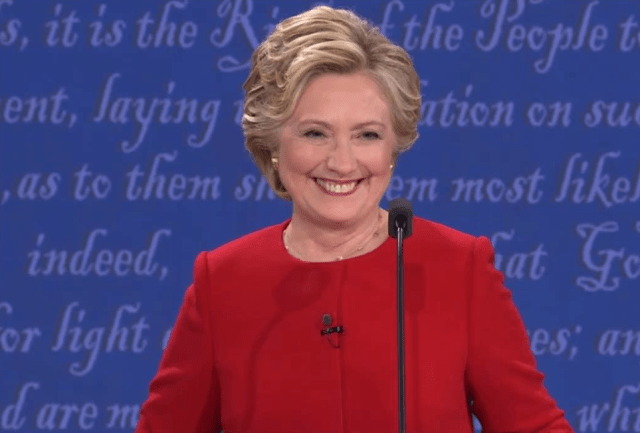
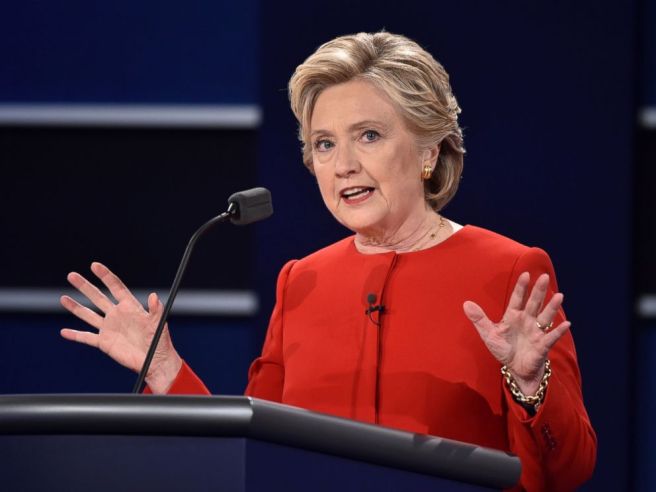
Hillary Clinton Spoke 38% of the Time During the First Presidential Debate

Hillary Clinton (ABC News)

Hillary Clinton (ABC News)

The first presidential debate aired this past Monday night between Democratic nominee Hillary Clinton and Republican nominee Donald Trump. It was clear that Trump interrupted Clinton many times (51 times, to be exact), but his talking time massively negatively impacted Clinton’s.

Clinton spoke only 38% of the debate running time.

How do we know this? Twitter crunched some numbers surrounding the frequency of the hashtag #debates, and possibly how many times the two nominees’ names (and maybe quotes) were mentioned. (I couldn’t find the methodology behind Twitter’s data, so I couldn’t delve into it. Sad.)

By contrast, Trump spoke for 62% of the time. Given his verbose tendencies, this hardly comes as a surprise.

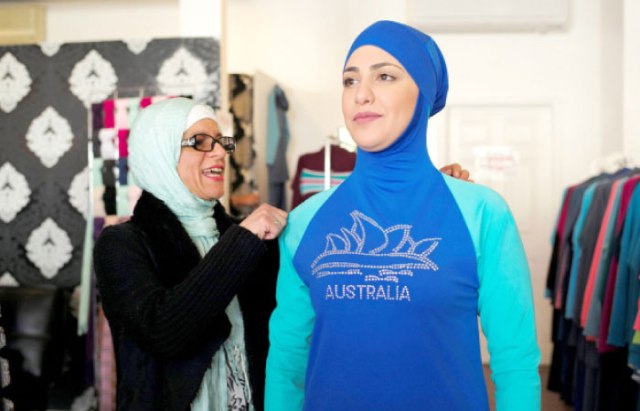
Burkini Sales Rise by 200% After French Ban

Burkini designer Aheda Zanetti (Saudi Gazette)

Burkini designer Aheda Zanetti (Saudi Gazette)

Earlier this summer, coastal French towns courted controversy when their respective mayors decided to ban burkinis on beaches. The burkini consists of a long-sleeved top with long pants and a head covering, and was developed for women who follow Islamic modesty standards so that they could go swimming while still covered. The term “burkini” comes from a portmanteau of the words “burqa” and “bikini.”

Despite the ban, burkini creator Aheda Zanetti says that online sales of now-famous swimwear have risen over 200%+ recently. (Now, we don’t know what her sales had been previously, or what the year-over-year change has proved to be, so unfortunately we have incomplete information.)

Zanetti says that her customers are not homogeneously Muslim. She reports that about 40% of her customers are from other faith traditions, such as Judaism and Mormonism, that adhere to modest dress standards.

The burkini ban stems from a stringent French view on separating religion from the state. The French government has banned religious symbols from government buildings since 2004. A ban specifically on burqas was passed in 2011.

Right now, about 30 French towns have instituted the ban, though the town of Villeneuve-Loubet has since overturned it.