Rock Icon David Bowie Has Died

David Bowie (BJournal)

David Bowie (BJournal)

I’d be remiss if I didn’t mention the biggest news this weekend, that music legend David Bowie has died. He passed away after a year-long battle with cancer, and had just released his 25th album two days before. Bowie was 69 (too young!).

Sure, his music made an impact, but so did Bowie’s sexuality. In the beginning of his career, he identified as gay. Then he said he was bisexual, and later backtracked on that. Bowie later married two women, one of them being supermodel Iman, and two children.

Bowie had a huge influence on anyone, especially kids coming of age, who felt out of place and was an icon with the way he played with gender and sexuality. He really enjoyed letting each part of himself out to play, and was very curious about everything. And those are lessons we can all take to heart.

Rest in peace, David Bowie. You were, and always will be, my favorite alien.

Black Women Covering the September Issue for “Vogue:” By The Numbers

Beyonce's 'Vogue' Cover, September 2015 (PopSugar)

Beyonce’s ‘Vogue’ Cover, September 2015 (PopSugar)

Sadly, the number of Black women covering the famed September issue of “Vogue” is very short. It really needs to be longer (how the hell is it 2015, and we’re still talking about this?!), and I have no doubt that it will be. Someday. But not soon enough.

As everyone knows by now, the ***Flawless Beyoncé will be covering the fashion bible’s September issue, which comes out Aug. 25th. It’s her first time covering the issue, though it’ll be her third time around as a “Vogue” cover model.

3: The number of Black women covering the September issue solo

1989: Supermodel Naomi Campbell covers the September issue

2010: Academy Award-winning actress Halle Berry covers the September issue.

The fashion industry is notoriously slow to change its ways (look at how many Black women were on “Vogue” covers in 2014). I hope Queen B’s new issue means we’ll see more diverse cover models, and soon.

#ThrowbackThursday: Beyoncé’s “Vogue” Covers, 2009 and 2013

Beyoncé's 'Vogue' covers, April 2009 and March 2013 (Celebuzz)

Beyoncé’s ‘Vogue’ covers, April 2009 and March 2013 (Celebuzz)

Last week, fashion bible “Vogue” announced its cover star for the always-hotly-anticipated September issue: the one, the only Beyoncé Knowles-Carter. But you may know the acclaimed singer solely by her first name.

This will mark Beyoncé’s third turn as the magazine’s cover model: She had previously appeared on the April 2009 and March 2013 covers. But this time is significant: It’ll be the first time she’s covered the September issue. Beyoncé will be only the third Black woman to cover the biggest issue of the year solo. (Her predecessors are supermodel Naomi Campbell and Academy Award-winning actress Halle Berry.)

The issue will hit newsstands Aug. 25th.


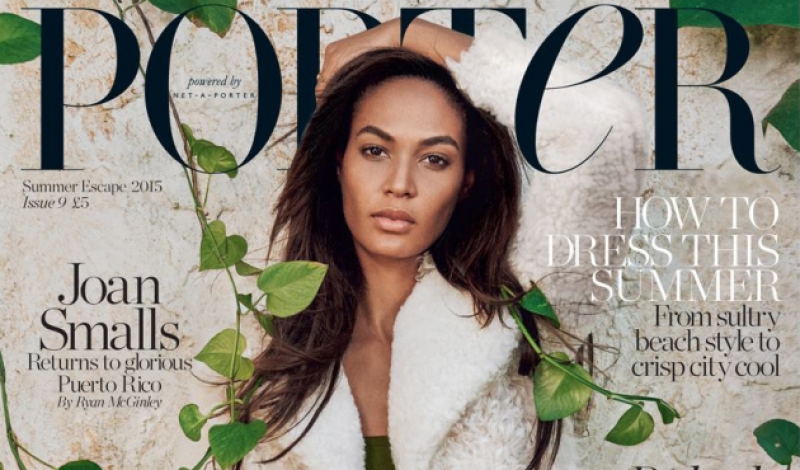
Joan Smalls is “Porter” Magazine’s First Woman of Color Cover Model

Joan Smalls for 'Porter' Magazine (Fashion Week Daily)

Joan Smalls for ‘Porter’ Magazine (Fashion Week Daily)

Supermodel Joan Smalls covers the summer edition of “Porter” magazine. She’s a model, she’s gorgeous; no big deal, right? Except, this time, it is: Smalls is the first woman of color to grace the cover.

The Puerto Rican beauty joins fellow supermodels Gisele Bundchen and Karlie Kloss in the “Porter” cover girl pantheon.

This isn’t the first time Smalls has made history, even in this decade: She became the first Latina model for Estée Lauder cosmetics in 2011.

Fashion companies and publications are finally recognizing to the fact that white isn’t the only skin tone that exists (“Vogue” has had a particular problem with this), and realizing that customers want to see models that resemble themselves. I just hope it’s not a trend but a step towards a large-scale change.

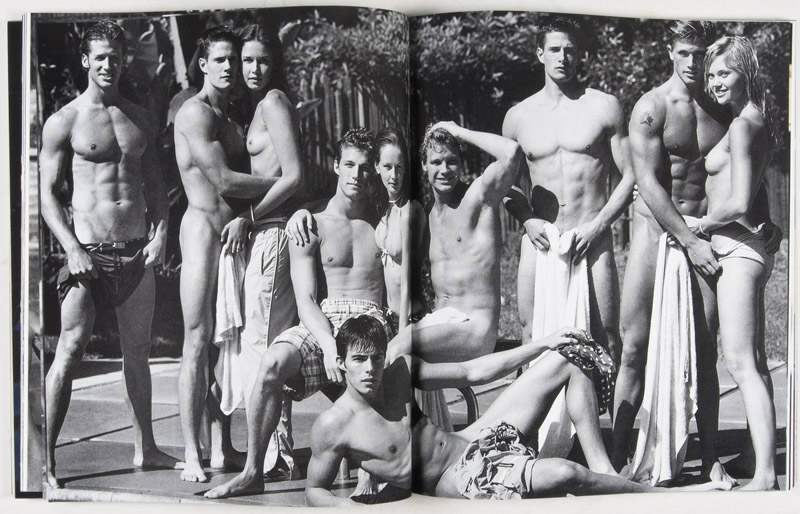
The New Abercrombie & Fitch Will Feature Less Sex (NSFW)

'A&F Quarterly' Spring Break Issue 2001 (Kline Books)

‘A&F Quarterly’ Spring Break Issue 2001 (Kline Books)

Happy Friday! If you’re in your mid-20s or older, you probably remember (and hell, wore) some Abercrombie & Fitch (A&F) back in the day. The stylishly distressed, yet massively overpriced, clothes were a status signifier back in middle and high school, when everyone wanted to be part of the cool crowd (which was comprised solely of all-American, apple-cheeked near-Aryans). And of course, who can forget those sex-drenched ads and catalogs?

The A&F of yore will now be changing that particular aspect. According to “The Washington Post,” the chain will no longer hire “models” (their term for sales associates) based on “body type or physical attractiveness.” They’ll also phase out the “sexualized marketing” (suggestive ads, shirtless models at storefront openings) by July.

This all comes as A&F tries to revamp its image, and project a more inclusive one. Former CEO Mike Jeffries was known for promoting the brand as exclusionary to everyone but his coveted “cool crowds,” and didn’t offer larger sizes. He stepped down from his post last December. The move came amid reports that the retailer’s shares have decreased 39% over the past year, and profits shrunk 5%+ last year.

It’ll be interesting to see if A&F can actually pull off this drastic brand reinvention, and if consumers will respond to it.

Laverne Cox Posed Nude for “Allure”

Laverne Cox (Allure)

Laverne Cox (Allure)

Happy Friday! We’re celebrating by looking at this gorgeous photo of a nude Laverne Cox in the May 2015 “Allure” issue.

Cox, a transgender woman, posed along with cisgender (read: female at birth) ladies Jordana Brewster, Nicole Beharie, Katheryn Winnick and Sandrine Holt. Recently named to the “Time” 100 Most Influential People list, Cox wanted to empower the various communities she represents by posing nude, showing a representation that isn’t usually seen.

We think she’s certainly doing that. Keep up the great work, Ms. Cox!


Thursday Trends: Young Women and #GrannyHair

Rihanna (Her Interest)

Rihanna (Her Interest)

Kylie Jenner did it. So did Rihanna and Kelly Osbourne. Of course, Lady Gaga, trendsetter that she is, rocked it back in 2010.

Grey hair.

Once upon a time, it was unseemly for women to go out sporting anything other than a full mane of brown, black, red or blonde hair. Grey was seen as unnatural and, at the same time, a little too natural. It was shoved to the side, to the back of the mind, ignoring the tell-tale side of aging.

Right now, women are embracing the color whole-heartedly, and running towards the grey instead of away from it. A recent BuzzFeed post shows how young women are riding the trend, especially seen on Instgram with the hashtag #GrannyHair.

But why now? Why is this grey hair’s big moment?

We seem to be in the midst of a “revering our elders” moment. (Real talk, though: that needs to happen every day. Call your grandparents, people!) The fashion world has been pioneering this lately. French fashion house Céline tapped 80-year-old essayist Joan Didion to be their latest model, and Saint Laurent is using 71-year-old Joni Mitchell. The major beauty players are doing the same, with 64-year-old Jessica Lange for Marc Jacobs and 69-year-old Helen Mirren for L’Oreal Paris. In this year’s Milan Fashion Week, trends skewed towards something your grandmother might don for a social event.

This makes total sense in terms of how current demographics are shifting. The baby boomer generation, born between 1946 and 1964, are turning officially “old” at a rapid clip. As of 2011, they numbered 77M+ and are “the largest generation in American history.” Baby boomers began turning 65 in 2011, and won’t stop until the end of 2029.

Here’s how CNN puts this demographic’s strength in numbers in terms of future projected growth:

The 65+ population segment is projected to double to 71.5 million by 2030 and grow to 86.7 million by 2050.

With this projected growth will come a lot of societal changes (I’ve always said that this isn’t a generation that’ll age quietly). We’re beginning to see initial impacts with how we view that generation and the ones before. For example, It used to be that you couldn’t be seen as a sexual being after a certain age, that you were out of the running in the race to make babies. And while that second part might be true, the first has been proven false by many women over “a certain age.” Case in point: see every instance where a late-night talk show host jokes about Helen Mirren. They’re always saying she’s hot (and she is!). Society has long seen older men with grey hair as sexy, and is now (finally!) coming around to the idea that older women are hot too.

Young women coloring their hair grey even has a historical precedent. In her book “Seductress: Women Who Ravished the World and Their Lost Art of Love” author Betsy Prioleau mentions that young women in the French court used to powder their hair grey to emulate their elders. (If you’ve seen Sofia Coppola’s “Marie Antoinette,” the director subtly includes this detail, noticeable in some shots.)

Overall, this trend really points to a shift in how we’re seeing aging. People seem to be more open to the fact that life doesn’t stop after a certain age. And young women are celebrating their elders with their grey hair, natural or not.

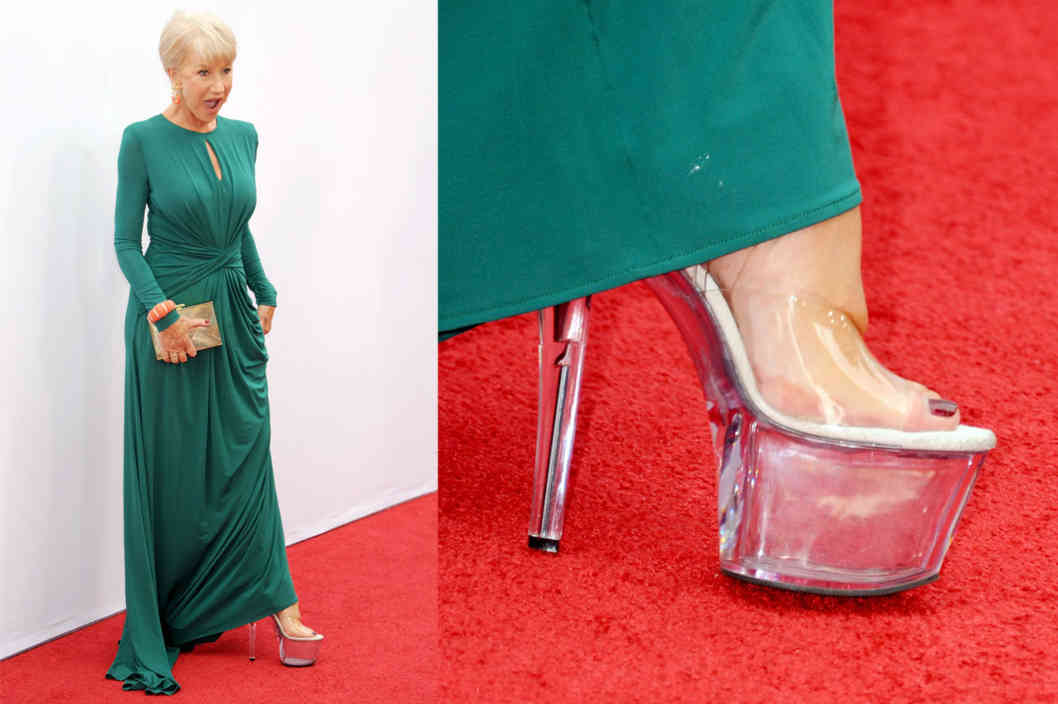
#ThrowbackThursday: Helen Mirren’s Stripper Shoes, 2013

Helen Mirren's stripper shoes (The Cut)

Helen Mirren’s stripper shoes (The Cut)

In 2013, Academy Award-winning actress Helen Mirren showed up to the LA premiere of “Red 2” wearing an elegant emerald dress…and clear, extremely high stripper shoes. She referred to the shoes as her personal leg-lengthening trick, and has apparently owned them for years.

I love seeing an older woman who hasn’t been shoved aside and told that she’s irrelevant, and is instead living her life with gusto and enthusiasm. (Also, I love Helen Mirren.) It’s rare to see, but I always hope more people follow suit.


#ThrowbackThursday: Abercrombie & Fitch Ad, 2012

Abercrombie and Fitch ad shot by Bruce Weber (Towleroad)

Abercrombie and Fitch ad shot by Bruce Weber (Towleroad)

Three years ago, acclaimed photographer Bruce Weber shot a promo for Abercrombie & Fitch that featured handsome male models doing things all guys do: wrestling, showering, and kissing.

That last one is depicted up top. Later, the clothing brand claimed that the video (and three related others) were part of an official A&F campaign, even though Weber had identified the video as such on his Facebook page.

Regardless, it’s still a cool image. Abercrombie will always be the first softcore your 13-year-old self squealed over, but it’s at least made some strides towards acceptance (certain other inflammatory comments from former CEO Mike Jeffries notwithstanding).

Thursday Trends: Plus-Size Models in Mainstream Media

Tess Munster (Bustle)

Tess Munster (Bustle)

It’s safe to say that plus-size models are having a moment in the spotlight right now. The fashion industry has finally cottoned on to the fact that most women are not a size -2 (which is rarely found in nature), but that more “normal”-sized women representative of the American public might want to see themselves depicted (and desired!). And the inclusion will also sell more for said fashion companies, so it’s a win-win all around.

We can trace this development to late last year, when the Pirelli calendar unveiled its 2015 edition. Candice Huffine made history as the first plus-size model to grace the legendary calendar’s pages. She broke a tradition stemming from 1964 of using the usual thin models to usher in a new year and a new outlook on beauty standards.

Speaking of beauty standards (more like #effyourbeautystandards), plus-size model/retro bombshell Tess Munster (now Tess Holliday) recently became the first plus-size model to sign with the U.K.’s MiLK Model Management. She’s now the first plus-size model signed to a mainstream agency, in the Curves division, and the first one within Curves above a size 20 (she’s a 22 and stands at 5 ft. 5 in.). Munster cuts a distinctive figure, with bright red wavy hair, alabaster skin and lots of tattoos. She’s been around for awhile, and was named a top plus-size model in the world by “Vogue Italia” in 2013. That same year, the “body positive activist” began the aforementioned hashtag to encourage women to love their bodies at any and every size. She also participated a video in which she and other plus-size models recreated Beyoncé’s music video for “***Flawless,” called “#everyBODYisflawless.”

Fashion blogger/model Nadia Aboulhosn was one of these models. She’s gained attention and press for her fashion prowess that’s all about the street style. The half-Lebanese stunner first drew notice when she won American Apparel’s XL Model Search in 2011.

Perhaps the most mainstream seal of approval, “Sports Illustrated” selected a plus-size model for this year’s Swimsuit Issue: Model Robin Lawley is a size 12. Lawley had previously been on the cover of Australian “Vogue,” as the first plus-size model, and was the first plus-size face of Ralph Lauren in 2012. But even though she’s plus-size by fashion industry standards, she still looks…well, like a normal tall, curvy girl. Like a model.

Let’s hope that plus-size women gaining visibility in the fashion world isn’t a one-time trend, and eventually becomes an unremarkable norm encompassing diverse shapes and sizes.