Thursday Trends: Same-Sex Couples Reflected in Advertising

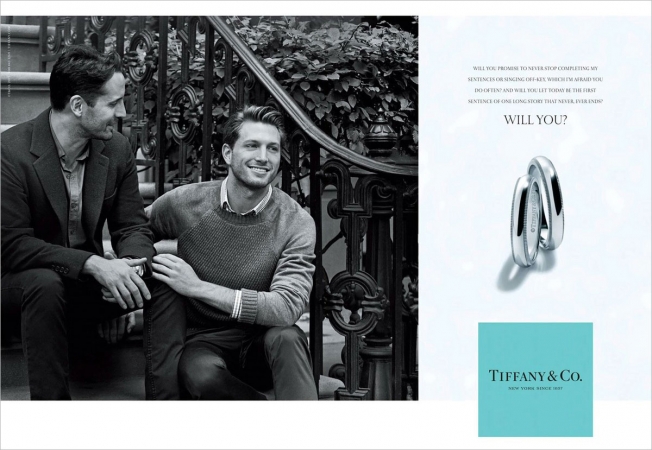
Tiffany's first ad featuring a gay couple (Adweek)

Tiffany’s first ad featuring a gay couple (Adweek)

Advertisements are finally getting with the times, and featuring more diversity than your run-of-the-mill straight white couple.

Last month, jewelry giant Tiffany’s debuted a new print ad for their wedding rings. But this ad had one thing different: it prominently featured a gay couple. And apparently the two men are a couple in real life, and were photographed on their own New York stoop.

This was the first time Tiffany’s has used a same-sex couple in their advertising. But it won’t be the last: Just this week, the brand used the same couple in a TV-spot ad. (The ad also features straight and interracial couples.) It signals that the 178-year-old brand recognizes that love comes in many forms, and they want to be all-inclusive. (And it’s a smart business move.)

Other brands in recent years have featured same-sex couples. Preppy retailer J. Crew used a gay couple in their catalog in spring 2011, and Gap used another couple on a billboard the following year. Incidentally, neither sets of couples are professional models: In the case of the J. Crew couple, one of the men was a designer for the brand. (It seems there’s also a side-trend of using real people.)

Lesbian couples are also increasingly represented. In 2012, JC Penney featured a lesbian couple with their children in a catalog pegged to Mother’s Day. Last year, condom brand Durex used two women being playfully affectionate with each other in an ad for a massage gel. This year, Hallmark showed an ad featuring a real-life lesbian couple describing their feelings for each other in the run up to Valentine’s Day.

It’s clear that things are changing. Even “The Onion” got in the action, with a (mock) article claiming that jewelry company Zales created an ad featuring a polyamorous triad. (But the article did rightfully call out that we, as a whole society, aren’t quite there yet.)

Hopefully this follow its natural progression, and  will eventually lead to more ads featuring same-sex couples with families. It’d be great to see future print and online ads and commercials where we see a family with two dads or two moms, NBD.

After all, this would make complete economic sense for these companies: In 2012, “Adweek” reported that the LGBT market is estimated to be worth around $743B+.


How Many States Back Same-Sex Marriage?

Same-sex marriage figurines (The Missouri Times)

Same-sex marriage figurines (The Missouri Times)

Earlier this month, Alabama became the 37th state to legalize same-sex marriage. That’s nearly 3/4ths of the nation now that have legalized the institution!

I was curious to see which region (if any) had the monopoly on backing same-sex marriage. Using the Census’s regional boundaries, and information pulled from ProCon.org, here’s what I found:

Pivot table of states that legalize same-sex marriage

Pivot table of states that legalize same-sex marriage

Unsurprisingly, the West is setting the pace for approving same-sex marriage, comprising 26% of the nation’s approvals. The South and the Northeast are neck-in-neck for second place at 18% each, and the Midwest lags behind with 12% of approvals. Hopefully this year will bring more states legalizing it!

Oregon Will Have the First Openly Bisexual Mayor

Kate Brown (The Democratic Party of Washington County)

Kate Brown (The Democratic Party of Washington County)

Progress is being in Oregon today: Former Oregon Secretary of State Kate Brown will be sworn in as governor, becoming the first openly bisexual woman (actually, person) in the nation to hold the office. Brown succeeds former governor John Kitzhaber, who resigned due to a criminal probe into his fiancée’s role in his office.

She was appointed to Oregon’s State House of Representatives in 1991, was elected the following year, and re-elected two years later in 1994. She moved to the Senate in 1996, and was elected Senate Majority Leader in 2004. She began serving as Oregon’s Secretary of State in 2009.

While her main interests center on removing barriers to voting registration and growing small businesses and entrepreneurship, she’s also advocated for LGBT rights. Brown was profiled in the “Out and Elected in the USA” survey of LGBT government officials in 1992. She’s been married to her husband Dan Little since 1997.

Brown hasn’t run into any trouble with her constituents with her status as a bisexual woman, as  Oregon is known for being very socially progressive. As Hannah Hoffman of “The Statesman Journal” notes:

Her sexuality has never been a prominent issue in Oregon, where Portland recently had an openly gay mayor in Sam Adams and where the current speaker of the House, Tina Kotek, is a lesbian.

Hopefully, we’ll see the rest of the country follow suit.


Reported vs. Actual Numbers in Same-Sex Attraction

Male homosexual attraction (Science Daily)

Male homosexual attraction (Science Daily)

One of my (many disparate) areas of interest is the concept of stated preference vs. revealed preference. It means that while you may say one thing, your actions may show another thing. “Preference falsification” (term coined by Duke University’s Timur Kuran) relates to this as positing that people aren’t always completely truthful about their preferences in public. (That’s one of the things that interests me about sexuality data: it’s so easy to lie! And nobody could conceivably find out!)

The study was published in 2013 by the National Bureau of Economic Research, and was performed by Ohio State University. It dealt with admitting sexual attraction in standard vs. veiled polls (veiled meaning anonymous).

Participants were asked about their attitudes towards LGBT people and same-sex attraction. With the “normal” poll (i.e. people’s identities were conjoined with their answers), 11% of respondents didn’t see themselves as heterosexual, and 17% admitted to having a sexual experience with someone of the same sex.

But shit got real during the veiled poll. Now 19% of respondents didn’t see themselves as straight, and 27% admitted a same-sex sexual experience. You don’t have to be good at math to see that that’s a large jump for both aspects of the study.

According to the study’s abstract:

“The veiled method increased self-reports of non-heterosexual identity by 65% (p<0.05) and same-sex sexual experiences by 59% (p<0.01).”

The study also found how religion, in this case Christianity, influenced some of the participants’ answers. The veiled approach inflated the discrepancy so that self-reports of non-heterosexuality and same-sex sexual experiences skyrocketed by 100%+ from the usual poll. Talk about underreporting!

Leelah Alcorn Suicide: Transgender Teen Suicide Stats

Leelah Alcorn (Yahoo News)

Leelah Alcorn (Yahoo News)

Leelah Alcorn was a 17-year-old transgender teen who committed suicide Dec. 28 of this past year. Born a boy named Joseph, she came out to her parents as transgender at 14 years old, and felt she was “a girl trapped in a boy’s body” since the age of four.

Alcorn wrote a suicide note on her Tumblr, published after her death, that called for better dialogue surrounding gender education and trans civil rights. She hoped her death (which could’ve been easily avoided) would spark a discussion and changes.

It’s pretty well-known that LGBT teens have a higher rate of suicides and suicide attempts than straight teens. According to The Trevor Project, LGBT youth (defined as ages 10-24) are “three times more likely to attempt suicide than their straight peers.”

For transgender teens, the numbers get more grim: The Youth Suicide Prevention Program cites national statistics that claim “more than 50% of transgender youth will have had at least one suicide attempt by their 20th birthday.” There seems to be discrepancy here, as The Trevor Project notes that 25% of transgender teens have attempted suicide, and almost 50% have thought about it. Either way, that’s pretty scary.

Familial (and friends’) support plays a big role in all teens’ lives, but is particularly needed for transgender teens. The Trevor Project cites a stat which posits that LGB teens who have “highly rejecting families” are 8.4 times more likely to attempt suicide. Though the site doesn’t include trans teens within this stat, it’s safe to say they probably face similar odds.

Leelah Alcorn’s death didn’t have to happen. It shouldn’t have happened at all. But I hope it begins the discussion she wanted and rightfully deserved.


Texas’s First Trans Homecoming King

Texas homecoming king Mel

Texas homecoming king Mel

Recently, high school student Mel won the title of his school’s homecoming king. Doesn’t sound like a big deal, does it?

But it actually is: Mel is the first transgender student to win the title in the entire state of Texas.

This is big considering the fact that Texas isn’t known as the most tolerant state. As “The Cutnotes, “it’s one of 32 states where a person can be fired for being openly transgender, and one of 29 states where you can fired for being openly gay or lesbian.” (“The Cut” also has a more detailed account of Mel’s story.)

But this shows that attitudes are changing, starting with the youth. I can’t wait to see how Texas, and other states, progress.