Prostate Health Boosted by Having Lots of Sex

Prostate screening patient

Prostate screening patient

You’re not being a man-whore, you’re protecting your health: A new study out of the University of Montreal says that having intercourse with 20 or more women helps men’s risk in developing prostate cancer decrease by 28%.

However, this effect only holds true for straight men: Men who had sex with 20 or more men were twice as likely to get the disease.

The study had 3K+ men answer an questionnaire about their sex lives. In the course of the study running Sept. 2005-Aug. 2009, 1.5K+ men were diagnosed with prostate cancer.

The article doesn’t mention how exactly 20 was determined to be the break-even point. It also begs the question as to what other numbers of partners do for preventing the cancer (for example, how does having 17 partners help, or hurt?).

I’d love to know more about this. Wouldn’t you?

Women’s DIY Halloween Costumes: By The Numbers

Sexy Rosie the Riveter costume

Sexy Rosie the Riveter costume

DIY has been a big trend for a few years now. It makes sense that it’s spread to Halloween costumes, where the major goals are to display creativity and individuality.

With this in mind, I wanted to see how many women’s magazines were touting DIY costumes, and parsing out any trends I could see. I initially wanted to find three lists from three different publications from this year, but had to settle for those from varying years. I looked lists from “Glamour” (published in 2010), “Marie Claire” (2013) and “Cosmopolitan” (2014).

Let’s take a look at what I found:

“Glamour:”

Year Published: 2010

Number of Entries: 21

Number of Movie-Referenced Costumes: 1

Number of TV-Referenced Costumes: 5

Number of Children’s Pop-Culture-Referenced Costumes: 0

Number of Iconic Cultural Figure References: 4

Outliers: includes 1 music-inspired costume, 9 creative* costumes


Marie Claire:”

Year Published: 2013

Number of Entries: 10

Number of Movie-Referenced Costumes: 4

Number of TV-Referenced Costumes: 2

Number of Children’s Pop-Culture-Referenced Costumes: 0

Number of Iconic Cultural Figure References: 1

Outliers: includes 1 celebrity baby costume, 1 music-inspired costume


Cosmopolitan:”

Year Published: 2014

Number of Entries: 20

Number of Movie-Referenced Costumes: 10

Number of TV-Referenced Costumes: 3

Number of Children’s Pop-Culture-Referenced Costumes: 5

Number of Iconic Cultural Figure References: 2

Outliers: includes 2 comic-book-referenced costumes, 4 Disney characters, 1 school girl costume


Overlaps:

Sandy from “Grease:” “Marie Claire” and “Cosmopolitan”

Rosie the Riveter: “Marie Claire” and “Cosmopolitan”

Sookie Stackhouse from “True Blood: “Glamour” and “Cosmopolitan”


Conclusions:

These three lists are virtually the same in that they focus heavily on referencing pop culture, mostly through movies and TV (see the overlaps list above). The “Glamour” list was on of the worst offenders here, as many of the ideas should’ve stayed in that year.

But the same “Glamour” list also had the most creative costumes (see asterisk above in said section), in that clever, out-of-the-ordinary costumes were included.

Overall, these DIY Halloween idea lists need a fresh look, and more space given to clever costumes and not ones just blindly referencing popular cultural aspects.

How Common Is Vaginismus?

Vaginal Dilators

Vaginal Dilators

If you haven’t heard the term, “vaginismus” refers to vaginal tightness during, or even preventing, sexual intercourse. It’s not widely talked about, but it definitely exists.

But how many women suffer from it.

Vaginismus.com estimates that it affects roughly every 2 in 1K women. In the US, as of the 2010 census, that amounts to 313K+ women, assuming it has an equal distribution, or affects women of all ages equally.

But since it’s such a private matter, and women may be ashamed and/or embarrassed to speak up about it, there’s no way to get a firmer number.

Other statistics cited on the page estimate that vaginismus occurs more often in women ages 15-24, since attempted first intercourse generally falls within that range. The Masters & Johnson Institute and the Center for Human Sexuality put the rate of vaginismus in their patients at 20% and 40%, respectively.

Single Parents’ Sex Lives

Parent and child

Parent and child

A recent study jointly done by the University of Nevada and The Kinsey Institute examines the sex lives of single parents.

According to “The Huffington Post,” the study, which used data from the 2012 Singles in America findings, looked at 5K+ single Americans age 21 and over. Single parents comprised almost 39% of the sample size.

Participants were asked questions regarding the frequency of sexual thoughts and actually getting it on, as well as the number of people they’d dated and how many children they had. The timeframe appears to be limited to one year.

Researchers said that the single parents reported having the same amount of sex as singles without children. Also, single parents with children under age five had more sex than those with older children. These findings were published in the Journal of  Sex Research.

However, the study doesn’t tell us what baseline was used for “normal” frequency of sexual intercourse and sexual thoughts. So we can’t really extrapolate much here.


#ThrowbackThursday: “Seinfeld” Undateable Conversation

"Seinfeld"'s Jerry and Elaine

“Seinfeld”‘s Jerry and Elaine

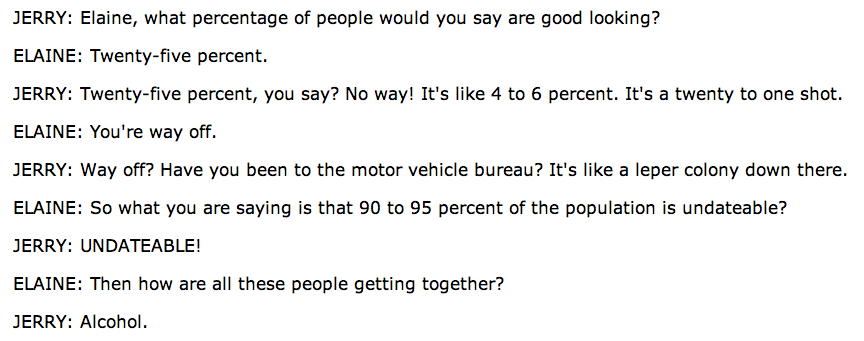
I’d forgotten about this apropos exchange from one of my favorite shows. It’s from Season 7’s episode “The Wink,” which first aired on Oct. 12, 1995.

Undateable bit from "Seinfeld" episode "The Wink"

Undateable bit from “Seinfeld” episode “The Wink”

Hmm, I have to question his methodology, which he’s not exactly being transparent about…

I wonder if the fictional Jerry Seinfeld would say that those numbers still hold true today, or have changed? Too bad we’ll never know.

How Many People Have Affairs?

Showtime's "The Affair"

Showtime’s “The Affair”

After watching the pilot of Showtime’s new series “The Affair,” I became curious about finding stats on affairs.

A 2012 “Psychology Today” article cites a study that claims 10-13% of adults cheat, with the percentage peaking at 20% in the 40s age range. It doesn’t break down whether this includes both married and otherwise committed couples, and doesn’t break the data down by gender.

Will you watch “The Affair?”


Just How Popular Is Analingus?

Nicki Minaj's "Anaconda" cover

Nicki Minaj’s “Anaconda” cover

Rimming. Salad tossing. Eating booty.

All of a sudden, it’s the sex act everyone can’t stop talking about (or reading about). But who’s actually actually doing it?

Sadly, I couldn’t find any specific surveys dedicated to purely analingus. (Kinsey Institute, want to get on that?) But we can deduce a couple of things from general anal sex stats.

A 2010 “Psychology Today” article states that “recent surveys” found that around 15% of Americans engage or have engaged in “some form” of anal sex. This amounts to around 20M people. (Also, props to the author for noting upfront that he couldn’t find any analingus stats himself.) But this doesn’t tell us a) how often, or not, Americans are engaged in anal play, and b) what exactly they’re doing with the ass. We also don’t know how “recent” these surveys were, or what length of time they covered.

Slightly more recently, the CDC’s 2011 National Health Statistics report found that 36% of women and 44% of men reported engaging in anal sex, using the cohort group of men and women ages 25-44. But again, this only tells us about one specific act, unless participants were lumping rimming under the general “anal sex” umbrella.

Unless we get an actual study devoted to analingus analytics, we’ll never know for sure. But anecdotally, in mainstream culture, the prevalence of the act appears to be on the rise.

Vaginal Orgasms: How Many Women Have Them?

Female Orgasm

Female Orgasm

Are vaginal orgasms the new yeti?

A new study published in “Clinical Anatomy came out on Oct. 6th, taking on various aspects of womens’ orgasms. The study claims that the vagina has no such structure that would lend itself to producing orgasms, and therefore there is no such thing as a vaginal orgasm. It also suggests that the vaginal orgasm some women claim to experience is caused by surrounding “orgasm triggers.”

(If you’re having trouble wading through the abstract, “The Cut” has a pretty good summary.)

Popular wisdom has always stated that most women do not regularly experience vaginal orgasms. But is this truly the case?

A 2009 article from “Psychology Today states that only 25% of women consistently experience vaginal orgasms. (In fact, that’s pretty much the opening sentence.) This percentage was found using a long-range combination of 33 studies over 80 years, so it’s decently comprehensive. The article doesn’t mention whether said women also experienced clitoral orgasms, or exactly what timeframe was used to measure consistency.

Contrary to Freud’s belief, the conclusions this new study is drawing might make women think they’re inferior if they are having vaginal orgasms. Because if you have a vaginal orgasm, and then are told they don’t exist, did you even O at all?


Mutual Masturbation: How Common Is It?

Couple at sunset

Couple at sunset

I learned an interesting stat last night: According to The Kinsey Institute, 85% of men have masturbated with another person in the room, while 66% of women have done the same. The sex educator who told me this said the numbers were higher than previously  thought, and could be higher still due to self-reporting.

What do you think? Are you surprised by these stats?

How Many People in the US Have an STD?

Graphic from "RA Magazine"

Graphic from “RA Magazine”

Here’s a fun number to keep in mind as we head into the weekend: more than 110M people have an STD.

According to two studies in the “Sexually Transmitted Diseases” journal, twenty million more people in the US get an STD each year, with half of these people ages 15-24. (The article doesn’t mention the overall age range of the study.)

Assuming the US population is the same as it was for the 2010 Census, that would mean 35%+ of the population has an STD.

Just something to keep in mind. Happy Friday!