Google Trends: “Vanilla Sex” vs. “Kinky Sex”

One image result from Googling 'kinky sex'

One image result from Googling ‘kinky sex’

I wanted to see how many times kinky sex was searched for online, so I decided to do a Google Trends comparison. I used “vanilla sex” as a search term since I figured that using plain “sex” would be too broad for my question. I searched only within the U.S. and used 2004-present as my timeframe.

Google Trends 'Vanilla Sex' vs. 'Kinky Sex'

Google Trends ‘Vanilla Sex’ vs. ‘Kinky Sex’

Surprisingly, the “vanilla sex” results (blue line) were much smaller than the “kinky sex” results (red line). My guess is that nobody really searches for vanilla sex (since you can get that pretty easily), and so people turn to the Internet to learn about kinky sex either for mere curiosity or are interested in pursuing it.

Let’s look at the results breakdown:

“Vanilla Sex” by Subregion:
'Vanilla Sex' by Subregion

‘Vanilla Sex’ by Subregion

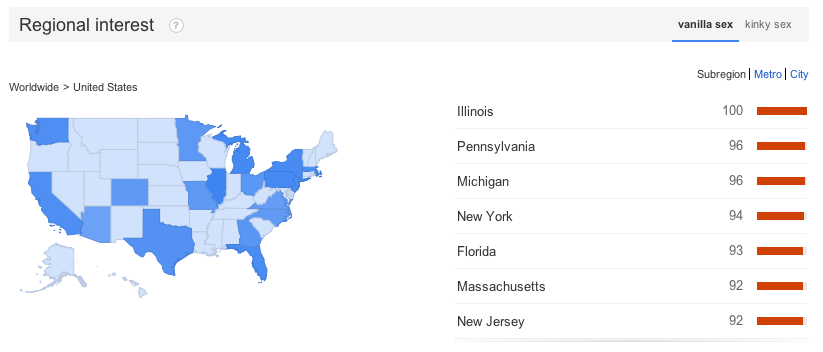
Illinois heads up this list, with Pennsylvania and Michigan tying for second with 96%, and Massachusetts and New Jersey tying for fifth with 92%. New York places third with 94%, while California achieves 89% in ninth place. Texas brings up the rear with 86%.

“Vanilla Sex” by Metro:
'Vanilla Sex' by Metro

‘Vanilla Sex’ by Metro

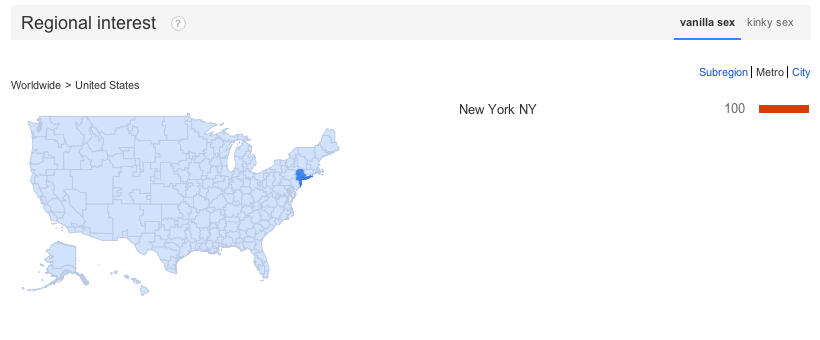
Yeah, this doesn’t look comprehensive. I find it very hard to believe that New York is the only metro area Googling “vanilla sex,” considering I found that the same metro area was madly Googling sexy Halloween costumes last month.

Unless it’s a case where the numbers need to hit a certain threshold to become visible, this does not look viable. At all.

“Vanilla Sex” by City:
'Vanilla Sex' by City

‘Vanilla Sex’ by City

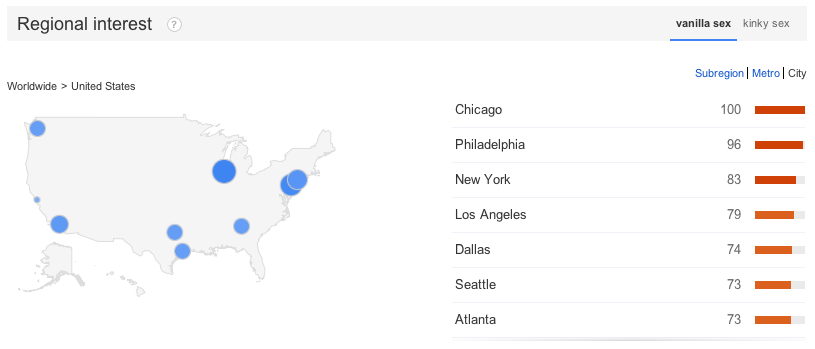
Chicago unsurprisingly tops this list, considering how Illinois topped the subregion list. New York and Los Angeles sit at third with 83% and fourth with 79%, respectively. Seattle, Atlanta and Houston have a three-way (heh) tie with 73%. San Francisco closes out the list with 57%, the lowest I’ve seen so far in doing these Google Trends.


“Kinky Sex” by Subregion:

'Kinky Sex' by Subregion

‘Kinky Sex’ by Subregion

Here’s where it gets interesting: All of the top states score at least 87%, which means these states have a big interest in kinky sex (nothing wrong with that, of course). Cueing the jokes about the South, Kentucky tops this list, with West Virginia a close second at 98%.

“Kinky Sex” by Metro:
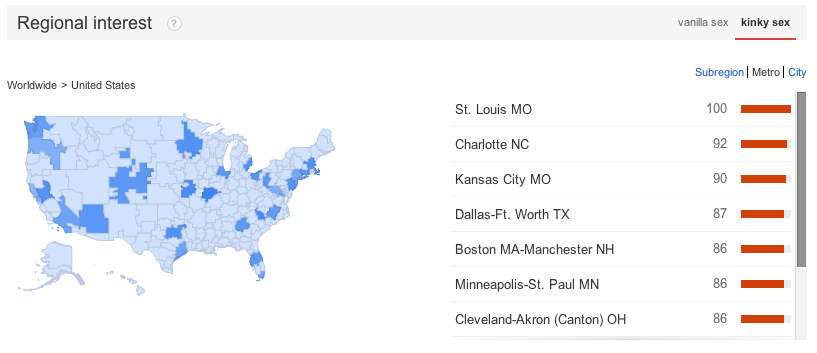
'Kinky Sex' by Metro

‘Kinky Sex’ by Metro

Missouri’s St. Louis and Kansas City appear at #1 with 100% and #3 with 90%, respectively. Charlotte, NC sits between them with 92%.

Aside from that, the rest of the metro areas are scattered among Texas, New Hampshire, Minnesota, Ohio, California, Michigan and Pennsylvania.

“Kinky Sex” by City:
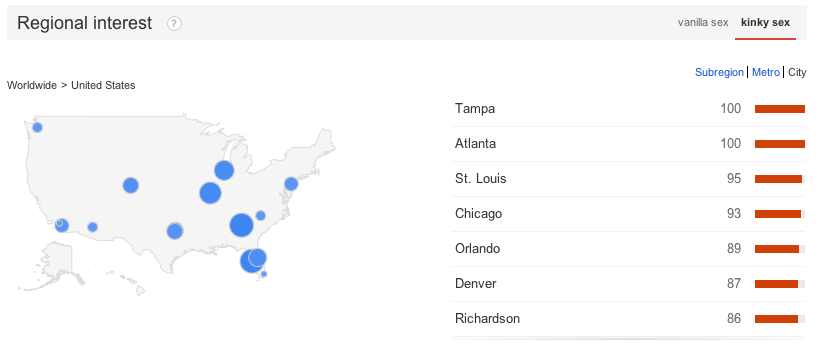
'Kinky Sex' by City

‘Kinky Sex’ by City

Southern cities Tampa and Atlanta tie for first, with St. Louis coming in at third with 95%. The rest of the lis is scattered geographically.


Conclusions:

It’s difficult to draw any concrete conclusions from the findings. It appears that Googling kinky sex is widespread and not limited to any particular region, metro area and/or city.

Purity Balls: How Popular Are They?

Purity ball

Purity ball

Sometimes, we get curious about the other side of sex education: the side where it pretty much doesn’t exist. Recently, I became curious about the popularity, or possible lack thereof, of purity balls.

For those who don’t know, Christian purity balls have popped up in the last decade as a way for young women (generally preteens and teens) to pledge to remain sexually pure until they marry. They usually take place within an evening event and dance, where fathers attend with their daughters. The fathers pledge to model an example of purity for their daughters, and to protect them from evil teenage boys and their desires.

The daughters, in turn, pledge their virginity to their father. Oh yeah, and the Lord.

Randy and Lisa Wilson created the first purity ball in 1998, and their website notes that balls have been held in 48 states since then. (According to their website, there have also been inquiries from 17 countries.)

In a “New York Times” article written in 2012, feminist writer Jessica Valenti reported 1K+ purity balls were held in 2006, for her 2010 book “The Purity Myth.” In a related stat, Leslee J. Uhruh, president of the National Abstinence Clearinghouse, claims she fielded 4K+ calls concerning holding purity balls “within a 12-month period,” though how this period is calculated isn’t defined.

Unfortunately, I couldn’t find any data on how fast the movement is growing, where it’s growing the most, how many attendees, and other points of interest.

Brown University Date Rape Drug GHB: How Common Is It?

Brown University's Robinson Hall, 2009

Brown University’s Robinson Hall, 2009

A female student at a Brown University fraternity party held on Oct. 17 has tested positive for a date-rape drug.

The student drank an alcoholic punch which contained GHB (gamma hydroxybutrate), which was found during a later test. One other student drank the punch, and those results are still pending.

The Australian Drug Foundation notes that symptoms such as drowsiness, lowered inhibitions and memory lapses become present 15-20 minutes after taking the drug, and can continue for 3-4 hours. It’s also easy to overdose since there aren’t much difference in dosage between an overdose and a safe amount.

This continues a story in which the aforementioned female student reported that she was sexually assaulted at the Phi Kappa Psi party.

How common is GHB’s use as a date-rape drug?

Unfortunately, I couldn’t find any hard numbers solely on GHB for colleges. A 2009 Monitoring the Future study found that .7% of eighth-graders and 1.1% of 12th-graders reported using the drug in the past year. GHB use peaked in 2000 when 1.2% of eighth-graders in 2000 and 2% of 12th-graders in 2004 reporting using it within the past year.

Drug abuse treatment website Serenity Lane reports that since there have been 15K+ overdoses and 72 deaths related to GHB. But this doesn’t tell us the age-spread, so it’s impossible to tell which, if any, age group this affected most.

Every resource I looked at listed GHB as a date-rape drug alongside rohypnol and ketamine. In fact, Brown’s own Health Services website devotes a page to GHB. It’s clear that its use is still a large issue.


How Common are Sexual Reassignment Surgeries (SRS)?

Lili Elbe, 1926

Lili Elbe, 1926

Last week, it was announced that English actor Eddie Redmayne will play Lili Elbe in an upcoming film. Elbe, a Dutch painter, was one of the first recipients of sexual reassignment surgery (SRS). Elbe was born Elnar Mogens Wegener in 1882 and started the surgery in 1930 in Germany. SRS was very experimental at the time, and she went through a series of five operations that spanned over two years.

Naturally, this made me wonder how common SRS surgeries (both male-to-female and female-to-male) are in the U.S.

In 2008, Dr. Mary Ann Horton published a paper on just that, where she examined all SRS surgeries performed within calendar year 2001.

She found that 1.1K+ overall SRS surgeries were performed, 740 being MTF and 430 being FTM.

The incidence of SRS followed an overall ratio to 1:240K. This broke down to 1:190 for MTF and 1:330 for FTM.

Unfortunately, it’s not clear how we can project these numbers to grow and/or change moving forward.


In any case, the development with Redmayne’s casting is significant is that cis-woman Nicole Kidman was initially cast in the role five years ago. Cis-man Redmayne’s casting might signal a shift in how Hollywood perceives depictions of tradespeople.


Prostate Health Boosted by Having Lots of Sex

Prostate screening patient

Prostate screening patient

You’re not being a man-whore, you’re protecting your health: A new study out of the University of Montreal says that having intercourse with 20 or more women helps men’s risk in developing prostate cancer decrease by 28%.

However, this effect only holds true for straight men: Men who had sex with 20 or more men were twice as likely to get the disease.

The study had 3K+ men answer an questionnaire about their sex lives. In the course of the study running Sept. 2005-Aug. 2009, 1.5K+ men were diagnosed with prostate cancer.

The article doesn’t mention how exactly 20 was determined to be the break-even point. It also begs the question as to what other numbers of partners do for preventing the cancer (for example, how does having 17 partners help, or hurt?).

I’d love to know more about this. Wouldn’t you?

How Common Is Vaginismus?

Vaginal Dilators

Vaginal Dilators

If you haven’t heard the term, “vaginismus” refers to vaginal tightness during, or even preventing, sexual intercourse. It’s not widely talked about, but it definitely exists.

But how many women suffer from it.

Vaginismus.com estimates that it affects roughly every 2 in 1K women. In the US, as of the 2010 census, that amounts to 313K+ women, assuming it has an equal distribution, or affects women of all ages equally.

But since it’s such a private matter, and women may be ashamed and/or embarrassed to speak up about it, there’s no way to get a firmer number.

Other statistics cited on the page estimate that vaginismus occurs more often in women ages 15-24, since attempted first intercourse generally falls within that range. The Masters & Johnson Institute and the Center for Human Sexuality put the rate of vaginismus in their patients at 20% and 40%, respectively.

Single Parents’ Sex Lives

Parent and child

Parent and child

A recent study jointly done by the University of Nevada and The Kinsey Institute examines the sex lives of single parents.

According to “The Huffington Post,” the study, which used data from the 2012 Singles in America findings, looked at 5K+ single Americans age 21 and over. Single parents comprised almost 39% of the sample size.

Participants were asked questions regarding the frequency of sexual thoughts and actually getting it on, as well as the number of people they’d dated and how many children they had. The timeframe appears to be limited to one year.

Researchers said that the single parents reported having the same amount of sex as singles without children. Also, single parents with children under age five had more sex than those with older children. These findings were published in the Journal of  Sex Research.

However, the study doesn’t tell us what baseline was used for “normal” frequency of sexual intercourse and sexual thoughts. So we can’t really extrapolate much here.


#ThrowbackThursday: “Seinfeld” Undateable Conversation

"Seinfeld"'s Jerry and Elaine

“Seinfeld”‘s Jerry and Elaine

I’d forgotten about this apropos exchange from one of my favorite shows. It’s from Season 7’s episode “The Wink,” which first aired on Oct. 12, 1995.

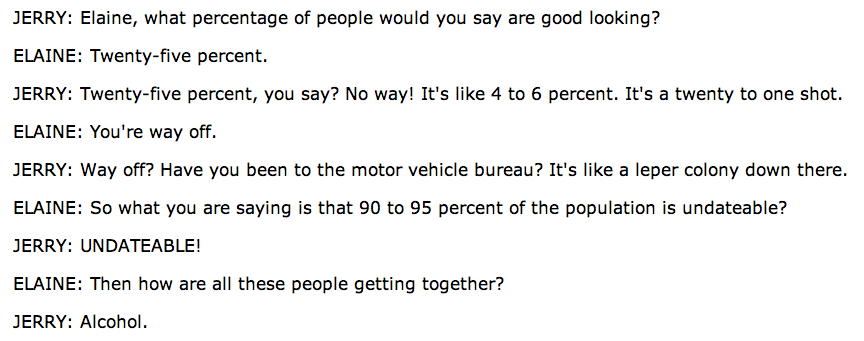
Undateable bit from "Seinfeld" episode "The Wink"

Undateable bit from “Seinfeld” episode “The Wink”

Hmm, I have to question his methodology, which he’s not exactly being transparent about…

I wonder if the fictional Jerry Seinfeld would say that those numbers still hold true today, or have changed? Too bad we’ll never know.

How Many People Have Affairs?

Showtime's "The Affair"

Showtime’s “The Affair”

After watching the pilot of Showtime’s new series “The Affair,” I became curious about finding stats on affairs.

A 2012 “Psychology Today” article cites a study that claims 10-13% of adults cheat, with the percentage peaking at 20% in the 40s age range. It doesn’t break down whether this includes both married and otherwise committed couples, and doesn’t break the data down by gender.

Will you watch “The Affair?”


Just How Popular Is Analingus?

Nicki Minaj's "Anaconda" cover

Nicki Minaj’s “Anaconda” cover

Rimming. Salad tossing. Eating booty.

All of a sudden, it’s the sex act everyone can’t stop talking about (or reading about). But who’s actually actually doing it?

Sadly, I couldn’t find any specific surveys dedicated to purely analingus. (Kinsey Institute, want to get on that?) But we can deduce a couple of things from general anal sex stats.

A 2010 “Psychology Today” article states that “recent surveys” found that around 15% of Americans engage or have engaged in “some form” of anal sex. This amounts to around 20M people. (Also, props to the author for noting upfront that he couldn’t find any analingus stats himself.) But this doesn’t tell us a) how often, or not, Americans are engaged in anal play, and b) what exactly they’re doing with the ass. We also don’t know how “recent” these surveys were, or what length of time they covered.

Slightly more recently, the CDC’s 2011 National Health Statistics report found that 36% of women and 44% of men reported engaging in anal sex, using the cohort group of men and women ages 25-44. But again, this only tells us about one specific act, unless participants were lumping rimming under the general “anal sex” umbrella.

Unless we get an actual study devoted to analingus analytics, we’ll never know for sure. But anecdotally, in mainstream culture, the prevalence of the act appears to be on the rise.