“Wonder Woman 2” Will Be the First Film to Use New Anti-Sexual Harassment Guidelines

Gal Gadot in 'Wonder Woman' (Buzzfeed)

Gal Gadot in ‘Wonder Woman’ (Buzzfeed)

We have another reason to love the next “Wonder Woman” movie! It’s been announced that the film will be the first to implement new anti-sexual harassment guidelines.

Drawn up by the Producers Guild of America (PGA) in response to the wave of sexual harassment coming to light, the guidelines will provide anti-sexual harassment training to those working on the movie and support to those who report harassment. These guidelines will apply across the film and TV industries. The guidelines were created by the PGA’s new Anti-Sexual Harassment Task Force.

It’s great to see the entertainment industry taking action to combat sexual harassment, and I hope these guidelines will be widely adopted.

“Wonder Woman 2” will be released in 2019.

By The Numbers: Women’s March 2018

Women's March 2018 (Yahoo)

Women’s March 2018 (Yahoo)

Did you go to a Women’s March this past weekend? I went to the one in LA, and had a great time! It was wonderful being surrounded by so many positive people interested in change.

I was curious to see if there were any numbers on how many people marched this year. It does make sense that turnout would be lower this year than last year, which saw around 3M people around the country. It has been noted that year-over-year attendance in major cities decreased, while those in surrounding areas actually increased due to protestors opting to attend marches closer to home.

While it was difficult to estimate because some cities had marches spread out over the weekend and some cities didn’t have estimates, other cities still reported numbers:

  • Los Angeles: 500K
  • New York City: 200K+
  • San Diego: 37K
  • Washington, DC: 10K
  • Raleigh, NC: 1K+
  • Casper, Wyoming: 350

Hit the links to read more about the numbers. Can’t wait to march next year!

By The Numbers: Women Making Bank

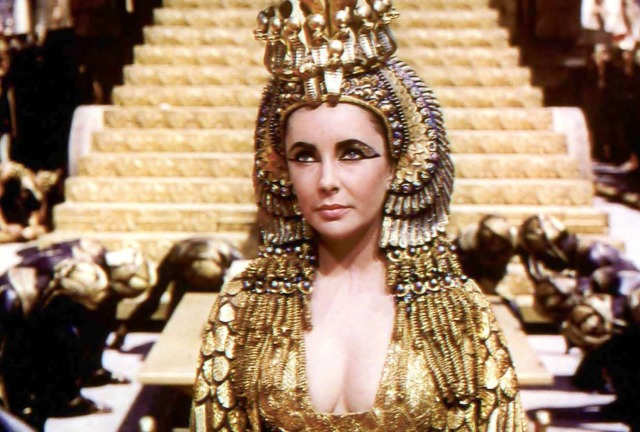
Elizabeth Taylor in 'Cleopatra,' 1963 (Eclipse Magazine)

Elizabeth Taylor in ‘Cleopatra,’ 1963 (Eclipse Magazine)

Earlier this week, Ellen Pompeo became the highest-paid TV actress currently on TV, making $20M a year. How’d she do it? She asked for it. Also, she knew her worth.

Who else has made bank while breaking the glass ceiling? Let’s take a look!

First Female Millionaire:

Madam C.J. Walker built a beauty empire and had a net worth of $600K at the time of her death. Adjusted for inflation, that’s that’s $8,757,479.29 in November 2017 money.

First Female Billionaire:

Lifestyle entrepreneur Martha Stewart became a billionaire in 2000, the year after her company Martha Stewart Living Omnimedia went public.

First Black Female Billionaire:

Be honest: you thought this would be Oprah, didn’t you? So did I…until I actually googled it. No, this honor goes to Sheila Johnson. Johnson co-founded BET with her ex-husband Bob Johnson and went on to work in hospitality and real estate, and own minority stakes in three sports teams. Johnson first made the “Forbes” Billionaire List in 2000.

First Film Actress to be Paid $1M for a Role:

This would be the incomparable Elizabeth Taylor, who played the titular role in “Cleopatra” in 1963.

Highest-Paid Actress of 2017:

Emma Stone made the “Forbes” 2017 list of highest paid actors and actresses at $26M. However, she’s the highest-ranking actress at #15.


#ThrowbackThursday: Eartha Kitt as Catwoman in “Batman,” 1967

Eartha Kitt as Catwoman (Pinterest)

Eartha Kitt as Catwoman (Pinterest)

Many people know Julie Newmar as Catwoman in the 1960s TV series “Batman,” but there was a second Catwoman as well! Actress and singer Eartha Kitt took over the role in 1967. Kitt was already famous by this time, having danced with the Katherine Dunham Company, recorded several songs and had been acting for many years.

Kitt played Catwoman from 1967 to 1968. Not bad for a woman Orson Welles called “the most exciting woman on Earth.”

Ellen Pompeo is the Highest-Paid TV Actress at $20M a Year

Ellen Pompeo in 'Grey's Anatomy' (Today)

Ellen Pompeo in ‘Grey’s Anatomy’ (Today)

Actress Ellen Pompeo has played the titular role in “Grey’s Anatomy” since 2004. And she’s finally making bank for it.

Pompeo is earning $575K per episode (!!), to the tune of $20M per year (!!!). She could also bring in another $6-7M with backend deals. Pompeo is now the highest-paid actress on TV.

Congrats to Ellen! May we all have the courage to go after what we’re worth!

Google Trends: “Black Panther”

Chadwick Boseman and Lupita Nyong'o in 'Black Panther' (Geeks of Doom)

Chadwick Boseman and Lupita Nyong’o in ‘Black Panther’ (Geeks of Doom)

As you may have heard, “Black Panther” comes out in less than a month (!!!). Tickets went on sale a little over a week ago, and Fandango has already reported that the movie’s pre-sales have set a new record for the Marvel Cinematic Universe (MCU), beating previous record-holder “Captain America: Civil War.”

I was curious to see how Google was affected by this record. Let’s take a look!

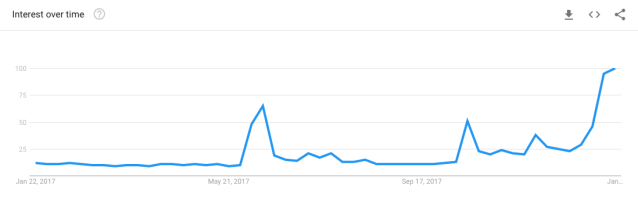
First, here’s a general search for “black panther” over the last 12 months:

Google Trends: 'black panther' search term over the past 12 months (Google Trends)

Google Trends: ‘black panther’ search term over the past 12 months (Google Trends)

See that spike in June? The movie’s teaser trailer dropped on Jan. 9, and received 89M views within its first 24 hours. And you can see the spike at the end within the last few weeks.

How many people searched for “black panther tickets?”

Google Trends: 'black panther tickets' from the past 12 months (Google Trends)

Google Trends: ‘black panther tickets’ from the past 12 months (Google Trends)

Check out that spike!! Everyone wanted in (no surprise, because this movie looks AMAZING!).

Since Fandango reported the new record, let’s see what the trend for searching “black panther fandango” looks like:

Google Trends: 'black panther fandango' search term for the past 12 months (Google Trends)

Google Trends: ‘black panther fandango’ search term for the past 12 months (Google Trends)

Once again, we see a drastic spike with the last week. One interesting thing is that while the search term “black panther tickets” projected a drop in the search term for the current week (see second graph), the search phrase that includes Fandango does not.

One thing is clear: The excitement surrounding this movie is definitely affecting search, so make sure that SEO is on point!

“Black Panther” Sets Fandango Record for Marvel Pre-Sales

Chadwick Boseman in 'Black Panther' (Marvel Cinematic Universe Wiki)

Chadwick Boseman in ‘Black Panther’ (Marvel Cinematic Universe Wiki)

Seriously, who *isn’t* eagerly awaiting “Black Panther” to drop?! If you know anyone that’s not, tell them to get right!!

The latest proof comes from ticket website Fandango, which opened ticket sales to the latest entry to Marvel Cinematic Universe (MCU) a week ago. Twenty-four hours later, “Black Panther” had set a new record for advance ticket pre-sales for a Marvel movie. Sadly, no numbers were given to back up this claim (because you know I’d love to see them!).

The film is clearly benefitting from broader awareness: Sales began after a national TV spot aired during the College Football Playoff National Championship. A recent Fandango survey of 8K moviegoers revealed that “Black Panther” is the second-most anticipated film of the year. It ranks below another MCU entry “Avengers: Infinity War.” Many of the “Black Panther” characters will appear in “Infinity War.” Titular star Chadwick Boseman was also voted the “most anticipated comic book hero in a standalone movie.”

This pre-sale record may or may not indicate how well “Black Panther” will do when it opens next month. According to entertainment industry trade “Deadline,” estimates not affiliated with the movie are predicting an opening weekend take of $80-85M, and maybe scaling up to $100M. But then “Captain America: Civil War” (the previous Fandango pre-sales record holder for the MCU) made $179M in its opening weekend, and went out to gross $1.15B (!) around the world.

“Black Panther” opens on Feb. 16, 2018, and stars Chadwick Boseman, Lupita Nyong’o, and Angela Bassett.

Trends: Calling Out Pay Disparity

Savannah Guthrie and Hoda Kotb of 'Today' (ET Online)

Savannah Guthrie and Hoda Kotb of ‘Today’ (ET Online)

Earlier this week, word got out that Michelle Williams got paid a per diem for quickly reshooting scenes for “All the Money in the World” ahead of its release. That per diem amounted to $80 per diem, totaling less than $1,000. Her costar Mark Wahlberg, on the other hand, was paid a whopping $1.5M for the reshoots.

As USA Today notes, “that works out to Williams being paid less than one-tenth of 1% of her male co-star.” Isn’t that crazy?! In light of this revelation, the Screen Actors Guild (SAG) is investigating the matter to see if any rules were violated during the making of the film.

This isn’t the first time men and women have faced a pay disparity. Far from it. But now, calling out pay disparity has become a public way to shame companies for making their employees feel undervalued.

This has been happening several times in news. After “Today” host Matt Lauer was fired, it was reported that Hoda Kotb and Savannah Guthrie would take over as co-hosts. Kotb and Guthrie would each be paid $7M, with their combined salaries making $14M. Later was making $25M, making the difference between his salary and those of his two co-hosts $11M.

Last month, E! Entertainment host Catt Sadler left her job of 12 years, because she was paid half as much as her male co-host Jason Kennedy. Her departure did not go unnoticed: Actresses Debra Messing, Laura Dern, and Eva Longoria confronted this year’s Golden Globes red carpet pre-show hosts Guiliana Rancic and Ryan Seacrest over the issue.

Awareness of pay disparity has also spread around the world. Former BBC News editor Carrie Gracie quit her position earlier this month once she learned that she had been severely underpaid throughout her career.

The pay disparity problem has also crossed racial lines. “Hawaii Five-O” stars Daniel Dae Kim and Grace Park each left the series last year due to pay disparity between themselves and their white costars. Though the two had been with the show since 2010, their respective raises were still 10-15% lower than those of their white costars.

It’s excellent that pay disparities are finally coming to light! Let’s hope they spur some lasting changes toward equality.

#ThrowbackThursday: Madame C.J. Walker, America’s First Female Millionaire

Madame C.J. Walker (Biography)

Madame C.J. Walker (Biography)

If you don’t know who Madame C.J. Walker is, get on that! The former Sarah Breedlove worked as a laundress and a singer before developing her own line of hair care products.  Walker eventually extended her product line into a beauty school and trained hairdressers in her products and specific methods. Through Walker’s entrepreneurship, she taught other black women how to run their own businesses and become financially independent.

By the time Madame C.J. Walker died at age 51, she’d become the first female millionaire, and a self-made one at that. Her net worth at the time of her death in 1919 was $600,000. Adjusted for inflation, that’s $8,757,479.29 in November 2017 money.

Google Trends: Time’s Up

Time's Up logo (Time's Up)

Time’s Up logo (Time’s Up)

On Jan. 1, 2018, 300+ powerful women working in Hollywood unleashed Time’s Up, a new initiative to combat sexual harassment in the workplace for all women. Awareness of the initiative debuted via an open letter penned by the Time’s Up founders, and published in The New York Times.

Within the past week-and-a-half, Time’s Up has received much attention, especially with the recent Golden Globes ceremony and the majority of female attendees showing up in black in solidarity for sexual harassment victims.

I was curious to see how much of a digital footprint the initiative has already made regarding search terms. So I looked at Google Trends.

I first used the search terms “times,” within the parameter of the past 30 days (Dec. 9, 2017-Jan. 9, 2018). Here’s the trend:

Google Trends: "timesup" search term, Dec. 9, 2017-Jan. 9, 2018 (Google Trends)

Google Trends: “timesup” search term, Dec. 9, 2017-Jan. 9, 2018 (Google Trends)

Check out that spike! And it’s all since Jan. 1, 2018!

I was also curious to see which regions were searching for “timesup” the most. And here’s what happened:
Google Trends: "timesup" search term interest by region, Dec. 9, 2017-Jan. 9, 2018 (Google Trends)

Google Trends: “timesup” search term interest by region, Dec. 9, 2017-Jan. 9, 2018 (Google Trends)

That was a surprise to me. I would’ve thought that there would’ve been enough data to show a regional breakout, but I was wrong.

This could be the result of how the search term is typed. So I decided to try another way: “times up.” Here was that trend:

Google Trends: "times up" search term, Dec. 9, 2017-Jan. 9, 2018 (Google Trends)

Google Trends: “times up” search term, Dec. 9, 2017-Jan. 9, 2018 (Google Trends)

This is a bit steadier, but it’s also probable that this search term did not directly and solely relate to the new initiative.

I then decided to try the hashtag version: “#timesup.” Here’s what that term’s trend looked like:
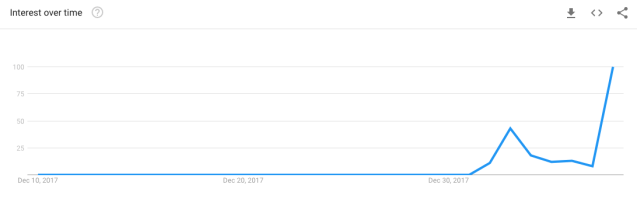
Google Trends: "#timesup" search term, Dec. 9, 2017-Jan. 8, 2017 (Google Trends)

Google Trends: “#timesup” search term, Dec. 9, 2017-Jan. 8, 2017 (Google Trends)

This one appears to be more directly related to the new initiative.

As Google Trends confirms, Time’s Up is already having an impact in terms of search. It’ll be interesting to see how the movement grows, and how search terms are subsequently affected.