Rachel Dolezal: How Many White People Have Passed As Black?

Rachel Dolezal (Young Cons)

Rachel Dolezal (Young Cons)

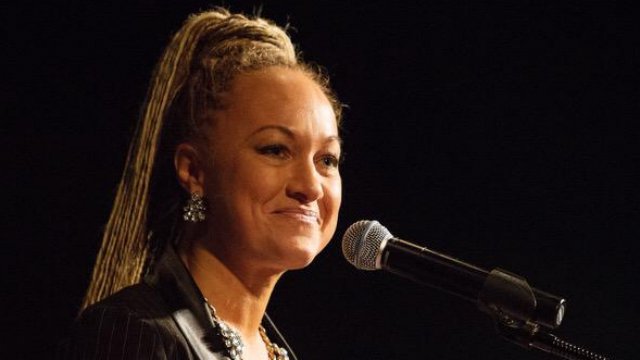
This is pretty insane: It came out last week that Rachel Dolezal, the president of the National Association for the Advancement of Colored People (NAACP) chapter in Spokane, Washington, isn’t black at all. Not one drop.

She’s actually white.

Her story came out after a reporter asked her point-blank if she was black. Dolezal dodged the question. Since then, other aspects of Dolezal’s life have come to light: attending Howard University, telling people her adopted black brother (who lived with her) was really her son, and teaching classes on African-American culture at Eastern Washington University. Dolezal also claimed to have received hate mail.

Dolezal began identifying as black in 2007, after years of identifying with the culture.

I wanted to see if there were any stats on white people passing as black in the larger culture. I don’t mean in terms of appropriating dress or mannerisms, but actually altering one’s physical appearance and living an elaborate lie.

And I couldn’t find anything. Shocker (but not really). This is such a strange situation that I’m not surprised there haven’t been enough subjects to be studied.

The only white person who’s done anything remotely similar was John Howard Griffin, author of “Black Like Me.” Griffin underwent physical changes, including darkening his skin under heat lamps, to pass for a black man and report on racial injustices in the South firsthand. But obviously, his motives were very different than Dolezal’s.

It’ll be interesting to see how Dolezal’s case plays out, and if she’ll drop her black identity now that she’s been exposed.

How Many Husbands Take Their Wives’ Last Names?

Zoe and Marco Saldana (KCCI)

Zoe and Marco Saldana (KCCI)

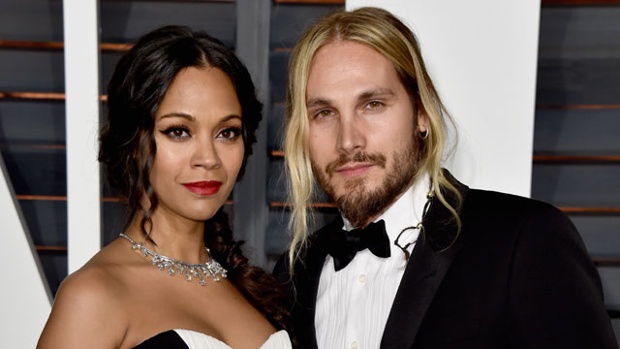
Happy Friday! Earlier this week, actress Zoe Saldana told “InStyle” that her husband Marco Perego wanted to take her last name, instead of having her take his. Saldana was initially hesitant:

I tried to talk him out of it. I told him, ‘If you use my name, you’re going to be emasculated by your community of artists, by your Latin community of men, by the world.’ But Marco looks up at me and says [in his Italian accent], ‘Ah, Zoe, I don’t give a sheet.’

Now, that’s a true man right there. Husbands taking their wife’s last name isn’t too common, at least anecdotally. But what about the data? Has it been tracked?

No, it hasn’t, at least not yet. I found several articles profiling couples who did it, but each article mentioned in some way that statistics weren’t tracked. Oh well. On the other hand, it’s a topic ripe for picking for a Ph.D. thesis. Any takers?

But Mr. Saldana (né Perego) made a huge impact. Meghan Blalock of “Who What Wear” puts his decision in context:

The storied history of women taking men’s last names in marriage is not just a trend or a matter of practicality—it’s a long-existing symptom of the patriarchal society in which we live, in which a marriage means that a woman is little more than a man’s property.

So his decision shows that he’s not just a traditionally masculine man, but that he has a sensitive side towards women and feminism, and isn’t afraid to show it. Pretty badass, right? Maybe we’ll see more men follow suit!

Thursday Trends: Whitewashing Asian Characters in Film

Emma Stone, 'Aloha' (Jezebel)

Emma Stone, ‘Aloha’ (Jezebel)

Let me be clear: this is not a good trend. At all. It should never have even started. And yet, here we are.

It’s still a problem.

Historically, Hollywood has always had a problem of “whitewashing,” i.e. casting white actors in roles specifically created for non-whites. The thinking is that whites are more “bankable,” but there aren’t many roles and opportunities for non-white actors as it is. So a white actor ends up taking a role from a non-white one, and many non-white people are deprived of seeing depictions of themselves on-screen.

This tends to happen a lot with Asian actors. Most recently, director Cameron Crowe came under fire for casting Emma Stone in his latest movie “Aloha.” Stone was cast as a character named Allison Ng, whose ancestry is one-quarter Chinese and one-quarter Hawaiian. (Having white and Asian or Pacific Islander ancestry is traditionally known as “hapa,” deriving from the Hawaiian Pidgin word for half. So Ng’s heritage would be termed “hapa” or “hapa haole,” to include the European ancestry.)

Look at the picture above and tell me with a straight face that Emma Stone resembles anyone remotely half-Asian.

Fortunately, Crowe caught some heat for this decision, and has publicly apologized for his choice. (But he covered his ass a little, saying that the character was meant to be frustrated that her features belied her mixed-race heritage.) But Crowe could’ve easily cast an Asian or mixed-race Asian for his film. He just chose not to.

This whitewashing of Asian characters tends to come up every few years. 2010’s “The Last Airbender” received a public outcry when it was revealed that the cast was mostly non-white actors, save for Dev Patel. (The debacle coined the term “race bending.”) This was odd considering that the TV series (on which the movie was based) was set in a world with obvious Asian elements, and it was animated using anime influence.

The 2008 movie “21” centered on the real-life story of the MIT Blackjack Team, a group of current and former students who beat the casinos at their own game by counting cards. Though many of the group were of Indian and Asian descent, the movie whitewashed the cast, using mostly Caucasian actors.

And then there are the times when white actors are actually put in yellowface. 2012’s “Cloud Atlas,” which had the ensemble actors playing various characters, actually had two examples of this, and took it past the point of no return: Jim Sturgess (who was also in “21”) and James D’Arcy both played Korean men at one point. Sturgess and D’Arcy are both white men, but they both spent extensive time in makeup to more realistically resemble Asian men.

This is far from a new problem. The 1956 film “Teahouse of the August Moon” featured legendary actor Marlon Brando as Japanese villager Sakini, donning full-on yellowface to physically embody the role. And everyone who’s seen 1961’s “Breakfast at Tiffany’s” remembers Mickey Rooney as Holly Golightly’s Japanese neighbor I.Y. Yunioshi, who, seen through modern eyes, was a jaw-droopingly offensive caricature. (“The New York Times” review of the film called Rooney “broadly exotic.”) Fortunately, the distance of time and perspective have allowed people to see that these portrayals were very offensive towards Asians, and it was wrong to a) write/portray the characters in such stereotypical ways, and b) cast actors not of the specific ethnicity to play these parts.

But maybe the message isn’t sinking in as much as it should be: Blonde, Caucasian actress Scarlett Johansson will star in DreamWorks’ adaptation of the anime title “Ghost in the Shell.”

Here’s the thing: There are so many asian and mixed-Asian actors out there. Kristin Kreuk, Chloe Bennet, Olivia Munn, John Cho, Steven Yeun, Daniel Henney, Harry Shum Jr., Sendhil Ramamurthy. And those are only the ones I didn’t need to Google off the top of my head. Point being, there’s massive opportunity here for diverse casting that reflects reality. So let’s get on it!
#ThrowbackThursday: Luise Ranier in “The Good Earth,” 1937

Luise Ranier, 'The Good Earth' (Rotten Tomatoes)

Luise Ranier, ‘The Good Earth’ (Rotten Tomatoes)

In 1937, actress Luise Ranier starred in a film adaptation of Pearl S. Buck’s novel “The Good Earth.” The plot centers on  the rise and fall of a Chinese family’s fortunes. Ranier played O-Lan, the family matriarch.

Ranier, who was born and spent her childhood in Germany, was Caucasian.

She became one of the first instances of Hollywood’s whitewashing: casting a white actor in a non-white role. Thus began the film industry’s troubled history with diversity on screen. But I guess it worked out for Ranier: she won an Oscar for Best Actress.

Joan Smalls is “Porter” Magazine’s First Woman of Color Cover Model

Joan Smalls for 'Porter' Magazine (Fashion Week Daily)

Joan Smalls for ‘Porter’ Magazine (Fashion Week Daily)

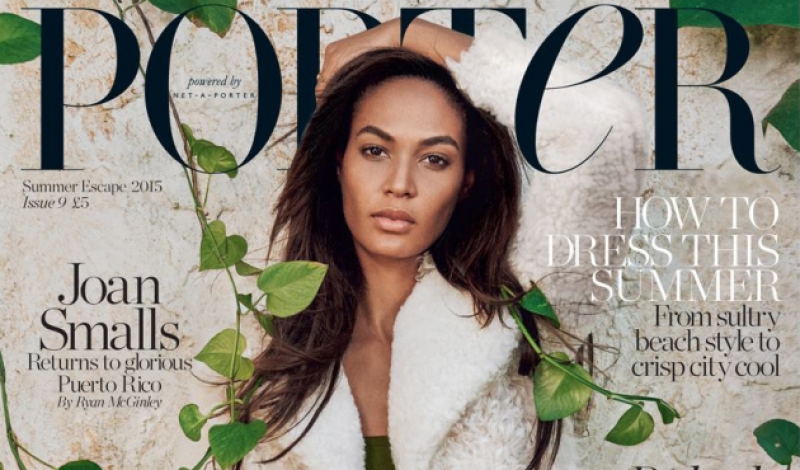
Supermodel Joan Smalls covers the summer edition of “Porter” magazine. She’s a model, she’s gorgeous; no big deal, right? Except, this time, it is: Smalls is the first woman of color to grace the cover.

The Puerto Rican beauty joins fellow supermodels Gisele Bundchen and Karlie Kloss in the “Porter” cover girl pantheon.

This isn’t the first time Smalls has made history, even in this decade: She became the first Latina model for Estée Lauder cosmetics in 2011.

Fashion companies and publications are finally recognizing to the fact that white isn’t the only skin tone that exists (“Vogue” has had a particular problem with this), and realizing that customers want to see models that resemble themselves. I just hope it’s not a trend but a step towards a large-scale change.

Brittney Griner/Glory Johnson Annulment: How Many Same-Sex Marriages End?

Glory Johnson and Brittney Griner (Forward Times Online)

Glory Johnson and Brittney Griner (Forward Times Online)

Phoenix Mercury star Brittney Griner filed for an annulment from her wife Glory Johnson, who plays for the Tulsa Shock. The two WNBA stars married May 8th, and Johnson announced her pregnancy June 4th.

With acceptance of same-sex marriage gaining ground, divorce will naturally follow. But how many same-sex marriages end?

It’s hard, and probably too early, to find concrete and up-to-date statistics on this. In 2011, UCLA’s Williams Institute found that same-sex couples who’ve formalized their commitment had a divorce rate of 1%+. This is lower than the annual divorce rate of heterosexual married couples, which is 2%.

Around 150K same-sex couples have married or otherwise committed to each other, so that would mean around 3K same-sex couples divorce each year. I couldn’t find any stats solely for annulments.

But in 2013, Pew Research Center’s FactTank found that same-sex marriages numbered around 71K+. It did take into account that there might be some underreporting going on.

As time passes and more same-sex marriages and divorces/annulments/separations are recorded, we’ll be able to see a clearer picture of any trends.


Caitlyn Jenner Gets New E! Docuseries “I Am Cait”

Caitlyn Jenner, 'I Am Cait' (Skynews Australia)

Caitlyn Jenner, ‘I Am Cait’ (Skynews Australia)

That was quick: Caitlyn Jenner announced that she’ll star in a docuseries titled “I Am Cait” for E!. (E! is also home to “Keeping Up with the Kardashians” and its various iterations.) The docuseries will follow Jenner as she begins life as a woman.

The eight-part series will premiere on July 26th, and will air in 120 countries.

This is the second docuseries announced on the life of a transgender woman this year. The E! show follows TLC’s previously announced “All That Jazz,” which will focus on teen transgender activist Jazz Jennings.

How Many People Don’t Trust Their Partners?

Jada Pinkett-Smith and Will Smith (Word On Da Street)

Jada Pinkett-Smith and Will Smith (Word On Da Street)

Happy Friday! Actress Jada Pinkett-Smith always has something to say on marriage or sex that some find controversial. But most of the time, what she has to say is very realistic, and more people should heed her advice.

Her most recent interview Wednesday on “Howard Stern” is a prime example. Pinkett-Smith’s marriage to actor Will Smith has frequently been plagued by cheating allegations, all of which she’s dismissed. On Stern’s radio show, she laid out why she’s not worried about her man’s actions:

You’ve got to trust who you’re with. And at the end of the day, I’m not here to be anybody’s watcher. I’m not his watcher. He’s a grown man.

Pinkett-Smith went on to say that as long as Smith could look himself in the mirror, it was all good.

She brings up a great point: Many people (most, it seems) don’t trust their partners, and live in fear that their significant other will cheat.

How widespread is this mindset? Pretty common. According to the 2013 book “The Normal Bar,” which shares secrets of successful couples, less than 40% of women and just over 50% of men claim to trust their partners. Scary, isn’t it?

We should all relax a little and take a page from Pinkett-Smith’s book.


Thursday Trends: Female Celebrities’ Fluid Sexuality

Maria Bello (Salon)

Maria Bello (Salon)

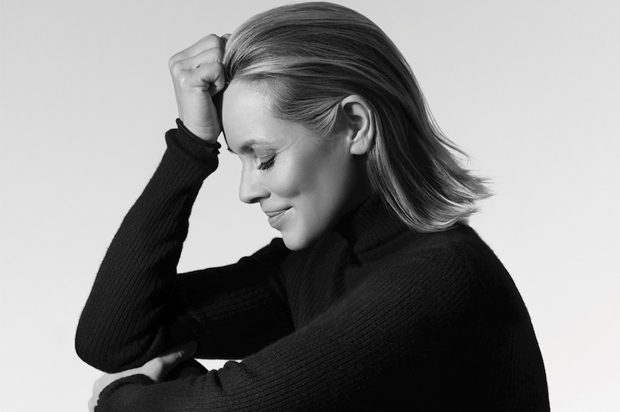
Last week, actress Maria Bello released her new memoir. “Whatever…Love Is Love” chronicles Bello’s journey as a single mom who self-identified as straight, but then unexpectedly fell in love with her female best friend. She penned a piece for “The New York Times” in 2013 that centered on worrying how her son would react to the news. (If you’re wondering, his response is her memoir title verbatim.) From there, Bello decided to redefine her relationships in a way that worked for her, and she now sexually identifies as a “whatever.”

Bello isn’t the only female public figure whose sexuality has shifted within the public eye. Oscar-winning actress Tatum O’Neal recently revealed that she likes and has been dating mostly women for some time now. O’Neal didn’t self-identify as lesbian or bisexual (she had previously been married to, and had children with, tennis ace John McEnroe), and says she’s “not one or the other.”

The millennial generation also has its share of sexually fluid women who eschew labels. Actress Amber Heard dated photographer Tasya van Ree before marrying actor Johnny Depp earlier this year. She also doesn’t label herself “one way or another.” Actress Lindsay Lohan famously had a volatile relationship with DJ Samantha Ronson, but then publicly self-identified as straight years after the relationship was over.

Though the majority of examples come from entertainment, the political sphere can claim on entrant. Chirlane McCray, wife of New York City mayor Bill de Blasio, self-identified as a lesbian when she met her now-husband in 1991. Years earlier in 1979, McCray had written an essay for “Essence,” titled “I Am A Lesbian,” which centered on gays and lesbians within the black community. McCray’s essay didn’t receive much attention until just before her husband decided to run for mayor in 2012.

What’s interesting about McCray’s case is how others in the media reacted to it: Many termed her some variation of “former lesbian.” But McCray never self-identified as anything remotely resembling that. Here’s how she responded in 2013 when asked if she self-identified as bisexual:

I am more than just a label. Why are people so driven to labeling where we fall on the sexual spectrum? Labels put people in boxes, and those boxes are shaped like coffins. Finding the right person can be so hard that often, when a person finally finds someone she or he is comfortable with, she or he just makes it work.

It’s fantastic how so many women (and people in general) are gaining the courage to step outside the box and do what works for them, especially in terms of sexuality and relationships. What I love about the above examples is that they’re all open to new experiences and don’t use labels to limit them. And that’s just beautiful.

#ThrowbackThursday: Angelina Jolie and Jenny Shimizu, 1996

Angelina Jolie and Jenny Shimizu (The Daily Mail UK)

Angelina Jolie and Jenny Shimizu (The Daily Mail UK)

Long before she become a well-known humanitarian with perfect bone structure and Mrs. Brad Pitt, Oscar-winning actress Angelina Jolie was kind of a wild child. But before wearing Billy Bob Thornton’s blood in a vial around her neck, she did something that (rightfully) now seems like no big deal.

Jolie began dating actress/model Jenny Shimizu on the set of their 1996 film “Foxfire.” Jolie claims that she fell in love with Shimizu “the first second [she] saw her,” and would’ve married Shimizu if she wasn’t already married to actor Jonny Lee Miller.

Reports put the definitive end of the relationship around 2005 (coincidentally the same year she starred in “Mr. & Mrs. Smith” opposite Pitt), but imagine an alternate universe where Jolie and Shimizu are the ultimate Hollywood bisexual power couple. Intriguing, right? Too bad it’ll only happen in our minds.