How Common are Transgender Siblings?

Lana Wachowski (Slate)

Lana Wachowski (Slate)

The Wachowski brothers are now the Wachowski sisters.

The directing duo, known for 1999’s “The Matrix” and 2015’s “Jupiter Ascending, have each gone through their own transitions to become transwomen. Lana (formerly known as Larry) began her transition in 2012, and Lilly (formerly known as Andy) was recently reported to have been transitioning.

This high-profile occurrence begs the question: How common are transgender siblings?

I wasn’t able to find any hard data on this. My guess is that it’s pretty rare, so there probably haven’t been any studies devoted to it. There are some numbers around twins transitioning (both identical and fraternal pairs), but that wouldn’t apply to the Wachowskis. But when and/or if the scientific community gets around to studying this phenomenon, I’ll be curious to see the numbers.




Lilly Wachowski Comes Out as a Transwoman

Lilly Wachowski (Slashfilm)

Lilly Wachowski (Slashfilm)

Earlier this month, another transwoman made her debut: Lilly Wachowski, formerly known as Andy Wachowski. Her debut comes four years after her brother Larry (now known as Lana) began her transition.

The Wachowskis are high-profile directors who debuted with “The Matrix” in 1999.

Female Genital Mutilation (FGM) Banned in Nigeria

Nigerian girl (Higher Perspectives)

Nigerian girl (Higher Perspectives)

Last fall, Nigeria became the first country to officially ban female genital mutilation (FGM). Previously, certain states had outlawed the practice. Former Nigerian president Goodluck Jonathan signed the bill into a law before he left office.

The United Nations banned FGM in 2012.

The World Health Organization (WHO) estimates that 125M+ women have been victims of the practice across the world. Nigeria has traditionally had one of the highest rates of FGM, accounting for 25% of cases worldwide.

FGM is used as a way to control a woman’s sexuality. The practice can result in any medical complications, including affecting fertility.


China’s Sex Ratio: How Skewed Is It?

Chinese One-Child Policy poster (The Galloping Beaver)

Chinese One-Child Policy poster (The Galloping Beaver)

Late last year, China ended its one-child policy, where each family was only allowed to have…one child. (Bet you didn’t see that one coming.) Though its rules have relaxed in recent years, this is the first time the practice has been officially abolished. (But we’ll see how long it takes for the policy to actually die down, data-wise.)

We’ve all heard about how skewed China’s sex ratios are; we’ve heard about how the country overwhelmingly favors male children to the detriment of an equal sex ratio. But what are the numbers behind this phenomenon?

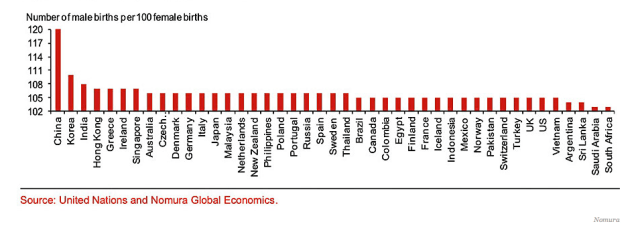
Consulting firm Nomura Research Institute, Ltd. released data in 2010 that revealed that Chinese women bear .71 of female births during their lifetime. That year, men outnumbered women by 50M+. The birth rate at that time was 120 boys per 100 girls, which works out to a sex ratio of 1.2.

If you’re a visual learner, here’s what that ratio looks like, especially in context with other countries:

China's male births compared to other countries' male births ('Business Insider')

China’s male births compared to other countries’ male births (‘Business Insider’)

As Business Insider notes:

That means lots of single, possibly angry males. Hard to imagine anything good coming out of this.

The policy was made into law in 1979, and abolished in 2015. That’s 36 years. Thirty-sex years of selected sex-selection in favor of boys at the expense of girls. (Fun fact: Kim Kardashian West participated in this when she was trying to get pregnant with her now-son.)

Scary, right? We’ll see how the new policy helps attempt to reverse this long-running trend.


Alejandro Gonzalez Inarritu is the First Mexican to Win the Best Director Oscar Two Consecutive Years

Alejandro Gonzalez Inarritu, Oscars 2015 (Latin Trends)

Alejandro Gonzalez Inarritu, Oscars 2015 (Latin Trends)

Alejandro Gonzalez Inarritu has a new record under his belt: He’s the first Mexican to win the Oscar for Best Director two consecutive years in a row. He won this year for “The Revenant,” and won for “Birdman.”

Inarritu joins two other directors in this distinction: John Ford (1940 and 1941) and Joseph L. Mankiewicz (1949 and 1950).

Congrats to Inarritu, and I can’t wait to see what else he does.

No Shit: Entertainment Isn’t Diverse: By The Numbers

Hollywood sign (Mapping Megan)

Hollywood sign (Mapping Megan)

A new study released this week by the University of Southern California (USC) Annenberg School for Communication and Journalism once again stated the obvious: Entertainment isn’t diverse.

If you don’t want to read the full report (though I’d recommend it), here are some choice stats:

Percentage of female speaking roles in film: 28.7%

Percentage of female film directors: 3.4%

Percentage of female screenwriters: 28.9%

Percentage of cable TV shows that have no Asian characters: 51%

Percentage of cable TV shows that have no Black characters: 23%


Still not convinced the #OscarsSoWhite hashtag is needed?

#ThrowbackThursday: Lupita Nyong’o, Oscars 2014

Lupita Nyong'o Oscar acceptance, 2014 (CBS News)

Lupita Nyong’o Oscar acceptance, 2014 (CBS News)

The Oscars are this weekend (Sunday, Feb. 28). If you’ve been following awards season this year, you know that the #OscarsSoWhite reared its ugly head again. This is the second year in a row that there have been no non-white nominees in the four acting categories. Shameful isn’t a strong enough word.

So I’m throwing it back to the last time we had a non-white winner in an acting category. That was back in 2014, at the 86th Annual Academy Awards. Lupita Nyong’o won Best Supporting Actress for her role in 2013’s “12 Years A Slave.” She’s both the most recent POC nominee and winner.

And because I couldn’t choose just one photo of Nyong’o, here’s another one that showcases her incredible Prada dress:

Lupita Nyong'o backstage at the Oscars, 2014 (Fiction Diversity WordPress)

Lupita Nyong’o backstage at the Oscars, 2014 (Fiction Diversity WordPress)


How Many Asian Actors Have Been Nominated for Oscars?

Yul Brynner in 'The King and I,' 1956 (Gold Derby)

Yul Brynner in ‘The King and I,’ 1956 (Gold Derby)

The Oscars are this weekend (Sunday, Feb. 28th), and the big controversy this year has centered around the lack of non-white acting nominees (and continues last year’s #OscarsSoWhite hashtag). But when talked about in detail, the conversation has seemed to focus more on including Black nominees and narratives. And that’s great! But there are a wealth of other races and ethnicities that need to be included in the conversation and given a place at the table.

This led me to wonder: how many Asian acting nominees and winners have there been in the history of the Academy Awards? Spoiler alert: not all that many, sadly.

The Best Actor category has seen the most Asian men win the award: Yul Brynner in 1956, and Ben Kingsley in 1982. These two men comprise two-thirds of the category’s Asian nominees.

Actress Merle Oberon was the first Asian nominated for any Oscar, and the first nominated for Best Actress. (The category was called “Best Lead Actress” when she was nominated in 1935.) She remains the sole Asian woman nominee of the category.

Of the seven Asian men who received Best Supporting Actor nominations spanning 1957 to 2003, only one has won: Haing S. Ngor in 1984. Six Asian women have received Best Supporting Actress nominations, but only one has won: Miyoshi Umeki in 1957.

Considering that these categories have five nominees each, and the Academy Awards have been occurring since 1930, this nominations/wins-to-visibility ratio is…fucking pathetic.

I really hope this year teaches the Academy a lesson, and we’ll begin to see more diverse characters and stories not just on screen, but materially validated by the old guard as well.


How Common is Intimate Partner Violence?

James Deen and Stoya (The Guardian UK)

James Deen and Stoya (The Guardian UK)

Late last year, adult film star James Deen was accused of rape by his former girlfriend, fellow adult film star Stoya. Other performers later came forward to accuse Deen of sexual assault, but Stoya’s two tweets on Nov. 28, 2015, started Deen’s downfall: He’s since been dropped from one major studio.

Rape can be part of a larger pattern of intimate partner violence. According to the National Coalition Against Domestic Violence (NCADV), intimate partner violence “comprises 15% of all violence crimes,” and women ages 18-24 are most likely to be “abused by an intimate partner.” In addition, 46%+ of women raped are raped by an acquaintance. Of this number, 45%+ of women are raped by an intimate partner. These are scary stats.

As of 2014, women ages 18-24 comprise 4.8% of the total population.As of the 2010 Census, women comprised 50.8% of the total population, or 156.9M+ residents. We can estimate that the current number of women in this age group who’ve been raped by an acquaintance might shake out to 155K+.

Here’s the math:

  • 156,964,212 *.0048 = 753,429 (estimate of women ages 18-24 as of 2014)
  • 753,429 * .46 = 346,578 (estimate of number of women in that age range raped by an acquaintance)
  • 346,578 * .45 = 155,961 (estimate of number of women ages 18-24 raped by an intimate partner)

Obviously, this isn’t an exact estimate, due to a couple of reasons: self-reporting (not all women will probably report rape/violence), and inaccurate data (using both 2010 and 2014 numbers).

Scary, right? Unfortunately, this is the reality, so take care of yourselves.


Channing Dungey is the First Black Woman to Run ABC

Channing Dungey and ABC logo (Variety)

Channing Dungey and ABC logo (Variety)

Big news on the entertainment/broadcast networks front: Channing Dungey was named President of ABC Entertainment last week. She’s the first Black woman to run a broadcast network’s entertainment division.

Dungey replaces outgoing president Paul Lee.

Before her new role, Dungey ran development of ABC’s shows. She’s worked with the “Thank God It’s Thursday” (TGIT)-block of “Scandal,” “How to Get Away With Murder,” and “Grey’s Anatomy,” earning her nickname of “the Shonda Rhimes whisperer.”

I’m eager to see how ABC’s programming will change as a result of Dungey’s promotion. Based on her glowing history with show runners, it sounds like viewers are in for a treat.