How Big is The Average Penis?

Sewing tape measure (Gika Rector)

Sewing tape measure (Gika Rector)

Happy Friday! Men, I’m sure you’ve all worried about your size at some point, right? (No royal we here, since I’m not a man and therefore have never had this particular worry.) Depending on your mood today, you may or may not want to read on.

Scientists have (once again) figured out the average penis size. But this time, they’ve really got it down. (Some might say to a science.)

British researchers looked at a pretty comprehensive sample size of 15K+ men from the U.S., Asia, Europe and Africa. The men ranged in age from 17 to 91 years old, and most of them were from either Europe or the Middle East.

The results, published in the “British Journal of Urology” and fittingly titled “Am I Normal?,” found the following:

The mean length of a flaccid penis is 3.6 inches, and the mean length of an erection is 5.16 inches. An average guy’s erect circumference is 4.5 inches.

(How many dudes are frantically measuring right now?)

Here’s more reassurance, per The U.K.’s “The Guardian:”

In reality, only 2.28% of the male population have an abnormally small penis, said the study – and the same percentage an unusually large one.

Over 97% of men have an average-sized penis. This also means that we can assume a normal distribution (or bell curve) in terms of distribution.

Breathing easier now?

To find these numbers, the researchers examined variables from 20 previous studies on penises (culled down from 96 original studies) to construct a “nomogram,” a graphical representation that’s supposed to include all ages and races of men’s genitalia.

The study is the first of its kind to “combine all existing data on penis length and girth into a definitive graph.” It’ll be used by doctors to reassure men from size anxieties.

Here’s one of the graphs related to penile length:
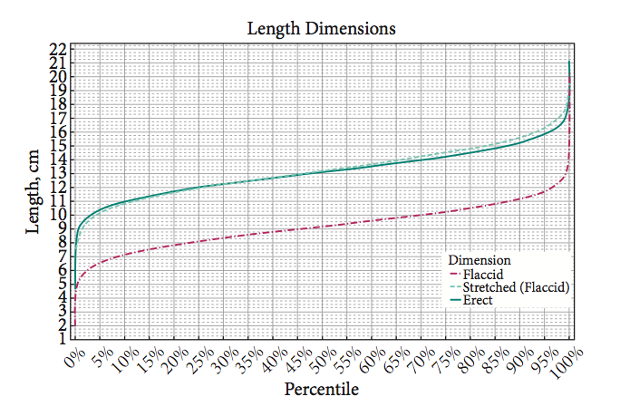
Penile length graph (The Guardian)

Penile length graph (The Guardian)

However, the researchers have admitted there are some flaws to this study. One is that size differences between the races can’t be compared equally, because the sample sizes of each race were not equal themselves.

And then there’s this flaw:

They acknowledged their results may have been somewhat skewed by the possibility that men who volunteer to be examined may be more confident in their penis size than the general population.

But I’m sure that’s just part and parcel of the entire package (sorry, couldn’t resist). Either way, 97%+ of men can now rest easy.


Google Trends: Was 2014 Really the Year of Eating Booty?

Nicki Minaj 'Anaconda' still (NY Daily News)

Nicki Minaj ‘Anaconda’ still (NY Daily News)

Last year, we heard all about how 2014 was the Year of Eating Booty (as termed by “Gawker”). Now we can’t go around and confirm this by asking randoms on the street if they got into anal play (come on, you expect everyone to tell the truth?), but we can check out Google Trends to see if anal terms were searched for more often.

I searched popular terms for the (somewhat-) transgressive sex act, and used a timeframe of January 2013-January 2015. I wanted to see how the entirety of 2014 compared to the year before for anal play-related search terms.

First, let’s start with the proper term for eating out your partner’s asshole:

Analingus:

Google Trends: 'Analingus' Search Term

Google Trends: ‘Analingus’ Search Term

There’s a bit of an increase, with a slightly steeper incline coming (heh) in the second half of last year.


Eating Booty:

Google Trends: 'Eating Booty' Search Term

Google Trends: ‘Eating Booty’ Search Term

Tyrone Palmer’s “Gawker” piece was published on Sept. 12. Those first initial rapid spikes occur in August, so we can’t argue that the “Gawker” piece had anything to do with that. It could’ve been responsible for the spikes throughout the rest of 2014 (not to mention that one huge spike at the end), but it’s pretty inconclusive.


Rimming:

Google Trends: 'Rimming' Search Term

Google Trends: ‘Rimming’ Search Term

This one stays pretty flat throughout. (I have to say, I never heard this term used much last year. It tended towards more colorful expressions for the act.)


Salad Tossing:

Google Trends: 'Tossing Salad' Search Term

Google Trends: ‘Tossing Salad’ Search Term

Like “analingus” and “eating booty,” this one started to get more active during the second half of 2014. My guess here is that it’s due to the popularity of Nicki Minaj’s single “Anaconda,” which was released on August 4th. (In it, she tells listeners that “this dude named Michael…tossed my salad like his name Romaine.”)


Conclusion:

2014 definitely showed an increase in Google search terms related to eating out one’s asshole, though these mainly took place during the second half of the year. I’d have to say that yes, 2014 was the year of eating booty, due to both “Gawker” and Nicki Minaj.

Google Trends: “Feminism” and “Feminist” (and Beyoncé)

'***Flawless' Still, 2013 (Huffington Post)

‘***Flawless’ Still, 2013 (Huffington Post)

On Dec. 13, 2013, Beyoncé’s self-titled studio album unexpectedly dropped, leading to rave critical reviews (and setting an iTunes record in the process). It quickly became apparent that Beyoncé was launching new sexual and feminist identities (particularly in “***Flawless”), and the world eagerly embraced her and feminism.

We have the anecdotal and cultural evidence. But do Google searches show this?

Leading up to its first anniversary, we look at how interest in feminism has changed over the past year, and how Beyoncé might have impacted that. All trends are for the United States.

First, some long-run patterns:

Google Trends: 'Feminism' and 'Feminist,' 2004-Present

Google Trends: ‘Feminism’ and ‘Feminist,’ 2004-Present

The above shows search term “feminism” (blue line) and “feminist” (red line) tracking from January 2004 to present. Throughout the decade, both terms parallel each other in terms of popularity, and hit the same peaks and lows: Each term’s most popular month occurred in April 2004, and the least popular month was August 2010.

It’s interesting to see how each term started out strong and then dipped down, and is now climbing back up.


Let’s look at how each term performed within the last 12 months (“Feminism” is the blue line, and “feminist” is the red line):

Google Trends: 'Feminism' and 'Feminist,' Last 12 Months (Dec. 2013-Dec. 2014)

Google Trends: ‘Feminism’ and ‘Feminist,’ Last 12 Months (Dec. 2013-Dec. 2014)

Searches for each term grew the week from Dec. 22-28, 2013. There are some spikes, the first of which occurs the week of Aug. 24-30, 2014. Beyoncé performed a medley of songs from her self-titled album at the MTV Video Music Awards (VMAs), which aired on Aug. 25. More notably, she performed “***Flawless” in front of a giant lit marquee claiming her as a “FEMINIST.”

The last baby spike in traffic for the terms occurred during Nov. 16-22, 2014, which was the week before Beyoncé released the Platinum Edition.


But how many people were searching for “feminism” and “feminist” in conjunction with Beyoncé? Let’s take a look:

Google Trends: 'Beyoncé Feminism' and 'Beyoncé Feminist,' Last 12 Months (Dec. 2013-Dec. 2014)

Google Trends: ‘Beyoncé Feminism’ and ‘Beyoncé Feminist,’ Last 12 Months (Dec. 2013-Dec. 2014)

This trend shows searches for “beyoncé feminism” (blue line) and “beyoncé feminist” (red line) over the past 12 months. She released her album on Dec. 13, which accounts for the notable spike occurred the week of Dec. 15-21, 2013. After that, both terms go relatively quiet during spring 2014 (and completely dormant during summer 2014), before “beyoncé feminist” makes an astronomical comeback the week of her VMAs performance.


Clearly, Beyoncé and her self-titled blockbuster album had an effect on basic terms “feminism” and “feminist.” We’ll have to see if this is a one-time thing, or will endure over time.


Google Trends: “Halloween Costumes” vs. “Sexy Halloween Costumes”

Sexy Elsa 'Frozen' Costume

Sexy Elsa ‘Frozen’ Costume

In celebration of Halloween being my favorite holiday, I’ll be crunching some data about it in the upcoming days. Enjoy!


With Halloween coming up on Friday (!!!), I was curious about how the recent Google searches reflected the all-important costume search. Google Trends to the rescue!

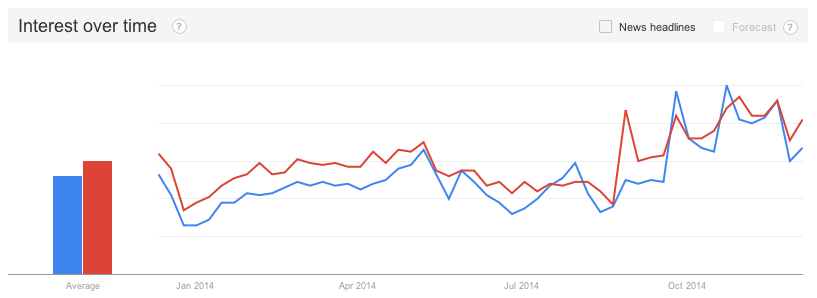
I searched “Halloween costumes” (blue line) against “sexy Halloween costumes” (red line) for the U.S. during the past 30 days (Sept. 27-Oct. 27, 2014), with the following results:

Google Trends: 'Halloween Costumes' vs. 'Sexy Halloween Costumes'

Google Trends: ‘Halloween Costumes’ vs. ‘Sexy Halloween Costumes’

Unsurprisingly, the search for sexy Halloween costumes, while small, still made an impression. But I would’ve predicted it would’ve been a fair bit larger.

Now, the fun part! Let’s look at each of these searches by subregion (in this case, state), metro and city.


“Halloween Costumes” by Subregion:

'Halloween Costumes' by Subregion

‘Halloween Costumes’ by Subregion

States with larger populations make a strong showing here: Wyoming, West Virginia, North Dakota, Montana and South Dakota descend from 100% to 86%. Notable conservative state Utah appears at 78%.

 “Halloween Costumes” by Metro:

'Halloween Costumes' by Metro

‘Halloween Costumes’ by Metro

Pennsylvania areas Wilkes Barre-Scranton (100%) and Pittsburgh (92%) take the top two spots. Salt Lake City reappears with 87%. New York takes up two consecutive entries with Albany-Schenectady-Troy with 85%, and Buffalo with 83%.

 “Halloween Costumes” by City:

'Halloween Costumes' by City

‘Halloween Costumes’ by City

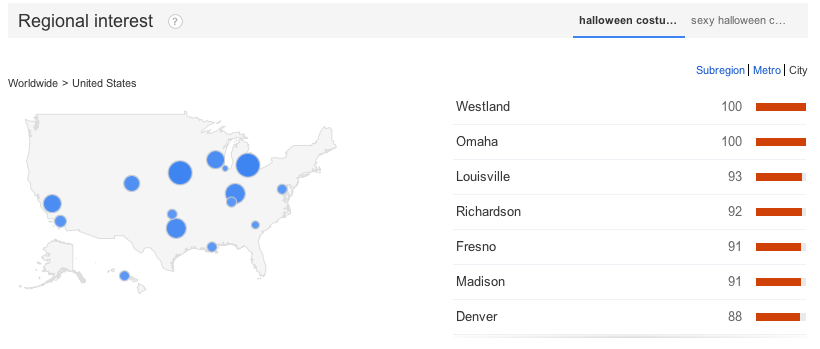
Here we have something I haven’t seen before: a tie! Westland, Michigan and Omaha, Nebraska both sit at the top with 100%.

Other points of interest: Major US cities make the list further down. Los Angeles clocks in at #8 with 82%, and Washington, D.C. appears next with 81%. Also the first non-Lower 48 city appeared at #10: Honolulu with 81%.


“Sexy Halloween Costumes” by Subregion:

'Sexy Halloween Costumes' by Subregion

‘Sexy Halloween Costumes’ by Subregion

Third most-populous state New York sets the pace at 100%. (Most-populated state California enters the race halfway down the list at #5 with 88%.) Michigan and Florida tie with 92%, with Pennsylvania hot on their heels at 91%. Second-most populated state Texas clocks in at #9 with 79%.

“Sexy Halloween Costumes” by Metro:

'Sexy Halloween Costumes' by Metro

‘Sexy Halloween Costumes’ by Metro

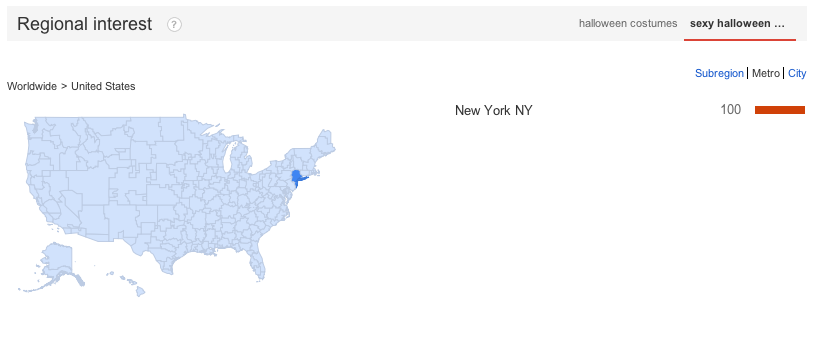
I’ve never seen this before: only one entry. It’s New York, the most-populated metro area. Clearly, everyone in the greater New York City area is searching for sexy Halloween costumes…right?

“Sexy Halloween Costumes” by City:

'Sexy Halloween Costumes' by City

‘Sexy Halloween Costumes’ by City

Interesting that the greater New York metro area is searching for sexy Halloween costumes more than the city’s residents themselves. But everyone in Los Angeles, the city proper, is Googling sexy costumes. Also of note is that all of these are very large cities (compared with the basic “Halloween costumes” search, which had smaller cities top the list).


Conclusions:

I didn’t expect this, but the “Halloween costumes” vs. “sexy Halloween costumes” searches tend to break down along urban/rural-ish lines. Those searching for “Halloween costumes” have tended to be from less-populated areas, whereas those Googling “sexy Halloween costumes” seem to be coming from more urban areas and making larger impacts.


Google Trends: “Sex” vs. “Gay Sex”

Internet searches can reveal so much. I’m interested in finding what light they can shed on the world’s sexual mores and appetites.

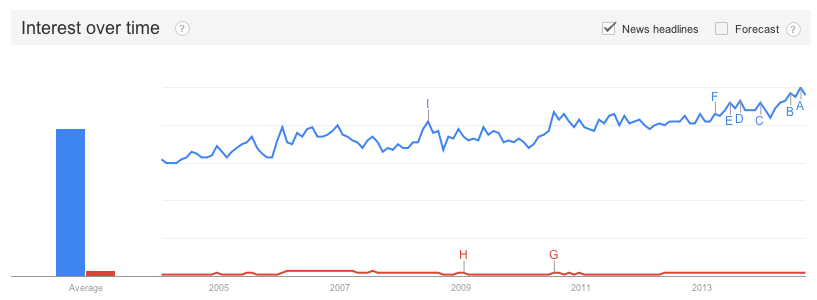
I used Google Trends to compare “sex” and “gay sex” search terms against each other, using 2004-present as my timeframe. The long-term results are below, with “sex” in blue and “gay sex” in red:

Google Trends - Sex vs. Gay Sex

Google Trends – Sex vs. Gay Sex

As we can see, there are any more searches for “sex” than “gay sex.” As a function of the world’s LGBT population (estimated to be as high as 20%), this seems very low. One explanation is that the “sex” search encompasses the “gay sex” hits, whereas the “gay sex” results logically only contain the one specific category.

Now to break it down by region and city:

“Sex:” Region:

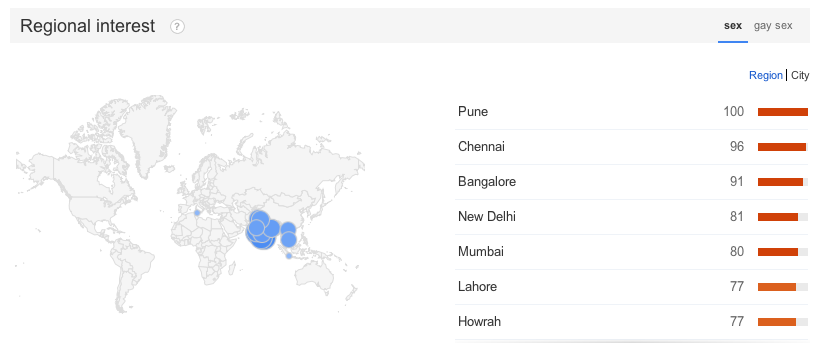
Google Trends terms countries as regions, and shows the top 10 countries. South Asia makes a strong showing, with Sri Lanka (100%) and India (85%) grabbing the top two spots. Southeast Asian countries Vietnam (67%) and Cambodia (64%) also appeared as well.

'Sex' Regional Breakout

‘Sex’ Regional Breakout

“Sex:” City:

India dominates this category, taking 9 spots in the top 10. The only non-Indian cities are Lahore, Pakistan’s second-largest city, which clocks in at #6.

The strong showing in India speaks to its population, now estimated to be around 1.27 billion. So it makes sense that it’s overwhelming the data set due to sheer quantity.

'Sex' City Breakout

‘Sex’ City Breakout


“Gay Sex:” Region:

Cambodia takes the top spot here, paving the way for other Southeast Asian countries: Laos (92%, #3) and Vietnam (77%, #4).

'Gay Sex' Regional Breakout

‘Gay Sex’ Regional Breakout

“Gay Sex:” City:

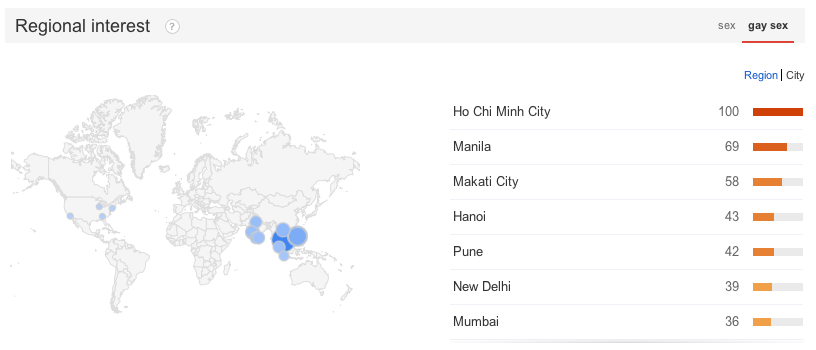
Ho Chi Minh City, capital of Vietnam, took the top spot here. Hanoi placed fourth with 43%.

The Philippines grabbed the second and third spots with Manila (69%) and Makati (58%).

Indian cities comprised #5-#9 of the top 10 spots, with Malaysia’s Kuala Lumpur taking the last spot at 35%.

'Gay Sex' City Breakout

‘Gay Sex’ City Breakout

Conclusion:

South and Southeast Asian countries are robustly represented with these searches. This could point to large populations leading to larger quantities of searches. There’s also the fact that many of these countries have culturally conservative sexual mores, so any interest piqued gets some play online.


Stay tuned for more! Any specific trends you’d like to see? Let me know!

Anal Sex: Married Men, 1950s and Now

What what in the butt.

What what in the butt.

In 1953, Kinsey found that 11% of men had had anal sex within marriage, out of a sample of 5.3K men. (This sample is described “younger white adults with some college education,” so obviously we’re only getting a narrow, appropriately 1950s-esque, slice of the population.)

The male population clocked in at 74.8M (67.1M white males) in 1950. The 2010 Census counted the male population as 151M, a 101%+ growth over 60 years. If that 11% still holds, that means over 16.610M of today’s male population have had anal sex.

Of course, this isn’t a completely pure, apples-to-apples comparison (more like apples-to-pears), so I’d like to come back to this if/when I find more information.