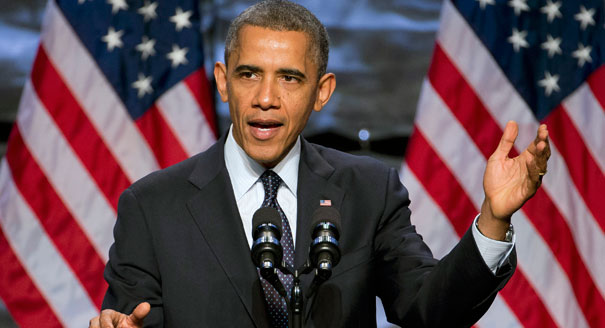
The Supreme Court Rules in Favor of Same-Sex Marriage

The White House (Mashable)

The White House (Mashable)

(Yes, I know this is old news by now, but I couldn’t start blogging again without acknowledging it. If only  could’ve seen into the future!)

Friday, June 26th was a historic day that was a long time coming: The Supreme Court ruled to legalize same-sex marriages nationwide in a 5-4 decision. The decision overrules states that had previously decided not to allow same-sex marriage, and prompted many previously-against states to begin issuing marriage licenses and performing ceremonies.

Naturally, this is a wonderful decision, not just for the LGBT(QQIA+) community, but also for humanity as a whole. I think people have finally recognized that it’s time. And that it’s been time. Interestingly, there hasn’t been much resistance from state governments: Though Louisiana initially said it’d wait for federal intervention to comply, towns within the state eventually began offering marriage licenses.

As an ally, I’m glad I got to see the day, and hope this is the start of many beneficial changes.


Rachel Dolezal: How Many White People Have Passed As Black?

Rachel Dolezal (Young Cons)

Rachel Dolezal (Young Cons)

This is pretty insane: It came out last week that Rachel Dolezal, the president of the National Association for the Advancement of Colored People (NAACP) chapter in Spokane, Washington, isn’t black at all. Not one drop.

She’s actually white.

Her story came out after a reporter asked her point-blank if she was black. Dolezal dodged the question. Since then, other aspects of Dolezal’s life have come to light: attending Howard University, telling people her adopted black brother (who lived with her) was really her son, and teaching classes on African-American culture at Eastern Washington University. Dolezal also claimed to have received hate mail.

Dolezal began identifying as black in 2007, after years of identifying with the culture.

I wanted to see if there were any stats on white people passing as black in the larger culture. I don’t mean in terms of appropriating dress or mannerisms, but actually altering one’s physical appearance and living an elaborate lie.

And I couldn’t find anything. Shocker (but not really). This is such a strange situation that I’m not surprised there haven’t been enough subjects to be studied.

The only white person who’s done anything remotely similar was John Howard Griffin, author of “Black Like Me.” Griffin underwent physical changes, including darkening his skin under heat lamps, to pass for a black man and report on racial injustices in the South firsthand. But obviously, his motives were very different than Dolezal’s.

It’ll be interesting to see how Dolezal’s case plays out, and if she’ll drop her black identity now that she’s been exposed.

Thursday Trends: Whitewashing Asian Characters in Film

Emma Stone, 'Aloha' (Jezebel)

Emma Stone, ‘Aloha’ (Jezebel)

Let me be clear: this is not a good trend. At all. It should never have even started. And yet, here we are.

It’s still a problem.

Historically, Hollywood has always had a problem of “whitewashing,” i.e. casting white actors in roles specifically created for non-whites. The thinking is that whites are more “bankable,” but there aren’t many roles and opportunities for non-white actors as it is. So a white actor ends up taking a role from a non-white one, and many non-white people are deprived of seeing depictions of themselves on-screen.

This tends to happen a lot with Asian actors. Most recently, director Cameron Crowe came under fire for casting Emma Stone in his latest movie “Aloha.” Stone was cast as a character named Allison Ng, whose ancestry is one-quarter Chinese and one-quarter Hawaiian. (Having white and Asian or Pacific Islander ancestry is traditionally known as “hapa,” deriving from the Hawaiian Pidgin word for half. So Ng’s heritage would be termed “hapa” or “hapa haole,” to include the European ancestry.)

Look at the picture above and tell me with a straight face that Emma Stone resembles anyone remotely half-Asian.

Fortunately, Crowe caught some heat for this decision, and has publicly apologized for his choice. (But he covered his ass a little, saying that the character was meant to be frustrated that her features belied her mixed-race heritage.) But Crowe could’ve easily cast an Asian or mixed-race Asian for his film. He just chose not to.

This whitewashing of Asian characters tends to come up every few years. 2010’s “The Last Airbender” received a public outcry when it was revealed that the cast was mostly non-white actors, save for Dev Patel. (The debacle coined the term “race bending.”) This was odd considering that the TV series (on which the movie was based) was set in a world with obvious Asian elements, and it was animated using anime influence.

The 2008 movie “21” centered on the real-life story of the MIT Blackjack Team, a group of current and former students who beat the casinos at their own game by counting cards. Though many of the group were of Indian and Asian descent, the movie whitewashed the cast, using mostly Caucasian actors.

And then there are the times when white actors are actually put in yellowface. 2012’s “Cloud Atlas,” which had the ensemble actors playing various characters, actually had two examples of this, and took it past the point of no return: Jim Sturgess (who was also in “21”) and James D’Arcy both played Korean men at one point. Sturgess and D’Arcy are both white men, but they both spent extensive time in makeup to more realistically resemble Asian men.

This is far from a new problem. The 1956 film “Teahouse of the August Moon” featured legendary actor Marlon Brando as Japanese villager Sakini, donning full-on yellowface to physically embody the role. And everyone who’s seen 1961’s “Breakfast at Tiffany’s” remembers Mickey Rooney as Holly Golightly’s Japanese neighbor I.Y. Yunioshi, who, seen through modern eyes, was a jaw-droopingly offensive caricature. (“The New York Times” review of the film called Rooney “broadly exotic.”) Fortunately, the distance of time and perspective have allowed people to see that these portrayals were very offensive towards Asians, and it was wrong to a) write/portray the characters in such stereotypical ways, and b) cast actors not of the specific ethnicity to play these parts.

But maybe the message isn’t sinking in as much as it should be: Blonde, Caucasian actress Scarlett Johansson will star in DreamWorks’ adaptation of the anime title “Ghost in the Shell.”

Here’s the thing: There are so many asian and mixed-Asian actors out there. Kristin Kreuk, Chloe Bennet, Olivia Munn, John Cho, Steven Yeun, Daniel Henney, Harry Shum Jr., Sendhil Ramamurthy. And those are only the ones I didn’t need to Google off the top of my head. Point being, there’s massive opportunity here for diverse casting that reflects reality. So let’s get on it!

Thursday Trends: Female Celebrities’ Fluid Sexuality

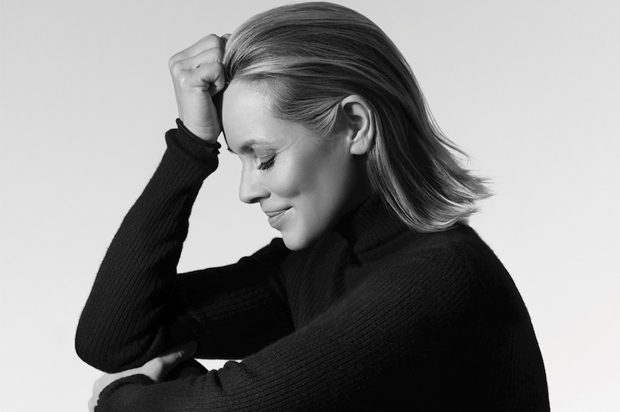
Maria Bello (Salon)

Maria Bello (Salon)

Last week, actress Maria Bello released her new memoir. “Whatever…Love Is Love” chronicles Bello’s journey as a single mom who self-identified as straight, but then unexpectedly fell in love with her female best friend. She penned a piece for “The New York Times” in 2013 that centered on worrying how her son would react to the news. (If you’re wondering, his response is her memoir title verbatim.) From there, Bello decided to redefine her relationships in a way that worked for her, and she now sexually identifies as a “whatever.”

Bello isn’t the only female public figure whose sexuality has shifted within the public eye. Oscar-winning actress Tatum O’Neal recently revealed that she likes and has been dating mostly women for some time now. O’Neal didn’t self-identify as lesbian or bisexual (she had previously been married to, and had children with, tennis ace John McEnroe), and says she’s “not one or the other.”

The millennial generation also has its share of sexually fluid women who eschew labels. Actress Amber Heard dated photographer Tasya van Ree before marrying actor Johnny Depp earlier this year. She also doesn’t label herself “one way or another.” Actress Lindsay Lohan famously had a volatile relationship with DJ Samantha Ronson, but then publicly self-identified as straight years after the relationship was over.

Though the majority of examples come from entertainment, the political sphere can claim on entrant. Chirlane McCray, wife of New York City mayor Bill de Blasio, self-identified as a lesbian when she met her now-husband in 1991. Years earlier in 1979, McCray had written an essay for “Essence,” titled “I Am A Lesbian,” which centered on gays and lesbians within the black community. McCray’s essay didn’t receive much attention until just before her husband decided to run for mayor in 2012.

What’s interesting about McCray’s case is how others in the media reacted to it: Many termed her some variation of “former lesbian.” But McCray never self-identified as anything remotely resembling that. Here’s how she responded in 2013 when asked if she self-identified as bisexual:

I am more than just a label. Why are people so driven to labeling where we fall on the sexual spectrum? Labels put people in boxes, and those boxes are shaped like coffins. Finding the right person can be so hard that often, when a person finally finds someone she or he is comfortable with, she or he just makes it work.

It’s fantastic how so many women (and people in general) are gaining the courage to step outside the box and do what works for them, especially in terms of sexuality and relationships. What I love about the above examples is that they’re all open to new experiences and don’t use labels to limit them. And that’s just beautiful.

Caitlyn (Formerly Bruce) Jenner Covers “Vanity Fair”

Caitlyn Jenner on the 'Vanity Fair' cover (Us Magazine)

Caitlyn Jenner on the ‘Vanity Fair’ cover (Us Magazine)

Another Kardashian (well, Jenner) woman has broken the Internet.

The latest issue of “Vanity Fair” debuted today, and with it, the introduction of Caitlyn Jenner. And she. Is. Beautiful.

Caitlyn, previously known as Bruce, first publicly confirmed her transition in April during an interview with Diane Sawyer for “20/20.” Since then, things have moved quickly: Jenner said she’d transition “sometime during the spring” and would wait to debut a female name. Just last week, sources reported that Jenner would cover “Vanity Fair” sometime this summer. But I’m sure nobody thought it’d be this soon.

This interview also marks the first time Jenner has used female pronouns to describe herself. Taking her cue, other media outlets are following suit.

All of this has paid off in terms of web traffic: “Vanity Fair” reported that the Jenner piece set a new traffic record, netting 6M+ unique visitors in just hours.

(Side note: Caitlyn evidently took a few notes from her step-daughter Kim Kardashian in terms of self-promotion, not that that’s a bad thing. She’s also overshadowing Kim’s announcement that she’s pregnant with her second child with husband Kanye West.)

It’s safe to say that Caitlyn is literally the most high-profile transwoman right now. (And she would know, having been part of the Kardashian/Jenner clan for decades.) Covering “Vanity Fair,” a staple in entertainment and society journalism, really marks a debut of her true self.

It’s very inspiring to see someone blossom once they’re so comfortable in their own skin, and this is definitely the case with Caitlyn.

“Mother of Lamaze” Elisabeth Bing Has Died

Elisabeth Bing (The New York Times)

Elisabeth Bing (The New York Times)

Elisabeth Bing, credited for bringing Dr. Fernand Lamaze’s childbirth techniques to American women, has died at age 100 in New York.

The Lamaze method emphasized relaxation during childbirth, and posited that a mother’s pain during giving birth stemmed from fear. Having studied natural childbirth since 1942, Bing first encountered Lamaze’s technique in the 1950s. In 1960, she and a colleague founded Lamaze International, then known as the American Society for Psychoprophylaxis in Obstetrics.

It’s estimated that 25% of expectant mothers and spouses attend a Lamaze class at some point during pregnancy. For context, almost 4M babies were born in 2010. This would put the number of Lamaze-attending parents-to-be around 1M. (But this wouldn’t be completely accurate because it assumes that every mother only gave birth to one child.)

Bing’s goal was to help empower women to make their own decisions regarding how childbirth would go for them, and she certainly achieved that.

Don Draper’s Conquests: By The Numbers UPDATED

'Mad Men' Don Draper, Midge Daniels, Megan Calvet Draper, Betty Draper, and Dr. Faye Miller (Vulture)

‘Mad Men’ Don Draper, Midge Daniels, Megan Calvet Draper, Betty Draper, and Dr. Faye Miller (Vulture)

Today’s post is an update of this post, in celebration/memoriam of last night’s “Mad Men” series finale. Now that the series has ended, we can make more definitive statements on what kind of women Don prefers. 

Everyone who watched the show knows that Don Draper (Jon Hamm) is a serial womanizer. Even when he’s married, he can’t stay faithful. It’s part of what makes him so intriguing: we know he’s wrong, but we couldn’t stop watching!

There’s been some ink spilled on the types of women he tends to bed, such as preferring docile women for marriage versus favoring strong-willed career women for affairs. But I was curious to find out if there were any other patterns, and so had some fun with Excel.

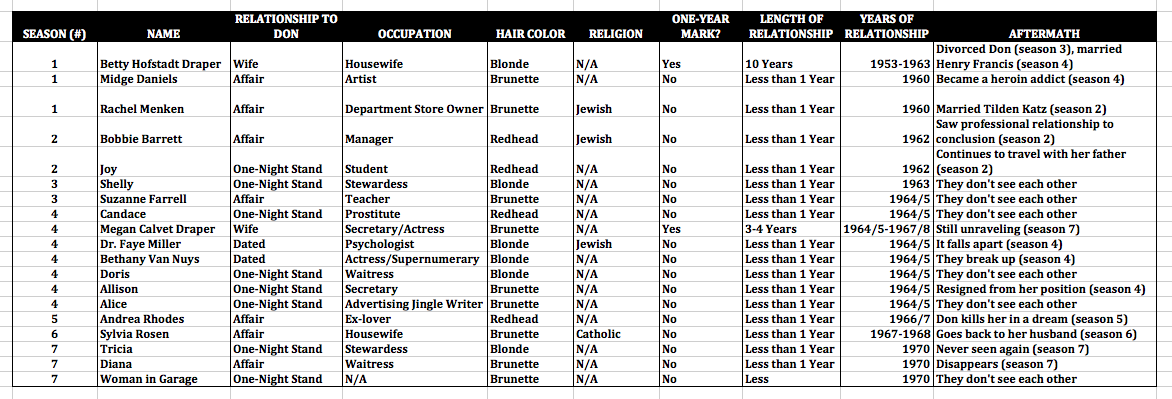
For fun, here’s what my entire Excel spreadsheet looked like:
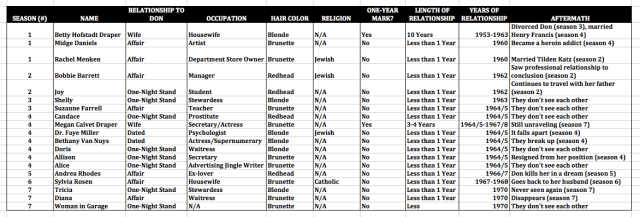
'Mad Men' Don Draper Conquests Excel Spreadsheet UPDATED

‘Mad Men’ Don Draper Conquests Excel Spreadsheet UPDATED

If you can’t see, I listed the names of Don’s 19 partners by season, their relationship to Don, occupation, hair color, religion, and overall length of the relationship. (Some of these metrics I didn’t end up using.) Some of these things I tried finding information as accurate as possible (such as the years each relationship spanned), but sometimes had to make a close guess. So if you see an error, please correct me and I’ll recalculate.

Now, let’s find some patterns via pivot tables.


Don’s Relationships by Type:

I broke down Don’s relationships into three types: wife, affair and one-night-stand. I defined affair as on-going with an emotional component, whereas I defined one-night stand as purely sexual, even though it may have happened more than once (as is the case with season 4’s Candace and season 7’s Tricia).

That being said, here’s the data:

'Mad Men' Don's Relationships by Type  Excel Pivot Table UPDATED

‘Mad Men’ Don’s Relationships by Type Excel Pivot Table UPDATED

We know he’s been married twice (I’m not counting Anna Draper, as she was never a conquest), so no surprise there. I figured Don has had more casual partners than serious ones, but I didn’t realize how much it would skew. Don’s had over three times as many affairs and one-night stands combined as he has married and dated partners combined. Interesting.


Partners’ Occupation:

I was interested to see if Don had any particular type in terms of career. Though every woman was different, four occupations reoccurred, and all of them roughly at the same rate.

Two of the 16 women (12.5%) were housewives, which were his first wife Betty and later season 6’s Sylvia Rosen. Another pattern that emerged were two actresses, who also held other jobs when Don knew them. These two were season 4’s Bethany Van Nuys (whose other job was a supernumerary) and his second wife Megan Calvet (who began as a secretary).

Don’s partners in season 7 made a couple more occupations a trend. Tricia was the second stewardess, with the first being season 3’s Shelly. Waitress Diana came after season 4’s Doris, also a waitress.


Partners’ Hair Color:

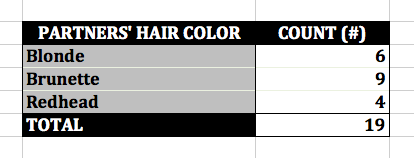
Gentlemen prefer blondes, but does Don? Let’s take a look:

'Mad Men' Don's Partners' Hair Color Excel Pivot Table UPDATED

‘Mad Men’ Don’s Partners’ Hair Color Excel Pivot Table UPDATED

No, Don’s more of a brunette man, with nearly half his partners sporting the color. He prefers blondes slightly more than redheads.


Religion:

I initially wanted to see how each partner’s religion broke down. Several did not mention or show any religious leanings, so I referred to their respective affiliations as “N/A,” because I didn’t want to automatically put partners into a “default Christian” category.

Only two of the 16 partners (12.5%) were overt about their religious affiliation: season 1’s Jewish department store heiress Rachel Menken, and the Catholic Sylvia Rosen (season 6, though she’s married to a Jewish man).

Other partners signaled their religious leanings indirectly. Season 4’s Dr. Faye Miller (Cara Buono), referenced her Jewish heritage in passing, using a Yiddish phrase. Season 2’s Bobbie Barrett was confirmed to be Jewish by none other than show creator Matthew Weiner himself.

What we can take from this is that while religion certainly isn’t a conscious preference of Don for his partners, he has selected distinctly Jewish women.


Duration of Relationship:

How long did each of Don’s dalliances last? Unsurprisingly for most of them, not very long:
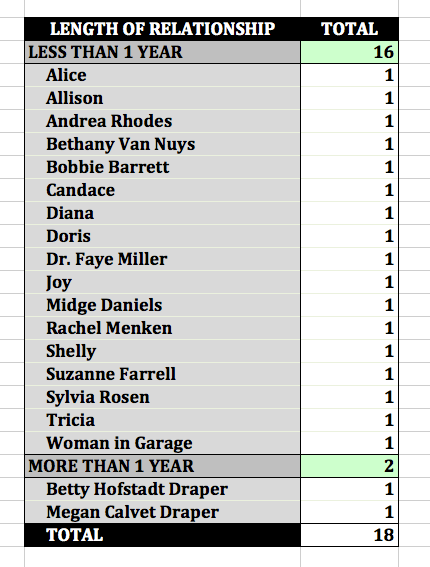
'Mad Men' Don's Length of Relationships Pivot Table UPDATED

‘Mad Men’ Don’s Length of Relationships Pivot Table UPDATED

I initially had assumed that some would’ve spanned more than a year, but the only partners with proven staying power have been his wives Betty and Megan.


Conclusion:

Delving into the metrics of Don’s sexual partners reveals some interesting findings: He prefers brunettes, doesn’t discriminate on the basis of religion or career, and has a short attention span when it comes to women.
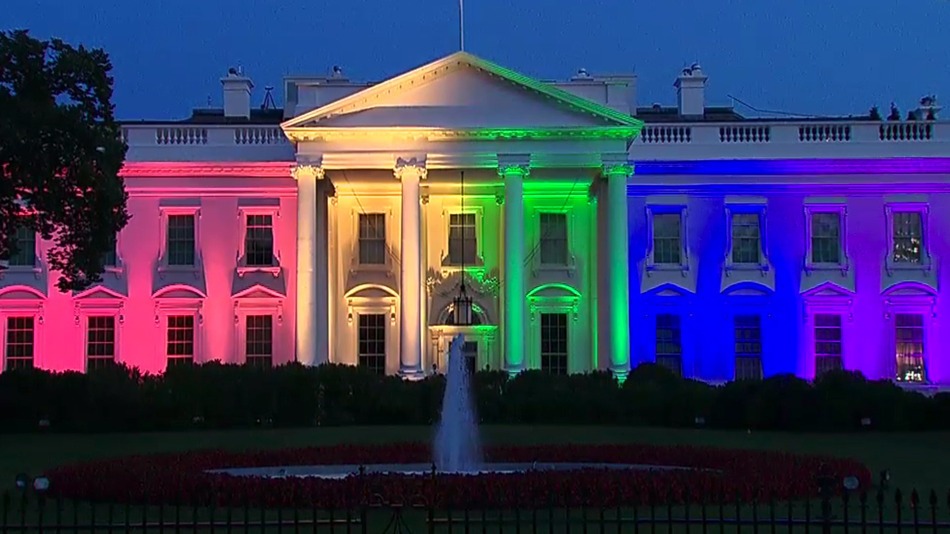
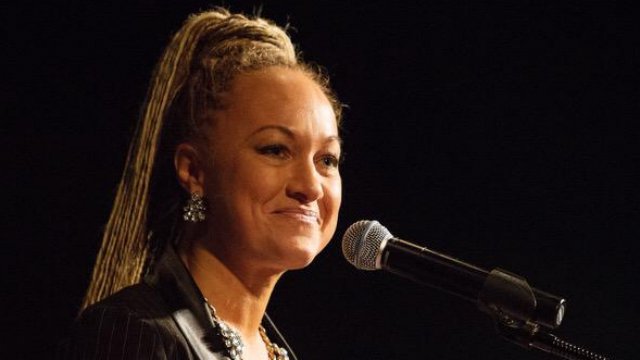
Sofia Vergara’s Frozen Embryos: Is There A Precedent for IVF Egg Custody?

Sofia Vergara (Celebrity Post)

Last week, “Modern Family” actress Sofia Vergara’s former fiancé Nick Loeb penned an op-ed for “The New York Times” regarding Vergara’s frozen eggs. The pair had initially frozen the eggs via in-vitro fertilization (IVF) in case they later wanted children, before their relationship ended last year. (Vergara is currently engaged to “True Blood” actor Joe Manganiello.) Now Loeb wants to unfreeze an eggs to implant within a surrogate, and have a child using his ex-fiance’s egg. (When the two were together, they had signed an agreement regarding using the eggs only with permission from both of them, but there wasn’t any discussion on what might happen if they split.) Vergara, as owner of said egg(s), is (naturally and understandably) refusing to release her eggs.

I wanted to find out of there was a precedent set for IVF egg custody. According to “Chicago Lawyer” magazine, there are no definitive laws or one-approach-fits-all (yet), but 10 states so far have made rules regarding IVF custody and procedure cases.

One big commonality between a lot of these approaches is an issue familiar to sexuality: consent. Courts are generally weighing the desires of each partner, called “balance of interests.” This can be applied if one partner wants to use the eggs, but the other doesn’t want that person to use them. Iowa takes a “co-consent” approach, in that both parties must agree to “sign off when the embryo is implanted in the woman.”

Contracts guide decisions in other states. In these instances, courts rely on “contracts drawn up by the couple before the embryos were created.”  New York, Washington, Texas and Oregon follow this method.

Some states take a blended approach (kind of like a blended orgasm). Tennessee, New Jersey and Pennsylvania first look for existing contracts between both parties before moving on to consent.

Other states are complete outliers in their approach. Iowa has “contemporaneous-mutual-consent,” which is a written agreement that states that both parties must sign off on use of the embryos. Massachusetts is another outlier, stating that the woman receives custody of the embryos in event of divorce.

Vergara and Loeb’s situation may bring attention to this dilemma shared by other ex-couples, and it could drive inquiries and move future legislation forward. We’ll have to see how it plays out.


“Federal Agents Gone Wild:” The Department of Justice Has a Prostitute Problem

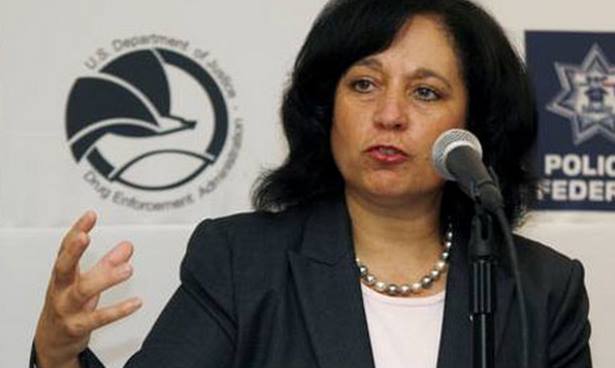
DEA chief Michele Leonhart (Girls Just Wanna Have Guns)

DEA chief Michele Leonhart (Girls Just Wanna Have Guns)

Yesterday, Michele Leonhart announced that she’d resign from her post as chief of the Drug Enforcement Agency (DEA) in early May. This comes after reports surfaced that some male employees were enjoying sex parties with prostitutes which were paid for by drug cartels in Colombia. And it had been going on for years. Conflict of interest much?

Earlier this month, Attorney General Eric Holder had to issue a department-wide memo for Department of Justice employees, reminding them that they are not allowed to solicit prostitutes under any circumstance. His point was that any employee who does this opens up himself, and the agency, to potential blackmail, extortion and leaking private information. (Seems like common sense to me.) I bet he never thought he’d have to write this kind of memo.

I tried to find if there were any other instances of this happening (since it was apparently uncovered during a routine Inspector General report), but couldn’t find anything. All stats I could find were more related to prostitution stats that the DOJ itself had reported on.

It’ll be interesting to watch how this all plays out, and what (if any) further punishments the DOJ partying employees will receive. (So far, employees who’ve confessed have only been suspended, but only up to a week-and-a-half.) It’s one thing to indulge in sex parties off the clock, but it’s another thing entirely to blur professional lines against those you’re supposed to be against (though I’m sure that was part of the appeal).


President Obama Supports Ending Conversion Therapy for LGBT Youth

President Barack Obama (Politico)

President Barack Obama (Politico)

Big news last week: President Obama publicly stated that he supports banning conversion therapy for LGBT youth. The announcement came in response to an online petition urging the president to take action after transgender teen Leelah Alcorn’s suicide late last year. (Before her death, Alcorn’s parents had forced her to attend conversion therapy in hopes of getting their “son” back.)

Right now, it’s unclear what form Obama’s support will take. White House officials say that it’s unlikely that the president would push for a national law, but instead would “support the efforts to ban the practice at the state level.” It’s important to note that is a far cry from how Obama started his political career: At the time, he didn’t support gay marriage.

But the president’s views on LGBT issues are rapidly evolving, paving the way for the rest of America to follow suit. And change starts at home: The White House recently created an “all-gender” restroom for transmen and transwomen who may feel uncomfortable using the traditional facilities.