Caitlyn Jenner Gets New E! Docuseries “I Am Cait”

Caitlyn Jenner, 'I Am Cait' (Skynews Australia)

Caitlyn Jenner, ‘I Am Cait’ (Skynews Australia)

That was quick: Caitlyn Jenner announced that she’ll star in a docuseries titled “I Am Cait” for E!. (E! is also home to “Keeping Up with the Kardashians” and its various iterations.) The docuseries will follow Jenner as she begins life as a woman.

The eight-part series will premiere on July 26th, and will air in 120 countries.

This is the second docuseries announced on the life of a transgender woman this year. The E! show follows TLC’s previously announced “All That Jazz,” which will focus on teen transgender activist Jazz Jennings.

How Has Colorado’s Teen Pregnancy Rate Dropped 40% Within 4 Years?

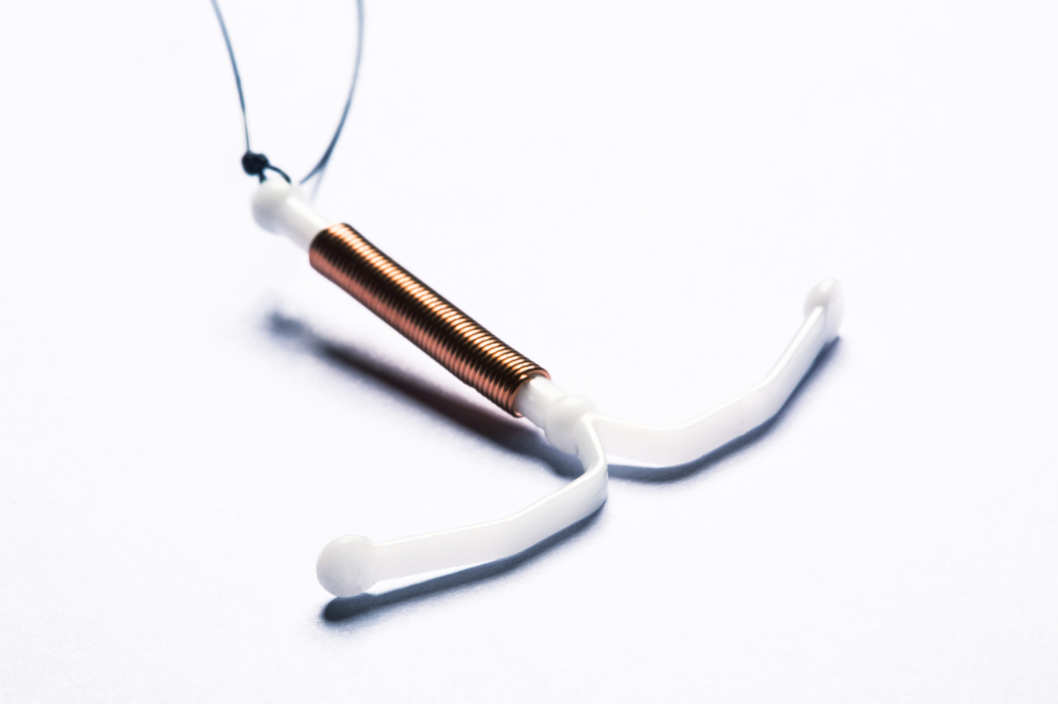
IUD (NY Mag)

IUD (NY Mag)

Colorado’s teen pregnancy rate has been getting some attention recently. But it’s not for the reason you think; it’s actually for the opposite reason.

From 2009 to 2013, Colorado reported a 40% decrease in teenage pregnancies, according to the Colorado Department of Public Health and Environment. Below is a graph that shows the decline:

Colorado's Birth Rate 2005-2012 (The Washington Post)

Colorado’s Birth Rate 2005-2012 (The Washington Post)

That seems insane, right? But there’s actually an interesting reason behind it.

In 2008, an anonymous donor (later revealed to be the Susan Thompson Buffett Foundation, named after Warren Buffett’s late wife) gave a $23 gift to be parceled out over five years. The gift was to be used for “long-term contraception” for low-income teens and women. Over 30K intrauterine devices (IUDs) were purchased and implemented. This measure was rolled out in 68 clinics, as part of Colorado’s Family Planning Initiative.

The IUDs were found to be a very significant factor in the state’s teen pregnancy decline. The study released by the Colorado Department of Public Health and Environment showed that “the percentage of young women receiving IUDs and implants quadrupled in participating clinics,” and, in a complementary effect, the women receiving IUDs accounted for 75% of the state’s overall teen birth rate decline.

On a national scale, Colorado rose from having the “29th lowest teen birth rate in the nation to the 19th.” This is significant as seven in 10 teen pregnancies in the state are unplanned.

The program expires this summer, and it’s unclear whether it will be renewed. But the numbers definitely speak for themselves in terms of effectiveness.


The New Abercrombie & Fitch Will Feature Less Sex (NSFW)

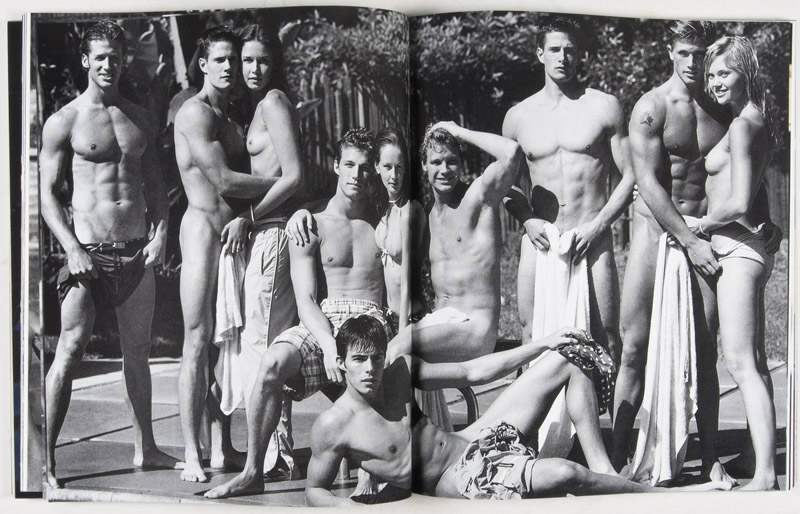
'A&F Quarterly' Spring Break Issue 2001 (Kline Books)

‘A&F Quarterly’ Spring Break Issue 2001 (Kline Books)

Happy Friday! If you’re in your mid-20s or older, you probably remember (and hell, wore) some Abercrombie & Fitch (A&F) back in the day. The stylishly distressed, yet massively overpriced, clothes were a status signifier back in middle and high school, when everyone wanted to be part of the cool crowd (which was comprised solely of all-American, apple-cheeked near-Aryans). And of course, who can forget those sex-drenched ads and catalogs?

The A&F of yore will now be changing that particular aspect. According to “The Washington Post,” the chain will no longer hire “models” (their term for sales associates) based on “body type or physical attractiveness.” They’ll also phase out the “sexualized marketing” (suggestive ads, shirtless models at storefront openings) by July.

This all comes as A&F tries to revamp its image, and project a more inclusive one. Former CEO Mike Jeffries was known for promoting the brand as exclusionary to everyone but his coveted “cool crowds,” and didn’t offer larger sizes. He stepped down from his post last December. The move came amid reports that the retailer’s shares have decreased 39% over the past year, and profits shrunk 5%+ last year.

It’ll be interesting to see if A&F can actually pull off this drastic brand reinvention, and if consumers will respond to it.

Thursday Trends: Young Women and #GrannyHair

Rihanna (Her Interest)

Rihanna (Her Interest)

Kylie Jenner did it. So did Rihanna and Kelly Osbourne. Of course, Lady Gaga, trendsetter that she is, rocked it back in 2010.

Grey hair.

Once upon a time, it was unseemly for women to go out sporting anything other than a full mane of brown, black, red or blonde hair. Grey was seen as unnatural and, at the same time, a little too natural. It was shoved to the side, to the back of the mind, ignoring the tell-tale side of aging.

Right now, women are embracing the color whole-heartedly, and running towards the grey instead of away from it. A recent BuzzFeed post shows how young women are riding the trend, especially seen on Instgram with the hashtag #GrannyHair.

But why now? Why is this grey hair’s big moment?

We seem to be in the midst of a “revering our elders” moment. (Real talk, though: that needs to happen every day. Call your grandparents, people!) The fashion world has been pioneering this lately. French fashion house Céline tapped 80-year-old essayist Joan Didion to be their latest model, and Saint Laurent is using 71-year-old Joni Mitchell. The major beauty players are doing the same, with 64-year-old Jessica Lange for Marc Jacobs and 69-year-old Helen Mirren for L’Oreal Paris. In this year’s Milan Fashion Week, trends skewed towards something your grandmother might don for a social event.

This makes total sense in terms of how current demographics are shifting. The baby boomer generation, born between 1946 and 1964, are turning officially “old” at a rapid clip. As of 2011, they numbered 77M+ and are “the largest generation in American history.” Baby boomers began turning 65 in 2011, and won’t stop until the end of 2029.

Here’s how CNN puts this demographic’s strength in numbers in terms of future projected growth:

The 65+ population segment is projected to double to 71.5 million by 2030 and grow to 86.7 million by 2050.

With this projected growth will come a lot of societal changes (I’ve always said that this isn’t a generation that’ll age quietly). We’re beginning to see initial impacts with how we view that generation and the ones before. For example, It used to be that you couldn’t be seen as a sexual being after a certain age, that you were out of the running in the race to make babies. And while that second part might be true, the first has been proven false by many women over “a certain age.” Case in point: see every instance where a late-night talk show host jokes about Helen Mirren. They’re always saying she’s hot (and she is!). Society has long seen older men with grey hair as sexy, and is now (finally!) coming around to the idea that older women are hot too.

Young women coloring their hair grey even has a historical precedent. In her book “Seductress: Women Who Ravished the World and Their Lost Art of Love” author Betsy Prioleau mentions that young women in the French court used to powder their hair grey to emulate their elders. (If you’ve seen Sofia Coppola’s “Marie Antoinette,” the director subtly includes this detail, noticeable in some shots.)

Overall, this trend really points to a shift in how we’re seeing aging. People seem to be more open to the fact that life doesn’t stop after a certain age. And young women are celebrating their elders with their grey hair, natural or not.

Lucy and Maria Aylmer: How Many Twins Look Racially Different?

Twin sisters Lucy and Maria Aylmer (BoredPanda)

Twin sisters Lucy and Maria Aylmer (BoredPanda)

This week, the Internet has been fascinated by a set of English fraternal twins Lucy and Maria Aylmer. But there’s something special about them: Lucy has pale skin and red hair, while Maria has brown skin and brown curly hair.

In other words, one twin looks white, and the other twin looks black.

Their parents have a mixed racial background: their mother is half Jamaican, and their father is white.

Occasionally, stories like theirs pop up every now and again. In 2009, another British mixed-race couple produced not one, but two, sets of identical twins who each looked very racially different from their sibling.

But how common is this?

Unfortunately, there are no statistics that track this. From “The Associated Press:”

The phenomenon is so uncommon that there are no statistics to illustrate its probability, although it is thought likely to become more common because of the growing number of mixed-race couples.

To give you an idea on exactly how uncommon this is (using numbers!), Dr. Sarah Jarvis of Britain’s Royal College of General Pracitioners, said in 2009 (though it still applies today):

“Even non-identical twins aren’t that common. Non-identical twins from mixed parents, of different races, less common still. To have two eggs fertilized and come out different colors, less common still. So, to have it happen twice must be one in millions.”

But that’s just a guess, though the BBC reported chances closer to 1 in 500 in 2011. We won’t know until we actually start tracking the numbers.

Why Are Condoms So Expensive in Venezuela Right Now?

Condoms (Prevention Justice)

Condoms (Prevention Justice)

Happy Friday!

Apropos of National Condom Week: Would you pay $755 for a box of condoms?

That’s insane, right? But right now, sexually-active and contraception-conscious Venezuelans don’t have much of a choice. That’s how much a 36-pack of Trojan condoms is going for. With the exchange rate, it works out to be $20+ per condom. If you’re shopping around, a 24-back of Durex condoms is selling for $317, making it the (slightly) more economical choice of $13+ per condom. (For context, this is about $10 more than the country’s standard black market rate.)

This is really alarming when you consider that the country’s minimum monthly wage is $888.24.

The Venezuelan people literally cannot afford to have safe sex.

The reason behind these sky-high prices? Oil.

Venezuela exports a lot of the stuff, using it to bring in around 95% of foreign earnings. But oil prices have fallen dramatically recently (over 60% drop within the past seven months), leading to fewer earnings for the country. This, in turn, inhibits Venezuela’s ability to import other basic goods (such as chicken, milk and corn), since their money doesn’t stretch as far. The Bank of America Corporation estimates the the country will import 42% less in earnings than it did in 2012.

Condoms aren’t the only contraceptive that’s hard to come by within the country. Birth control pills are also in high demand, and are very hard to find right now.

According to “Bloomberg Business,” the shortages began in late December, when the Venezuelan government “tightened dollar disbursements amid sliding oil revenue.” The Venezuelan Pharmaceutical Federation offered the following observation:

No condoms were available in 10 eastern and central Caracas pharmacies visited in late January, compared with as many as 20 different kinds available at some locations in November, including Reckitt Benckiser Group plc’s Durex and Church & Dwight Co.’s Trojan brands.

Venezuelan President Nicolas Maduro was attempting to fix this problem before it started: Last June, he announced that the government was building a condom factory to meet the country’s demand. But since then, customers disliked the quality of the condoms, and demand often outpaced supply.

Another factor in this saga is Venezuela’s own sexual health stats. According to a 2012 World Bank study, the country has the fifth-highest number of teen pregnancies out of the 21 Latin America countries. (This averages out to be 88+ live births for women ages 15-19 for every 1K women.) It also has the fourth-highest number of people living with AIDS on the continent.

If this condom (and birth control) shortage continues, it’ll impact Venezuela’s teen pregnancy and AIDS population for the worse. As prices rise, people will become more inclined to completely forgo any birth control method, and the government might not be able to support the overwhelming resulting birth rate. Let’s hope a solution arrives before these things come to pass.

I’m just thankful condoms are not only cheaper than a child, but also cheaper than a month’s rent.

Oregon Will Have the First Openly Bisexual Mayor

Kate Brown (The Democratic Party of Washington County)

Kate Brown (The Democratic Party of Washington County)

Progress is being in Oregon today: Former Oregon Secretary of State Kate Brown will be sworn in as governor, becoming the first openly bisexual woman (actually, person) in the nation to hold the office. Brown succeeds former governor John Kitzhaber, who resigned due to a criminal probe into his fiancée’s role in his office.

She was appointed to Oregon’s State House of Representatives in 1991, was elected the following year, and re-elected two years later in 1994. She moved to the Senate in 1996, and was elected Senate Majority Leader in 2004. She began serving as Oregon’s Secretary of State in 2009.

While her main interests center on removing barriers to voting registration and growing small businesses and entrepreneurship, she’s also advocated for LGBT rights. Brown was profiled in the “Out and Elected in the USA” survey of LGBT government officials in 1992. She’s been married to her husband Dan Little since 1997.

Brown hasn’t run into any trouble with her constituents with her status as a bisexual woman, as  Oregon is known for being very socially progressive. As Hannah Hoffman of “The Statesman Journal” notes:

Her sexuality has never been a prominent issue in Oregon, where Portland recently had an openly gay mayor in Sam Adams and where the current speaker of the House, Tina Kotek, is a lesbian.

Hopefully, we’ll see the rest of the country follow suit.


Brazil Will Pass Out Free Condoms During Carnival

Mardi Gras mask and beads (123 RF)

Mardi Gras mask and beads (123 RF)

Happy Mardi Gras! Known in English as Fat Tuesday (and just in time for National Condom Week), today celebrates casting off repression, upending social norms and indulging in vices before the Christian season of Lent begins (when enjoying all earthly pleasures ceases for 40 days). Much like Halloween, masks and costumes, dancing and lust in the air figure prominently.

Brazil has made Carnival an international destination, and it’s legendary for a reason. Several cities throw parades, led by various samba schools. Many foreigners fly in for the multi-day party (spanning the Friday before to Ash Wednesday at noon), making Carnival the country’s biggest tourism booster.

Naturally, when the shackles of convention are thrown aside, a lot more spontaneous sex occurs (because when in Rio…). But the Brazilian government is always prepared for this: they give out free condoms.

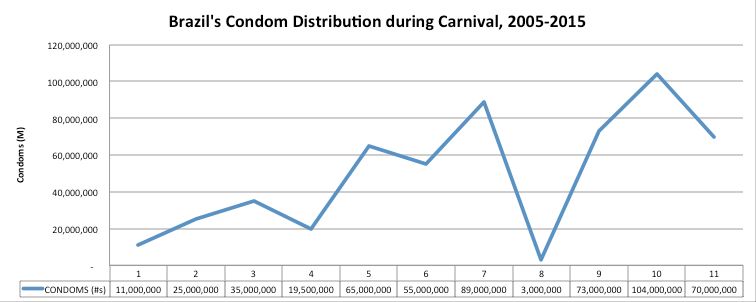
This year, they’ll hand out 70M condoms throughout the country. They’ve done this for years, handing out 65M in 2009, 55M in 2010, 89M in 2011, 3M in 2012, 73M in 2013 and 104M in 2014.

For visual learners, here’s a decade-long progression in line-graph form:

Brazil's Condom Distribution during Carnival, 2005-2015

Brazil’s Condom Distribution during Carnival, 2005-2015

As you can see, the number of condoms distributed during Carnival has tended to baseline around 70-75M in recent years (aside from 2012, whose 3M looks incorrect, to say the least).

Last year, the Brazilian government estimated that 2M+ people were on the streets at any given time during Carnival. Surely attendees can find at least one person to hook up with during the popular “blocos” (street-wide parties).