Sex & Stats’ 2014 Year in Review

Beyonce's 'Flawless' performance at the 2014 MTV Video Music Award

Beyoncé’s ‘Flawless’ performance at the 2014 MTV Video Music Awards

We’re almost done with 2014, so let’s take a look back at some important movements in the world of sexuality.

Trans Issues:

After a long time, the trans community has come into the spotlight.

It started back in early March, when Jared Leto took home the Best Supporting Actor Oscar for playing trans woman Rayon in “Dallas Buyers Club.” This was the first time an actor won an Oscar for a trans role, and the second time an actor playing a trans character had been nominated for an Academy Award. (The first time was when Felicity Huffman played a trans woman in 2005’s “Transamerica,” and garnered a Best Actress nomination.) The film also sparked a dialogue about cisgendered actors playing trans roles.

The community has been making strides on a local level as well. This fall, a Texas high school elected its first trans homecoming king.


Anal Play:

“We’ve been experimenting with the butt,” a good friend of mine said recently. Though she was referring to what she and her partner were getting up to, this statement also applies to our culture’s newfound fascination with anal play.

Ever since a stripper alleged that Drake enjoyed having his salad tossed, it seems like anal play and rappers  are having a major intersectionality moment. Nicki Minaj has proven this most frequently with her singles “Anaconda” and “Only,” positing herself in the power position of receiving, and greatly enjoying, having her asshole eaten out.

Anal sex also appeared on our broadcast TV screens in mainstream American homes this fall. The “How To Get Away With Murder” pilot and an episode of “The Mindy Project” both featured the formerly taboo act (the former more explicitly than the latter). Bonus points for both featuring interracial couples as well.


Feminism:

This is technically a holdover from 2013, but feminism continued to stake its claim in culture this year.

“Harry Potter” actress Emma Watson gave an inspiring speech to the United Nations launching the HeForShe campaign, mobilizing men to do their part for feminism. Chanel designer Karl Lagerfeld ended his spring 2015 runway show with models holding up signs painted with feminist slogans. Singer John Legend declared that society would be better if all men were be feminists.

Of course, Beyoncé also had a hand in this. (No surprise there, as her 2013 self-titled album sampled Chiamanda Ngozi Adichie’s now-famous TED talk on feminism.) She started it off strong in January authoring an essay on workplace inequality for “The Shriver Report: A Woman’s Nation Pushes Back From the Brink.”

But that was small compared to what was to come: During the 2014 MTV Video Music Awards, Beyoncé performed “***Flawless” in front of a giant lit marquee, branding herself as a FEMINIST. IN ALL CAPS. It certainly raised consciousness for many people, because Google searches for “feminist” and “beyonce feminist” majorly spiked that week.


2014 has been very eventful, and let’s hope society keeps making sex-positive strides forward in 2015. See you next year!

Google Trends: “Feminism” and “Feminist” (and Beyoncé)

'***Flawless' Still, 2013 (Huffington Post)

‘***Flawless’ Still, 2013 (Huffington Post)

On Dec. 13, 2013, Beyoncé’s self-titled studio album unexpectedly dropped, leading to rave critical reviews (and setting an iTunes record in the process). It quickly became apparent that Beyoncé was launching new sexual and feminist identities (particularly in “***Flawless”), and the world eagerly embraced her and feminism.

We have the anecdotal and cultural evidence. But do Google searches show this?

Leading up to its first anniversary, we look at how interest in feminism has changed over the past year, and how Beyoncé might have impacted that. All trends are for the United States.

First, some long-run patterns:

Google Trends: 'Feminism' and 'Feminist,' 2004-Present

Google Trends: ‘Feminism’ and ‘Feminist,’ 2004-Present

The above shows search term “feminism” (blue line) and “feminist” (red line) tracking from January 2004 to present. Throughout the decade, both terms parallel each other in terms of popularity, and hit the same peaks and lows: Each term’s most popular month occurred in April 2004, and the least popular month was August 2010.

It’s interesting to see how each term started out strong and then dipped down, and is now climbing back up.


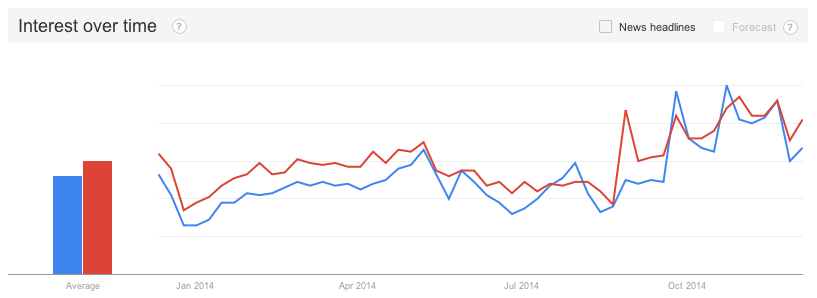
Let’s look at how each term performed within the last 12 months (“Feminism” is the blue line, and “feminist” is the red line):

Google Trends: 'Feminism' and 'Feminist,' Last 12 Months (Dec. 2013-Dec. 2014)

Google Trends: ‘Feminism’ and ‘Feminist,’ Last 12 Months (Dec. 2013-Dec. 2014)

Searches for each term grew the week from Dec. 22-28, 2013. There are some spikes, the first of which occurs the week of Aug. 24-30, 2014. Beyoncé performed a medley of songs from her self-titled album at the MTV Video Music Awards (VMAs), which aired on Aug. 25. More notably, she performed “***Flawless” in front of a giant lit marquee claiming her as a “FEMINIST.”

The last baby spike in traffic for the terms occurred during Nov. 16-22, 2014, which was the week before Beyoncé released the Platinum Edition.


But how many people were searching for “feminism” and “feminist” in conjunction with Beyoncé? Let’s take a look:

Google Trends: 'Beyoncé Feminism' and 'Beyoncé Feminist,' Last 12 Months (Dec. 2013-Dec. 2014)

Google Trends: ‘Beyoncé Feminism’ and ‘Beyoncé Feminist,’ Last 12 Months (Dec. 2013-Dec. 2014)

This trend shows searches for “beyoncé feminism” (blue line) and “beyoncé feminist” (red line) over the past 12 months. She released her album on Dec. 13, which accounts for the notable spike occurred the week of Dec. 15-21, 2013. After that, both terms go relatively quiet during spring 2014 (and completely dormant during summer 2014), before “beyoncé feminist” makes an astronomical comeback the week of her VMAs performance.


Clearly, Beyoncé and her self-titled blockbuster album had an effect on basic terms “feminism” and “feminist.” We’ll have to see if this is a one-time thing, or will endure over time.


#ThrowbackThursday: Brown University’s Sex Week 2014

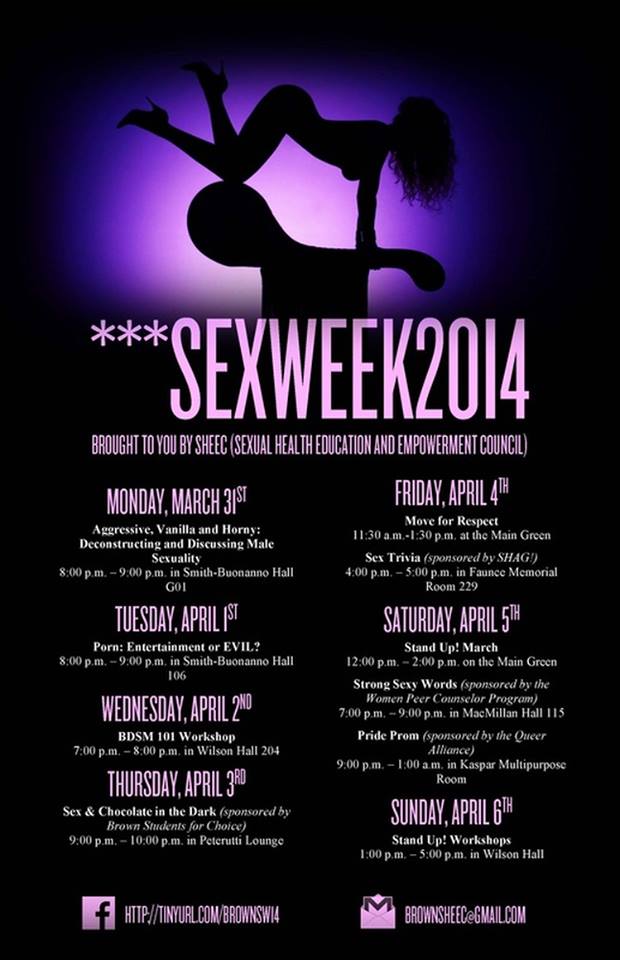
Brown Sex Week 2014 Poster

Brown Sex Week 2014 Poster

WOW! I was researching for this afternoon’s blog post (it’s live in a few hours!), and stumbled on this fantastic art for Brown University’s Sex Week 2014.

Or should I say, ***Sex Week 2014. Est-ce tu aimes le sexe?

Beyoncé + sex education = Win. Every time.

Carry on.