How Many Germs Transfer During Kissing?

Remco Kort, author of the kissing study, stands near his Kiss-O-Meter developed for the Micropia museum (Huffington Post)

Remco Kort, author of the kissing study, stands near his Kiss-O-Meter developed for Amsterdam’s Micropia museum (Huffington Post)

Happy Friday! Germs are everywhere. Some germs are good (probiotics), and some germs are bad (E. coli).

But some germs are just sort of there, waiting to be unleashed from us. Like when we’re kissing someone else.

A recent study published in “Microbiome” found that a whopping 80 million germs are exchanged during a French kiss. And this is only if the kiss lasts only 10 seconds.

Scientists from the Netherlands Organisation for Applied Scientific Research (TNO) had 21 couples visiting the Artis Royal Zoo kiss for the aforementioned amount of time, and collected saliva from each participant before and after the kiss. One partner then drank a probiotic yogurt before kissing again, and scientists again collected samples.

The study found that the microbes from any couples’ mouths resulted in similar strains of bacteria than from any two random strangers’ mouths. We often hear that long-term couples begin to resemble each other, and now that’s proven to be the case on the inside as well.

But these germs might not be only bad for us. Study author Remco Kort said that diversifying one’s microbes could actually result in better health.

Sounds like a great case for kissing a lot of different people, right? Now get out there and boost your health!


Black Stars on “Vogue” Covers in 2014: By The Numbers

Lupita Nyong'o, 'Vogue' Magazine Jul. 2014 (IB Times)

Lupita Nyong’o, ‘Vogue’ Magazine Jul. 2014 (IB Times)

A recent “Daily Mail” article points out that (American) “Vogue” had more black cover stars during 2014 than during any previous year.

While this still isn’t ideal in terms of diversity, it seems the magazine is on the right path in including equal representation, both on the cover and within its pages. Let’s just hope things keep progressing upwards.

Here’s how the numbers break down:

Number of “Vogue” issues in 2014: 12

Number of cover stars in 2014: 15

Number of black cover stars: 4 (26%+)

Number of black models: 1 (Joan Smalls, who shared the cover with Cara Delevingne and Karlie Kloss)

Number of black actresses: 1 (Lupita Nyong’o)

– Number of black musicians: 2 (Rihanna and Kanye West)


Number of black cover stars in recent years:

– 2013: 2 (Michelle Obama and Beyoncé)

– 2012: 1 (Serena Williams)

– 2011: 1 (Rihanna)


Most recent time the September issue featured a black star: 2010 (Halle Berry)

Previous to 2010, the last time the September issue featured a black star: 1989, 21 years previously (Naomi Campbell)


Number of “Vogue” publications that did not use any black/people of color cover stars in 2014: 5 (“Vogue UK,” “Vogue Paris,” “Vogue Ukraine,” “Vogue Netherlands,” “Vogue Russia”)


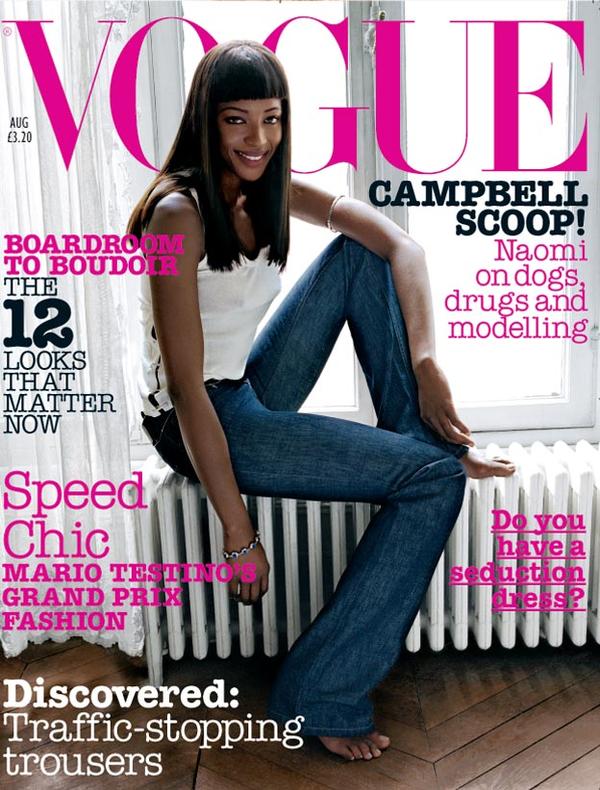
#ThrowbackThursday: Naomi Campbell for British “Vogue,” 2002

Naomi Campbell, 'Vogue' Magazine Aug. 2002 (Huffington Post Canada)

Naomi Campbell, ‘Vogue’ Magazine Aug. 2002 (Huffington Post Canada)

Last week, model Jourdan Dunn announced via Instagram that she’d be covering the February 2015 issue of British “Vogue.”

This is significant because it’s been over 12 years since the magazine featured a sole black model. The last time was in Aug. 2002, which Naomi Campbell covered (pictured above).

Dunn has also graced the cover in 2008, appearing with Eden Clark and Rosie Huntington-Whiteley.

“Vogue” was founded as a weekly publication in 1892, went bi-weekly in 1905, and began publishing monthly in 1973. The magazine has 23 different national and regional editions.

Leelah Alcorn Suicide: Transgender Teen Suicide Stats

Leelah Alcorn (Yahoo News)

Leelah Alcorn (Yahoo News)

Leelah Alcorn was a 17-year-old transgender teen who committed suicide Dec. 28 of this past year. Born a boy named Joseph, she came out to her parents as transgender at 14 years old, and felt she was “a girl trapped in a boy’s body” since the age of four.

Alcorn wrote a suicide note on her Tumblr, published after her death, that called for better dialogue surrounding gender education and trans civil rights. She hoped her death (which could’ve been easily avoided) would spark a discussion and changes.

It’s pretty well-known that LGBT teens have a higher rate of suicides and suicide attempts than straight teens. According to The Trevor Project, LGBT youth (defined as ages 10-24) are “three times more likely to attempt suicide than their straight peers.”

For transgender teens, the numbers get more grim: The Youth Suicide Prevention Program cites national statistics that claim “more than 50% of transgender youth will have had at least one suicide attempt by their 20th birthday.” There seems to be discrepancy here, as The Trevor Project notes that 25% of transgender teens have attempted suicide, and almost 50% have thought about it. Either way, that’s pretty scary.

Familial (and friends’) support plays a big role in all teens’ lives, but is particularly needed for transgender teens. The Trevor Project cites a stat which posits that LGB teens who have “highly rejecting families” are 8.4 times more likely to attempt suicide. Though the site doesn’t include trans teens within this stat, it’s safe to say they probably face similar odds.

Leelah Alcorn’s death didn’t have to happen. It shouldn’t have happened at all. But I hope it begins the discussion she wanted and rightfully deserved.


Are Male or Female Submissives More Common?

Jamie Dornan as Christian Grey (EW.com)

Jamie Dornan as Christian Grey (EW.com)

In a recent interview with “Elle UK,” actor Jamie Dornan discussed his role in the upcoming “Fifty Shades of Grey.” He will play businessman Christian Gray, who initiates Anastasia Steele (Dakota Johnson) into his world of pleasure and pain.

Dornan described going to a sex dungeon for research and expressed surprise at how large and widespread the lifestyle is. He then claimed that “more men are submissives than women.”

Is this true?

Dornan was probably speaking from his own anecdotal experience of visiting the dungeon. We don’t know if he visited more than one (and where the dungeon or dungeons were located), and so cannot extrapolate any larger trends from his observation.

But a couple of recent studies illuminate how dominant and submissive roles in BDSM break down along gender lines. Naturally, one of the questions asked was how participants self-identify: as doms, as subs, as women, as men.

In 2013, a Dutch study found 33% of the men surveyed identified as submissive, while 48% identified as dominant. Among women, 76% of respondents identified as submissive, and 8% identified as dominant.

Closer to home, a study from Southern California came out, which examined mental health among BDSM practitioners.

Within the study, 26% self-identified as submissive (with 61% self-identifying as dominant). Amongst women, 69% identified as submissive, and 30% identified as dominant.

This might be a stat where the anecdotal evidence differs from the numerical data. The male respondents might not’ve wanted to self-identify as submissive, and so might’ve skewed the data. But that doesn’t mean they don’t exist.

John Jolie-Pitt: Transgender Children Statistics

John Jolie-Pitt (Refinery 29)

John Jolie-Pitt (Refinery 29)

Happy 2015! I hope everyone had a fun and relaxing holiday season.

Now, let’s get back to business. The business of sex and numbers.

Last month, actors Angelina Jolie and Brad Pitt stepped out with their family for the premiere of Jolie’s new film (and directorial debut) “Unbroken.” Many media outlets commented on their eight-year-old daughter Shiloh wearing a tux to the event. Shiloh has been asked to be referred to as “John” and self-identifies as a boy. (Wonderfully supportive parents Jolie and Pitt have readily obliged.)

John has not publicly identified himself as transgender, and his parents have not identified him as such either.

But how many children might identify as, or fit the label of, transgender?

At the moment, there’s really no hard data answering this question. Either researchers aren’t delving into this topic, or they might not be using the term “transgender” when asking a child to self-identify.

But gender identity tends to be fixed early in life. A PDF on children’s transgender identity for parents from Parents, Families and Friends of Lesbians and Gays (PFLAG) San Francisco notes the following:

“Most people have a sense of their gender identity between ages two and four. If your child expresses a transgender identity since early childhood, it is unlikely they will change their mind as they age. Their sense of themselves will only deepen.”

This makes sense as it relates to John, as Jolie observing that he “wants to be a boy” in a 2010 “Vanity Fair” interview.

It’ll be interesting to watch John Jolie-Pitt grow up and how his gender identity changes or stays the same. No matter which happens, it’s great to see a notable example of a supportive family surrounding him. Hopefully, it’ll change and open some minds.

WordPress 2014 In Review for Sex & Stats

As we all know by now, I love numbers of any kind. When WordPress offered an annual report on my new(ish) blog, I jumped on it and eagerly dug through it! Enjoy!

The WordPress.com stats helper monkeys prepared a 2014 annual report for this blog.

Here’s an excerpt:

A San Francisco cable car holds 60 people. This blog was viewed about 2,900 times in 2014. If it were a cable car, it would take about 48 trips to carry that many people.

Click here to see the complete report.

Sex & Stats’ 2014 Year in Review

Beyonce's 'Flawless' performance at the 2014 MTV Video Music Award

Beyoncé’s ‘Flawless’ performance at the 2014 MTV Video Music Awards

We’re almost done with 2014, so let’s take a look back at some important movements in the world of sexuality.

Trans Issues:

After a long time, the trans community has come into the spotlight.

It started back in early March, when Jared Leto took home the Best Supporting Actor Oscar for playing trans woman Rayon in “Dallas Buyers Club.” This was the first time an actor won an Oscar for a trans role, and the second time an actor playing a trans character had been nominated for an Academy Award. (The first time was when Felicity Huffman played a trans woman in 2005’s “Transamerica,” and garnered a Best Actress nomination.) The film also sparked a dialogue about cisgendered actors playing trans roles.

The community has been making strides on a local level as well. This fall, a Texas high school elected its first trans homecoming king.


Anal Play:

“We’ve been experimenting with the butt,” a good friend of mine said recently. Though she was referring to what she and her partner were getting up to, this statement also applies to our culture’s newfound fascination with anal play.

Ever since a stripper alleged that Drake enjoyed having his salad tossed, it seems like anal play and rappers  are having a major intersectionality moment. Nicki Minaj has proven this most frequently with her singles “Anaconda” and “Only,” positing herself in the power position of receiving, and greatly enjoying, having her asshole eaten out.

Anal sex also appeared on our broadcast TV screens in mainstream American homes this fall. The “How To Get Away With Murder” pilot and an episode of “The Mindy Project” both featured the formerly taboo act (the former more explicitly than the latter). Bonus points for both featuring interracial couples as well.


Feminism:

This is technically a holdover from 2013, but feminism continued to stake its claim in culture this year.

“Harry Potter” actress Emma Watson gave an inspiring speech to the United Nations launching the HeForShe campaign, mobilizing men to do their part for feminism. Chanel designer Karl Lagerfeld ended his spring 2015 runway show with models holding up signs painted with feminist slogans. Singer John Legend declared that society would be better if all men were be feminists.

Of course, Beyoncé also had a hand in this. (No surprise there, as her 2013 self-titled album sampled Chiamanda Ngozi Adichie’s now-famous TED talk on feminism.) She started it off strong in January authoring an essay on workplace inequality for “The Shriver Report: A Woman’s Nation Pushes Back From the Brink.”

But that was small compared to what was to come: During the 2014 MTV Video Music Awards, Beyoncé performed “***Flawless” in front of a giant lit marquee, branding herself as a FEMINIST. IN ALL CAPS. It certainly raised consciousness for many people, because Google searches for “feminist” and “beyonce feminist” majorly spiked that week.


2014 has been very eventful, and let’s hope society keeps making sex-positive strides forward in 2015. See you next year!

Trojan 2014 Sexual Health Report Card: By The Numbers

Trojan 2014 Sexual Health Report Card (via Twitter)

Trojan 2014 Sexual Health Report Card (via Twitter)

Earlier this year, Trojan (the condom brand, duh) released its 2014 Sexual Health Report Card. Now in its ninth year, the Report Card measures sexual health resources for 140 colleges selected from the Bowl Championship Series. Scoring categories include student health centers’ access to quality information, STI and HIV testing and condom and contraceptive availability, among other points.

This year, PAC-12 school Oregon State wrested the #1 spot from Princeton University. As the Report Card notes, the top spot has typically vacillated between the Ivy League and the Big Ten. The PAC-12 also took spots #4 (University of Arizona) and #5 (Stanford) in the top 10.

I wanted to see if there were any discernible patterns within the data, so I crunched some numbers and played with some pivot tables.

By College Conference:

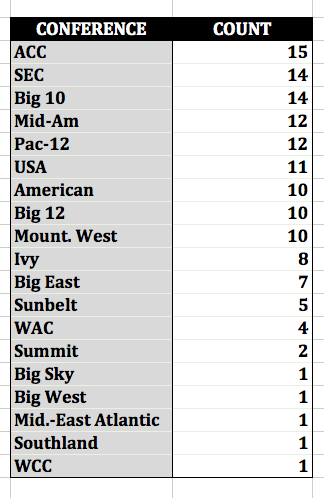
Trojan Sexual Health Report Card 2014: College Conferences

Trojan Sexual Health Report Card 2014: College Conferences

The Atlantic Coast Conference (ACC) took the top spot for conferences with 15 entries, and the Southeastern Conference (SEC) came in tied second with the Big Ten with 14 entries each. The Mid-American and PAC-12 conferences each have 12. Conference USA boasts 11 schools, and the American, Big 12 and Mountain West schools each have 10 schools.

The ACC, SEC and Ivy League all had each of its schools place within the rankings.


By School Type:
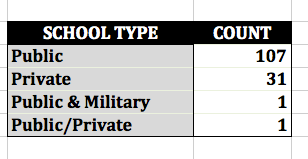
Trojan Sexual Health Report Card 2014: School Type

Trojan Sexual Health Report Card 2014: School Type

Over 76% of ranked schools were public schools, and 22% of schools were private. Ivies comprised over 25% of private schools listed.

Virginia Tech was categorized as public and military, and University of Pittsburgh was public and private.


By State:
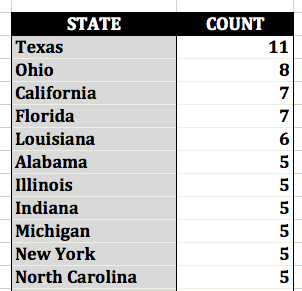
Trojan Sexual Health Report Card 2014: States

Trojan Sexual Health Report Card 2014: States

Texas boasts 11 schools ranked, while Ohio has eight schools for second place. California and Florida tie with seven schools each. Louisiana has six, and Alabama, Illinois, Indiana, Michigan, New York and North Carolina each have five schools represented.

On the other end of the scale, several states are one-hit wonders: Hawaii, Maryland, Minnesota, Missouri, Nebraska, New Hampshire, Washington D.C., and Wyoming.

By Region:
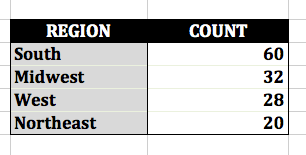
Trojan Sexual Health Report Card 2014: Region

Trojan Sexual Health Report Card 2014: Region

Here’s something interesting: The South makes up 42%+ of the report’s regional breakdown. I didn’t expect that considering the region’s traditionally rocky relationship with sex education.

By contrast, the Northeast comprises only 14%+.


Past Winners:

In the report card’s nine years of age, Ivy League schools have taken the crown four times: Yale (2006, inaugural year), Columbia (2010 and 2011), and Princeton (2013).

Columbia and Princeton have previously topped the list despite not having school-wide Sex Weeks.

Some previous winners have precipitously descended the list since their banner year. University of Minnesota-Twin Cities made #1 in 2007, but has since slid to #24, a rate of 2.8+ spots per year. University of South Carolina-Columbia topped the list in 2009, and is now 29, sliding down the list at a much faster 5+ spots a year. Yale descended to #44 this year, sliding the fastest at 5.3+ spots per year.


Interesting Outliers:

Despite Trojan’s claim to show schools from all 50 states in their report, Alaska is conspicuously absent.

Only one HBCU (historically black college or university) made the cut: Savannah State University in Savannah, Georgia. The school came in at #133. Savannah State has made the list before, ranking #134 in 2013.

Indiana University-Bloomington checks in at #36. This wouldn’t be weird except the university houses the Kinsey Institute. You’d think sexual health would be a priority considering it’s apparently lucrative research.


Methodology:

Trojan outlined the criteria they look for within the report (and even leave room for extra credit), and they’ve ranked schools on a 4.0 scale before. I’d like to learn more transparency about how the different factors were selected and weighted in terms of priority.

One weird thing was that the University of Alabama was listed twice, ranked both #30 and #120. This was confusing and will need to be corrected for future report cards.


Final Thoughts:

I’d love to see more diversity of school represented. It’d be great to see other HBCUs (Spelman, Morehouse, etc.) and art schools (Pratt Institute, RISD, etc.). The National Center for Education Statistics puts the number of four-year colleges at 2.8K+ (as of 2010-2011), and it’d be fantastic to see a wider swath of schools surveyed.