How Do Most Women Feel About Their Abortions?

Pregnant woman (SLO County)

Pregnant woman (SLO County)

The popular media image of a woman who has had an abortion is that she regrets it. She sighs with longing whenever she sees a child around the age of her unborn one, thinking that it could have been them.

While the emotional aspect might pop up now and again, many women who’ve had abortions feel that they’ve made the right choice for themselves. A recent study followed women who’ve undergone the procedure and followed up with them for years to determine their emotional wellbeing.

From 2008 to 2010, researchers looked at 667 women across 30 U.S. clinics, and divided them into two groups: women who terminated a pregnancy within the first trimester, and women who terminated within two weeks of the mandated limit. The researchers then called the women every six months afterwards for three years to identify negative and positive emotions associated with the act.

Overall, women felt that they had made the right decision 99% of the time, and experienced “decreased emotional intensity” over time. Those who felt negative emotions were likely to have had a planned pregnancy, and/or difficulty in making the decision to undergo an abortion. There was virtually no difference between how the two groups of women processed the experience.

This is very important information, as it overturns a popularly-held misconception. Hopefully, these results will act as a catalyst so that the Supreme Court will stop basing abortion rulings on “abortion regret.”

Caitlyn Jenner Receives the ESPYs’ Arthur Ashe Courage Award

Caitlyn Jenner, 2015 ESPYs (JustJared)

Caitlyn Jenner, 2015 ESPYs (JustJared)

Happy Friday! The ESPYs aired last night, and all anyone can talk about is Caitlyn Jenner receiving the Arthur Ashe Courage Award. Named for tennis great/AIDS victim Ashe, the award is given to individuals whose actions “transcend sports,” and has been awarded since 1993.

It was her first public appearance at a major awards event, and she killed. Jenner gave a speech that highlighted her personal journey to self-acceptance as a transwoman. She also talked about her fellow athletes’ responsibility to crew the change:

How do we start? We start with education. I was fortunate to meet Arthur Ashe a few times, and I know how important education was to him. Learn as much as you can about another person to understand them better.

Jenner later spoke about how her transition felt, and what the trans community needs from larger society:

But this transition has been harder on me than anything I could imagine. And that’s the case for so many others besides me. For that reason alone, trans people deserve something vital. They deserve your respect. And from that respect comes a more compassionate community, a more empathetic society and a better world for all of us.

Jenner is the first transwoman to receive the award.

Diversity Amongst Principal Dancers in Top Ballet Companies: By The Numbers

San Francisco Ballet's Yuan Yuan Tan and Davit Karapetyan in George Balanchine's 'Scotch Symphony,' 2012 (Odette's Ordeal)

San Francisco Ballet’s Yuan Yuan Tan and Davit Karapetyan in George Balanchine’s ‘Scotch Symphony,’ 2012 (Odette’s Ordeal)

It’s a well-known fact that classical ballet companies aren’t known for their diversity. With the news that American Ballet Theatre (ABT) dancer Misty Copeland has been promoted to principal, I was curious to see just how (non-) diverse the major ballet companies are.

First, I identified the top classical ballet companies in the U.S.: ABT, New York City Ballet (NYCB), San Francisco Ballet, Pacific Northwest Ballet, and Houston Ballet. (I didn’t look at Chicago’s Joffrey Ballet because the company doesn’t use traditional levels, as far as I could tell.)

Next, I looked at each company’s roster, looking for diversity. I decided to narrow my search to solely the principal dancers to save time. I then made a spreadsheet of my findings:

Principal Dancer Diversity at Top Ballet Companies Excel Spreadsheet

Principal Dancer Diversity at Top Ballet Companies Excel Spreadsheet

The first glaring thing is none of the companies have any Black principals at this time. (Copeland will change that when she begins her new position in August.) Every company listed has at least one principal of Asian descent, and San Francisco has two.

Here’s how the various companies break down.

American Ballet Theatre (ABT):

ABT has 15 principal dancers. Four Latino/Latina dancers make up 25%+ of the company’s diversity.

Houston Ballet:

Houston Ballet has the smallest group of principals with just eight dancers. The one Asian dancer and one Latina dancer combine to make up 25% of the diversity.

New York City Ballet (NYCB):

NYCB has the highest number of principal dancers at 24. Latino/Latina dancers comprise 12%+. Though not noted above, NYCB also features one dancer of South Asian descent.

Pacific Northwest Ballet:

This company has the worst diversity score. No Black or Latino/Latina dancers, and only one Asian dancer, in a group of 12 principals.

San Francisco Ballet:

With six dancers among 20 principals, San Francisco Ballet’s Latino/Latina contingent make up 30% of that company’s diversity, the largest of the studied cohort. Though not noted above, the company also features one dancer of South Asian descent.

#ThrowbackThursday: Lauren Anderson in the Houston Ballet’s “Don Quixote,” 2006

Lauren Anderson, with Carlos Acosta, in Houston Ballet's 'Don-Quixote' (DanseTrack)

Lauren Anderson, with Carlos Acosta, in Houston Ballet’s ‘Don-Quixote’ (DanseTrack)

Misty Copeland may be the most recognizable Black almost-principal ballet dancer right now. But she’s not the first.

Lauren Anderson danced with the Houston Ballet from 1983 until her retirement in 2006. Born and bred in Houston, she began training at the company’s Ben Stevenson Academy (named for the company’s artistic director, now emeritus) before joining the company itself.

In 1990, Anderson was named principal dancer. She was the Black woman to achieve the rank within the Houston Ballet, but also became one of the most visible Black classical ballet principal dancers within a major company.

The above photo shows Anderson dancing with Carlos Acosta in the Houston Ballet’s 2006 production of “Don Quixote.”

Kim Kardashian West’s Implanted Male Embryos: How Common Is It?

Kanye West and Kim Kardashian West (US Weekly)

Kanye West and Kim Kardashian West (US Weekly)

As the whole world knows by now, Kim Kardashian is pregnant with her second child, a boy, through in-vitro fertilization (IVF). Apparently, her husband Mr. Kim Kardashian (a.k.a. Kanye West) wanted a boy, or, as he calls it, “an heir.”

To achieve the desired result, Kardashian chose to only implant male embryos (and evidently, it worked). She most likely underwent preimplantation genetic diagnosis (PGD), a procedure which screens embryos for sex characteristics, looking for XX (a girl) or XY (a boy).

In 2012, it was estimated that PGD was used for 4K-6K procedures per year. In 2014, fertility treatment procedures, including but not limited to IVF, were estimated at around 165K+ per year. PGD is used with IVF, so PGD cases comprise between 2%-3% of total fertility treatments.

Interestingly, the U.S. is one of the only countries in the world within which PGD may used for “prenatal sex selection.” In many countries, its use is restricted to medical and chromosome-related issues.

Nobody can yet say if this will become a widespread practice. It does raise some questions about the ethics of calling the shots on choosing your child’s sex. But this isn’t a new concern: New York University’s Director of the Bioethics Program S. Matthew Liao wrote a paper on the subject in 2004 for the “Journal of Medical Ethics” while at Johns Hopkins University. About halfway through the paper, he acknowledges, “As far as I know, no one has tried to use genetic engineering for sex selection.” Things have certainly changed in 11 years. Welcome to your brave new world.

Misty Copeland is American Ballet Theatre’s First Black Principal Dancer

Misty Copeland in 'Swan Lake' (Vanity Fair)

Misty Copeland in ‘Swan Lake’ (Vanity Fair)

Last week, the American Ballet Theatre (ABT) in New York City promoted dancer Misty Copeland to principal. Copeland is the first Black woman to attain the level of principal (the highest level possible for a dancer) in ABT’s 75-year history. (ABT has previously had one Black man reach principal: Desmond Richardson, who achieved the level in 1997.) Since she’s considered a classical ballet dancer, this is all the more rare.

Copeland is considered to be a ballet prodigy since she began studying at age 13, and began dancing in pointe shoes a mere three months (!) later. She came to the larger public’s attention when she starred in the now-famous UnderArmour 2014 ad spot “I Will What I Want,” which featured her dancing. Since then, Copeland has written a biography and a children’s book, appeared on the cover of “Time” for their 2015 Top 100 list, and was the subject of a documentery, “A Ballerina’s Tale,” that premiered at the Tribeca 2015 Film Festival.

Copeland’s notable roles include the titular role in “The Firebird,” Swanhilda in “Coppélia,” and the dual roles of Odette/Odile in “Swan Lake.” The “Swan Lake” roles were significant for Copeland, and the rest of the ballet world:

It was a symbolically significant moment in American arts, in which a black woman danced the role of ballet’s famed white swan—and sold out all of her performances from the moment tickets went on sale months earlier.

Copeland became a member of ABT’s corps de ballet in 2001, and was promoted to soloist in 2007. She’ll start as principal dancer on August 1st.

The Supreme Court Rules in Favor of Same-Sex Marriage

The White House (Mashable)

The White House (Mashable)

(Yes, I know this is old news by now, but I couldn’t start blogging again without acknowledging it. If only  could’ve seen into the future!)

Friday, June 26th was a historic day that was a long time coming: The Supreme Court ruled to legalize same-sex marriages nationwide in a 5-4 decision. The decision overrules states that had previously decided not to allow same-sex marriage, and prompted many previously-against states to begin issuing marriage licenses and performing ceremonies.

Naturally, this is a wonderful decision, not just for the LGBT(QQIA+) community, but also for humanity as a whole. I think people have finally recognized that it’s time. And that it’s been time. Interestingly, there hasn’t been much resistance from state governments: Though Louisiana initially said it’d wait for federal intervention to comply, towns within the state eventually began offering marriage licenses.

As an ally, I’m glad I got to see the day, and hope this is the start of many beneficial changes.


Google Trends: How Many People Are Searching for a Female Viagra?

Little pink pill (Stuff NZ)

Little pink pill (Stuff NZ)

Hot on the heels of the news that a female Viagra is edging closer to public consumption, I wanted to see how often U.S. Internet users (which would be basically everyone) were searching for information related to female Viagra. I used “2004-present” as my timeframe.

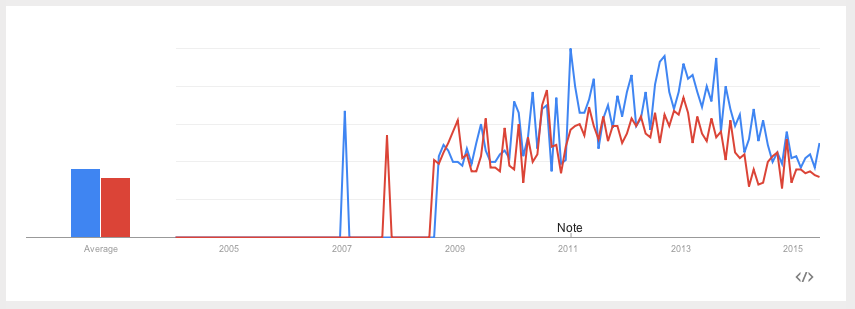
First, here’s how often “female viagra” (red line) against “viagra” (blue line):

Google Trends: 'Female Viagra' vs. 'Viagra,' U.S. 2004-Present

Google Trends: ‘Female Viagra’ vs. ‘Viagra,’ U.S. 2004-Present

As you can see, there’s a lot less searching for the former term versus the latter.

Now, let’s look at “female Viagra” on its own:
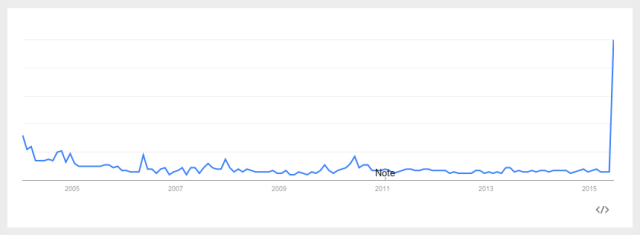
Google Trends: 'Female Viagra,' U.S. 2004-Present

Google Trends: ‘Female Viagra,’ U.S. 2004-Present

It’s hard to ignore that huge spike at the end of the timeframe. That occurred this month. It’s no coincidence: Sprout Pharmaceuticals announced that their female desire pill Flibanserin/ADDYI was recommended for Food & Drug Administration (FDA) approval on Jun. 5th.

Flibanserin/ADDYI will treat women with low libidos, known medically as hypoactive sexual desire disorder (HSDD). I wanted to see how common Google searches for low sex drives appeared.

First, I searched “low sex drive in women,” which was the first specific option Google autofilled for me:
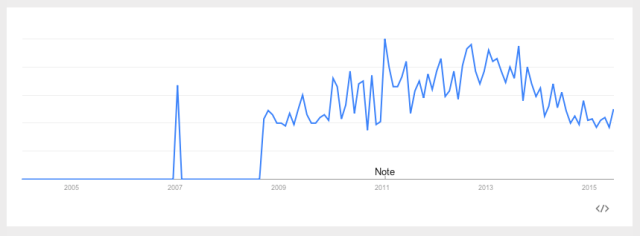
Google Trends: 'Low Sex Drive in Women,' U.S. 2004-Present

Google Trends: ‘Low Sex Drive in Women,’ U.S. 2004-Present

Interesting. It appears that the term hit its peak (ha) around a spike in 2011, and then crested in 2013. It’s dipped since then, but is starting to come back up. (Also, I’d love to know what happened in 2007.)

But let’s put this in context. Here’s “low sex drive in women” (blue line) versus “low sex drive” (red line):
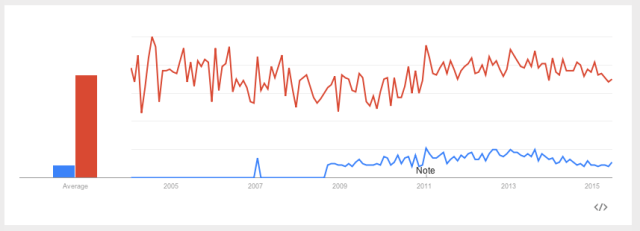
Google Trends: 'Low Sex Drive in Women' vs. 'Low Sex Drive,' U.S. 2004-Present

Google Trends: ‘Low Sex Drive in Women’ vs. ‘Low Sex Drive,’ U.S. 2004-Present

It’s interesting that the female-specific searches don’t make up that much of the overall searches.

Now let’s find out how many men are searching for information on low desire. Here’s “low sex drive in women” (blue line) versus “low sex drive in men” (red line):

Google Trends: 'Low Sex Drive in Women' vs. 'Low Sex Drive in Men,' U.S. 2004-Present

Google Trends: ‘Low Sex Drive in Women’ vs. ‘Low Sex Drive in Men,’ U.S. 2004-Present

OK, now we can see that low libidos in women are an issue, insofar as they’re being Googled.

So a lot of people (we could probably reasonably assume women) are searching for information on low sex drives in women. But how many are searching for a solution? Maybe a cure, call it “female viagra” (red line)?

Google Trends: 'Low Sex Drive in Women' vs. 'Female Viagra,' U.S. 2004-Present

Google Trends: ‘Low Sex Drive in Women’ vs. ‘Female Viagra,’ U.S. 2004-Present

Holy shit, this is amazing. Sure, users are searching for (presumably) information on women having low sex drives, but they’re searching a lot more for a solution. At no point in this graph are there more searches for “low sex drive in women” than there are for “female viagra.” Also, note how the “female viagra” searches spike at the end, halfway through 2015. As noted above, that’s when Sprout announced their “little pink pill.”

Conclusion:

The evidence here points to the fact that people are actively searching for solutions to cure women’s low sex drives. This certainly warrants a female Viagra pill to be brought to market, but why the hell wasn’t this developed sooner?!


Sprout Pharmaceuticals’ Female Viagra Closer to Becoming Publicly Available

The experimental drug flibanserin, made by Sprout Pharmaceuticals, is at the center of a regulatory controversy.

The experimental drug flibanserin, made by Sprout Pharmaceuticals, is at the center of a regulatory controversy.

Sprout Pharmaceuticals has developed what they’re calling the Viagra for women. The new drug, named Flibanserin, purports to treat hypoactive sexual desire disorder (low sex drive, in other words) in pre-menopausal women. So far, $50M has been raised in preparation for the drug’s launch, and the Food & Drug Administration (FDA) has approved its benefits/risk profile.

The drug, now known as ADDYI, has had a long road thus far:  The drug was first rejected in 2010, when it was determined that the risks outweighed the dubious (at the time) benefits. Sprout began working on the drug in 2011, after being sold by the drug’s initial developer Boehringer Ingelheim. In December 2013, the FDA had rejected the drug for the second time.

In February 2014, the FDA wanted to see more tests done, specifically how the drug behaved when used with other medications. (Almost 10% of women taking the pill reported sleepiness during the trial.) The company resubmitted New Drug Application (NDA) this past February. The “little pink pill” was approved by an FDA advisory committee (done one step before final FDA approval), provided that more safety restrictions were added.

So far, Flibanserin/ADDYI has been tested on 11K+ women, and claims to be the “one of the most studied women’s health products in history.” Here’s what Sprout found after some recent trials:

In three 24-week randomized Phase 3, six-month, double-blind, placebo-controlled, parallel-group North American studies of premenopausal women with a mean age of 36 years, ADDYI consistently demonstrated a highly statistically significant difference over placebo on three key endpoints, including increase in sexual desire, decrease in distress from the loss of sexual desire and increase in the frequency of satisfying sex. Women treated with ADDYI showed significant improvements at every point of measurement in all pivotal clinical trials, with benefits seen as early as four weeks and sustained over the 24-week treatment period.

It’s too early to know when the drug will hit the public market. But it’ll be interesting to see how it performs (haha).