Planned Parenthood Endorses Hillary Clinton

Hillary Clinton (The Washington Times)

Hillary Clinton (The Washington Times)

Planned Parenthood has endorsed a candidate for the primary election: Hillary Clinton, the only woman running for the Democratic nomination. This is the first time in Planned Parenthood’s 100-year history that the organization has endorsed a candidate.

For this who’ve been living under a rock, Planned Parenthood provides a number of serves for womens’ reproductive health, including birth control, Pap smears and abortions.

It’s becoming increasingly clear that women’s issues will take up a prominent share of issues discussed leading up to this year’s election. Last week, Republicans in the Senate voted to defund Planned Parenthood. Thankfully, they didn’t get very far, since President Obama vetoed it.

I hope this endorsement brings out women (and men!) to the polls who might not’ve voted otherwise come November.


Birth Control Is Now Available Over The Counter in Oregon

Birth control pills (Salon)

Birth control pills (Salon)

Good news for those who may not have insurance, or don’t want to visit the doctor: Birth control is (slowly) becoming available over-the-counter at your nearest pharmacy. That’s right, soon (depending on where you live) you won’t need a prescription.

Right now, the service is only available in Oregon, and it kicked into effect Jan. 1st of this year. Here’s how it works: A woman can walk into her local pharmacy, and fill out a questionnaire about her health. If all systems go, she can get birth control. If the pharmacist refuses to supply her on the grounds of religious reasons, the pharmacist is required to provide suggestions as to where the customer can find birth control.

This all applies if the woman is over 18 years old. If she’s under 18, she’ll still need a doctor’s prescription, though this standard will be relaxed at some point in the future.

It’s also pretty significant that a woman signed this into law: Oregon’s governor Kate Brown signed the bill into law last July.

But Oregon might not be the only state with this law in place for long: California is working out its own law, which is set to go into effect in March. And Colorado and Washington have introduced similar laws within their own respective states. Let’s hope the other 46 states soon see the light and follow suit.


Rock Icon David Bowie Has Died

David Bowie (BJournal)

David Bowie (BJournal)

I’d be remiss if I didn’t mention the biggest news this weekend, that music legend David Bowie has died. He passed away after a year-long battle with cancer, and had just released his 25th album two days before. Bowie was 69 (too young!).

Sure, his music made an impact, but so did Bowie’s sexuality. In the beginning of his career, he identified as gay. Then he said he was bisexual, and later backtracked on that. Bowie later married two women, one of them being supermodel Iman, and two children.

Bowie had a huge influence on anyone, especially kids coming of age, who felt out of place and was an icon with the way he played with gender and sexuality. He really enjoyed letting each part of himself out to play, and was very curious about everything. And those are lessons we can all take to heart.

Rest in peace, David Bowie. You were, and always will be, my favorite alien.

China’s (Now Ended) One-Child Policy: By The Numbers

Chinese One-Child Policy poster (The Galloping Beaver)

Chinese One-Child Policy poster (The Galloping Beaver)

Most people have heard of China’s infamous one-child policy. it’s exactly what it sounds like: each married couple is only allowed to have one child.

Now the policy has ended. Actually, it ended on Jan. 1st, less than a week ago.

A lot of people don’t know the story behind the concept, and why it was initially implemented. Here are some numbers that made the one-child policy look like a sensible idea at the time:

China’s total population:

1960: 667.1M

1970: 818.3M

China’s population grew 151.2M in 10 years, or at the rate of 15.12M per year. The government was worried that the population would continue growing exponentially at the same rate, with the country eventually becoming unsustainable.

Fertility rate:

1960: 5.76 births/1 woman

1970: 5.47 births/1 woman

The fertility rate stayed stable (and strong) throughout the 1960s.

Crude birth rate:

1960: 20.9

1970: 33.4

This metric shows the “number of of live births occurring during the year, per 1,000 population estimated at midyear.” The number hit a high in 1963 with 43.4, no doubt sending the Chinese government into a full-fledged panic.

With the above stats as historical context, it’s a bit easier to see why the Chinese government implemented the One-Child Policy, and kept it for the 35 years they did.

#ThrowbackThursday: Chinese One-Child Policy Propaganda Poster, 1986

Chinese One-Child Policy poster (The Galloping Beaver)

Chinese One-Child Policy poster (The Galloping Beaver)

As of Jan. 1, China’s one-child policy is officially history. Married couples are now allowed to have up to two children for the first time since 1979.

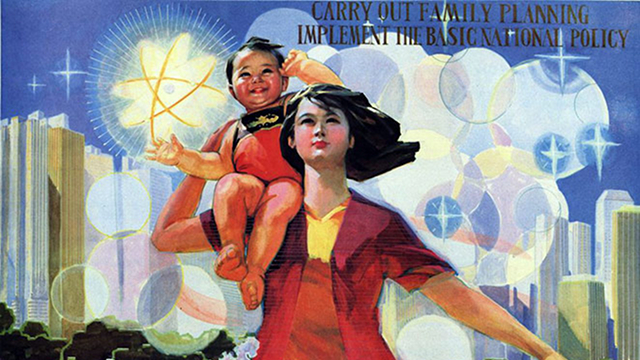
I’ve always thought propaganda posters were interesting, and here’s a great one for the one-child policy. It’s from 1986, and titled, “Carry out family planning, implement the basic national policy.” The image carries that can-do attitude made popular by Rosie the Riveter, and it’s easy to get swept up in the sentiment. Not to mention, the overall poster design’s pretty great too.


Saudi Women Win 20 Seats in Elections

Saudi Woman voting (Haaretz)

Saudi woman voting (Haaretz)

In Saudi Arabia, women have now gained a step towards equality: holding office.

In the recent elections held on Dec. 12 of last year, 20 women were elected to municipal seats. They comprise almost 10% of the 2.1K seats available. These seats were the only ones Saudi citizens vote for.

This was the first time women were allowed to vote in municipal elections. The most recent elections were held in 2005 and 2011.

Women were allowed to campaign for seats, albeit in a limited manner. They were not allowed to give out material that showed their faces (though this applied to both men and women), and could not speak to male audiences directly. (A candidate would have to speak from behind a partition or enlist a male relative to speak for her.) Women comprised 979 out of 7K candidates, or nearly 14%.

Around 130K+ women registered to vote, with the voting age being 21. There are 12.2M+ total women, and election officials estimated around 5M women would be eligible to vote. The country’s total population is around 30M.

This speaks to some good progress being made, and I hope there’s more on the horizon. This could happen: Before King Abdullah died, he decreed in 2013 that the Consultive Council, an appointed body that advises the king, be made up of 20% women.

Japan’s Surviving Comfort Women Will Receive Reparations

Korean comfort women (Japan Daily Press)

Korean comfort women (Japan Daily Press)

On Dec. 28, the heads of Japan and South Korea came to an agreement over making reparations for the remaining comfort women.

For those who are unfamiliar, comfort women were Korean women who served Japan’s Imperial Army before and during World War II…as sex slaves. This happened during Japan’s colonial rule over South Korea, which lasted from 1910 to 1945, and contributed to strained relations that continue to this day.

It’s difficult to pinpoint exactly how many comfort women existed, since accurate records weren’t kept. Most estimates put it at a range around 100K to 200K. Women began coming forward about their experiences in the early 1990s.

Of the 238 women who’ve come forward in South Korea, only 46 survive.

Obviously, this is a huge abuse of women (not to mention that of human rights), so it’s good that Japanese Prime Minister Shinzo Abe and South Korean Foreign Minister Yun Byung-se are trying to make it right 70 years later.

In addition to a formal apology, Japan will provide $8.3M-worth of reparations. However, the money won’t go directly to the survivors; it’ll be used by South Korea to establish healthcare for the women.

These reparations are significant because it’s the first time the Japanese government will provide the money. In 1993, Japan set up donations provided by private donors, but it wasn’t fully accepted by South Korea. At that time, 60 South Korean women received aid from the donations.

It’ll be interesting to see how these reparations make a difference for the women, and how the action changes Japan and South Korea’s relationship.


How Many Children are Born on New Year’s Day?

baby after bath #11

Baby (Dermatique UK)

Happy 2016! I hope it’s off to a good start for everyone, and your resolutions are intact so far.

In the spirit of the season, I was curious to find out how common New Year’s Day births are. No more auspicious time for a baby to make its debut, right?

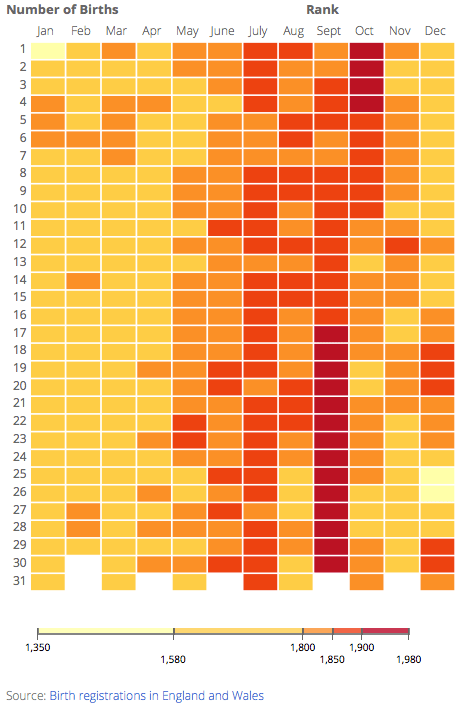
The United Kingdom’s Office for National Statistics kept records of popular birthdays from 1995 to 2014. As you can see below, New Year’s Day sees around 200 fewer births than any given day in England:

Screen Shot 2016-01-03 at 5.52.01 PM

U.K. Average Daily Births (The Telegraph UK/Office for National Statistics)

If you absorb best by color-coded blocks, here’s every day of the year plotted out:

Screen Shot 2016-01-03 at 6.00.03 PM

Birth registrations in England and Wales, 1995-2014 (The Telegraph UK/Office for National Statistics)

Click on the link to go to the whole table (it’s interactive). Jan. 1st can only claim 1,574 births, which makes it the 364th most-popular birthday.

I don’t know enough to hypothesize if birth patterns are the same in the United States, but I’d love to find out.

Justin Trudeau’s Cabinet is 50% Women

Canadian Prime Minister Justin Trudeau and his cabinet (CNBC)

Canadian Prime Minister Justin Trudeau and his cabinet (CNBC)

The new Canadian Prime Minister Justin Trudeau is working swiftly to make his own mark on his country: Last week, he debuted his new cabinet, which looks very different from the previous one (or most governing bodies, for that matter).

Trudeau’s cabinet is 50% women. That’s right, exactly half. Fifteen men, and fifteen women, along with Trudeau himself. Trudeau’s reasoning for his cabinet’s equality? “Because it’s 2015.” (Finally!) He also wanted a cabinet that “looked like Canada.”

But his actions aren’t just benefitting women; they’ll benefit the whole country:

The countries with the most female lawmakers have made major strides on issues such as education, labor-force participation and paid leave. [Sweden, Rwanda, and Finland] ha[ve] either a parliament or a ministry that is at least 50% female, while women make up only 19% of the U.S. Congress and only four of Obama’s 15 Cabinet members.

With this action, Trudeau sends a clear message: He respects and values women as peers and intellectual equals. And he intends to lead the twin charges of equality and diversity during his term. Incidentally, these terms have no limit. But I hope Trudeau is in power and makes needed changes for a long time to come.

China Ends Its Famous One-Child Policy

Chinese One-Child Policy poster (The Galloping Beaver)

Chinese One-Child Policy poster (The Galloping Beaver)

Whoa. Here’s something I didn’t expect to happen within my lifetime: Last week, China officially ended its one-child-per-family policy. Now, married couples are allowed to have up to two children. Crazy! (Though I kind of doubt that many couples will get crazy, and have more than two.)

The one-child policy was informally adopted (i.e. “strongly encouraged”) in 1975, made into law by the country’s Communist Party four years later. The law followed China’s population exceeding 800M+ people in 1970, with leaders realizing that the then-current growth rate was unsustainable.

However, the law has been relaxed for exceptions. In 1984, parents were allowed to have two children if one parent was an only. In 2013, this became alright if only one parent was an only child.

It’s estimated that the policy has prevented 400M+ births.

But why was the policy abolished, and why now? There are a few reasons. One is that the male-to-female sex ratio is becoming unbearably skewed, which tends to happen when preference for one sex greatly outweighs the other. (In this case, the Chinese preferred boys to girls, even going so far as to commit infanticide if a child was born a girl.) The birth rate is also declining, and the mortality rate is on track to outpace it. Per “The New York Times:”

China’s working-age population, those 15 to 64, grew by at least 100 million people from 1990 until a couple of years ago. But that expansion is petering out, and more people are living longer, leaving a greater burden on a shrinking work force. Now, about 10 percent of the population is 65 or older, and according to earlier estimates, that proportion is likely to reach 15 percent by 2027 and 20 percent by 2035.

China’s population is now 1.3B+, with 30% being over 50. It’s estimated that the decision will affect 100M+ couples.