“Federal Agents Gone Wild:” The Department of Justice Has a Prostitute Problem

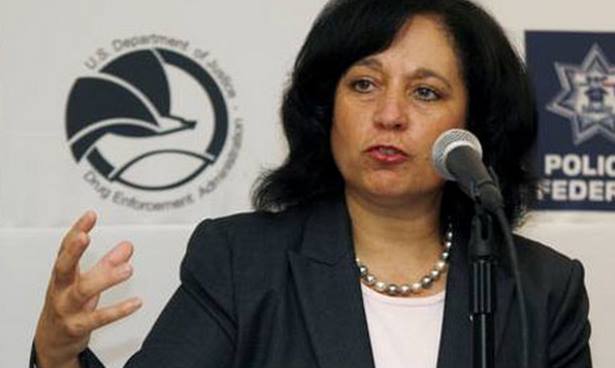
DEA chief Michele Leonhart (Girls Just Wanna Have Guns)

DEA chief Michele Leonhart (Girls Just Wanna Have Guns)

Yesterday, Michele Leonhart announced that she’d resign from her post as chief of the Drug Enforcement Agency (DEA) in early May. This comes after reports surfaced that some male employees were enjoying sex parties with prostitutes which were paid for by drug cartels in Colombia. And it had been going on for years. Conflict of interest much?

Earlier this month, Attorney General Eric Holder had to issue a department-wide memo for Department of Justice employees, reminding them that they are not allowed to solicit prostitutes under any circumstance. His point was that any employee who does this opens up himself, and the agency, to potential blackmail, extortion and leaking private information. (Seems like common sense to me.) I bet he never thought he’d have to write this kind of memo.

I tried to find if there were any other instances of this happening (since it was apparently uncovered during a routine Inspector General report), but couldn’t find anything. All stats I could find were more related to prostitution stats that the DOJ itself had reported on.

It’ll be interesting to watch how this all plays out, and what (if any) further punishments the DOJ partying employees will receive. (So far, employees who’ve confessed have only been suspended, but only up to a week-and-a-half.) It’s one thing to indulge in sex parties off the clock, but it’s another thing entirely to blur professional lines against those you’re supposed to be against (though I’m sure that was part of the appeal).
 

President Obama Supports Ending Conversion Therapy for LGBT Youth

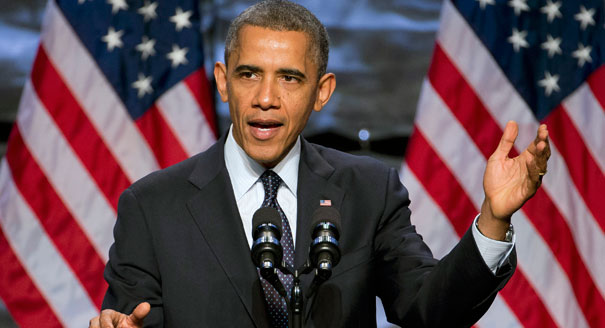
President Barack Obama (Politico)

President Barack Obama (Politico)

Big news last week: President Obama publicly stated that he supports banning conversion therapy for LGBT youth. The announcement came in response to an online petition urging the president to take action after transgender teen Leelah Alcorn’s suicide late last year. (Before her death, Alcorn’s parents had forced her to attend conversion therapy in hopes of getting their “son” back.)

Right now, it’s unclear what form Obama’s support will take. White House officials say that it’s unlikely that the president would push for a national law, but instead would “support the efforts to ban the practice at the state level.” It’s important to note that is a far cry from how Obama started his political career: At the time, he didn’t support gay marriage.

But the president’s views on LGBT issues are rapidly evolving, paving the way for the rest of America to follow suit. And change starts at home: The White House recently created an “all-gender” restroom for transmen and transwomen who may feel uncomfortable using the traditional facilities.


Michelle Bachelet Proposes Lifting Chile’s Total Abortion Ban

Chilean President Michele Bachelet (Slate)

Chilean President Michele Bachelet (Slate)

Late last month, Chilean President Michelle Bachelet proposed lifting her country’s total abortion ban.

Chile is one of seven Latin American countries to completely ban abortion. Bachelet’s bill allows for the measure in case of rape, or if the mother and/or baby are at risk of dying during the pregnancy. The procedure would be allowed up until the 12th week (3rd month) of pregnancy, or until the 18th week for girls younger than 14 years of age. Girls ages 14 to 17 would need their parents’ permission for the procedure.

Abortion has been outlawed in Chile since 1989, imposed under former dictator Augusto Pinochet during his rule. Anyone breaking this law faces up to five years in jail. (Before the ban, abortions were allowed in extenuating circumstances.) Twelve bills decriminalizing the procedure have been proposed since 1991, but none (so far) have passed through the country’s Congress.

The measure would cut down the number of women taking chances on risky, “back-street” abortions detrimental to their health. A “Reuters” estimate puts the number of illegal abortions between 15K and 160K. (Since the numbers would have to be self-reported in this case, it’s difficult to get an accurate count.)

According to an interview in Spanish newspaper “El Pais,” Bachelet was originally planning on proposing the bill in late 2014.

Bachelet faces opposition from anti-abortion activists, and from UDI, the opposing political party. Culturally, the country is also very socially conservative, owing to a large Catholic stronghold. But despite this, recent public polls found that 70% of Chileans support the bill.

This isn’t the first time Bachelet has worked to reform family planning: In her first term as president (2006-2010), she made the morning-after pill free in government hospitals available to women ages 14 and older, with parental consent unneeded.

This is one time where I think having a politician make laws about women’s bodies could work: In addition to being a woman, Bachelet is also a registered pediatrician. #FemaleLeadersKnowBest

No Shit: Colleges Are Underreporting Sexual Assaults

UVA Rotunda (Wikipedia)

UVA Rotunda (Wikipedia)

This should come as a surprise to absolutely no one: A recent study published in “Psychology, Public Policy and Law” found that colleges underreport sexual assaults on their campuses.

Conducted by the American Psychological Association, University of Kansas researcher Corey Rayburn Yung analyzed data pertaining to on-campus sexual assault reports from 31 colleges and universities. (This data came via the Clery Act, a federal law that mandates how colleges self-report crimes.) He specifically looked at “large schools with on-campus housing and 10K students” that were audited between 2001-2012 by the U.S. Department of Education for meeting federal reporting standards.

Here’s what Yung found:

During the audits, the reported numbers of sexual assaults increased by approximately 44 percent on average from previously reported levels. After the audits ended, the reported number of sexual assaults in following years dropped to pre-audit levels, evidence that some schools provided a more accurate picture of sexual assaults on campus only when they were under federal scrutiny, the study concluded.

(The study notes that individual stats for each school weren’t provided, and some didn’t show a spike in reporting during this period.)

It makes sense that a school would be more vigilant in reporting assaults during a government-mandated audit. But holy shit that’s a huge discrepancy. (To his credit, Yung did say that the study’s initial hypothesis was that colleges were underreporting these numbers, so he wasn’t going into this super-naive.)

But here’s another troubling thing, taken from the study’s abstract:

The data indicate[s] that the audits have no long-term effect on the reported levels of sexual assault, as those crime rates return to previous levels after the audit is completed.

So these schools are only on top of things when the Feds are breathing down their neck. Basically you’re shit out of luck if you’re assaulted on-campus during a non-audit timeframe, college women.

It’s probable that issues influencing the underreporting are the schools wanting to cover up the assaults (obviously), and/or schools might attempt the resolve the cases in a timely manner during the audit.

This sheds light on how higher education institutions see sexual assault: more of a potential blight on their reputations than actual concern for victims. Said Yung:

The study shows that many universities continue to view rape and sexual assault as a public relations issue rather than a safety issue. They don’t want to be seen as a school with really high sexual assault numbers, and they don’t want to go out of their way to report that information to students or the media.

What happens to schools that don’t comply with the sexual assault reporting requirements? They’re fined $35K, which pretty much amounts to a student’s (or half a student’s) yearly tuition.

I don’t know about you, but I’ve long suspected this to be the case. A similar phenomenon occurs with reporting unemployment numbers: A person who doesn’t work is counted as “unemployed” only if they’ve been actively looking for work within that past four weeks. If they haven’t done so, they’re not counted at all. Whenever a new jobs report comes out claiming that the unemployment number has dropped, a lot of people who haven’t been looking get hopeful and begin to look for work again, and then the real unemployment number grows. (And then everyone wonders why it’s bigger than before.)

To solve this problem, Yung calls for greater resources allocated to the issue, more frequent audits and greater fines for delinquent schools. I’d say that that’s a good step in the right direction.

How Many States Back Same-Sex Marriage?

Same-sex marriage figurines (The Missouri Times)

Same-sex marriage figurines (The Missouri Times)

Earlier this month, Alabama became the 37th state to legalize same-sex marriage. That’s nearly 3/4ths of the nation now that have legalized the institution!

I was curious to see which region (if any) had the monopoly on backing same-sex marriage. Using the Census’s regional boundaries, and information pulled from ProCon.org, here’s what I found:

Pivot table of states that legalize same-sex marriage

Pivot table of states that legalize same-sex marriage

Unsurprisingly, the West is setting the pace for approving same-sex marriage, comprising 26% of the nation’s approvals. The South and the Northeast are neck-in-neck for second place at 18% each, and the Midwest lags behind with 12% of approvals. Hopefully this year will bring more states legalizing it!

Why Are Condoms So Expensive in Venezuela Right Now?

Condoms (Prevention Justice)

Condoms (Prevention Justice)

Happy Friday!

Apropos of National Condom Week: Would you pay $755 for a box of condoms?

That’s insane, right? But right now, sexually-active and contraception-conscious Venezuelans don’t have much of a choice. That’s how much a 36-pack of Trojan condoms is going for. With the exchange rate, it works out to be $20+ per condom. If you’re shopping around, a 24-back of Durex condoms is selling for $317, making it the (slightly) more economical choice of $13+ per condom. (For context, this is about $10 more than the country’s standard black market rate.)

This is really alarming when you consider that the country’s minimum monthly wage is $888.24.

The Venezuelan people literally cannot afford to have safe sex.

The reason behind these sky-high prices? Oil.

Venezuela exports a lot of the stuff, using it to bring in around 95% of foreign earnings. But oil prices have fallen dramatically recently (over 60% drop within the past seven months), leading to fewer earnings for the country. This, in turn, inhibits Venezuela’s ability to import other basic goods (such as chicken, milk and corn), since their money doesn’t stretch as far. The Bank of America Corporation estimates the the country will import 42% less in earnings than it did in 2012.

Condoms aren’t the only contraceptive that’s hard to come by within the country. Birth control pills are also in high demand, and are very hard to find right now.

According to “Bloomberg Business,” the shortages began in late December, when the Venezuelan government “tightened dollar disbursements amid sliding oil revenue.” The Venezuelan Pharmaceutical Federation offered the following observation:

No condoms were available in 10 eastern and central Caracas pharmacies visited in late January, compared with as many as 20 different kinds available at some locations in November, including Reckitt Benckiser Group plc’s Durex and Church & Dwight Co.’s Trojan brands.

Venezuelan President Nicolas Maduro was attempting to fix this problem before it started: Last June, he announced that the government was building a condom factory to meet the country’s demand. But since then, customers disliked the quality of the condoms, and demand often outpaced supply.

Another factor in this saga is Venezuela’s own sexual health stats. According to a 2012 World Bank study, the country has the fifth-highest number of teen pregnancies out of the 21 Latin America countries. (This averages out to be 88+ live births for women ages 15-19 for every 1K women.) It also has the fourth-highest number of people living with AIDS on the continent.

If this condom (and birth control) shortage continues, it’ll impact Venezuela’s teen pregnancy and AIDS population for the worse. As prices rise, people will become more inclined to completely forgo any birth control method, and the government might not be able to support the overwhelming resulting birth rate. Let’s hope a solution arrives before these things come to pass.

I’m just thankful condoms are not only cheaper than a child, but also cheaper than a month’s rent.

Oregon Will Have the First Openly Bisexual Mayor

Kate Brown (The Democratic Party of Washington County)

Kate Brown (The Democratic Party of Washington County)

Progress is being in Oregon today: Former Oregon Secretary of State Kate Brown will be sworn in as governor, becoming the first openly bisexual woman (actually, person) in the nation to hold the office. Brown succeeds former governor John Kitzhaber, who resigned due to a criminal probe into his fiancée’s role in his office.

She was appointed to Oregon’s State House of Representatives in 1991, was elected the following year, and re-elected two years later in 1994. She moved to the Senate in 1996, and was elected Senate Majority Leader in 2004. She began serving as Oregon’s Secretary of State in 2009.

While her main interests center on removing barriers to voting registration and growing small businesses and entrepreneurship, she’s also advocated for LGBT rights. Brown was profiled in the “Out and Elected in the USA” survey of LGBT government officials in 1992. She’s been married to her husband Dan Little since 1997.

Brown hasn’t run into any trouble with her constituents with her status as a bisexual woman, as  Oregon is known for being very socially progressive. As Hannah Hoffman of “The Statesman Journal” notes:

Her sexuality has never been a prominent issue in Oregon, where Portland recently had an openly gay mayor in Sam Adams and where the current speaker of the House, Tina Kotek, is a lesbian.

Hopefully, we’ll see the rest of the country follow suit.


Brazil Will Pass Out Free Condoms During Carnival

Mardi Gras mask and beads (123 RF)

Mardi Gras mask and beads (123 RF)

Happy Mardi Gras! Known in English as Fat Tuesday (and just in time for National Condom Week), today celebrates casting off repression, upending social norms and indulging in vices before the Christian season of Lent begins (when enjoying all earthly pleasures ceases for 40 days). Much like Halloween, masks and costumes, dancing and lust in the air figure prominently.

Brazil has made Carnival an international destination, and it’s legendary for a reason. Several cities throw parades, led by various samba schools. Many foreigners fly in for the multi-day party (spanning the Friday before to Ash Wednesday at noon), making Carnival the country’s biggest tourism booster.

Naturally, when the shackles of convention are thrown aside, a lot more spontaneous sex occurs (because when in Rio…). But the Brazilian government is always prepared for this: they give out free condoms.

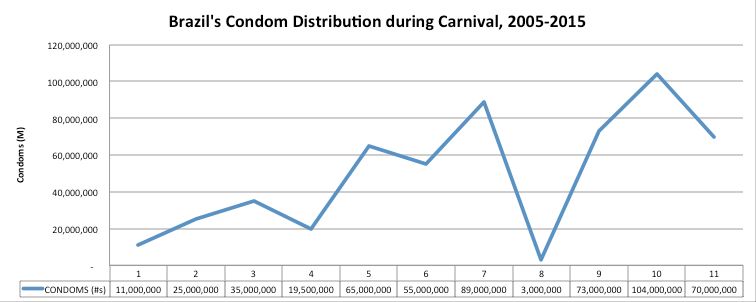
This year, they’ll hand out 70M condoms throughout the country. They’ve done this for years, handing out 65M in 2009, 55M in 2010, 89M in 2011, 3M in 2012, 73M in 2013 and 104M in 2014.

For visual learners, here’s a decade-long progression in line-graph form:

Brazil's Condom Distribution during Carnival, 2005-2015

Brazil’s Condom Distribution during Carnival, 2005-2015

As you can see, the number of condoms distributed during Carnival has tended to baseline around 70-75M in recent years (aside from 2012, whose 3M looks incorrect, to say the least).

Last year, the Brazilian government estimated that 2M+ people were on the streets at any given time during Carnival. Surely attendees can find at least one person to hook up with during the popular “blocos” (street-wide parties).