Burkini Sales Rise by 200% After French Ban

Burkini designer Aheda Zanetti (Saudi Gazette)

Burkini designer Aheda Zanetti (Saudi Gazette)

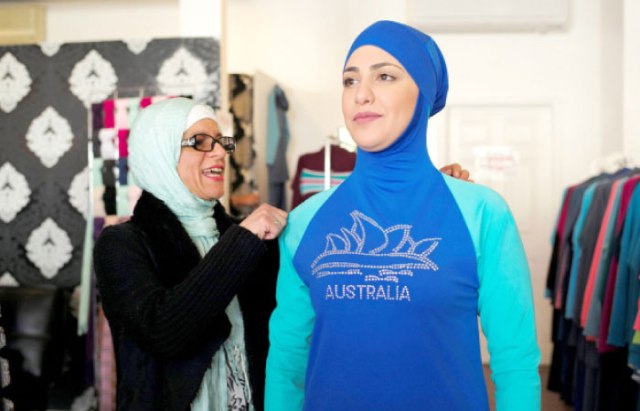
Earlier this summer, coastal French towns courted controversy when their respective mayors decided to ban burkinis on beaches. The burkini consists of a long-sleeved top with long pants and a head covering, and was developed for women who follow Islamic modesty standards so that they could go swimming while still covered. The term “burkini” comes from a portmanteau of the words “burqa” and “bikini.”

Despite the ban, burkini creator Aheda Zanetti says that online sales of now-famous swimwear have risen over 200%+ recently. (Now, we don’t know what her sales had been previously, or what the year-over-year change has proved to be, so unfortunately we have incomplete information.)

Zanetti says that her customers are not homogeneously Muslim. She reports that about 40% of her customers are from other faith traditions, such as Judaism and Mormonism, that adhere to modest dress standards.

The burkini ban stems from a stringent French view on separating religion from the state. The French government has banned religious symbols from government buildings since 2004. A ban specifically on burqas was passed in 2011.

Right now, about 30 French towns have instituted the ban, though the town of Villeneuve-Loubet has since overturned it.


Geraldine Roman is the Philippines’ First Transgender Congresswoman

Filipina Congresswoman Geraldine Roman (CNN)

Filipina Congresswoman Geraldine Roman (CNN)

The Philippines made history earlier this month when the country’s congress elected its first transgender member.

Geraldine Roman won her seat with 62% of the vote, judging by reporting from 99% of districts, and she’ll represent the northern Bataan province’s first district.

Roman’s platform included banning any anti-LGBT discrimination and making gender changes legal.

This is a giant progressive step for a country in which divorce, abortion, and same-sex marriage are illegal. It’s also illegal for a transperson to change their name and sex. There have also not been any gay or lesbian politicians serving at the national level.

How Many People Support North Carolina’s HB2 Law?

North Carolina Governor Pat McCrory (Instinct Magazine)

North Carolina Gov. Pat McCrory speaks during a news conference, Monday, Jan. 7, 2013, in Raleigh, N.C. In one of his first acts as governor, McCrory issued an executive order to repeal the nonpartisan judicial nominating commission established by former Gov. Bev Perdue. (AP Photo/The News & Observer, Takaaki Iwabu)

The outcry against North Carolina’s HB2 law, also known as the famously-derided “bathroom bill,” has been swift and fierce. But can we measure the reaction? And is it representative of the whole?

Fortunately, a recent poll provides some insight. CNN and ORC International polled 1K+ adults via phone (both landlines and cells), and asked those surveyed about North Carolina’s new law. Respondents also could self-identify as Democrat, Republican, or Independent. As the study notes, the sample was weighted to resemble the country as a whole.

When asked about equal protections for transpeople, 75% of respondents “favor law guaranteeing equal protection.” For equal protections for gays and lesbians, that number rose slightly to 80%.

Now, one might be tempted to correlate the former stat with the rise of transgender visibility in mainstream society. But that’s not the case. Respondents were also asked if they had a close family member or friend who’s transgender, and 80% did not. That’s huge! Things really are changing.

The U.S. Department of Justice Sues North Carolina over Controversial LGBT Law

U.S. Attorney General Loretta Lynch (WCNC)

U.S. Attorney General Loretta Lynch (WCNC)

The federal government has spoken, and it is not happy. Yesterday, the Department of Justice (DOJ) sued the state of North Carolina over its controversial HB2 law.

Quick recap: the non-infamous law bars any anti-discrimination legislation against any members of the LGBT community. Also commonly known as the “bathroom bill,” the law also decrees that any transgender person must use the bathroom of their assigned sex at birth instead of the one with which they identify. (For example, a transwoman would use the men’s restroom, regardless of her physical appearance.)

But what happened first is that the DOJ (led by Attorney General Loretta Lynch, who was born in Greensboro, North Carolina) gave North Carolina governor Pat McCrory, a.k.a. the one who started this whole mess, until Monday morning to negate the horrid new law. And guess what McCrory didn’t do?

Instead, McCrory decided to sue the DOJ, claiming that there needs to be legislation regulating “transgender bathroom use” (??) at the national level.

So guess what the DOJ did? The DOJ sued North Carolina right back.

This wasn’t completely out of the blue. The DOJ had previously threatened legal action if HB2 wasn’t repealed. The DOJ is now suing on the grounds that the bathroom restrictions discriminate against transgender people (no shit).

I’m very interested to see how this will play out. I have no doubt that justice will prevail, and McCrory will end up on the wrong side of the law/history. But how long will it take, and what other complications could come up?


Porn Site Blocks North Carolina IP Addresses

Typing on a laptop keyboard (Free Stock Photos)

Typing on a laptop keyboard (Free Stock Photos)

By now, we’ve all heard about what’s going on in North Carolina with the House Bill 2 (HB2), which has abolished statewide anti-discrimination legislation against the LGBT community. Many companies are unhappy about it, and have either threatened to, or already have, pulled their business from the state.

One company is doing something a little different. Porn site xHamster has begun blocking any inbound users from any North Carolina (NC) IP addresses. At first, users with these addresses saw only a black screen. Later, NC users were asked if they supported HB2. If they answered affirmatively, they see numbers relating to NC users who search for “gay” and “she male” as keywords for their porn consumption. (Spoiler alert: the numbers for those are not insignificant.)

xHamster.com homepage for NC IP addresses (@xhamstercom)

xHamster.com homepage for NC IP addresses (@xhamstercom)

It is unclear how many IP addresses are registered in NC, and how many visitors xHamster.com receives in a given month.


France Outlaws Paying for Sex

French prostitutes (The Independent UK)

French prostitutes (The Independent UK)

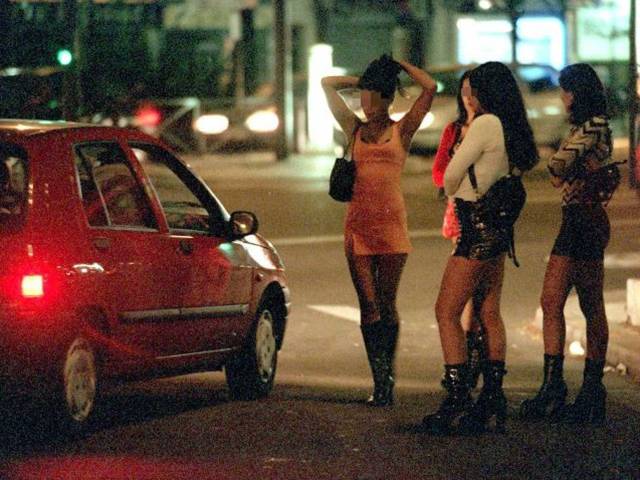
Earlier this month, France made a major move: The country has now made paying for sex illegal.

If someone is caught paying for sex, they’ll be fined up to $1.7K for a first offense, and up to $4.2K+ for a second time. The offender may also be required to attend classes on sex workers’ conditions.

France isn’t the only country to pass a measure of this kind, or even the first: The country follows in the footsteps of the U.K., Sweden, Iceland, and Norway.

Advocates of the new ban claim that this will help sex workers get out of the trade. But sex workers are opposing this new measure, reasoning that it will expose them to more violence.

It’s estimated that France has between 20K to 40K sex workers. (Naturally, it’s difficult to get an accurate count.)

North Carolina Passes LGBT Discrimination Law

North Carolina Governor Pat McCrory (Instinct Magazine)

North Carolina Gov. Pat McCrory speaks during a news conference, Monday, Jan. 7, 2013, in Raleigh, N.C. In one of his first acts as governor, McCrory issued an executive order to repeal the nonpartisan judicial nominating commission established by former Gov. Bev Perdue. (AP Photo/The News & Observer, Takaaki Iwabu)

North Carolina Mayor Pat McCrory has now ensured that his state has made the news recently for all the wrong reasons: On Mar. 24th, he signed House Bill 2 into law, which overrides any local government’s anti-discrimination bills that benefitted the LGBT community. (The bill was introduced by the North Carolina State Legislature, which I’ve now refer to as the NCSL.) And not only did McCrory sign this into law, he did it in just one day.

Why is this a huge deal? For one, the NCSL has now blocked a measure that the city of Charlotte (the state’s largest city and the South’s banking hub) recently brought forth which banned discrimination against the LGBT community. Where others would see progress, the NCSL saw…inappropriate public restroom use?

“The Atlantic” breaks down what exactly this new law (ick!) entails:

It also prevents any local governments from passing their own non-discrimination ordinances, mandates that students in the state’s schools use bathrooms corresponding to the gender on their birth certificate, and prevents cities from enacting minimum wages higher than the state’s.

Seriously, this new law is all kinds of trouble. But what really gets me is the notion of forcing transgender students to use the restrooms of the gender for which they were assigned at birth. The NCSL is perpetuating the myth that transpeople are pedophiles, and will follow children into public restrooms to ensure vulnerability. I don’t have to tell you how insane that is, do I?

McCrory’s also sending a statement that the capricious whims of the state government will rule any actions local governments make to better their own communities.

This measure will go into effect on Apr. 1st.

Real talk here: I’m from North Carolina. I haven’t lived there in years, but my parents and much of my extended family still resides there. I love going back to visit, but wouldn’t want to live back there again for various reasons. And this new law has given me yet another reason not to go back.

If North Carolina really wants to show that the state, and its residents, are progressive and accepting of all, the NCSL and Pat McCrory really need to turn this ship around, and fast. (I mean, damn, Charlotte’s newspaper “The Charlotte Observer” just published an op-ed putting McCrory in the ranks of other Southern governors that proved to be on the wrong side of history.)

I’m aware of how Southerners are portrayed and thought of outside the bounds of the South (and have even been the victim of these stereotypes sometimes), and right now, North Carolina is looking like a right bumpkin. And not a cute one. Instead of the little cousin who’s endearingly behind the times due to her own innocent ignorance, the Old North State has progressed (ha!) to being the willfully racist hick uncle everyone just grits their teeth and bears at the best of times.

I used to be proud of where I’m from. But this latest idiocy is making it real hard to be.
Five Women File Class Action Suit to Lift New York’s Tampon Tax

Tampon (Salon)

Tampon (Salon)

Did you know that a tampon tax exists? No? A lot of people don’t. Thankfully, that’s about to change.

The “tampon tax” is a sales tax applied to feminine hygiene needs (tampons and pads). Many states have one in place, and it’s been proven to really add up over time (especially since the average women menstruates for around 37 years).

Right now, women aren’t going to take it any more. Five women in New York have filed a class-action lawsuit against commissioner Jerry Boone and the New York State Department of Taxation and Finance. Their stance is that feminine hygiene products aren’t classified as medical use, and so are relegated to the 4% sales tax.

The lawsuit also models the amount of money women are spending through this tax:

According to the lawsuit, women spend on average more than $70 a year on tampons and pads, and women who menstruate constitute more than one-quarter of New York state’s 20 million population. The plaintiffs estimate that the state collects around $14 million in taxes by imposing a four percent sales tax on tampons and pads, less than one-hundredth of one percent of the state’s annual budget of $142 billion.

And the five women bringing the lawsuit aren’t the only ones who think the tax should be outlawed:

New York Governor Andrew Cuomo said on Thursday that the tax should be repealed. Earlier this year, Manhattan Assemblywoman Linda Rosenthal introduced a bill seeking to end the state’s taxation on tampons and pads.

It’ll be interesting to see how long it takes to affect change in this area.

#ThrowbackThursday: John Ashcroft Covers the Spirit of Justice Statue’s Nudity, 2002

U.S. Attorney General John Ashcroft and Spirit of Justice statue, 2002 (Medieval POC Tumblr)

U.S. Attorney General John Ashcroft and Spirit of Justice statue, 2002 (Medieval POC Tumblr)

So this became weirdly relevant again: In 2002, Attorney General John Ashcroft put up drapes (that cost $8,000) on the Spirit of Justice statue housed in the U.S. Department of Justice in Washington, D.C. Why? Ostensibly to make a better backdrop for television. What Ashcroft didn’t mention was that his head was generally centered in between Lady Justice’s nude breasts. Better backdrop, my ass.

Just yesterday, Rome’s Capitoline Museum covered up classical nude statues before a press conference with Iranian President Hassan Rouhani occurred. There seems to be some confusion as to who and why this happened: Though the Iranian embassy asked that the statues be covered, neither Italy’s Culture Minister Dario Franceschini nor Prime Minister Matteo Renzi had been aware of the request.

An investigation into the matter is currently underway.


Planned Parenthood Endorses Hillary Clinton

Hillary Clinton (The Washington Times)

Hillary Clinton (The Washington Times)

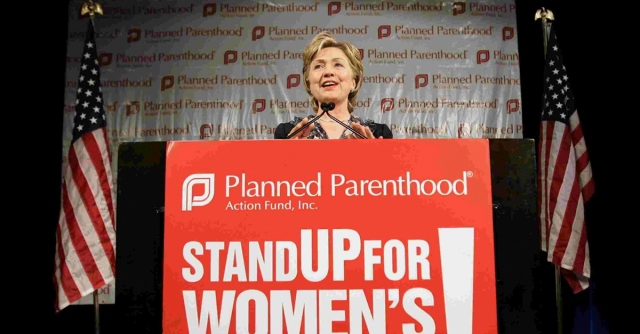
Planned Parenthood has endorsed a candidate for the primary election: Hillary Clinton, the only woman running for the Democratic nomination. This is the first time in Planned Parenthood’s 100-year history that the organization has endorsed a candidate.

For this who’ve been living under a rock, Planned Parenthood provides a number of serves for womens’ reproductive health, including birth control, Pap smears and abortions.

It’s becoming increasingly clear that women’s issues will take up a prominent share of issues discussed leading up to this year’s election. Last week, Republicans in the Senate voted to defund Planned Parenthood. Thankfully, they didn’t get very far, since President Obama vetoed it.

I hope this endorsement brings out women (and men!) to the polls who might not’ve voted otherwise come November.