#ThrowbackThursday: Chinese One-Child Policy Propaganda Poster, 1986

Chinese One-Child Policy poster (The Galloping Beaver)

Chinese One-Child Policy poster (The Galloping Beaver)

As of Jan. 1, China’s one-child policy is officially history. Married couples are now allowed to have up to two children for the first time since 1979.

I’ve always thought propaganda posters were interesting, and here’s a great one for the one-child policy. It’s from 1986, and titled, “Carry out family planning, implement the basic national policy.” The image carries that can-do attitude made popular by Rosie the Riveter, and it’s easy to get swept up in the sentiment. Not to mention, the overall poster design’s pretty great too.


How Many Children are Born on New Year’s Day?

baby after bath #11

Baby (Dermatique UK)

Happy 2016! I hope it’s off to a good start for everyone, and your resolutions are intact so far.

In the spirit of the season, I was curious to find out how common New Year’s Day births are. No more auspicious time for a baby to make its debut, right?

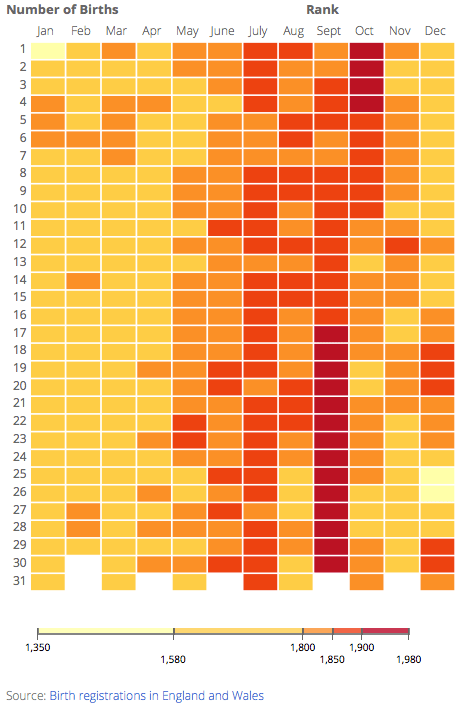
The United Kingdom’s Office for National Statistics kept records of popular birthdays from 1995 to 2014. As you can see below, New Year’s Day sees around 200 fewer births than any given day in England:

Screen Shot 2016-01-03 at 5.52.01 PM

U.K. Average Daily Births (The Telegraph UK/Office for National Statistics)

If you absorb best by color-coded blocks, here’s every day of the year plotted out:

Screen Shot 2016-01-03 at 6.00.03 PM

Birth registrations in England and Wales, 1995-2014 (The Telegraph UK/Office for National Statistics)

Click on the link to go to the whole table (it’s interactive). Jan. 1st can only claim 1,574 births, which makes it the 364th most-popular birthday.

I don’t know enough to hypothesize if birth patterns are the same in the United States, but I’d love to find out.

Trends: Companies Expanding Maternity/Paternity Leave Policies

Netflix 2014 logo (Under Consideration)

Netflix 2014 logo (Under Consideration)

A very positive trend has sprung up recently: Companies are their expanding parental leave policies. The main goal is to recruit more women with work-life balance policies, and to retain talent by allowing time off for family matters. Because trouble at home often means distracted employees and lower productivity. (I feel like that’s on a modern-day Mather Work Incentive poster somewhere.)

Big strides have been made this year: Consulting powerhouse Accenture bumped up its maternity leave policy to 16 weeks in March, which applies to both full-time and part-time employees. In April, Johnson & Johnson announced a new eight-week paid leave policy. In June, major bank Goldman Sachs began offering new fathers and “non-primary caregivers” four weeks of paid leave. (The company currently offers 16 weeks of paid maternity leave.) The U.S. Navy and Marines mandated an 18-week maternity leave policy, effective immediately, in July.

This trend has become especially prevalent in the tech industry, with a lot of changes occurring just this past month. In August, Microsoft recently announced a new parental leave policy, in which employees would get paid at 100% of their salary for 12 weeks. New mothers will have eight weeks of paid maternity leave, which, combined with disability leave, could entitle them to 20 weeks of paid leave.

Adobe’s policy also changed: Mothers will now receive 26 weeks of paid leave, up from the nine weeks off from the previous policy. It’ll be a combination of medical leave (10 weeks) and paternal leave (16 weeks).

Netflix announced they’re bumping up their maternity and paternity leave policies to an unlimited amount of time. New mothers and fathers are allowed to take as much time off as they like during a child’s first year, whether though birth or adoption. (Netflix isn’t a stranger to expanding time off: Employees already get unlimited vacation time.) But the policy isn’t all inclusive: It only applies toward salaried employees, so hourly workers aren’t able to take advantage of it.

It’ll be interesting to see if (when) other companies follow suit, and if paid parental leave will eventually be federally mandated. These are definitely steps in the right direction.



#ThrowbackThursday: Paid Maternity Leave Around the World

Paid Maternity Leave Around the World (Blogspot)

Paid Maternity Leave Around the World (Blogspot)

Yeah, this is a #TBT, but it’s relevant to today. In fact, it’s still happening today. The United States is one of the few countries left in the world that doesn’t pay for maternity leave. Crazy, right?!

This map just lays it out. I hope the U.S. comes to its senses soon, and enacts paid maternity leave for all new (and reoccurring) mothers.

By The Numbers: How Many States Require an Ultrasound Viewing Before an Abortion?

WASHINGTON, DC - MARCH 16: Wisconsin Gov. Scott Walker speaks at the 2013 Conservative Political Action Conference (CPAC) March 16, 2013 in National Harbor, Maryland. The American Conservative Union held its annual conference in the suburb of Washington, DC to rally conservatives and generate ideas.  (Photo by Pete Marovich/Getty Images)

WASHINGTON, DC – MARCH 16: Wisconsin Gov. Scott Walker speaks at the 2013 Conservative Political Action Conference (CPAC) March 16, 2013 in National Harbor, Maryland. The American Conservative Union held its annual conference in the suburb of Washington, DC to rally conservatives and generate ideas. (Photo by Pete Marovich/Getty Images)

Earlier this week, Wisconsin Republican governor/maybe-presidential hopeful Scott Walker signed a new law requiring that women who wanted to get abortions be required to get an ultrasound of the fetus before making their decision. Walker’s reasoning was that he wanted women to make informed choices (i.e. choose life!) about their unborn children. (Side note: he also referred to ultrasounds as “a cool thing out there.” I’m not touching that one.)

I wanted to find out how widespread the practice of requiring expectant mothers to view an ultrasound before proceeding with an abortion was. So I turned to trusty source The Guttmacher Institute for some stats.

Number of states that require giving contextual information (i.e. written materials and/or verbal counseling) around the ultrasound: 12

Number of states that require the abortion provider to show and describe the ultrasound: 3

Number of states that require the abortion provider to offer a viewing of the ultrasound if it’s part of the abortion process: 9

The Guttmacher has more numbers on this topic. Personally, I find it fascinating that these laws are essentially banking on the assumed fact that women are ruled by their emotions and are baby-crazy, and so seeing an ultrasound before an abortion would change their minds.

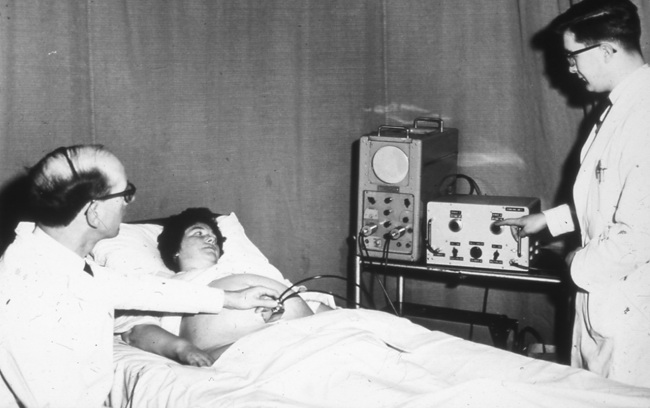
#ThrowbackThursday: Ultrasound, 1963

Ultrasound, 1963 (University of Cambridge)

Ultrasound, 1963 (University of Cambridge)

The first obstetric ultrasound was developed in 1956 in Scotland by Ian Donald and Tom Brown, using a prototype based off detecting flaws in industrial ships. It began to be used regularly within the country, and later spread to the U.K. and America in the 1970s.


Ultrasounds use ultrasonic waves to determine features of the fetus. Early on, this couldn’t be done, as the technology wasn’t nearly as advanced. It’s fascinating to see how it’s caught up.

How Has Colorado’s Teen Pregnancy Rate Dropped 40% Within 4 Years?

IUD (NY Mag)

IUD (NY Mag)

Colorado’s teen pregnancy rate has been getting some attention recently. But it’s not for the reason you think; it’s actually for the opposite reason.

From 2009 to 2013, Colorado reported a 40% decrease in teenage pregnancies, according to the Colorado Department of Public Health and Environment. Below is a graph that shows the decline:

Colorado's Birth Rate 2005-2012 (The Washington Post)

Colorado’s Birth Rate 2005-2012 (The Washington Post)

That seems insane, right? But there’s actually an interesting reason behind it.

In 2008, an anonymous donor (later revealed to be the Susan Thompson Buffett Foundation, named after Warren Buffett’s late wife) gave a $23 gift to be parceled out over five years. The gift was to be used for “long-term contraception” for low-income teens and women. Over 30K intrauterine devices (IUDs) were purchased and implemented. This measure was rolled out in 68 clinics, as part of Colorado’s Family Planning Initiative.

The IUDs were found to be a very significant factor in the state’s teen pregnancy decline. The study released by the Colorado Department of Public Health and Environment showed that “the percentage of young women receiving IUDs and implants quadrupled in participating clinics,” and, in a complementary effect, the women receiving IUDs accounted for 75% of the state’s overall teen birth rate decline.

On a national scale, Colorado rose from having the “29th lowest teen birth rate in the nation to the 19th.” This is significant as seven in 10 teen pregnancies in the state are unplanned.

The program expires this summer, and it’s unclear whether it will be renewed. But the numbers definitely speak for themselves in terms of effectiveness.


“Mother of Lamaze” Elisabeth Bing Has Died

Elisabeth Bing (The New York Times)

Elisabeth Bing (The New York Times)

Elisabeth Bing, credited for bringing Dr. Fernand Lamaze’s childbirth techniques to American women, has died at age 100 in New York.

The Lamaze method emphasized relaxation during childbirth, and posited that a mother’s pain during giving birth stemmed from fear. Having studied natural childbirth since 1942, Bing first encountered Lamaze’s technique in the 1950s. In 1960, she and a colleague founded Lamaze International, then known as the American Society for Psychoprophylaxis in Obstetrics.

It’s estimated that 25% of expectant mothers and spouses attend a Lamaze class at some point during pregnancy. For context, almost 4M babies were born in 2010. This would put the number of Lamaze-attending parents-to-be around 1M. (But this wouldn’t be completely accurate because it assumes that every mother only gave birth to one child.)

Bing’s goal was to help empower women to make their own decisions regarding how childbirth would go for them, and she certainly achieved that.