#ThrowbackThursday: Serena Williams Wins the Australian Open, 2017

Serena Williams at the 2017 Australian Open (Indian Express)

United States’ Serena Williams celebrates after winning the first set against Barbora Strycova of the Czech Republic during their fourth round match at the Australian Open tennis championships in Melbourne, Australia, Monday, Jan. 23, 2017. (AP Photo/Kin Cheung)

In January, tennis superstar Serena Williams beat her sister, fellow tennis star Venus Williams, in the final set of the Australian Open. The win was her seventh Australian Open title, and 23rd Grand Slam singles title. Williams is now back to being the #1-ranked tennis player in the world.

Williams was also in the early weeks of pregnancy during the Australian Open. So there’s that.

NPR Releases 2016 Staff Diversity Numbers

National Public Radio (NPR) Logo (NPR)

National Public Radio (NPR) Logo (NPR)

In April, National Public Radio (known colloquially as NPR) released its staff diversity data for 2016. Here were the main findings for that year:

According to NPR’s human resources department, of the 350 employees in the news division as of Oct. 31, 2016, 75.4 percent were white. Asians made up 8.3 percent of the staff, followed by blacks or African-Americans (8.0 percent), Hispanics or Latinos (5.4 percent), those who identified as two or more races or ethnic identities (2.6 percent) and American Indian (0.3 percent).

NPR has been tracking this data since 2012, and it’s interesting to see how the numbers fare on a long-term basis. Spoiler alert: they pretty much flatlined. This falls in line with long-term newsroom diversity trends. Per the American Society of News Editors (ASNE): “In 2016, minorities comprised about 17 percent of employees at daily newspapers and 23 percent at online-only sites.” Pretty bad.

Here’s where NPR falls in comparison to other media:

NPR is behind The Washington Post (31 percent diverse) and The Los Angeles Times (34 percent). At 25 percent diverse, NPR is just above The New York Times newsroom, which is about 22 percent diverse.

Newsroom diversity has become part of a larger conversation regarding workplace, and companies publicly releasing they diversity data. But some newsrooms are refusing to disclose their data. The ASNE reported that 737 newsrooms responded with data for the 2016 survey. That’s out of 1.7K+ newsrooms contacted, making a 42%+ response rate.


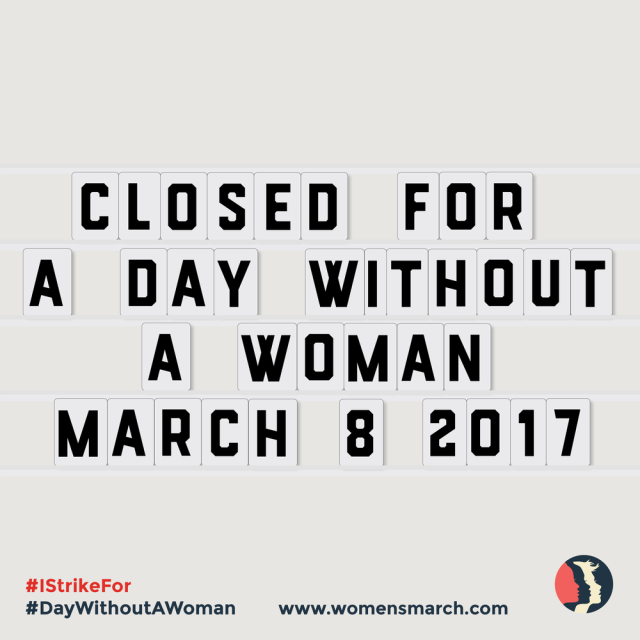
Going Dark for “A Day Without A Woman”

A Day Without A Woman (Women's March on Washington)

A Day Without A Woman (Women’s March on Washington)

Today, I’m going dark for a cause: A Day Without A Woman.

Guidelines for the day via A Day Without A Woman:

Anyone, anywhere, can join by making March 8th A Day Without a Woman, in one or all of the following ways:

  1. Women take the day off, from paid and unpaid labor
  2. Avoid shopping for one day (with exceptions for small, women- and minority-owned businesses).
  3. Wear RED in solidarity with A Day Without A Woman

This day coincides with International Women’s Day (IWD) and the International Women’s Strike (IWS). The day will also spotlight all the financial power women possess:

The idea behind a women’s general strike is that if women refuse to do all of their typical work for a day, it will force people to notice how important and under-appreciated that work is.

And that economic impact will be felt:

Women make up nearly half of the U.S. labor force and influence about 73% of all household spending.

Though I’ll be working today at my office job, I plan to show my support by wearing red, reading feminist literature (currently deciding between “We Should All Be Feminists” by Chiamanda Ngozi Adichie and “Bad Feminist” by Roxane Gay), and masturbating.

See you on March 9th!

School Districts Shutting Down For “A Day Without A Woman”

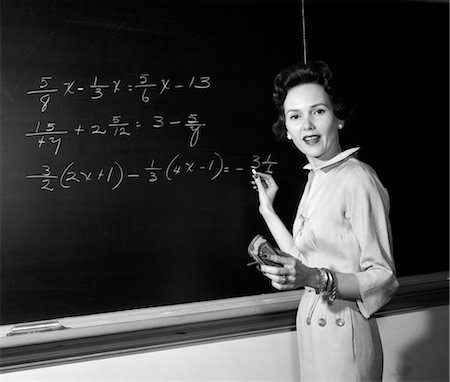
1950s female teacher (Masterfile)

1950s female teacher (Masterfile)

Tomorrow is A Day Without A Woman, a day to call attention to women’s economic power and labor (including the unpaid and emotional kind). Because women do have economic power: Studies show that “women make up nearly half of the U.S. labor force and influence about 73% of all household spending.”

One profession that is traditionally female-dominant is teaching. The National Center for Education Statistics found that for the 2011-2012 school year, female teachers comprised 76% of all public school teachers. (This gap is especially prominent in elementary schools.) These so-called “pink collar” jobs are ones where women dominate, but can be considered to be “lower” in status because of the feminine association (which is wrong, wrong, WRONG!!).

Naturally, the public school system might be hit hard tomorrow. Some school districts have already cancelled classes as a result of teachers taking the day off to strike. The Alexandria, Virginia public school system reported receiving over 300 requests for the day off. Brooklyn preschool The Maple Street School and the Chapel Hill-Carrboro public school system in North Carolina (where 75% of employees are women) will also be closed. All schools in Prince George’s County, Maryland, will also be closed, after 1.7K teachers and 30% of transportation staff requested the day off.

Trends: Muslim Firsts in Popular Culture

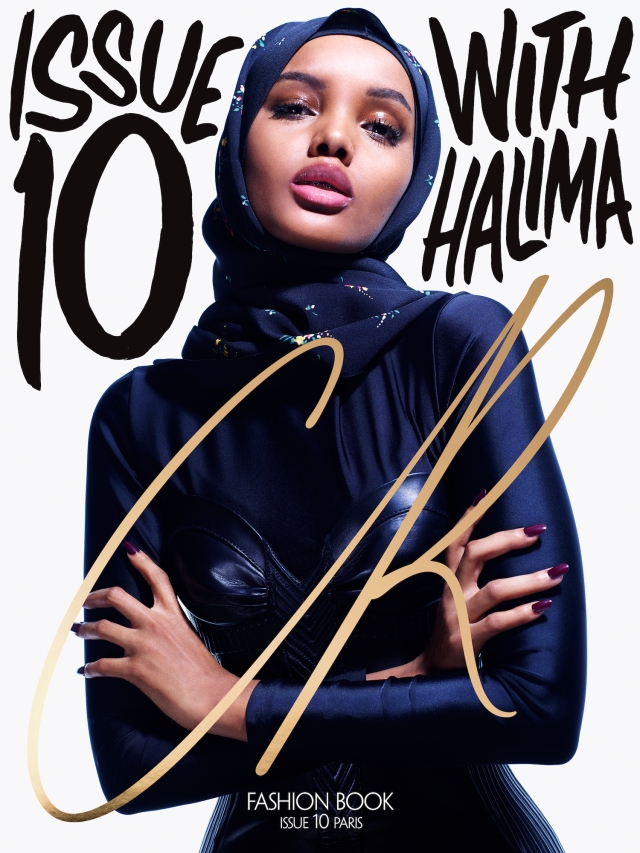
Halima Aden covering 'CR Fashion Book' (CR Fashion Book)

Halima Aden covering ‘CR Fashion Book’ (CR Fashion Book)

Recently, Muslims in the U.S. have gained prominence in a series of firsts in mainstream culture.

Last year, Halima Aden competed in the Miss Minnesota beauty pageant. Aden wears hijab, and wore a burkini during the swimsuit portion of the event. Though she didm’t win the title, people took notice of her, especially the fashion industry. IMG Models recently signed Aden, who’s now their first hijabi model. (It’s important to note that while Aden is the first hijabi model for the company, she is not their first Muslim model.) Aden recently appeared on the cover of CR Fashionbook, where the headline cemented her one-name-only status (similar to that of Iman, who interviewed Aden for the issue).

Earlier this week, actor Mahershala Ali won the Oscar for Best Supporting Actor for his work in “Moonlight.” This wasn’t a surprise: Ali had been winning awards at all of the awards running up the Oscars. But Ali is the first Muslim actor to win an Academy Award. He spoke about converting to Islam in his acceptance speech for male actor in a supporting role at this year’s SAG Awards, where he warned against letting the minutia of differences overtake the similarities.

Hopefully this exposure normalizes Muslims for people who may not have met one in person. I hope this is just the start of more prominent Muslims in pop culture to come.

#ThrowbackThursday: Halima Aden’s Burkini, 2016

Halima Aden's burkini in the Miss Minnesota USA pageant, 2016 (WFDD).jpg

Halima Aden’s burkini in the Miss Minnesota USA pageant, 2016 (WFDD).jpg

In November 2016, Halima Aden competed in the Miss Minnesota USA pageant. Naturally, the pageant had the typical swimsuit portion. While other contestants strutted out in colorful bikinis, Aden went in a different direction. The Somalian model chose to put her Muslim faith front and center. She wears hijab, and wore a burkini for the swimsuit portion of the event.

Aden is the first woman to compete in hijab and burkini. Though she didn’t take home the title, Aden’s sartorial choice and adherence to her values made headlines.

Viola Davis Makes Record with Oscar Win

Viola Davis Oscar win, 2017 (TV Insider)

Viola Davis Oscar win, 2017 (TV Insider)

Viola Davis (a.k.a QUEEN VIOLA) won the Best Supporting Actress Oscar for her role in “Fences.” (She also gave an excellent acceptance speech.) This wasn’t remotely a surprise, as she was CLEANING UP during awards season. This win has now ushered Davis into an upper echelon of artists that many people don’t achieve.

When she was nominated for the award, Davis started making history right out of the gate.   She became the first Black actor or actress to receive three Oscar nominations. (Her two previous nominations were for “Doubt” in 2008, and “The Help” in 2011.) This year’s Best Supporting Actress nominations was the first time three Black women were nominated, and the second time three non-white women were nominated.

With her win, Davis has hit other records. She’s now the 23rd person to win what’s called the triple crown of acting: a Tony, an Emmy, and a “competitive” (a.k.a. non-honorary) Oscar. Davis is also the first Black actor to achieve this feat, winning Tony for “King Hedley II” in 2001, and “Fences” in 2010, and an Emmy for “How to Get Away with Murder” in 2015.

This club is a rare one indeed. Davis is the first actress of her generation to achieve this honor. She even beat perennial-nominee-for-everything Meryl Streep to the punch.

Davis also has three out of the four awards required for an EGOT “grand slam:” Emmy, Grammy, Oscar and Tony (though one could argue that Davis herself brings the G). The Grammys don’t honor acting, so the EGOT is more about versatility in the entertainment industry.

Black Actor Oscar Nominations: By The Numbers

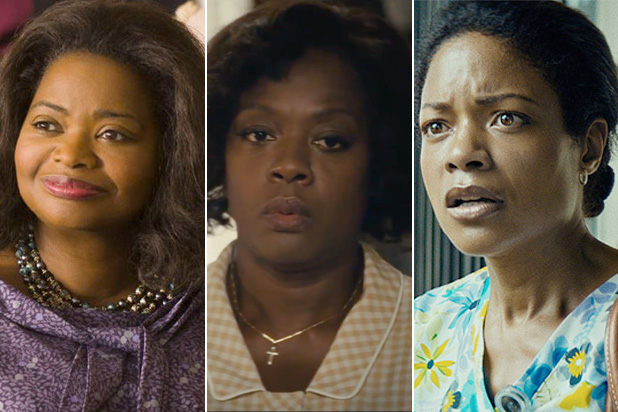
7 Best Supporting Actress Nominees Octavia Spencer, Viola Davis and Naomie Harris (The Wrap)

7 Best Supporting Actress Nominees Octavia Spencer, Viola Davis and Naomie Harris (The Wrap)

Remember how the last couple of Oscar ceremonies were plagued by a lack of diverse nominees, especially in the major categories? The Academy has appeared to learn from that. The change has become especially clear in the acting categories. This year, each acting category has at least one Black nominee.

Here are the stats:

Best Actor: Denzel Washington (“Fences”)

  • Washington is now the most nominated Black actor in Oscar history. He’s had six previous nominations, two for Best Supporting Actor and four for Best Actor. He won Best Supporting Actor in “Glory” in Best Actor for “Training Day” in 2001.

Best Actress: Ruth Negga (“Loving”)

Best Supporting Actor: Mahershala Ali (“Moonlight”)

Best Supporting Actress: Viola Davis (“Fences”), Naomie Harris (“Moonlight”), Octavia Spender (“Hidden Figures”)

  • This year is the first time an acting category has had three Black nominees. The last time an acting category had two Black nominees was in 1985, when Margaret Avery and Oprah Winfrey were both nominated for “The Color Purple.”
  • This is the second time the Best Supporting Actress category has had three non-white nominees. The first time was in 2007, with Jennifer Hudson for “Dreamgirls,” and Adriana Barraza and Rinko Kikuchi for “Babel” nominated.
  • Davis made history this year by becoming the first Black actress to score three Oscar nominations. Previously, Whoopi Goldberg was the only Black actress to have two Oscar nominations. She won the Oscar for her second nomination for her performance in “Ghost” in 1991.

#ThrowbackThursday: Whoopi Goldberg Wins the Best Supporting Actress Oscar for “Ghost,” 1990

Whoopi Goldberg at the Oscars, 1991 (Leosigh)

Whoopi Goldberg at the Oscars, 1991 (Leosigh)

Actress/comedian Whoopi Goldberg won an Oscar for “Ghost,” the seminal Patrick Swayze movie where his character dies and comes back as, you guessed it, a ghost. (Shocker, right?) Goldberg played Oda Mae Brown, a psychic who helps Swayze’s character.

Goldberg won the Best Supporting Actress Oscar for the movie a the 63rd Annual Academy Awards in 1991. This was her second Oscar nomination: Goldberg had previously been nominated for Best Actress in 1986’s “The Color Purple.”

Until the 2017 Oscar nominations were announced, Goldberg was the only Black actress to be nominated for an Oscar twice. Now there’s a new record: Powerhouse actress Viola Davis received a nomination for her work in “Fences,” and she is now the only Black actress to be nominated three times for an Oscar.  Davis had previously been nominated in 2009 for “Doubt” and in 2012 for “The Help.”

Women Who’ve Headlined Coachella: By The Numbers

Bjork Headlining Coachella, 2002 (Snakkle)

Bjork Headlining Coachella, 2002 (Snakkle)

The Coachella Valley Music and Arts Festival (also known as…Coachella) runs over two weekends in April. Headliners were announced earlier this month, and music superstar/feminist/legend for our times Beyonce will headline each Saturday’s performance at the main Coachella stage.

Why is this significant?

Coachella festivals (#): 18

  • Founded in 1999

Total female headliners (#): 3

Bjork headlined in 2002 and 2007.

Unique female headliners (#): 2

  • Bjork and soon-to-be Beyonce

Female headliners (%): 16.67%

Main stage acts (approximate #): 135

*Source: Coachella Festival line-ups page on Wikipedia