Planned Parenthood Endorses Hillary Clinton

Hillary Clinton (The Washington Times)

Hillary Clinton (The Washington Times)

Planned Parenthood has endorsed a candidate for the primary election: Hillary Clinton, the only woman running for the Democratic nomination. This is the first time in Planned Parenthood’s 100-year history that the organization has endorsed a candidate.

For this who’ve been living under a rock, Planned Parenthood provides a number of serves for womens’ reproductive health, including birth control, Pap smears and abortions.

It’s becoming increasingly clear that women’s issues will take up a prominent share of issues discussed leading up to this year’s election. Last week, Republicans in the Senate voted to defund Planned Parenthood. Thankfully, they didn’t get very far, since President Obama vetoed it.

I hope this endorsement brings out women (and men!) to the polls who might not’ve voted otherwise come November.


China’s (Now Ended) One-Child Policy: By The Numbers

Chinese One-Child Policy poster (The Galloping Beaver)

Chinese One-Child Policy poster (The Galloping Beaver)

Most people have heard of China’s infamous one-child policy. it’s exactly what it sounds like: each married couple is only allowed to have one child.

Now the policy has ended. Actually, it ended on Jan. 1st, less than a week ago.

A lot of people don’t know the story behind the concept, and why it was initially implemented. Here are some numbers that made the one-child policy look like a sensible idea at the time:

China’s total population:

1960: 667.1M

1970: 818.3M

China’s population grew 151.2M in 10 years, or at the rate of 15.12M per year. The government was worried that the population would continue growing exponentially at the same rate, with the country eventually becoming unsustainable.

Fertility rate:

1960: 5.76 births/1 woman

1970: 5.47 births/1 woman

The fertility rate stayed stable (and strong) throughout the 1960s.

Crude birth rate:

1960: 20.9

1970: 33.4

This metric shows the “number of of live births occurring during the year, per 1,000 population estimated at midyear.” The number hit a high in 1963 with 43.4, no doubt sending the Chinese government into a full-fledged panic.

With the above stats as historical context, it’s a bit easier to see why the Chinese government implemented the One-Child Policy, and kept it for the 35 years they did.

#ThrowbackThursday: Chinese One-Child Policy Propaganda Poster, 1986

Chinese One-Child Policy poster (The Galloping Beaver)

Chinese One-Child Policy poster (The Galloping Beaver)

As of Jan. 1, China’s one-child policy is officially history. Married couples are now allowed to have up to two children for the first time since 1979.

I’ve always thought propaganda posters were interesting, and here’s a great one for the one-child policy. It’s from 1986, and titled, “Carry out family planning, implement the basic national policy.” The image carries that can-do attitude made popular by Rosie the Riveter, and it’s easy to get swept up in the sentiment. Not to mention, the overall poster design’s pretty great too.


How Many Children are Born on New Year’s Day?

baby after bath #11

Baby (Dermatique UK)

Happy 2016! I hope it’s off to a good start for everyone, and your resolutions are intact so far.

In the spirit of the season, I was curious to find out how common New Year’s Day births are. No more auspicious time for a baby to make its debut, right?

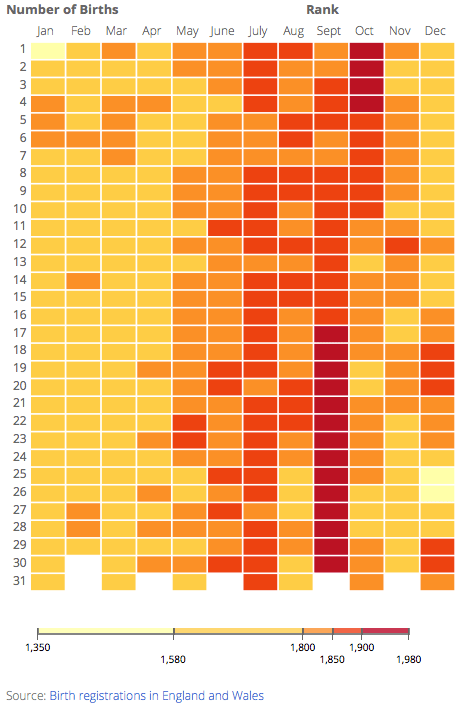
The United Kingdom’s Office for National Statistics kept records of popular birthdays from 1995 to 2014. As you can see below, New Year’s Day sees around 200 fewer births than any given day in England:

Screen Shot 2016-01-03 at 5.52.01 PM

U.K. Average Daily Births (The Telegraph UK/Office for National Statistics)

If you absorb best by color-coded blocks, here’s every day of the year plotted out:

Screen Shot 2016-01-03 at 6.00.03 PM

Birth registrations in England and Wales, 1995-2014 (The Telegraph UK/Office for National Statistics)

Click on the link to go to the whole table (it’s interactive). Jan. 1st can only claim 1,574 births, which makes it the 364th most-popular birthday.

I don’t know enough to hypothesize if birth patterns are the same in the United States, but I’d love to find out.

China Ends Its Famous One-Child Policy

Chinese One-Child Policy poster (The Galloping Beaver)

Chinese One-Child Policy poster (The Galloping Beaver)

Whoa. Here’s something I didn’t expect to happen within my lifetime: Last week, China officially ended its one-child-per-family policy. Now, married couples are allowed to have up to two children. Crazy! (Though I kind of doubt that many couples will get crazy, and have more than two.)

The one-child policy was informally adopted (i.e. “strongly encouraged”) in 1975, made into law by the country’s Communist Party four years later. The law followed China’s population exceeding 800M+ people in 1970, with leaders realizing that the then-current growth rate was unsustainable.

However, the law has been relaxed for exceptions. In 1984, parents were allowed to have two children if one parent was an only. In 2013, this became alright if only one parent was an only child.

It’s estimated that the policy has prevented 400M+ births.

But why was the policy abolished, and why now? There are a few reasons. One is that the male-to-female sex ratio is becoming unbearably skewed, which tends to happen when preference for one sex greatly outweighs the other. (In this case, the Chinese preferred boys to girls, even going so far as to commit infanticide if a child was born a girl.) The birth rate is also declining, and the mortality rate is on track to outpace it. Per “The New York Times:”

China’s working-age population, those 15 to 64, grew by at least 100 million people from 1990 until a couple of years ago. But that expansion is petering out, and more people are living longer, leaving a greater burden on a shrinking work force. Now, about 10 percent of the population is 65 or older, and according to earlier estimates, that proportion is likely to reach 15 percent by 2027 and 20 percent by 2035.

China’s population is now 1.3B+, with 30% being over 50. It’s estimated that the decision will affect 100M+ couples.
 

Yahoo CEO Marissa Mayer is Pregnant with Twin Girls

Yahoo CEO Marissa Mayer (The New Yorker)

Yahoo CEO Marissa Mayer (The New Yorker)

Last week, Marissa Mayer, best-known as Yahoo’s CEO (one of the most-well known female CEOs in tech, if not the world), announced that she’s pregnant with twin girls. She made the announcement in a way befitting her industry: on Yahoo’s Tumblr.

The twins will be the second and third children for Mayer and her husband, Zachary Bogue. Mayer gave birth to her first child, her son Macallister, in September 2012. (That year was a momentous one for her: She became CEO of Yahoo earlier in July.) Mayer announced her pregnancy the same day that Yahoo announced her as their new CEO.

Mayer has said she’ll work through her pregnancy before her due date in December. She also worked through most of her first pregnancy.

After her son’s birth, Mayer famously didn’t take a break for maternity leave, returning to work only two week after giving birth. She also installed a nursery right next door to her office.

It’ll be interesting to see if having to care for two babies at once slows her down at all, and if she changes her views on feminism and working from home.


Trends: Companies Expanding Maternity/Paternity Leave Policies

Netflix 2014 logo (Under Consideration)

Netflix 2014 logo (Under Consideration)

A very positive trend has sprung up recently: Companies are their expanding parental leave policies. The main goal is to recruit more women with work-life balance policies, and to retain talent by allowing time off for family matters. Because trouble at home often means distracted employees and lower productivity. (I feel like that’s on a modern-day Mather Work Incentive poster somewhere.)

Big strides have been made this year: Consulting powerhouse Accenture bumped up its maternity leave policy to 16 weeks in March, which applies to both full-time and part-time employees. In April, Johnson & Johnson announced a new eight-week paid leave policy. In June, major bank Goldman Sachs began offering new fathers and “non-primary caregivers” four weeks of paid leave. (The company currently offers 16 weeks of paid maternity leave.) The U.S. Navy and Marines mandated an 18-week maternity leave policy, effective immediately, in July.

This trend has become especially prevalent in the tech industry, with a lot of changes occurring just this past month. In August, Microsoft recently announced a new parental leave policy, in which employees would get paid at 100% of their salary for 12 weeks. New mothers will have eight weeks of paid maternity leave, which, combined with disability leave, could entitle them to 20 weeks of paid leave.

Adobe’s policy also changed: Mothers will now receive 26 weeks of paid leave, up from the nine weeks off from the previous policy. It’ll be a combination of medical leave (10 weeks) and paternal leave (16 weeks).

Netflix announced they’re bumping up their maternity and paternity leave policies to an unlimited amount of time. New mothers and fathers are allowed to take as much time off as they like during a child’s first year, whether though birth or adoption. (Netflix isn’t a stranger to expanding time off: Employees already get unlimited vacation time.) But the policy isn’t all inclusive: It only applies toward salaried employees, so hourly workers aren’t able to take advantage of it.

It’ll be interesting to see if (when) other companies follow suit, and if paid parental leave will eventually be federally mandated. These are definitely steps in the right direction.


#ThrowbackThursday: Paid Maternity Leave Around the World

Paid Maternity Leave Around the World (Blogspot)

Paid Maternity Leave Around the World (Blogspot)

Yeah, this is a #TBT, but it’s relevant to today. In fact, it’s still happening today. The United States is one of the few countries left in the world that doesn’t pay for maternity leave. Crazy, right?!

This map just lays it out. I hope the U.S. comes to its senses soon, and enacts paid maternity leave for all new (and reoccurring) mothers.

How Do Most Women Feel About Their Abortions?

Pregnant woman (SLO County)

Pregnant woman (SLO County)

The popular media image of a woman who has had an abortion is that she regrets it. She sighs with longing whenever she sees a child around the age of her unborn one, thinking that it could have been them.

While the emotional aspect might pop up now and again, many women who’ve had abortions feel that they’ve made the right choice for themselves. A recent study followed women who’ve undergone the procedure and followed up with them for years to determine their emotional wellbeing.

From 2008 to 2010, researchers looked at 667 women across 30 U.S. clinics, and divided them into two groups: women who terminated a pregnancy within the first trimester, and women who terminated within two weeks of the mandated limit. The researchers then called the women every six months afterwards for three years to identify negative and positive emotions associated with the act.

Overall, women felt that they had made the right decision 99% of the time, and experienced “decreased emotional intensity” over time. Those who felt negative emotions were likely to have had a planned pregnancy, and/or difficulty in making the decision to undergo an abortion. There was virtually no difference between how the two groups of women processed the experience.

This is very important information, as it overturns a popularly-held misconception. Hopefully, these results will act as a catalyst so that the Supreme Court will stop basing abortion rulings on “abortion regret.”

Kim Kardashian West’s Implanted Male Embryos: How Common Is It?

Kanye West and Kim Kardashian West (US Weekly)

Kanye West and Kim Kardashian West (US Weekly)

As the whole world knows by now, Kim Kardashian is pregnant with her second child, a boy, through in-vitro fertilization (IVF). Apparently, her husband Mr. Kim Kardashian (a.k.a. Kanye West) wanted a boy, or, as he calls it, “an heir.”

To achieve the desired result, Kardashian chose to only implant male embryos (and evidently, it worked). She most likely underwent preimplantation genetic diagnosis (PGD), a procedure which screens embryos for sex characteristics, looking for XX (a girl) or XY (a boy).

In 2012, it was estimated that PGD was used for 4K-6K procedures per year. In 2014, fertility treatment procedures, including but not limited to IVF, were estimated at around 165K+ per year. PGD is used with IVF, so PGD cases comprise between 2%-3% of total fertility treatments.

Interestingly, the U.S. is one of the only countries in the world within which PGD may used for “prenatal sex selection.” In many countries, its use is restricted to medical and chromosome-related issues.

Nobody can yet say if this will become a widespread practice. It does raise some questions about the ethics of calling the shots on choosing your child’s sex. But this isn’t a new concern: New York University’s Director of the Bioethics Program S. Matthew Liao wrote a paper on the subject in 2004 for the “Journal of Medical Ethics” while at Johns Hopkins University. About halfway through the paper, he acknowledges, “As far as I know, no one has tried to use genetic engineering for sex selection.” Things have certainly changed in 11 years. Welcome to your brave new world.