El Salvadorian Government Advises Women Not Get Pregnant Due to Zika Virus

Baby with microcephaly (Health Then More)

Baby with microcephaly (Health Then More)

Despite arriving on the viral diseases scene just recently, the Zika virus has already made a large impact. The first cases in the Americas were reported in Brazil last spring, where the virus was linked to birth defects that affected brain development. The most commonly cited birth defect was microcephaly, which results in an abnormally small brain. Earlier this year, the Centers for Disease Control and Prevention (CDC) here in the U.S. have advised that pregnant women should not travel to the 14 countries affected by the virus.

Now, the government of El Salvador (one of the affected countries) is going one step further and advising women of childbearing age to refrain from getting pregnant until 2018. The announcement came after 5K+ cases of the virus were detected in women in 2015 and early this year. Of this number, it’s suspected that 96 women had contracted the virus, but so far, none have resulted in microcephaly. I couldn’t find information on how high-risk El Salvador is for the Zika virus, but this measure would lead me to believe that it looks pretty dire.

The government of Colombia has released a similar warning, but is advising women to wait six to eight months. Colombia has the second-highest rate of Zika infections after Brazil.

In terms of each country’s birth rates (counted as births per 1K people), El Salvador has 16.79. It just edges past Colombia with a birth rate of 16.73. By contrast, Brazil has a birth rate of 14.72. It’ll be interesting to see how El Salvador and Colombia’s birth rates are affected this year by their respective government’s measures.

The Zika virus is transmitted via mosquito, and is characterized by joint pain, fever, rash and red eyes.


China’s (Now Ended) One-Child Policy: By The Numbers

Chinese One-Child Policy poster (The Galloping Beaver)

Chinese One-Child Policy poster (The Galloping Beaver)

Most people have heard of China’s infamous one-child policy. it’s exactly what it sounds like: each married couple is only allowed to have one child.

Now the policy has ended. Actually, it ended on Jan. 1st, less than a week ago.

A lot of people don’t know the story behind the concept, and why it was initially implemented. Here are some numbers that made the one-child policy look like a sensible idea at the time:

China’s total population:

1960: 667.1M

1970: 818.3M

China’s population grew 151.2M in 10 years, or at the rate of 15.12M per year. The government was worried that the population would continue growing exponentially at the same rate, with the country eventually becoming unsustainable.

Fertility rate:

1960: 5.76 births/1 woman

1970: 5.47 births/1 woman

The fertility rate stayed stable (and strong) throughout the 1960s.

Crude birth rate:

1960: 20.9

1970: 33.4

This metric shows the “number of of live births occurring during the year, per 1,000 population estimated at midyear.” The number hit a high in 1963 with 43.4, no doubt sending the Chinese government into a full-fledged panic.

With the above stats as historical context, it’s a bit easier to see why the Chinese government implemented the One-Child Policy, and kept it for the 35 years they did.

#ThrowbackThursday: Chinese One-Child Policy Propaganda Poster, 1986

Chinese One-Child Policy poster (The Galloping Beaver)

Chinese One-Child Policy poster (The Galloping Beaver)

As of Jan. 1, China’s one-child policy is officially history. Married couples are now allowed to have up to two children for the first time since 1979.

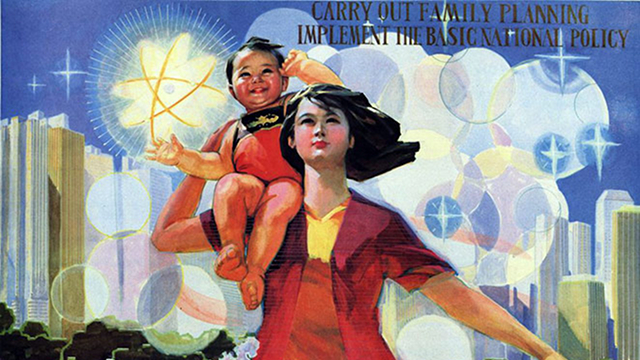
I’ve always thought propaganda posters were interesting, and here’s a great one for the one-child policy. It’s from 1986, and titled, “Carry out family planning, implement the basic national policy.” The image carries that can-do attitude made popular by Rosie the Riveter, and it’s easy to get swept up in the sentiment. Not to mention, the overall poster design’s pretty great too.


How Many Children are Born on New Year’s Day?

baby after bath #11

Baby (Dermatique UK)

Happy 2016! I hope it’s off to a good start for everyone, and your resolutions are intact so far.

In the spirit of the season, I was curious to find out how common New Year’s Day births are. No more auspicious time for a baby to make its debut, right?

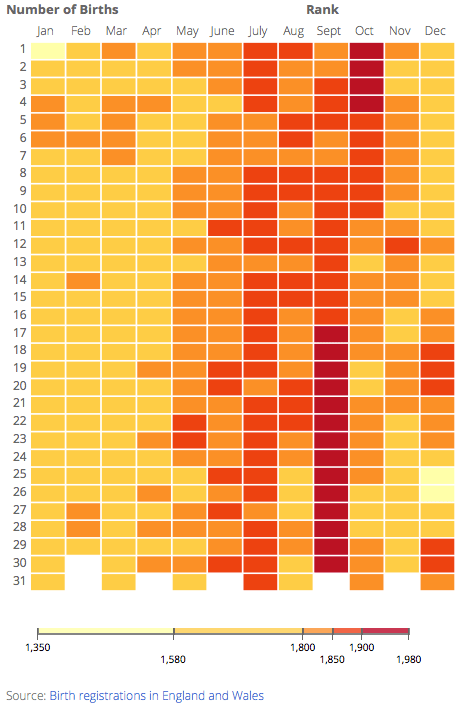
The United Kingdom’s Office for National Statistics kept records of popular birthdays from 1995 to 2014. As you can see below, New Year’s Day sees around 200 fewer births than any given day in England:

Screen Shot 2016-01-03 at 5.52.01 PM

U.K. Average Daily Births (The Telegraph UK/Office for National Statistics)

If you absorb best by color-coded blocks, here’s every day of the year plotted out:

Screen Shot 2016-01-03 at 6.00.03 PM

Birth registrations in England and Wales, 1995-2014 (The Telegraph UK/Office for National Statistics)

Click on the link to go to the whole table (it’s interactive). Jan. 1st can only claim 1,574 births, which makes it the 364th most-popular birthday.

I don’t know enough to hypothesize if birth patterns are the same in the United States, but I’d love to find out.

China Ends Its Famous One-Child Policy

Chinese One-Child Policy poster (The Galloping Beaver)

Chinese One-Child Policy poster (The Galloping Beaver)

Whoa. Here’s something I didn’t expect to happen within my lifetime: Last week, China officially ended its one-child-per-family policy. Now, married couples are allowed to have up to two children. Crazy! (Though I kind of doubt that many couples will get crazy, and have more than two.)

The one-child policy was informally adopted (i.e. “strongly encouraged”) in 1975, made into law by the country’s Communist Party four years later. The law followed China’s population exceeding 800M+ people in 1970, with leaders realizing that the then-current growth rate was unsustainable.

However, the law has been relaxed for exceptions. In 1984, parents were allowed to have two children if one parent was an only. In 2013, this became alright if only one parent was an only child.

It’s estimated that the policy has prevented 400M+ births.

But why was the policy abolished, and why now? There are a few reasons. One is that the male-to-female sex ratio is becoming unbearably skewed, which tends to happen when preference for one sex greatly outweighs the other. (In this case, the Chinese preferred boys to girls, even going so far as to commit infanticide if a child was born a girl.) The birth rate is also declining, and the mortality rate is on track to outpace it. Per “The New York Times:”

China’s working-age population, those 15 to 64, grew by at least 100 million people from 1990 until a couple of years ago. But that expansion is petering out, and more people are living longer, leaving a greater burden on a shrinking work force. Now, about 10 percent of the population is 65 or older, and according to earlier estimates, that proportion is likely to reach 15 percent by 2027 and 20 percent by 2035.

China’s population is now 1.3B+, with 30% being over 50. It’s estimated that the decision will affect 100M+ couples.


The Boy Scouts Will Allow Gay Scout Leaders

'Boy Scout Handbook,' 1962 (Envisioning the American Dream)

‘Boy Scout Handbook,’ 1962 (Envisioning the American Dream)

The Boy Scouts of America will soon undergo a momentous change: The organization will begin to allow gay adults to serve as troop leaders. This follows a sea change of public opinion, and several years of declining Boys Scouts membership. Nothing on paper has been been implemented yet, but the change is expected to be officially announced soon.

However, there is a catch: Troops backed by religious institutions will be able to deny troop leaders on the basis of their sexual orientation. The Boys Scouts are conscious that many members come from within religious folds, and feel those world views must be honored, respected and given a place at the table.

Here’s some context on how long it’s taken the organization to begin embracing gay participants: The Boy Scouts of America were founded in 1910. Gay troop members have been allowed within the organization only since 2013 (a mere two years ago!).

It’ll be interesting to me to see whether we’ll see an upsurge in gay leaders (either statistically or self-reported), and how long it will take to become noticeable. I’m also curious about how this will effect the Boy Scouts’ overall membership, since the organization will be seen as a (somewhat) more inclusive space. (And I wouldn’t be surprised if they began rebranding as such.)

Why Are Girls Entering Puberty Earlier?

Teen girl (Barnorama)

Teen girl (Barnorama)

It might seem like teenage girls are looking younger and younger each year, but there’s some truth to that. Researchers are finding that the age of onset puberty has been declining over the years, and girls are beginning to physically resemble grown women at younger ages.

A 2010 study put out by “Pediatrics,” the American Academy of Pediatrics’ (AAP) journal, followed a cohort of 1.2K+ girls between the ages of six and eight years of age from New York, Cincinnati and San Francisco. The study measured breast “budding,” normally the first physical step in female puberty. The results found that girls were beginning this stage around ages seven or eight, which is earlier than girls who were born only 10 years ago. (Incidentally, there was no change in age of first menstruation.)

This is even earlier than what was found in a previous AAP study completed in 1997. That year, results showed that girls began puberty between eight and nine years of age.

So what’s been causing the change? There appears to be a link between sugary drinks and early onset puberty for girls. The study defined early puberty as age of first menstruation, but not by breast budding.

It appears more research is needed, but this is an issue that needs to be addressed sooner rather than later.

How Has Colorado’s Teen Pregnancy Rate Dropped 40% Within 4 Years?

IUD (NY Mag)

IUD (NY Mag)

Colorado’s teen pregnancy rate has been getting some attention recently. But it’s not for the reason you think; it’s actually for the opposite reason.

From 2009 to 2013, Colorado reported a 40% decrease in teenage pregnancies, according to the Colorado Department of Public Health and Environment. Below is a graph that shows the decline:

Colorado's Birth Rate 2005-2012 (The Washington Post)

Colorado’s Birth Rate 2005-2012 (The Washington Post)

That seems insane, right? But there’s actually an interesting reason behind it.

In 2008, an anonymous donor (later revealed to be the Susan Thompson Buffett Foundation, named after Warren Buffett’s late wife) gave a $23 gift to be parceled out over five years. The gift was to be used for “long-term contraception” for low-income teens and women. Over 30K intrauterine devices (IUDs) were purchased and implemented. This measure was rolled out in 68 clinics, as part of Colorado’s Family Planning Initiative.

The IUDs were found to be a very significant factor in the state’s teen pregnancy decline. The study released by the Colorado Department of Public Health and Environment showed that “the percentage of young women receiving IUDs and implants quadrupled in participating clinics,” and, in a complementary effect, the women receiving IUDs accounted for 75% of the state’s overall teen birth rate decline.

On a national scale, Colorado rose from having the “29th lowest teen birth rate in the nation to the 19th.” This is significant as seven in 10 teen pregnancies in the state are unplanned.

The program expires this summer, and it’s unclear whether it will be renewed. But the numbers definitely speak for themselves in terms of effectiveness.


Thursday Trends: Young Women and #GrannyHair

Rihanna (Her Interest)

Rihanna (Her Interest)

Kylie Jenner did it. So did Rihanna and Kelly Osbourne. Of course, Lady Gaga, trendsetter that she is, rocked it back in 2010.

Grey hair.

Once upon a time, it was unseemly for women to go out sporting anything other than a full mane of brown, black, red or blonde hair. Grey was seen as unnatural and, at the same time, a little too natural. It was shoved to the side, to the back of the mind, ignoring the tell-tale side of aging.

Right now, women are embracing the color whole-heartedly, and running towards the grey instead of away from it. A recent BuzzFeed post shows how young women are riding the trend, especially seen on Instgram with the hashtag #GrannyHair.

But why now? Why is this grey hair’s big moment?

We seem to be in the midst of a “revering our elders” moment. (Real talk, though: that needs to happen every day. Call your grandparents, people!) The fashion world has been pioneering this lately. French fashion house Céline tapped 80-year-old essayist Joan Didion to be their latest model, and Saint Laurent is using 71-year-old Joni Mitchell. The major beauty players are doing the same, with 64-year-old Jessica Lange for Marc Jacobs and 69-year-old Helen Mirren for L’Oreal Paris. In this year’s Milan Fashion Week, trends skewed towards something your grandmother might don for a social event.

This makes total sense in terms of how current demographics are shifting. The baby boomer generation, born between 1946 and 1964, are turning officially “old” at a rapid clip. As of 2011, they numbered 77M+ and are “the largest generation in American history.” Baby boomers began turning 65 in 2011, and won’t stop until the end of 2029.

Here’s how CNN puts this demographic’s strength in numbers in terms of future projected growth:

The 65+ population segment is projected to double to 71.5 million by 2030 and grow to 86.7 million by 2050.

With this projected growth will come a lot of societal changes (I’ve always said that this isn’t a generation that’ll age quietly). We’re beginning to see initial impacts with how we view that generation and the ones before. For example, It used to be that you couldn’t be seen as a sexual being after a certain age, that you were out of the running in the race to make babies. And while that second part might be true, the first has been proven false by many women over “a certain age.” Case in point: see every instance where a late-night talk show host jokes about Helen Mirren. They’re always saying she’s hot (and she is!). Society has long seen older men with grey hair as sexy, and is now (finally!) coming around to the idea that older women are hot too.

Young women coloring their hair grey even has a historical precedent. In her book “Seductress: Women Who Ravished the World and Their Lost Art of Love” author Betsy Prioleau mentions that young women in the French court used to powder their hair grey to emulate their elders. (If you’ve seen Sofia Coppola’s “Marie Antoinette,” the director subtly includes this detail, noticeable in some shots.)

Overall, this trend really points to a shift in how we’re seeing aging. People seem to be more open to the fact that life doesn’t stop after a certain age. And young women are celebrating their elders with their grey hair, natural or not.

Pregnant Girls Banned from Sierra Leone Schools

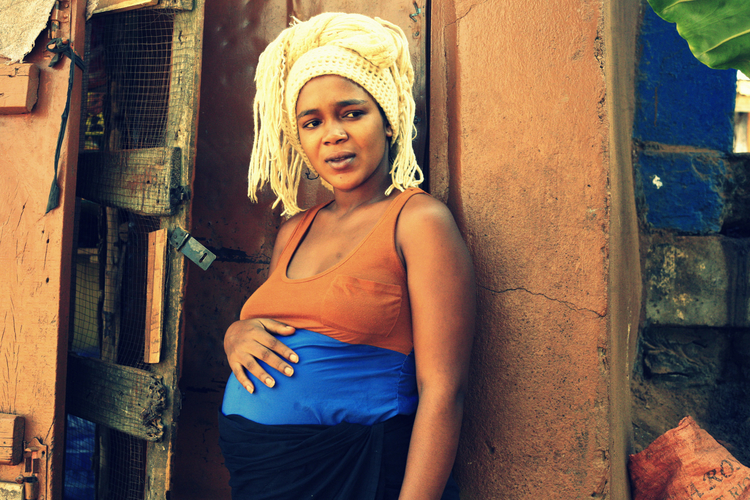
Pregnant Sierra Leone woman (The Fatou Blog)

Pregnant Sierra Leone woman (The Fatou Blog)

Schools in Sierra Leone closed during the Ebola epidemic are scheduled to re-open today, welcoming children eager to learn again. But the country’s Minister of Education Minkailu Bah has banned one group from returning: pregnant teen girls, claiming they’re a distraction to their peers and would hinder learning.

Incidentally, this ban isn’t new, having been in place since 2010. But it’s making headlines now.

Whether or not this qualifies as a “distraction” is another debate entirely, but teenage pregnancies within the country are becoming more common. A recent long-term study by the UNESCO HIV and Health Education Clearing House found that 33%+ of all Sierran Leonian pregnancies involve teen girls, and nearly 40%+ are involved in a “maternal death.” For context relative to the size of the country’s population, 41% of Sierra Leone citizens are under age 18. Those are some scary stats.

Sierra Leone isn’t the only country battling this issue. As a whole, Africa has the highest rates of teenage pregnancies, taking 18 of the top 20 spots in a 2013 United Nations Population Fund (UNFPA) rankings report.

The recent teenage pregnancy epidemic has been attributed to Ebola, in that girls who might otherwise be attending school are now more vulnerable to sexual violence. They may also have to survive and provide, and do so via prostitution. So there might be a bit of a substitution effect at play here.

But human rights governing bodies have taken note of Bah’s stance. The United Nations issued a statement in which stated that “education is a fundamental human right that Sierra Leone has committed itself to uphold.” The UN also reminded the country of its own Education Act, passed in 2004, which barred discrimination of those seeking education.

We’ll see how Bah’s proposed idea pans out. But the words of UNFPA’s Executive Director Babatunde Osotimehin ring true here:

Adolescent pregnancy is intertwined with issues of human rights. A pregnant girl who is pressured or forced to leave school, for example, is denied her right to education.