The UK Bans Certain Sex Acts in Porn

Handcuffs, a.k.a. "physical restraint" (Fleshlight)

Handcuffs, a.k.a. “physical restraint” (Fleshlight)

Earlier this month, the United Kingdom enacted a ban on certain sex acts in porn. The ban amends the 2003 Communications Act, which previously sketched in “unacceptable” acts as ones associated with violence and abuse.

Now, the British Board of Film Censors (BBFC) has narrowed down their lists of “good” and “bad” sexual acts to very specific, fetish-focused ones. Per “The Independent:”

The Audiovisual Media Services Regulations 2014 requires that video-on-demand (VoD) online porn now adhere to the same guidelines laid out for DVD sex shop-type porn by the British Board of Film Censors (BBFC).

The acts listed under “content that is not acceptable” includes a variety of BDSM-related activities, age-play, and female ejaculation. Almost all of the sex acts listed are included under the BBFC’s “Restricted 18” rating, which means that the films can only be shown at licensed adult cinemas and sex shops.

Now this only applies to porn made within the UK, and porn made outside its bounds is totally fair game to have any of these “unacceptable” acts. I have to wonder if this will lead to a rise in Brits importing their porn to see these now-illicit acts. Now foreign porn production houses can get themselves piece of that hardcore caning action:

Pornhub's UK Banned Porn Content Table (The Independent)

Pornhub’s UK Banned Porn Content Table (The Independent)

(Side note: I’d love to know how these nine acts were agreed upon. And how female ejaculation made its way in. It doesn’t seem to fit with the overall theme of violence and pain the rest of the entries have. Seriously, what’s up with that?!)

The UK has had a long, uncomfortable history attempting to regulate porn. (Robert Rosen’s “Independent” article provides some enlightening historical context.) The country only legalized hardcore porn in 2000, about 30 years after the rest of the Western world. And you’d be considered a criminal for possessing “non-realistic sexual images of a minor,” or, in popular parlance, cartoon porn.

This ruling certainly changes the game for British porn producers and consumers, so it’ll be interesting to watch how its landscape changes over time. Who knows, Britain could, at some point, enact a law dictating that only a certain amount of porn can be imported at any given time. After all, Pelchat’s amendment worked for French radio.

UVA Sexual Assault: Rape Punishments on College Campuses

UVA Rotunda (Hoo Stories)

UVA Rotunda (Hoo Stories)

On Nov. 19, “Rolling Stone” published a harrowing article on a UVA student’s 2012 gang rape, and its eventual social and political fallout and complications around the campus. The article goes into depth in detailing UVA’s culture of avoiding the topic of sexual assault, and terming any assaults mere “bad experiences.”

The article cites UVA’s honor code culture that also functions to keep sexual assault quiet. It points out that 183 students have been expelled for violating the honor code since 1998, but there have been no expulsions resulting from reporting sexual assault (which is arguably more prevalent, from anecdotal data).

This isn’t just a UVA issue. Last year, Yale allowed five students guilty of “nonconsensual sex” to continue their education at the Ivy institution without suspension or expulsion. (The sixth one was suspended and future probation.) Instead, they were given punishments ranging from sensitivity training to a reprimand.

The “Rolling Stone” article notes that one in five women will be sexually assaulted during their time in college, but only 12% will report an assault to the police. So it’s clear that the actual numbers are much higher than those being reported. Hopefully, this UVA case will spur on more open discussions on sexual assault, particularly on college campuses, and urge universities to hand out heavier punishments for assailants.

Women’s Opposite-Sex Friends Leads to More Sex in Relationships

Woman and Men At Work (via Black Enterprise)

Woman and Men At Work (via Black Enterprise)

Happy Friday! A recent study from the Journal of Comparative Psychology revealed something interesting: Attractive, heterosexual women who report more male friends also report more sex within their relationships.

The study surveyed 393 men in committed sexual relationships who described their partners as attractive. The more male friends their female partner had, the more sex they had in their own relationship. The men clearly were subconsciously reacting to competing with other (platonic) males.

As the abstract notes:

“This research is the first to empirically investigate the number of potential male rivals in the local environment as a cue to sperm competition risk in humans.”

Too bad the self-reporting didn’t extend to finding out who generally tended to initiate sex within the relationship.

The Pirelli Calendar Shoots Candice Huffine, Its First Plus-Size Model

Candice Huffine, 2015 Pirelli Calendar shoot

Candice Huffine, 2015 Pirelli Calendar shoot

Last month, Pirelli unveiled its long-awaited 2015 calendar, with a very notable first: Candice Huffine became the first plus-size model to grace the calendar’s legendary pages since it began in 1964. So what took so long? According to their website, the Pirelli calendar is devoted to “pioneering innovation to staying ahead of the game.” This remark was made by Pirelli Chairman and CEO Marco Tronchetti Provera, and is displayed prominently on the calendar’s history page. It’s not as if Pirelli has shied away from doing something out of the norm for its calendar before. In 1987, photographer Terence Donovan used only black models (including a young Naomi Campbell) within its pages. It’s very sad that only after approaching 500 models over the course of 52 years, we’re only beginning to see plus-size women represented in one of the most well-known calendars. Now if only she was represented on the 2015 Pirelli Calendar site itself…

Gallup’s 2013 Interracial Marriage Approval Rates

Gallup 2013 Interracial Marriage Results

Gallup 2013 Interracial Marriage Results

Within the past few years, there’s been a lot of talk about the changing face of America (as “National Geographic” called it last year), in terms of racial demographics. It’ll change a lot more in the coming generations. In 2013, Gallup conducted a poll to find how Americans felt about interracial marriage.

The 2013 Minority Rights and Relations poll found that 87% of American adults approve of interracial marriage, with 84% of whites and 96% of non-Hispanic blacks approving. (This latter distinction is important because Hispanics were counted 1968-2003.) The survey comprised 4K+ Americans, with 1K+ identifying as non-Hispanic blacks. Interracial marriage was defined as one between “whites and non-whites.”

Since the 2011 poll taken two years prior, whites’ approval crept up one percentage point to 84%, while non-Hispanic blacks’ approval held steady at 96%.

The study also examined how the approval broke down by age and geographic location. Unsurprisingly, the Millennials and Generation Z (18-29 age range) lead the charge, approving by 96%. The 30-49-year-olds approval rate tracks closely behind at 93%. For the older groups, there’s less approval (which makes sense as they reflect the times in which they grew up): Ages 50-64 approve at 84%, and ages 65+ approve at 70%.

In terms of geographic region, the West wins out with approval ratings of 93%. Next up, the East and Midwest tie with 86%. With the South, old habits die hard, and it brings up the rear with approval ratings of 83%.

I’m now interested to see how approval of other interracial relationships shake out, such Caucasian/Hispanic, Asian/Black, etc. I think Gallup needs to examine these next.

But it’s very interesting to see how things have changed over almost 60 years: When the study was first produced in 1958, only 4% of Americans approved of interracial marriage. Now, the percentage is heading that way for those who disapprove. The trends are positive for Team Love!

How Female Orgasms Influence Mate Choice

Orgasm

Orgasm

Happy Friday! Here’s something to fun to keep mind as you head out for the weekend:

A new study claims that female orgasms influence beneficial mate choice: The more orgasms a woman has was directly correlated to her partner’s income, confidence and attractiveness. But it’s not all about quantity. Orgasm intensity was related to sexual satisfaction in terms of intercourse frequency and “how attracted they were to their partners.” Makes sense, right? (“Salon” breaks it down into less-scientific terms.)

The study analyzed “heterosexual female college students in committee relationships,” but doesn’t go into detail about these subjects. What was their average age? How long had the couples been together, on average? How times a week were the couples having sex on average?

Sounds like an excellent way to make a positive mate choice to me.

Google Trends: “Vanilla Sex” vs. “Kinky Sex”

One image result from Googling 'kinky sex'

One image result from Googling ‘kinky sex’

I wanted to see how many times kinky sex was searched for online, so I decided to do a Google Trends comparison. I used “vanilla sex” as a search term since I figured that using plain “sex” would be too broad for my question. I searched only within the U.S. and used 2004-present as my timeframe.

Google Trends 'Vanilla Sex' vs. 'Kinky Sex'

Google Trends ‘Vanilla Sex’ vs. ‘Kinky Sex’

Surprisingly, the “vanilla sex” results (blue line) were much smaller than the “kinky sex” results (red line). My guess is that nobody really searches for vanilla sex (since you can get that pretty easily), and so people turn to the Internet to learn about kinky sex either for mere curiosity or are interested in pursuing it.

Let’s look at the results breakdown:

“Vanilla Sex” by Subregion:

'Vanilla Sex' by Subregion

‘Vanilla Sex’ by Subregion

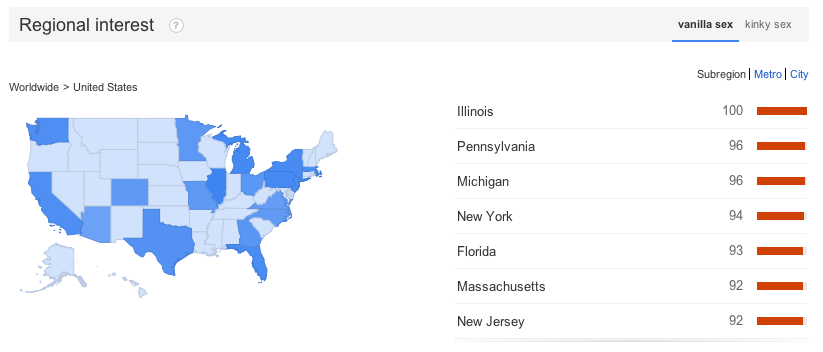
Illinois heads up this list, with Pennsylvania and Michigan tying for second with 96%, and Massachusetts and New Jersey tying for fifth with 92%. New York places third with 94%, while California achieves 89% in ninth place. Texas brings up the rear with 86%.

“Vanilla Sex” by Metro:

'Vanilla Sex' by Metro

‘Vanilla Sex’ by Metro

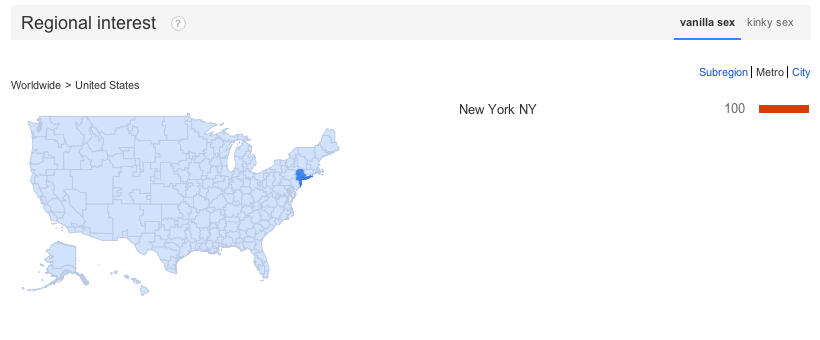
Yeah, this doesn’t look comprehensive. I find it very hard to believe that New York is the only metro area Googling “vanilla sex,” considering I found that the same metro area was madly Googling sexy Halloween costumes last month.

Unless it’s a case where the numbers need to hit a certain threshold to become visible, this does not look viable. At all.

“Vanilla Sex” by City:

'Vanilla Sex' by City

‘Vanilla Sex’ by City

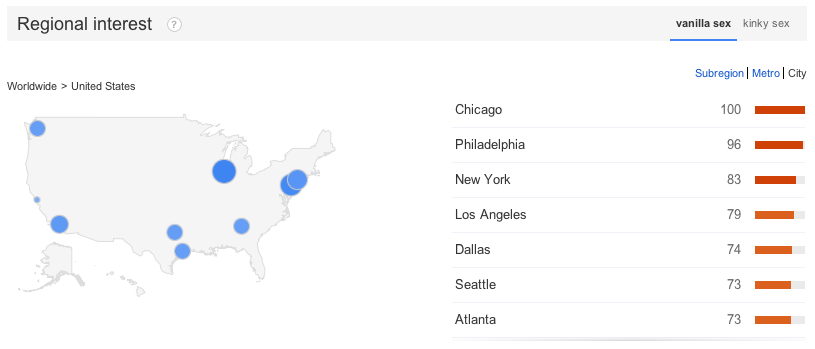
Chicago unsurprisingly tops this list, considering how Illinois topped the subregion list. New York and Los Angeles sit at third with 83% and fourth with 79%, respectively. Seattle, Atlanta and Houston have a three-way (heh) tie with 73%. San Francisco closes out the list with 57%, the lowest I’ve seen so far in doing these Google Trends.


“Kinky Sex” by Subregion:

'Kinky Sex' by Subregion

‘Kinky Sex’ by Subregion

Here’s where it gets interesting: All of the top states score at least 87%, which means these states have a big interest in kinky sex (nothing wrong with that, of course). Cueing the jokes about the South, Kentucky tops this list, with West Virginia a close second at 98%.

“Kinky Sex” by Metro:

'Kinky Sex' by Metro

‘Kinky Sex’ by Metro

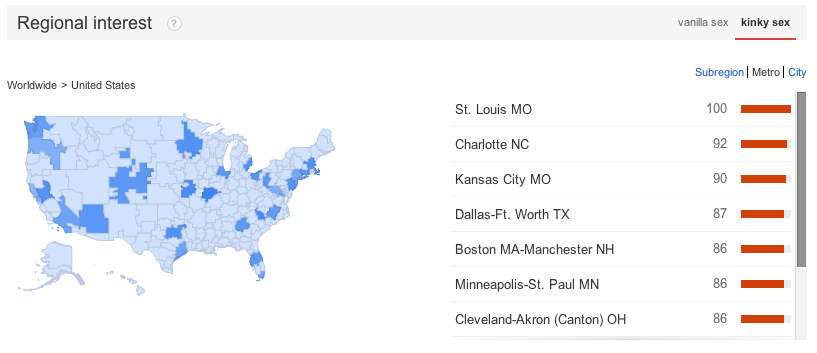
Missouri’s St. Louis and Kansas City appear at #1 with 100% and #3 with 90%, respectively. Charlotte, NC sits between them with 92%.

Aside from that, the rest of the metro areas are scattered among Texas, New Hampshire, Minnesota, Ohio, California, Michigan and Pennsylvania.

“Kinky Sex” by City:

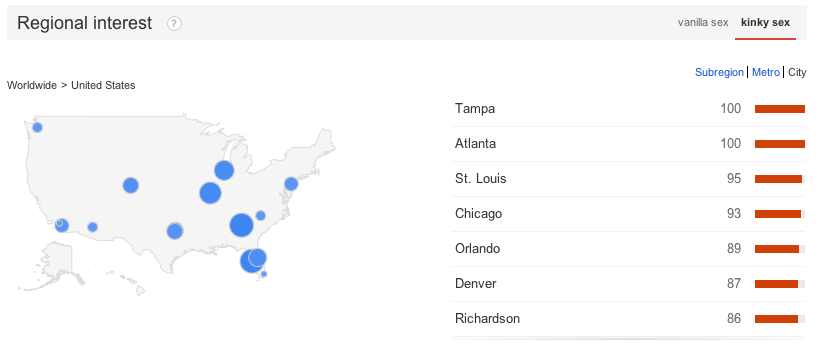
'Kinky Sex' by City

‘Kinky Sex’ by City

Southern cities Tampa and Atlanta tie for first, with St. Louis coming in at third with 95%. The rest of the lis is scattered geographically.


Conclusions:

It’s difficult to draw any concrete conclusions from the findings. It appears that Googling kinky sex is widespread and not limited to any particular region, metro area and/or city.

Purity Balls: How Popular Are They?

Purity ball

Purity ball

Sometimes, we get curious about the other side of sex education: the side where it pretty much doesn’t exist. Recently, I became curious about the popularity, or possible lack thereof, of purity balls.

For those who don’t know, Christian purity balls have popped up in the last decade as a way for young women (generally preteens and teens) to pledge to remain sexually pure until they marry. They usually take place within an evening event and dance, where fathers attend with their daughters. The fathers pledge to model an example of purity for their daughters, and to protect them from evil teenage boys and their desires.

The daughters, in turn, pledge their virginity to their father. Oh yeah, and the Lord.

Randy and Lisa Wilson created the first purity ball in 1998, and their website notes that balls have been held in 48 states since then. (According to their website, there have also been inquiries from 17 countries.)

In a “New York Times” article written in 2012, feminist writer Jessica Valenti reported 1K+ purity balls were held in 2006, for her 2010 book “The Purity Myth.” In a related stat, Leslee J. Uhruh, president of the National Abstinence Clearinghouse, claims she fielded 4K+ calls concerning holding purity balls “within a 12-month period,” though how this period is calculated isn’t defined.

Unfortunately, I couldn’t find any data on how fast the movement is growing, where it’s growing the most, how many attendees, and other points of interest.

Brown University Date Rape Drug GHB: How Common Is It?

Brown University's Robinson Hall, 2009

Brown University’s Robinson Hall, 2009

A female student at a Brown University fraternity party held on Oct. 17 has tested positive for a date-rape drug.

The student drank an alcoholic punch which contained GHB (gamma hydroxybutrate), which was found during a later test. One other student drank the punch, and those results are still pending.

The Australian Drug Foundation notes that symptoms such as drowsiness, lowered inhibitions and memory lapses become present 15-20 minutes after taking the drug, and can continue for 3-4 hours. It’s also easy to overdose since there aren’t much difference in dosage between an overdose and a safe amount.

This continues a story in which the aforementioned female student reported that she was sexually assaulted at the Phi Kappa Psi party.

How common is GHB’s use as a date-rape drug?

Unfortunately, I couldn’t find any hard numbers solely on GHB for colleges. A 2009 Monitoring the Future study found that .7% of eighth-graders and 1.1% of 12th-graders reported using the drug in the past year. GHB use peaked in 2000 when 1.2% of eighth-graders in 2000 and 2% of 12th-graders in 2004 reporting using it within the past year.

Drug abuse treatment website Serenity Lane reports that since there have been 15K+ overdoses and 72 deaths related to GHB. But this doesn’t tell us the age-spread, so it’s impossible to tell which, if any, age group this affected most.

Every resource I looked at listed GHB as a date-rape drug alongside rohypnol and ketamine. In fact, Brown’s own Health Services website devotes a page to GHB. It’s clear that its use is still a large issue.


How Common are Sexual Reassignment Surgeries (SRS)?

Lili Elbe, 1926

Lili Elbe, 1926

Last week, it was announced that English actor Eddie Redmayne will play Lili Elbe in an upcoming film. Elbe, a Dutch painter, was one of the first recipients of sexual reassignment surgery (SRS). Elbe was born Elnar Mogens Wegener in 1882 and started the surgery in 1930 in Germany. SRS was very experimental at the time, and she went through a series of five operations that spanned over two years.

Naturally, this made me wonder how common SRS surgeries (both male-to-female and female-to-male) are in the U.S.

In 2008, Dr. Mary Ann Horton published a paper on just that, where she examined all SRS surgeries performed within calendar year 2001.

She found that 1.1K+ overall SRS surgeries were performed, 740 being MTF and 430 being FTM.

The incidence of SRS followed an overall ratio to 1:240K. This broke down to 1:190 for MTF and 1:330 for FTM.

Unfortunately, it’s not clear how we can project these numbers to grow and/or change moving forward.


In any case, the development with Redmayne’s casting is significant is that cis-woman Nicole Kidman was initially cast in the role five years ago. Cis-man Redmayne’s casting might signal a shift in how Hollywood perceives depictions of tradespeople.