Thursday Trends: Whitewashing Asian Characters in Film

Emma Stone, 'Aloha' (Jezebel)

Emma Stone, ‘Aloha’ (Jezebel)

Let me be clear: this is not a good trend. At all. It should never have even started. And yet, here we are.

It’s still a problem.

Historically, Hollywood has always had a problem of “whitewashing,” i.e. casting white actors in roles specifically created for non-whites. The thinking is that whites are more “bankable,” but there aren’t many roles and opportunities for non-white actors as it is. So a white actor ends up taking a role from a non-white one, and many non-white people are deprived of seeing depictions of themselves on-screen.

This tends to happen a lot with Asian actors. Most recently, director Cameron Crowe came under fire for casting Emma Stone in his latest movie “Aloha.” Stone was cast as a character named Allison Ng, whose ancestry is one-quarter Chinese and one-quarter Hawaiian. (Having white and Asian or Pacific Islander ancestry is traditionally known as “hapa,” deriving from the Hawaiian Pidgin word for half. So Ng’s heritage would be termed “hapa” or “hapa haole,” to include the European ancestry.)

Look at the picture above and tell me with a straight face that Emma Stone resembles anyone remotely half-Asian.

Fortunately, Crowe caught some heat for this decision, and has publicly apologized for his choice. (But he covered his ass a little, saying that the character was meant to be frustrated that her features belied her mixed-race heritage.) But Crowe could’ve easily cast an Asian or mixed-race Asian for his film. He just chose not to.

This whitewashing of Asian characters tends to come up every few years. 2010’s “The Last Airbender” received a public outcry when it was revealed that the cast was mostly non-white actors, save for Dev Patel. (The debacle coined the term “race bending.”) This was odd considering that the TV series (on which the movie was based) was set in a world with obvious Asian elements, and it was animated using anime influence.

The 2008 movie “21” centered on the real-life story of the MIT Blackjack Team, a group of current and former students who beat the casinos at their own game by counting cards. Though many of the group were of Indian and Asian descent, the movie whitewashed the cast, using mostly Caucasian actors.

And then there are the times when white actors are actually put in yellowface. 2012’s “Cloud Atlas,” which had the ensemble actors playing various characters, actually had two examples of this, and took it past the point of no return: Jim Sturgess (who was also in “21”) and James D’Arcy both played Korean men at one point. Sturgess and D’Arcy are both white men, but they both spent extensive time in makeup to more realistically resemble Asian men.

This is far from a new problem. The 1956 film “Teahouse of the August Moon” featured legendary actor Marlon Brando as Japanese villager Sakini, donning full-on yellowface to physically embody the role. And everyone who’s seen 1961’s “Breakfast at Tiffany’s” remembers Mickey Rooney as Holly Golightly’s Japanese neighbor I.Y. Yunioshi, who, seen through modern eyes, was a jaw-droopingly offensive caricature. (“The New York Times” review of the film called Rooney “broadly exotic.”) Fortunately, the distance of time and perspective have allowed people to see that these portrayals were very offensive towards Asians, and it was wrong to a) write/portray the characters in such stereotypical ways, and b) cast actors not of the specific ethnicity to play these parts.

But maybe the message isn’t sinking in as much as it should be: Blonde, Caucasian actress Scarlett Johansson will star in DreamWorks’ adaptation of the anime title “Ghost in the Shell.”

Here’s the thing: There are so many asian and mixed-Asian actors out there. Kristin Kreuk, Chloe Bennet, Olivia Munn, John Cho, Steven Yeun, Daniel Henney, Harry Shum Jr., Sendhil Ramamurthy. And those are only the ones I didn’t need to Google off the top of my head. Point being, there’s massive opportunity here for diverse casting that reflects reality. So let’s get on it!
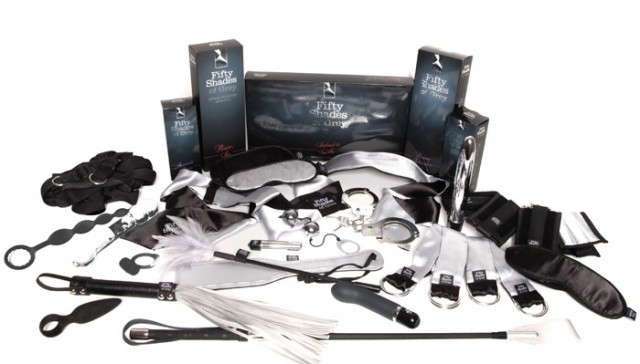
How Has “Fifty Shades of Grey” Impacted the Sex Toy Industry?

'Fifty Shades of Grey'-themed sex toys (Crushable)

‘Fifty Shades of Grey’-themed sex toys (Crushable)

With the recent “Fifty Shades of Grey” movie coming out last month (along with the requisite storm of thinkpieces), the sex toy industry is seeing an impact on the bottom line.

Different sex toy retailers are feeling an impact. “Variety” reports that Manhattan-based The Pleasure Chest was offering “Fifty Shades”-themed classes every night leading up to the movie’s premiere (though it doesn’t say for many weeks this went on).

Online retailer Adam & Eve, which holds the largest market share at 4%, has also gained a boost in sales. They’re also selling their own toy line “Scarlet Couture” pegged to the movie, in addition to the official “Fifty Shades”-inspired line.

“The Hollywood Reporter” has a piece which came out before the movie opened giving us some hard numbers. The U.K. sex toy brand Lovehoney made the line of “Fifty Shades”-inspired toys, which includes blindfolds, riding crops and feather ticklers. Demand for the “Inner Goddess” Ben Wa balls (or vaginal balls) sold out Europe in pre-orders. (Full disclosure: I was actually given a box of these when I attended a sexual health conference in January.)

THR reports that Lovehoney’s profits “tripled from $1.1 million the year before to $3.39 million by January 2014.” The “Fifty Shades” line has already sold 1.2M units worldwide, and is estimated to boost sales by 40% once the movie debuts.

If you’re looking for lingerie, Bluebella has you covered. The lingerie line has three “Fifty Shades”-inspired collections, and they anticipate a spike in sales not only from the movie, but also from Valentine’s Day.

“Inc.” also had a comprehensive article on this cultural phenomenon, and puts it in the larger context of a sea change. Market research firm IBISWorld found the following:

Between 2008 and 2013, sex toy sales in the U.S. increased by approximately 12.5 percent annually, raking in $610 million in 2013 overall.

The article notes that it’s more the smaller companies seeing a boon to their bottom line. But there’s also been a shift in who the sex toy industry’s customers are:

In 2013, women made up approximately 67 percent of U.S. industry patronage, which was a 12 percent increase from 2008.

It’ll be interesting to see if this is just a one-time sales spike, specifically in BDSM gear, or if this trend will continue, eventually making the practice almost, dare I say, vanilla.


“Fifty Shades of Grey” Morning After: Opening Weekend Box Office

'Fifty Shades of Grey' still (Nova FM)

‘Fifty Shades of Grey’ still (Nova FM)

Last week, we examined different aspects of “Fifty Shades of Grey,” in preparation for the then-upcoming movie. 

Who saw “Fifty Shades of Grey” this weekend? I did, twice (and I own my choices).

The collective ticket-buying (and swooning over Jamie Dornan) is estimated to make $81M+ its three-day opening weekend (comprising Friday, Saturday and Sunday). The movie opened at 3.6K+ theaters (“the widest release to date for an R-rated film,” as “The Hollywood Reporter” notes), and is projected to make $90M+ over the four-day holiday weekend (which includes Monday). If it hits this number, “Fifty Shades of Grey” will hold the honor of having the biggest President’s Day opening weekend in history.

Internationally, the movie has opened to #1 in 56 markets to nab $158M+, doing very well in Europe and Latin America. “Deadline Hollywood” reports that five countries have yet to release it, including Korea and the United Arab Emirates, through Mar. 5. China will release the movie next weekend. So far, the global total numbers $248M+.

Needless to say, “Fifty Shades” is doing gangbusters business. It’s safe to say the movie will turn a profit: it was only made for $40M.

The movie has also hit another milestone: it’s the biggest opening for a female director. Catherine Hardwicke previously held this record for directing the first “Twilight” film, released in November 2008. (Incidentally, the “Fifty Shades” trilogy started out as “Twilight” fan fiction.) That movie took in $69M+ its first weekend.

It’s unclear whether director Sam Taylor-Johnson would try to repeat that feat with the next two movies in the “Fifty Shades” trilogy. So far, there have not been any discussions of her returning, as she only signed a deal to make one movie.

Hopefully, this stunning showing will open the door for more female-led erotic films, both in front of and behind the camera.