Sprout Pharmaceuticals’ Female Viagra Closer to Becoming Publicly Available

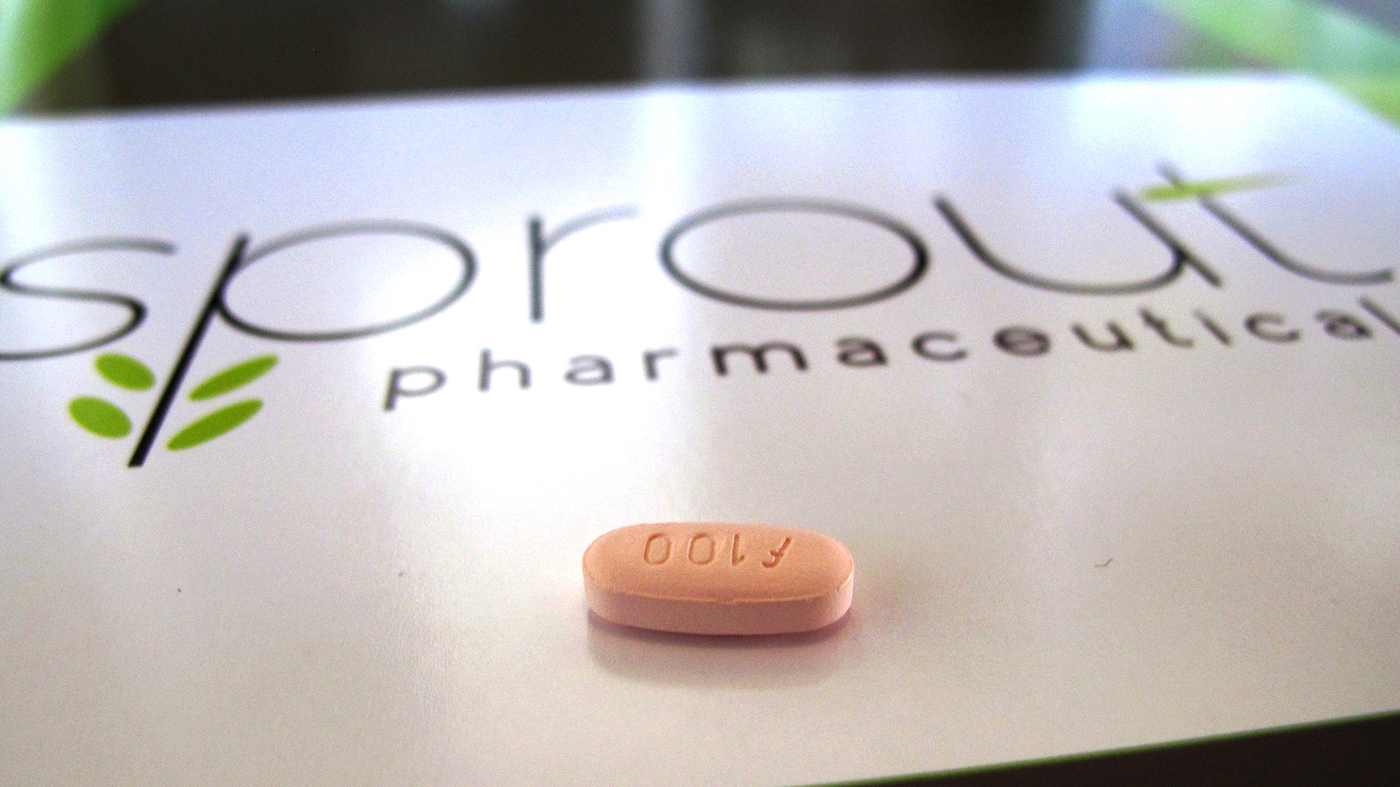
The experimental drug flibanserin, made by Sprout Pharmaceuticals, is at the center of a regulatory controversy.

The experimental drug flibanserin, made by Sprout Pharmaceuticals, is at the center of a regulatory controversy.

Sprout Pharmaceuticals has developed what they’re calling the Viagra for women. The new drug, named Flibanserin, purports to treat hypoactive sexual desire disorder (low sex drive, in other words) in pre-menopausal women. So far, $50M has been raised in preparation for the drug’s launch, and the Food & Drug Administration (FDA) has approved its benefits/risk profile.

The drug, now known as ADDYI, has had a long road thus far:  The drug was first rejected in 2010, when it was determined that the risks outweighed the dubious (at the time) benefits. Sprout began working on the drug in 2011, after being sold by the drug’s initial developer Boehringer Ingelheim. In December 2013, the FDA had rejected the drug for the second time.

In February 2014, the FDA wanted to see more tests done, specifically how the drug behaved when used with other medications. (Almost 10% of women taking the pill reported sleepiness during the trial.) The company resubmitted New Drug Application (NDA) this past February. The “little pink pill” was approved by an FDA advisory committee (done one step before final FDA approval), provided that more safety restrictions were added.

So far, Flibanserin/ADDYI has been tested on 11K+ women, and claims to be the “one of the most studied women’s health products in history.” Here’s what Sprout found after some recent trials:

In three 24-week randomized Phase 3, six-month, double-blind, placebo-controlled, parallel-group North American studies of premenopausal women with a mean age of 36 years, ADDYI consistently demonstrated a highly statistically significant difference over placebo on three key endpoints, including increase in sexual desire, decrease in distress from the loss of sexual desire and increase in the frequency of satisfying sex. Women treated with ADDYI showed significant improvements at every point of measurement in all pivotal clinical trials, with benefits seen as early as four weeks and sustained over the 24-week treatment period.

It’s too early to know when the drug will hit the public market. But it’ll be interesting to see how it performs (haha).
How Many Husbands Take Their Wives’ Last Names?

Zoe and Marco Saldana (KCCI)

Zoe and Marco Saldana (KCCI)

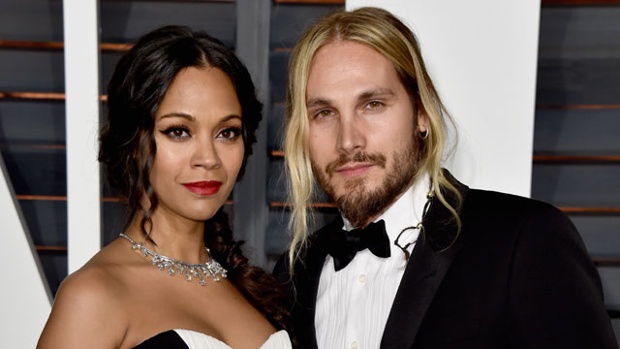
Happy Friday! Earlier this week, actress Zoe Saldana told “InStyle” that her husband Marco Perego wanted to take her last name, instead of having her take his. Saldana was initially hesitant:

I tried to talk him out of it. I told him, ‘If you use my name, you’re going to be emasculated by your community of artists, by your Latin community of men, by the world.’ But Marco looks up at me and says [in his Italian accent], ‘Ah, Zoe, I don’t give a sheet.’

Now, that’s a true man right there. Husbands taking their wife’s last name isn’t too common, at least anecdotally. But what about the data? Has it been tracked?

No, it hasn’t, at least not yet. I found several articles profiling couples who did it, but each article mentioned in some way that statistics weren’t tracked. Oh well. On the other hand, it’s a topic ripe for picking for a Ph.D. thesis. Any takers?

But Mr. Saldana (né Perego) made a huge impact. Meghan Blalock of “Who What Wear” puts his decision in context:

The storied history of women taking men’s last names in marriage is not just a trend or a matter of practicality—it’s a long-existing symptom of the patriarchal society in which we live, in which a marriage means that a woman is little more than a man’s property.

So his decision shows that he’s not just a traditionally masculine man, but that he has a sensitive side towards women and feminism, and isn’t afraid to show it. Pretty badass, right? Maybe we’ll see more men follow suit!

Josh Duggar Scandal: How Much Child Sexual Abuse Occurs Within Religious Cults?

Josh and Anna Duggar and their children (E! Online)

Josh and Anna Duggar and their children (E! Online)

Last month, eldest son of the “19 Kids and Counting” Duggar clan Josh Duggar admitted he’d sexually molested five girls when he was 14 years old in 2002, some of which were his sisters. (When these incidents took place, Duggar had five sisters, who ranged in age from four to 12.)

More revelations came out over the days that followed: Duggar was sent away to a friend who had a home remodeling business after he admitted what he’d done; he didn’t receive any counseling, contrary to what had initially been stated, and Duggar was given a minor talking-to from Arkansas State Trooper Jim Hutchens, who’s now in prison for child pornography. After the allegations came to light, a judge ordered the incriminating documents be destroyed, apparently on behalf of one of the alleged victims.

The Duggar family is part of the Quiverfull movement, a worldview that purports to be about Christianity and living Biblically. Earmarks of being Quiverfull include having lots of children (supplying Christian soldiers to prepare for the upcoming spiritual battle), dressing modestly and shaming victims of sexual abuse.

Until now, the fact that the Quiverfull movement is a cult has flown under the radar. But now it’s come under the scrutiny of a full-fledged public spotlight.

I wanted to find some statistics on sexual abuse, especially child/incestual sexual abuse, within cults. Unsurprisingly, I was unable to find anything. No long-range studies have been done. This makes sense: Cults usually want to cover their tracks, and make themselves look like they aren’t cults at all and are completely normal. In terms of gathering information, it’d be very hard to infiltrate and gain members’ trust to get an accurate picture of what occurs within one. Even if a member did admit to something, they might see it as totally normal.

Unfortunately, the statue of limitations on Duggar’s heinous acts has now expired. But now we have some idea of the long-ranging detrimental effects of the Quiverfull movement. There are better ways to help victims of sexual abuse and molestation, regardless of their personal viewpoint.


President Obama Supports Ending Conversion Therapy for LGBT Youth

President Barack Obama (Politico)

President Barack Obama (Politico)

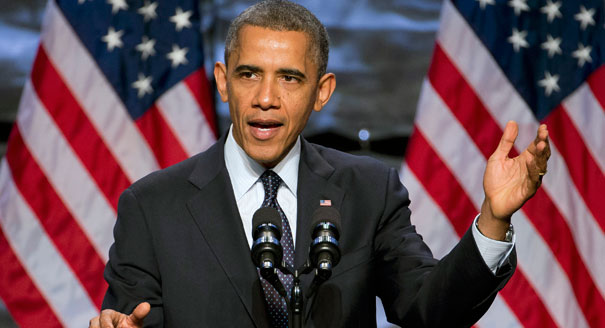
Big news last week: President Obama publicly stated that he supports banning conversion therapy for LGBT youth. The announcement came in response to an online petition urging the president to take action after transgender teen Leelah Alcorn’s suicide late last year. (Before her death, Alcorn’s parents had forced her to attend conversion therapy in hopes of getting their “son” back.)

Right now, it’s unclear what form Obama’s support will take. White House officials say that it’s unlikely that the president would push for a national law, but instead would “support the efforts to ban the practice at the state level.” It’s important to note that is a far cry from how Obama started his political career: At the time, he didn’t support gay marriage.

But the president’s views on LGBT issues are rapidly evolving, paving the way for the rest of America to follow suit. And change starts at home: The White House recently created an “all-gender” restroom for transmen and transwomen who may feel uncomfortable using the traditional facilities.


Trans Teen Jazz Jennings is the New Face of Clean & Clear

Trans teen activist Jazz Jennings (The Mary Sue)

Trans teen activist Jazz Jennings (The Mary Sue)

2015 continues to be a big year for the trans community as they make strides towards heightened visibility. Now, the community can add one more mainstream accomplishment: teen models.

Fourteen-year-old Jazz Jennings was named the new face of skincare line Clear & Clear last week. She’ll be fronting their “See the Real Me” promotional campaign, and tells her personal story in a video in an effort to encourage others to share their stories via social media.

Assigned male at birth, Jennings is the first trans model to represent the brand.

Jennings had already made a splash 10 years ago, when she became the youngest-known person diagnosed with gender dysmorphia. As she’s grown up, she’s been very active in advocating for LGBT rights, specifically for teens. Jennings has also written a book “I Am Jazz” detailing her story, and she was named to “Time”‘s Most Influential Teens List in 2014.

I’m sure we’ll be hearing a lot more from Jennings as she grows up and continues to accomplish great things. And we won’t have to wait long: Cable channel TLC will air a docuseries on her titled “All That Jazz.”


Emoji Users Have More Sex

Sexytime emojis (NY Mag)

Sexytime emojis (NY Mag)

Happy Friday! [Insert hallelujah hands emoji here!]

If you don’t use emojis in everyday text-speak, you might want to start. Science shows that emoji users have more sex. And don’t you want to be part of that group? [Winking emoji]

Dating site Match.com released a wide-ranging study, Singles in America 2015, earlier this year. The study surveyed 5.6K singles (none of whom, incidentally used Match) in their 20s, 30s and 40s that represented the U.S population according to the 2010 Census. It has some pretty interesting findings, but the emoji one is gold.

For real, the Match researchers found that singles who use emojis have more sex than singles who don’t.

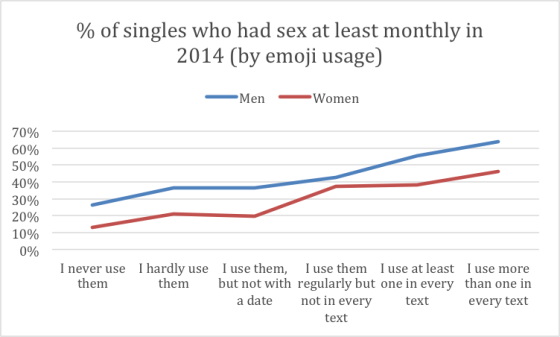
Cultural anthropologist Dr. Helen Fisher, one of the leaders of the study, found that “54% of emoji users had sex in 2014 compared to 31% of singles who did not.” [Fist-bump emoji]

There was also a direct correlation between how many emojis a single person used and how much sex they had:

Match.com 'Singles in America 2015' Emoji Survey Graph ('Time' Magazine)

Match.com ‘Singles in America 2015’ Emoji Survey Graph (‘Time’ Magazine)

Another benefit to emojis: “women who use kiss-related emojis have an easier time achieving orgasms with a familiar partner.” [Eggplant (or banana) and fireworks emojis here] This suggests that these women value good communication.

As for the emojis themselves, it mentions that the most commonly used ones are the wink (53%), smiley face (38%) and the kiss (27%).

The study showed that people tend to use emojis to show personality, which 50% of single men and women agreed on. Thirty-five percent of singles said that emojis make “expressing feelings” easier.

Fisher has an idea as to why this is happening:

“Technology reduces our ability to express our emotions, and emotional expression is a huge part of communication, so we are reinventing ways to express ourselves”

What are you waiting for?! If this doesn’t convince you to use emojis, nothing will.

If anything, this could help spread the proliferation of emojis so we can all have more sex than ever. Maybe by that time, we’ll be able to switch between English and emoji keyboards on laptops. [Side-eye and prayer emojis]


Oregon Will Have the First Openly Bisexual Mayor

Kate Brown (The Democratic Party of Washington County)

Kate Brown (The Democratic Party of Washington County)

Progress is being in Oregon today: Former Oregon Secretary of State Kate Brown will be sworn in as governor, becoming the first openly bisexual woman (actually, person) in the nation to hold the office. Brown succeeds former governor John Kitzhaber, who resigned due to a criminal probe into his fiancée’s role in his office.

She was appointed to Oregon’s State House of Representatives in 1991, was elected the following year, and re-elected two years later in 1994. She moved to the Senate in 1996, and was elected Senate Majority Leader in 2004. She began serving as Oregon’s Secretary of State in 2009.

While her main interests center on removing barriers to voting registration and growing small businesses and entrepreneurship, she’s also advocated for LGBT rights. Brown was profiled in the “Out and Elected in the USA” survey of LGBT government officials in 1992. She’s been married to her husband Dan Little since 1997.

Brown hasn’t run into any trouble with her constituents with her status as a bisexual woman, as  Oregon is known for being very socially progressive. As Hannah Hoffman of “The Statesman Journal” notes:

Her sexuality has never been a prominent issue in Oregon, where Portland recently had an openly gay mayor in Sam Adams and where the current speaker of the House, Tina Kotek, is a lesbian.

Hopefully, we’ll see the rest of the country follow suit.