Trans Teen Jazz Jennings is the New Face of Clean & Clear

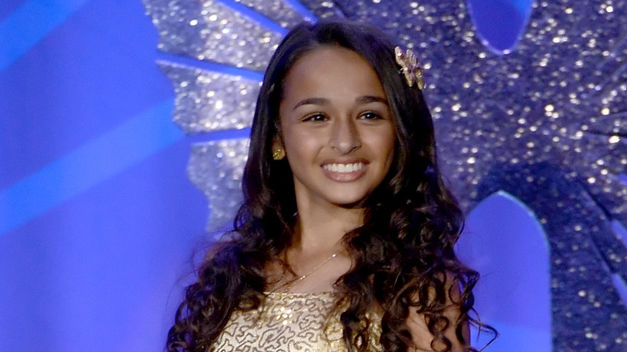
Trans teen activist Jazz Jennings (The Mary Sue)

Trans teen activist Jazz Jennings (The Mary Sue)

2015 continues to be a big year for the trans community as they make strides towards heightened visibility. Now, the community can add one more mainstream accomplishment: teen models.

Fourteen-year-old Jazz Jennings was named the new face of skincare line Clear & Clear last week. She’ll be fronting their “See the Real Me” promotional campaign, and tells her personal story in a video in an effort to encourage others to share their stories via social media.

Assigned male at birth, Jennings is the first trans model to represent the brand.

Jennings had already made a splash 10 years ago, when she became the youngest-known person diagnosed with gender dysmorphia. As she’s grown up, she’s been very active in advocating for LGBT rights, specifically for teens. Jennings has also written a book “I Am Jazz” detailing her story, and she was named to “Time”‘s Most Influential Teens List in 2014.

I’m sure we’ll be hearing a lot more from Jennings as she grows up and continues to accomplish great things. And we won’t have to wait long: Cable channel TLC will air a docuseries on her titled “All That Jazz.”




Harvard Bans Student-Teacher Relationships

Harvard University (Huffington Post)

Harvard University (Huffington Post)

Last month, Harvard University officially banned all sexual and/or romantic student-teacher relationships. They did so as part of reviewing the school’s Title IX policy, which prohibits sexual discrimination in education.

The Faculty of Arts and Sciences’ committee decided on three points: an undergraduate cannot date a professor, a graduate student cannot date a professor if the professor is supervising the student, and a grad student can’t date an undergrad if that student is working closely with the undergrad.

The university had previously banned relationships between faculty members and students only if they were in the same class. It had also classified any other student-teacher sexual or romantic relationships as “inappropriate.”

But why is Harvard acting now? Susan Svrluga at “The Washington Post” has the answer:

The new policy comes at a time when sex and gender issues — all the ways that people define themselves, their sexuality, their relationships, and how they interact with one another — are relentlessly discussed on college campuses.

Harvard is also in the middle of reviewing, and revising, its Title IX policy. It’s one of 55 schools that had previously gotten attention from the U.S. Department of Education due to its “handling of sexual assault cases.” (And we all know how that goes.)

Another aspect of the ban is that it prevents professors from abusing their power as educators by sleeping with students under their care. The measure ensures that exploitation and student favoritism doesn’t happen as a result. This makes sense, as many courts cases tried in the ’90s found universities liable for sexual assault cases.

Other schools already have measures in place regarding student-teacher relationships. Yale instituted their own ban in 2010, and the University of Connecticut put one in place in 2013. Arizona State University proposed a tougher measure on student-teacher relationships earlier this year.

It’ll be interesting to see if other schools follow their example in the coming months and/or years, or if this ban will remain an anomaly.


Emoji Users Have More Sex

Sexytime emojis (NY Mag)

Sexytime emojis (NY Mag)

Happy Friday! [Insert hallelujah hands emoji here!]

If you don’t use emojis in everyday text-speak, you might want to start. Science shows that emoji users have more sex. And don’t you want to be part of that group? [Winking emoji]

Dating site Match.com released a wide-ranging study, Singles in America 2015, earlier this year. The study surveyed 5.6K singles (none of whom, incidentally used Match) in their 20s, 30s and 40s that represented the U.S population according to the 2010 Census. It has some pretty interesting findings, but the emoji one is gold.

For real, the Match researchers found that singles who use emojis have more sex than singles who don’t.

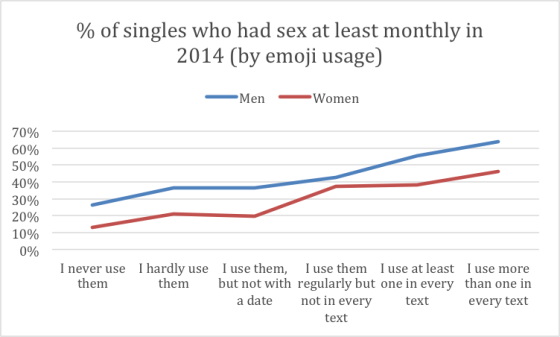
Cultural anthropologist Dr. Helen Fisher, one of the leaders of the study, found that “54% of emoji users had sex in 2014 compared to 31% of singles who did not.” [Fist-bump emoji]

There was also a direct correlation between how many emojis a single person used and how much sex they had:

Match.com 'Singles in America 2015' Emoji Survey Graph ('Time' Magazine)

Match.com ‘Singles in America 2015’ Emoji Survey Graph (‘Time’ Magazine)

Another benefit to emojis: “women who use kiss-related emojis have an easier time achieving orgasms with a familiar partner.” [Eggplant (or banana) and fireworks emojis here] This suggests that these women value good communication.

As for the emojis themselves, it mentions that the most commonly used ones are the wink (53%), smiley face (38%) and the kiss (27%).

The study showed that people tend to use emojis to show personality, which 50% of single men and women agreed on. Thirty-five percent of singles said that emojis make “expressing feelings” easier.

Fisher has an idea as to why this is happening:

“Technology reduces our ability to express our emotions, and emotional expression is a huge part of communication, so we are reinventing ways to express ourselves”

What are you waiting for?! If this doesn’t convince you to use emojis, nothing will.

If anything, this could help spread the proliferation of emojis so we can all have more sex than ever. Maybe by that time, we’ll be able to switch between English and emoji keyboards on laptops. [Side-eye and prayer emojis]


Thursday Trends: Recognizing Actors for Portraying Transpeople

Jeffrey Tambor as Maura Pfefferman in 'Transparent' (Business Insider)

Jeffrey Tambor as Maura Pfefferman in ‘Transparent’ (Business Insider)

Last week at the Golden Globe Awards, actor Jeffrey Tambor received the award for Best Actor in a Television Series, Musical or Comedy. Tambor plays Maura in Amazon Studios’ “Transparent,” a transgender woman who’s always identified as a woman, and how it affects her three adult children. (The series also won the Golden Globe for Best TV Series, Musical or Comedy.)

Tambor, who dedicated his award to the trans community, is the latest actor to be recognized for his work in playing a transperson. Though some actors before him have achieved recognition in portraying trans characters, the awards and nominations have come few and far between. But Tambor’s award comes less than a year since Jared Leto won the Best Supporting Actor Oscar for playing a transwoman in “Dallas Buyers Club.” This suggests that the trans community is rapidly gaining in visibility, and portrayals of the community members’ nuances are beginning to be normalized onscreen.

The first film actor to be nominated for portraying a trans person was Chris Sarandon for “Dog Day Afternoon” back in 1975. Sarandon played Leon Shermer, the pre-operative trans wife of bank robber Sonny Wortzik (Al Pacino). The character was based on the real-life Elizabeth Eden, initially born Ernest Aron. Sarandon received Golden Globe and Oscar nominations for his work.

The first film actor to win an award for playing a trans person was Hilary Swank, portraying Brandon Teena in 1999’s “Boys Don’t Cry.” Swank won the Best Actress in a Motion Picture, Drama Golden Globe and the Best Actress Oscar.

Last year, the Emmys made history when it nominated its first transgender acting nominee. Laverne Cox, who plays hairdresser/inmate Sophia Burset in Netflix’s “Orange Is the New Black,” was nominated for outstanding guest actress in a comedy series. (Though she didn’t win, Cox later scored another first as the first openly trans person to grace the cover of “Time” in June.)

It’s important to note that previous to Cox, all the actors nominated were cisgender, and this has occasionally become a point of contention. After Leto won the Oscar in 2014, discussions arose around transgender actors portraying trans characters.

With actors receiving recent recognition in portraying trans characters, the trans community’s visibility is rapidly rising. As more audiences watch trans stories, mainstream acceptance should spread.