UVA Rape Story Retracted: Has It Happened Before?

UVA (Brohammas)

UVA (Brohammas)

Last week, “Rolling Stone” released an investigative report on its now-infamous piece “A Rape on Campus.” The report, produced jointly with the Columbia Graduate School of Journalism, delved into fact-checking the narrative. Ultimately, the investigation found many fact-checking and methodology errors (overall termed a “systematic failing”), and “Rolling Stone” retracted the piece.

I was interested to see if any other investigative journalism pieces, specifically on rape cases, had been retracted at any time. But I wasn’t able to find any. The closest things I could find were examples of victims later recanting their stories.

This has proven to be a first for the journalism world in that such an expansive feature (on such a timely, hot-button issue, no less) has been so thoroughly demolished by its fabrications. Though the story initially drew awareness to rape victims on college campuses, it ultimately ended up casting more negative light on the publication and journalist who covered it. Let’s hope that future journalists covering sexual assault stories will be scared into performing their due diligence to get all the facts right.


Sex & The ’60s: Don Draper’s Conquests By The Numbers

'Mad Men' Don Draper, Midge Daniels, Megan Calvet Draper, Betty Draper, and Dr. Faye Miller (Vulture)

‘Mad Men’ Don Draper, Midge Daniels, Megan Calvet Draper, Betty Draper, and Dr. Faye Miller (Vulture)

This week, we’re examining sexuality data from the 1960s, in celebration of the upcoming final half-season of “Mad Men” beginning Apr. 5th.

Everyone who watches the show knows that Don Draper (Jon Hamm) is a serial womanizer. Even when he’s married, he can’t stay faithful. It’s part of what makes him so intriguing: we know he’s wrong, but we can’t stop watching!

There’s been some ink spilled on the types of women he tends to bed, such as preferring docile women for marriage versus favoring strong-willed career women for affairs. But I was curious to find out if there were any other patterns, and so had some fun with Excel.

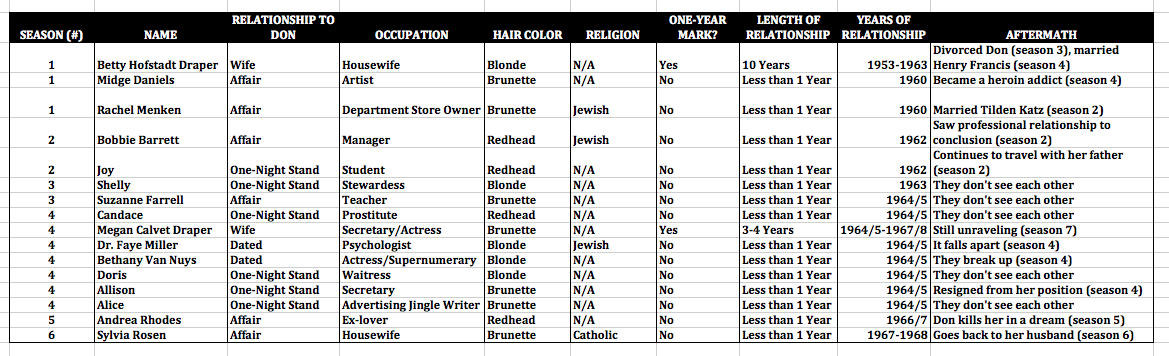
For fun, here’s what my entire Excel spreadsheet looked like:
'Mad Men' Don Draper Conquests Excel Spreadsheet

‘Mad Men’ Don Draper Conquests Excel Spreadsheet

If you can’t see, I listed the names of Don’s 16 partners by season, their relationship to Don, occupation, hair color, religion, and overall length of the relationship. (Some of these metrics I didn’t end up using.) Some of these things I tried finding information as accurate as possible (such as the years each relationship spanned), but sometimes had to make a close guess. So if you see an error, please correct me and I’ll recalculate.

Now, let’s find some patterns via pivot tables.


Don’s Relationships by Type:

I broke down Don’s relationships into three types: wife, affair and one-night-stand. I defined affair as on-going with an emotional component, whereas I defined one-night stand as purely sexual, even though it may have happened more than once (as is the case with Candace the prostitute).

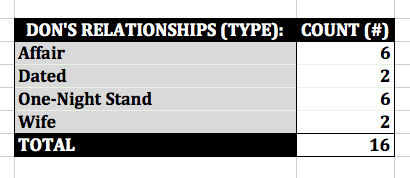
That being said, here’s the data:

'Mad Men' Don's Relationships by Type Excel Pivot Table

‘Mad Men’ Don’s Relationships by Type Excel Pivot Table

We know he’s been married twice (I’m not counting Anna Draper, as she was never a conquest), so no surprise there. I figured Don has had more casual partners than serious ones, but I didn’t realize how much it would skew. Don’s had three times as many affairs and one-night stands combined as he has married and dated partners combined. Interesting.


Partners’ Occupation:

I was interested to see if Don had any particular type in terms of career. But every woman was so different that only two things reoccurred. Two of the 16 women (12.5%) were housewives, which were his first wife Betty and later season 6’s Sylvia Rosen. Another pattern that emerged were two actresses, who also held other jobs when Don knew them. These two were season 4’s Bethany Van Nuys (whose other job was a supernumerary) and his second wife Megan Calvet (who began as a secretary).


Partners’ Hair Color:

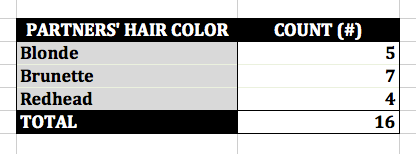
Gentlemen prefer blondes, but does Don? Let’s take a look:
'Mad Men' Don's Partners' Hair Color Excel Pivot Table

‘Mad Men’ Don’s Partners’ Hair Color Excel Pivot Table

No, Don’s more of a brunette man, with nearly half his partners sporting the color. Blonde and redhead are nearly equal, with blonde pulling ahead by one partner.


Religion:

I initially wanted to see how each partner’s religion broke down. Several did not mention or show any religious leanings, so I referred to their respective affiliations as “N/A,” because I didn’t want to automatically put partners into a “default Christian” category.

Only two of the 16 partners (12.5%) were overt about their religious affiliation: season 1’s Jewish department store heiress Rachel Menken, and the Catholic Sylvia Rosen (season 6, though she’s married to a Jewish man).

Other partners signaled their religious leanings indirectly. Season 4’s Dr. Faye Miller (Cara Buono), referenced her Jewish heritage in passing, using a Yiddish phrase. Season 2’s Bobbie Barrett was confirmed to be Jewish by none other than show creator Matthew Weiner himself.

What we can take from this is that while religion certainly isn’t a conscious preference of Don for his partners, he has selected distinctly Jewish women.


Duration of Relationship:

How long did each of Don’s dalliances last? Unsurprisingly for most of them, not very long:

'Mad Men' Don's Length of Relationships Pivot Table

‘Mad Men’ Don’s Length of Relationships Pivot Table

I initially had assumed that some would’ve spanned more than a year, but the only partners with proven staying power have been his wives Betty and Megan.


Conclusion:

Delving into the metrics of Don’s sexual partners reveals some interesting findings: He prefers brunettes, doesn’t discriminate on the basis of religion or career, and has a short attention span when it comes to women.


How Many College Sexual Assault Investigations Have Been Suspended?

UVA Campus (Brohammas)

UVA Campus (Brohammas)

Yesterday, the Charlottesville, Virginia police announced that they’re suspending their investigation of the UVA fraternity rape allegations due to lack of evidence. After reviewing records and conducting 70 interviews, investigators were unable to find key witnesses or a statement that the assault occurred.

This leads to the obvious question: How many sexual assault investigations have been suspended?

I was specifically interested in the topic in the context of colleges and universities, and searched for that. I was unable to find any conclusive data, which makes sense, as I don’t think schools would be eager to give those numbers out.

The police did say they’re leaving the investigation open, and that it could resume in the future. But I’m sure there are even fewer statistics on re-opened college sexual assault cases.


Dell Williams, Influential Sex Shop Entrepreneur, Has Died

Sex shop founder/entrepreneur Dell Williams (Refinery29)

Sex shop founder/entrepreneur Dell Williams (Refinery29)

Sad news from last week: Dell Williams, founder of the first woman-friendly sex shop Eve’s Garden, died at the age of 92.

Her origin story begins in the early ’70s, when she decided to purchase a Hitachi Magic Wand, “the Rolls-Royce of vibrators” after attending famed sex educator Betty Dodson’s “Body/Sex Workshop.” (Dodson was a huge proponent of the Magic Wand.) When Williams attempted to buy the device at a New York City Macy’s, she was shamed by a younger male sales associate.

She reported her lightbulb moment as follows:

Someone really ought to open up a store where a woman can buy one of these things without some kid asking her what she’s going to do with it.

This experience led Williams to build Eve’s Garden from her kitchen table, pursuing it as a side-hustle while working a 9-to-5 as an advertising executive. She was working on this at an interesting time: Discussions about female sexuality were beginning to bubble up, contrasting with the point that sex shops were run by, and catered pretty exclusively to men.

She showed an aptitude for entrepreneurship, as the thriving mail-order business (founded in 1974) grew into a storefront, and later went online. The site sells condoms, sex toys, and books, including Williams’ biography “Revolution in the Garden.”

Williams quickly became one of the go-to women to comment on sexuality changes amidst the larger society. In 1973, she organized a conference on women’s sexuality that received a lot of attention, and was consulted on sexual matters ranging from how to up the passion during Valentine’s Day to Britney Spears’ own ode to female masturbation “Touch of My Hand.”

But perhaps Williams was destined to go into the sex industry: Legend has it she was named for journalist Floyd Dell, who was an ardent supporter for Margaret Sanger’s work.

Williams started something that (thankfully) continues to thrive to this day: the woman-friendly sex shop, where women can go in and explore without fear of being shamed or side-eyed.

Above all, she knew the power of a sexually healthy and knowledgable woman (and how scared the rest of the world is of her). For her dedication in her biography, she wrote:

It has long been my unassailable belief that orgasmic women can change the world.  By this I mean that a woman who is unfettered sexually is unfettered politically, socially, economically and she is unstoppable.


Why is There an Orgasm Gap in Hook-Ups vs. Relationships?

Orgasm (NYC Barstool Sports)

Orgasm (NYC Barstool Sports)

In honor of International Women’s Day yesterday, let’s examine a very real issue that a lot of women face: the orgasm gap in hookups vs. relationships.

There have been a few studies on this. A 2013 study by the Kinsey Institute at Indiana University found that “women were twice as likely to reach orgasm from intercourse or oral sex in serious relationships as in hookups.” The study surveyed 600 male and female college students. A study out of New York University found that only 40% of women achieved orgasm during their most recent hookup that included sex, where 80% of men reported climaxing. This study polled 24K students at 21 colleges.

But when a woman is in a committed relationship, their orgasm rate shoots up to 75%.

Why is this?

There are several reasons for this: more frequent and consistent practice with a steady partner, communication with a partner and/or feeling empowered and confident within one’s sexuality.

Dr. Debby Herbenick of The Kinsey Institute points out that men tend to report orgasms more than women, so the number of women having orgasms might well be higher. Also, the term “hook(ing) up” includes sexual acts that might not result in having an orgasm, such as kissing.

But women can have sex and get pregnant without climaxing. So why are we so worried about having one (or multiples)?

Dr. Elisabeth A. Lloyd, author of “The Case of the Female Orgasm: Bias in the Science of Evolution,” puts it best:

“The female orgasm is for fun.”

And she’s so totally right. So get out there and go get yours!

Harvard Bans Student-Teacher Relationships

Harvard University (Huffington Post)

Harvard University (Huffington Post)

Last month, Harvard University officially banned all sexual and/or romantic student-teacher relationships. They did so as part of reviewing the school’s Title IX policy, which prohibits sexual discrimination in education.

The Faculty of Arts and Sciences’ committee decided on three points: an undergraduate cannot date a professor, a graduate student cannot date a professor if the professor is supervising the student, and a grad student can’t date an undergrad if that student is working closely with the undergrad.

The university had previously banned relationships between faculty members and students only if they were in the same class. It had also classified any other student-teacher sexual or romantic relationships as “inappropriate.”

But why is Harvard acting now? Susan Svrluga at “The Washington Post” has the answer:

The new policy comes at a time when sex and gender issues — all the ways that people define themselves, their sexuality, their relationships, and how they interact with one another — are relentlessly discussed on college campuses.

Harvard is also in the middle of reviewing, and revising, its Title IX policy. It’s one of 55 schools that had previously gotten attention from the U.S. Department of Education due to its “handling of sexual assault cases.” (And we all know how that goes.)

Another aspect of the ban is that it prevents professors from abusing their power as educators by sleeping with students under their care. The measure ensures that exploitation and student favoritism doesn’t happen as a result. This makes sense, as many courts cases tried in the ’90s found universities liable for sexual assault cases.

Other schools already have measures in place regarding student-teacher relationships. Yale instituted their own ban in 2010, and the University of Connecticut put one in place in 2013. Arizona State University proposed a tougher measure on student-teacher relationships earlier this year.

It’ll be interesting to see if other schools follow their example in the coming months and/or years, or if this ban will remain an anomaly.


How Many States Cover Transgender Medical Care?

Estradiol estrogen pill (Open Minded Health)

Estradiol estrogen pill (Open Minded Health)

As the transgender community continues to gain visibility in mainstream culture, the issues they face will become more common. Receiving proper medical care is one such issue that will continue to gain prominence.

Last week, Oregon became the latest state to cover transgender care under Medicaid. According to NPR, services include hormone therapy (for example, giving a transwoman estrogen pills), puberty suppression and gender reassignment surgery. Other states with health coverage that cover transgender care include California, Colorado, Connecticut, New York and Vermont. (New York made the decision to cover gender reassignment surgery just last month.)

Only 14% of the United States covers transgender medical care by state. Let’s hope the population’s new visibility helps other states make the right decision to include medical care for transpeople.

Sweet Peach’s Vaginal Probiotics: Could They Work?

Sexy Peach

Sexy Peach

Last week, probiotic supplement Sweet Peach was introduced at the DEMO Conference in San Jose, California. Unveiled by Cambrian Genomics founders (and men) Austen Heinz and Gilad Gome, the supplement was initially pitched as an artificial fragrance (like, say, a peach) for the vagina, replacing the organ’s natural scent.

Understandably, people were outraged. But this turned out to be incorrect. Audrey Hutchinson, the actual founder of Sweet Peach Probiotics (and a woman), described how Sweet Peach would work thusly:

“A user will take a sample of her vaginal microbiome and send it in for analysis. After determining the makeup of her microbiome–in effect, taking a census of the microorganisms that reside in her vagina–the company will supply a personalized regimen of probiotic supplements designed to promote optimal health.”

The ultimate goal is that using Sweet Peach would help women avoid health issues caused by microorganisms, such as yeast infections.

Sweet Peach’s goals parallels recent news and studies done about replacing “bad” gut with “good” bacteria in the digestive tract to ease gastrointestinal issues.

But could it work for the vagina as well?

It’s too early to tell. Right now, the National Center for Complementary and Alternative Medicine (NCCAM) Oral Probiotics page says that probiotics have mainly been used for oral and the aforementioned gastrointestinal issues. These probiotics are mostly taken in the form of oral pills or live cultures (such as yogurt).

The NCCAM notes that some probiotics studied have the potential to aid in healing, as a 2013 UCLA study shows. The study found that women who ingested probiotics through yogurt had more beneficial brain function during rest states and emotion-recognition tests.

But this study worked off the previously established gut-mind connection, which can responsible for stress and fight-or-flight responses.

As of now, there’s no known gut-vagina connection.

A recent op-ed by microbe expert Ed Yong in “The New York Times” recently alluded to the difficulty using microbes to boost vaginal health:

“The results would be hard to interpret and might be outdated by the time they arrived.”

In short, the NCCAM reminds us that we’re still pretty far from answering certain existing questions:

“The rapid growth in marketing and consumer interest and use has outpaced scientific research on the safety and efficacy of probiotics for specific health applications.”