Bernie Sanders Essay: How Many Women Have Rape Fantasies?

Bernie Sanders (Crooks and Liars)

Bernie Sanders (Crooks and Liars)

Last week, “Mother Jones” found an essay that presidential hopeful Bernie Sanders wrote in 1972 for alternative newspaper “Vermont Freeman.” Sanders’ two-page essay observed sexual dynamics between men and women.

Here’s the part that got everyone talking:

A woman enjoys intercourse with her man — as she fantasizes being raped by 3 men simultaneously.

Sanders was positing this as a general observation that held true about all women. But is he correct in this assumption?

There’s been some research done on this fantasy.

Last year, researchers at the University of Canada, Quebec asked territory residents about their sexual fantasies and published results in the “Journal of Sexual Medicine.” Though the researchers didn’t directly ask about rape fantasies, they did ask respondents if they agreed with the statement “I have fantasized about being forced to have sex,” which can be construed as such. Over 28% of women agreed with that statement, but it wasn’t enough to hit the “normal fantasy” cutoff (which started at 50% agreement from respondents). The study didn’t examine how often the women had these fantasies.

A 2010 “Psychology Today” article on women’s rape fantasies stated that nine surveys on the topic had been published between 1973 and 2008. Here’s what that collective body of data showed:

They show that about four in 10 women admit having them (31-57%) with a median frequency of about once a month. Actual prevalence of rape fantasies is probably higher because women may not feel comfortable admitting them.

A 2009 study done by North Texas University found that answers depended on what terminology was used. Fifty-two percent of college women said they’d fantasized about being “overpowered by a man,” but only 32% of women agreed when it was labeled “rape.” It’s interesting to note that this range nestles right in the range quoted above.

There also appeared to be an inverse correlation between the number of women who reported having rape fantasies and the frequency with which they had them: 25% of women reported having the fantasy less than once a year, and 13% had the fantasy a few times a year. So while it might be a part of some women’s sexual fantasy playlist, it doesn’t pop up in the rotation with much frequency for those women.

Though Sanders was certainly on to something with his claim, the fantasy isn’t nearly as pervasive (or self-reported) as he made it seem. But Sanders did recognize the desires that that specific fantasy taps into: a woman being overpowered by a man who can’t stop himself from ravishing her. No wonder he recently compared it to “Fifty Shades of Grey.”

Caitlyn (Formerly Bruce) Jenner Covers “Vanity Fair”

Caitlyn Jenner on the 'Vanity Fair' cover (Us Magazine)

Caitlyn Jenner on the ‘Vanity Fair’ cover (Us Magazine)

Another Kardashian (well, Jenner) woman has broken the Internet.

The latest issue of “Vanity Fair” debuted today, and with it, the introduction of Caitlyn Jenner. And she. Is. Beautiful.

Caitlyn, previously known as Bruce, first publicly confirmed her transition in April during an interview with Diane Sawyer for “20/20.” Since then, things have moved quickly: Jenner said she’d transition “sometime during the spring” and would wait to debut a female name. Just last week, sources reported that Jenner would cover “Vanity Fair” sometime this summer. But I’m sure nobody thought it’d be this soon.

This interview also marks the first time Jenner has used female pronouns to describe herself. Taking her cue, other media outlets are following suit.

All of this has paid off in terms of web traffic: “Vanity Fair” reported that the Jenner piece set a new traffic record, netting 6M+ unique visitors in just hours.

(Side note: Caitlyn evidently took a few notes from her step-daughter Kim Kardashian in terms of self-promotion, not that that’s a bad thing. She’s also overshadowing Kim’s announcement that she’s pregnant with her second child with husband Kanye West.)

It’s safe to say that Caitlyn is literally the most high-profile transwoman right now. (And she would know, having been part of the Kardashian/Jenner clan for decades.) Covering “Vanity Fair,” a staple in entertainment and society journalism, really marks a debut of her true self.

It’s very inspiring to see someone blossom once they’re so comfortable in their own skin, and this is definitely the case with Caitlyn.

Josh Duggar Scandal: How Much Child Sexual Abuse Occurs Within Religious Cults?

Josh and Anna Duggar and their children (E! Online)

Josh and Anna Duggar and their children (E! Online)

Last month, eldest son of the “19 Kids and Counting” Duggar clan Josh Duggar admitted he’d sexually molested five girls when he was 14 years old in 2002, some of which were his sisters. (When these incidents took place, Duggar had five sisters, who ranged in age from four to 12.)

More revelations came out over the days that followed: Duggar was sent away to a friend who had a home remodeling business after he admitted what he’d done; he didn’t receive any counseling, contrary to what had initially been stated, and Duggar was given a minor talking-to from Arkansas State Trooper Jim Hutchens, who’s now in prison for child pornography. After the allegations came to light, a judge ordered the incriminating documents be destroyed, apparently on behalf of one of the alleged victims.

The Duggar family is part of the Quiverfull movement, a worldview that purports to be about Christianity and living Biblically. Earmarks of being Quiverfull include having lots of children (supplying Christian soldiers to prepare for the upcoming spiritual battle), dressing modestly and shaming victims of sexual abuse.

Until now, the fact that the Quiverfull movement is a cult has flown under the radar. But now it’s come under the scrutiny of a full-fledged public spotlight.

I wanted to find some statistics on sexual abuse, especially child/incestual sexual abuse, within cults. Unsurprisingly, I was unable to find anything. No long-range studies have been done. This makes sense: Cults usually want to cover their tracks, and make themselves look like they aren’t cults at all and are completely normal. In terms of gathering information, it’d be very hard to infiltrate and gain members’ trust to get an accurate picture of what occurs within one. Even if a member did admit to something, they might see it as totally normal.

Unfortunately, the statue of limitations on Duggar’s heinous acts has now expired. But now we have some idea of the long-ranging detrimental effects of the Quiverfull movement. There are better ways to help victims of sexual abuse and molestation, regardless of their personal viewpoint.


No Shit: People Who Have More Sex Are Happier

Couple in bed (Nairobi Today)

Couple in bed (Nairobi Today)

Happy Friday! Here comes a stat, courtesy of everyone’s favorite superhero Captain Obvious:

The more sex you have, the happier you’ll be.

Please tell me this is common sense and not an earth-shattering revelation.

According to a 2014 study from the University of Colorado-Boulder, led by researcher Tim Wadsworth, there’s a direct correlation between frequency of sexual activity and a person’s “happiness quotient.” And these two factors fed off each other:

“Those who reportedly had more sex were seen to be experience more happiness and vice versa.”

Since this is self-reported information, it’s hard to tell the degree to which subjects experienced more happiness. But hey, if they felt it, they felt it.

But Wadsworth has certainly done his due diligence in determining this assessment: He interviewed 15K+ subjects.

By The Numbers: How Many States Require an Ultrasound Viewing Before an Abortion?

WASHINGTON, DC - MARCH 16: Wisconsin Gov. Scott Walker speaks at the 2013 Conservative Political Action Conference (CPAC) March 16, 2013 in National Harbor, Maryland. The American Conservative Union held its annual conference in the suburb of Washington, DC to rally conservatives and generate ideas.  (Photo by Pete Marovich/Getty Images)

WASHINGTON, DC – MARCH 16: Wisconsin Gov. Scott Walker speaks at the 2013 Conservative Political Action Conference (CPAC) March 16, 2013 in National Harbor, Maryland. The American Conservative Union held its annual conference in the suburb of Washington, DC to rally conservatives and generate ideas. (Photo by Pete Marovich/Getty Images)

Earlier this week, Wisconsin Republican governor/maybe-presidential hopeful Scott Walker signed a new law requiring that women who wanted to get abortions be required to get an ultrasound of the fetus before making their decision. Walker’s reasoning was that he wanted women to make informed choices (i.e. choose life!) about their unborn children. (Side note: he also referred to ultrasounds as “a cool thing out there.” I’m not touching that one.)

I wanted to find out how widespread the practice of requiring expectant mothers to view an ultrasound before proceeding with an abortion was. So I turned to trusty source The Guttmacher Institute for some stats.

Number of states that require giving contextual information (i.e. written materials and/or verbal counseling) around the ultrasound: 12

Number of states that require the abortion provider to show and describe the ultrasound: 3

Number of states that require the abortion provider to offer a viewing of the ultrasound if it’s part of the abortion process: 9

The Guttmacher has more numbers on this topic. Personally, I find it fascinating that these laws are essentially banking on the assumed fact that women are ruled by their emotions and are baby-crazy, and so seeing an ultrasound before an abortion would change their minds.

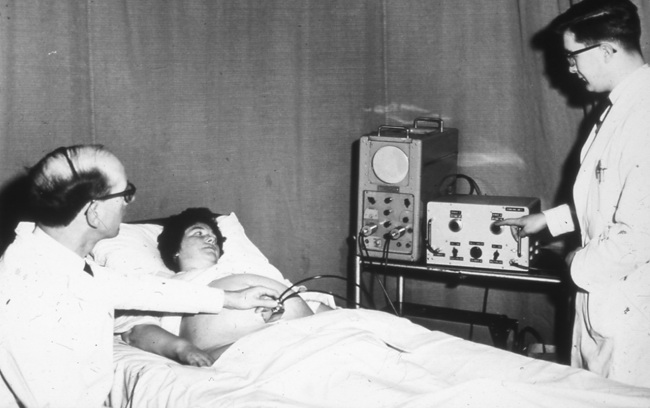
#ThrowbackThursday: Ultrasound, 1963

Ultrasound, 1963 (University of Cambridge)

Ultrasound, 1963 (University of Cambridge)

The first obstetric ultrasound was developed in 1956 in Scotland by Ian Donald and Tom Brown, using a prototype based off detecting flaws in industrial ships. It began to be used regularly within the country, and later spread to the U.K. and America in the 1970s.


Ultrasounds use ultrasonic waves to determine features of the fetus. Early on, this couldn’t be done, as the technology wasn’t nearly as advanced. It’s fascinating to see how it’s caught up.

Why Are Girls Entering Puberty Earlier?

Teen girl (Barnorama)

Teen girl (Barnorama)

It might seem like teenage girls are looking younger and younger each year, but there’s some truth to that. Researchers are finding that the age of onset puberty has been declining over the years, and girls are beginning to physically resemble grown women at younger ages.

A 2010 study put out by “Pediatrics,” the American Academy of Pediatrics’ (AAP) journal, followed a cohort of 1.2K+ girls between the ages of six and eight years of age from New York, Cincinnati and San Francisco. The study measured breast “budding,” normally the first physical step in female puberty. The results found that girls were beginning this stage around ages seven or eight, which is earlier than girls who were born only 10 years ago. (Incidentally, there was no change in age of first menstruation.)

This is even earlier than what was found in a previous AAP study completed in 1997. That year, results showed that girls began puberty between eight and nine years of age.

So what’s been causing the change? There appears to be a link between sugary drinks and early onset puberty for girls. The study defined early puberty as age of first menstruation, but not by breast budding.

It appears more research is needed, but this is an issue that needs to be addressed sooner rather than later.

How Has Colorado’s Teen Pregnancy Rate Dropped 40% Within 4 Years?

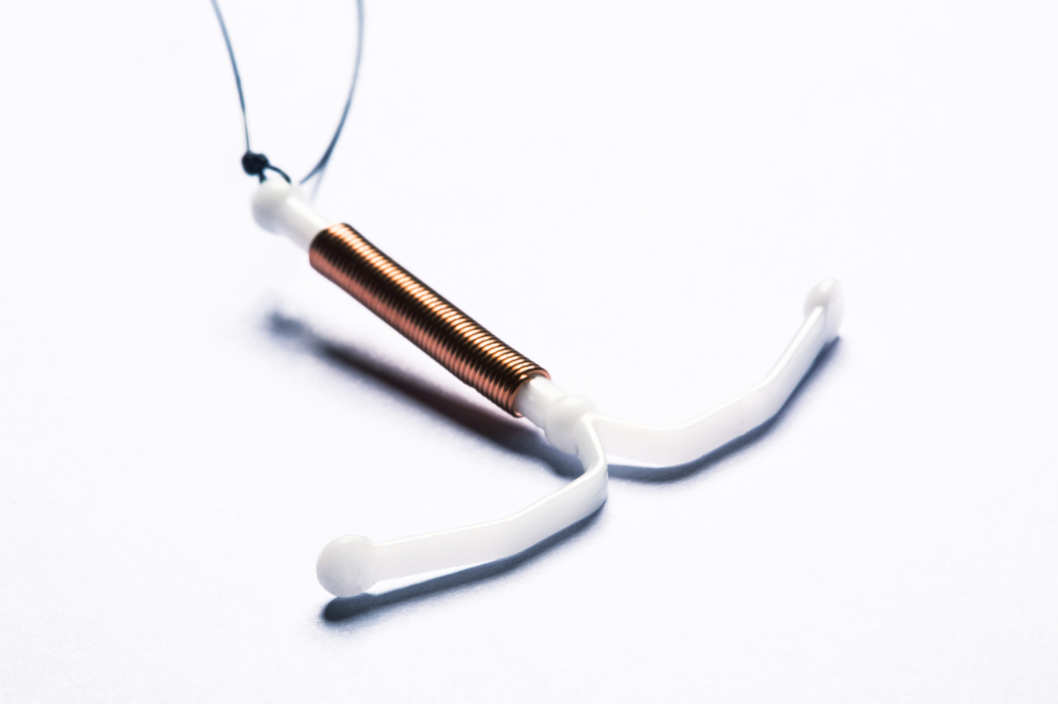
IUD (NY Mag)

IUD (NY Mag)

Colorado’s teen pregnancy rate has been getting some attention recently. But it’s not for the reason you think; it’s actually for the opposite reason.

From 2009 to 2013, Colorado reported a 40% decrease in teenage pregnancies, according to the Colorado Department of Public Health and Environment. Below is a graph that shows the decline:

Colorado's Birth Rate 2005-2012 (The Washington Post)

Colorado’s Birth Rate 2005-2012 (The Washington Post)

That seems insane, right? But there’s actually an interesting reason behind it.

In 2008, an anonymous donor (later revealed to be the Susan Thompson Buffett Foundation, named after Warren Buffett’s late wife) gave a $23 gift to be parceled out over five years. The gift was to be used for “long-term contraception” for low-income teens and women. Over 30K intrauterine devices (IUDs) were purchased and implemented. This measure was rolled out in 68 clinics, as part of Colorado’s Family Planning Initiative.

The IUDs were found to be a very significant factor in the state’s teen pregnancy decline. The study released by the Colorado Department of Public Health and Environment showed that “the percentage of young women receiving IUDs and implants quadrupled in participating clinics,” and, in a complementary effect, the women receiving IUDs accounted for 75% of the state’s overall teen birth rate decline.

On a national scale, Colorado rose from having the “29th lowest teen birth rate in the nation to the 19th.” This is significant as seven in 10 teen pregnancies in the state are unplanned.

The program expires this summer, and it’s unclear whether it will be renewed. But the numbers definitely speak for themselves in terms of effectiveness.


“Mother of Lamaze” Elisabeth Bing Has Died

Elisabeth Bing (The New York Times)

Elisabeth Bing (The New York Times)

Elisabeth Bing, credited for bringing Dr. Fernand Lamaze’s childbirth techniques to American women, has died at age 100 in New York.

The Lamaze method emphasized relaxation during childbirth, and posited that a mother’s pain during giving birth stemmed from fear. Having studied natural childbirth since 1942, Bing first encountered Lamaze’s technique in the 1950s. In 1960, she and a colleague founded Lamaze International, then known as the American Society for Psychoprophylaxis in Obstetrics.

It’s estimated that 25% of expectant mothers and spouses attend a Lamaze class at some point during pregnancy. For context, almost 4M babies were born in 2010. This would put the number of Lamaze-attending parents-to-be around 1M. (But this wouldn’t be completely accurate because it assumes that every mother only gave birth to one child.)

Bing’s goal was to help empower women to make their own decisions regarding how childbirth would go for them, and she certainly achieved that.

Don Draper’s Conquests: By The Numbers UPDATED

'Mad Men' Don Draper, Midge Daniels, Megan Calvet Draper, Betty Draper, and Dr. Faye Miller (Vulture)

‘Mad Men’ Don Draper, Midge Daniels, Megan Calvet Draper, Betty Draper, and Dr. Faye Miller (Vulture)

Today’s post is an update of this post, in celebration/memoriam of last night’s “Mad Men” series finale. Now that the series has ended, we can make more definitive statements on what kind of women Don prefers. 

Everyone who watched the show knows that Don Draper (Jon Hamm) is a serial womanizer. Even when he’s married, he can’t stay faithful. It’s part of what makes him so intriguing: we know he’s wrong, but we couldn’t stop watching!

There’s been some ink spilled on the types of women he tends to bed, such as preferring docile women for marriage versus favoring strong-willed career women for affairs. But I was curious to find out if there were any other patterns, and so had some fun with Excel.

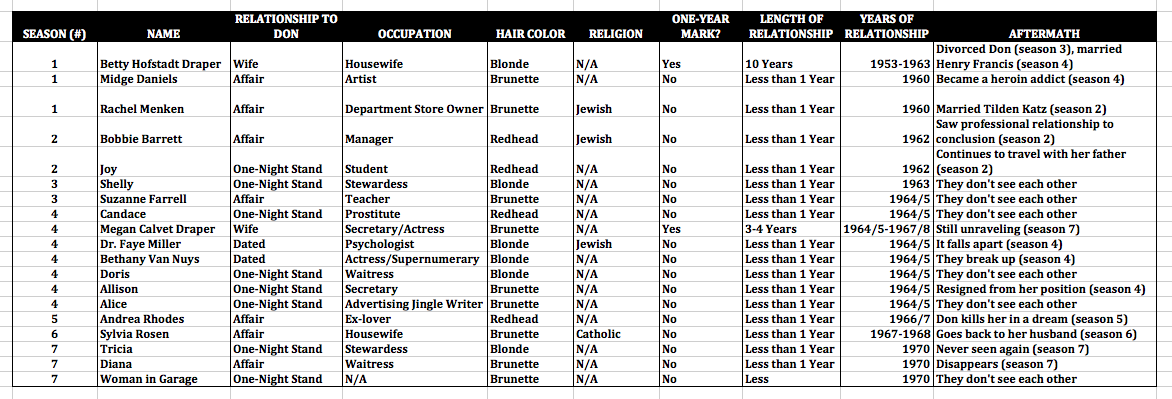
For fun, here’s what my entire Excel spreadsheet looked like:

'Mad Men' Don Draper Conquests Excel Spreadsheet UPDATED

‘Mad Men’ Don Draper Conquests Excel Spreadsheet UPDATED

If you can’t see, I listed the names of Don’s 19 partners by season, their relationship to Don, occupation, hair color, religion, and overall length of the relationship. (Some of these metrics I didn’t end up using.) Some of these things I tried finding information as accurate as possible (such as the years each relationship spanned), but sometimes had to make a close guess. So if you see an error, please correct me and I’ll recalculate.

Now, let’s find some patterns via pivot tables.


Don’s Relationships by Type:

I broke down Don’s relationships into three types: wife, affair and one-night-stand. I defined affair as on-going with an emotional component, whereas I defined one-night stand as purely sexual, even though it may have happened more than once (as is the case with season 4’s Candace and season 7’s Tricia).

That being said, here’s the data:

'Mad Men' Don's Relationships by Type  Excel Pivot Table UPDATED

‘Mad Men’ Don’s Relationships by Type Excel Pivot Table UPDATED

We know he’s been married twice (I’m not counting Anna Draper, as she was never a conquest), so no surprise there. I figured Don has had more casual partners than serious ones, but I didn’t realize how much it would skew. Don’s had over three times as many affairs and one-night stands combined as he has married and dated partners combined. Interesting.


Partners’ Occupation:

I was interested to see if Don had any particular type in terms of career. Though every woman was different, four occupations reoccurred, and all of them roughly at the same rate.

Two of the 16 women (12.5%) were housewives, which were his first wife Betty and later season 6’s Sylvia Rosen. Another pattern that emerged were two actresses, who also held other jobs when Don knew them. These two were season 4’s Bethany Van Nuys (whose other job was a supernumerary) and his second wife Megan Calvet (who began as a secretary).

Don’s partners in season 7 made a couple more occupations a trend. Tricia was the second stewardess, with the first being season 3’s Shelly. Waitress Diana came after season 4’s Doris, also a waitress.


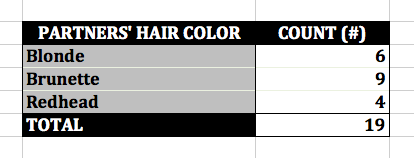
Partners’ Hair Color:

Gentlemen prefer blondes, but does Don? Let’s take a look:

'Mad Men' Don's Partners' Hair Color Excel Pivot Table UPDATED

‘Mad Men’ Don’s Partners’ Hair Color Excel Pivot Table UPDATED

No, Don’s more of a brunette man, with nearly half his partners sporting the color. He prefers blondes slightly more than redheads.


Religion:

I initially wanted to see how each partner’s religion broke down. Several did not mention or show any religious leanings, so I referred to their respective affiliations as “N/A,” because I didn’t want to automatically put partners into a “default Christian” category.

Only two of the 16 partners (12.5%) were overt about their religious affiliation: season 1’s Jewish department store heiress Rachel Menken, and the Catholic Sylvia Rosen (season 6, though she’s married to a Jewish man).

Other partners signaled their religious leanings indirectly. Season 4’s Dr. Faye Miller (Cara Buono), referenced her Jewish heritage in passing, using a Yiddish phrase. Season 2’s Bobbie Barrett was confirmed to be Jewish by none other than show creator Matthew Weiner himself.

What we can take from this is that while religion certainly isn’t a conscious preference of Don for his partners, he has selected distinctly Jewish women.


Duration of Relationship:

How long did each of Don’s dalliances last? Unsurprisingly for most of them, not very long:

'Mad Men' Don's Length of Relationships Pivot Table UPDATED

‘Mad Men’ Don’s Length of Relationships Pivot Table UPDATED

I initially had assumed that some would’ve spanned more than a year, but the only partners with proven staying power have been his wives Betty and Megan.


Conclusion:

Delving into the metrics of Don’s sexual partners reveals some interesting findings: He prefers brunettes, doesn’t discriminate on the basis of religion or career, and has a short attention span when it comes to women.