Taiwan Elects First Female President

Taiwan's main opposition Democratic Progressive Party (DPP) Chairperson Tsai Ing-wen gives a speech during a news conference in Taipei

Taiwan’s main opposition Democratic Progressive Party (DPP) Chairperson Tsai Ing-wen gives a speech during a news conference in Taipei April 15, 2015. REUTERS/Pichi Chuang

Taiwan hit a milestone last week: Citizens elected Tsai Ing-wen, making her the first female president of the country. She heads the Democratic Progressive Party (DPP), and won 56% of the vote.

Tsai’s concerns for the country including growing the economy and ensuring that China respects Taiwan’s democracy. It’ll be interesting to see how she implements these measures, and how both Taiwan and China react.

El Salvadorian Government Advises Women Not Get Pregnant Due to Zika Virus

Baby with microcephaly (Health Then More)

Baby with microcephaly (Health Then More)

Despite arriving on the viral diseases scene just recently, the Zika virus has already made a large impact. The first cases in the Americas were reported in Brazil last spring, where the virus was linked to birth defects that affected brain development. The most commonly cited birth defect was microcephaly, which results in an abnormally small brain. Earlier this year, the Centers for Disease Control and Prevention (CDC) here in the U.S. have advised that pregnant women should not travel to the 14 countries affected by the virus.

Now, the government of El Salvador (one of the affected countries) is going one step further and advising women of childbearing age to refrain from getting pregnant until 2018. The announcement came after 5K+ cases of the virus were detected in women in 2015 and early this year. Of this number, it’s suspected that 96 women had contracted the virus, but so far, none have resulted in microcephaly. I couldn’t find information on how high-risk El Salvador is for the Zika virus, but this measure would lead me to believe that it looks pretty dire.

The government of Colombia has released a similar warning, but is advising women to wait six to eight months. Colombia has the second-highest rate of Zika infections after Brazil.

In terms of each country’s birth rates (counted as births per 1K people), El Salvador has 16.79. It just edges past Colombia with a birth rate of 16.73. By contrast, Brazil has a birth rate of 14.72. It’ll be interesting to see how El Salvador and Colombia’s birth rates are affected this year by their respective government’s measures.

The Zika virus is transmitted via mosquito, and is characterized by joint pain, fever, rash and red eyes.


Planned Parenthood Endorses Hillary Clinton

Hillary Clinton (The Washington Times)

Hillary Clinton (The Washington Times)

Planned Parenthood has endorsed a candidate for the primary election: Hillary Clinton, the only woman running for the Democratic nomination. This is the first time in Planned Parenthood’s 100-year history that the organization has endorsed a candidate.

For this who’ve been living under a rock, Planned Parenthood provides a number of serves for womens’ reproductive health, including birth control, Pap smears and abortions.

It’s becoming increasingly clear that women’s issues will take up a prominent share of issues discussed leading up to this year’s election. Last week, Republicans in the Senate voted to defund Planned Parenthood. Thankfully, they didn’t get very far, since President Obama vetoed it.

I hope this endorsement brings out women (and men!) to the polls who might not’ve voted otherwise come November.


Birth Control Is Now Available Over The Counter in Oregon

Birth control pills (Salon)

Birth control pills (Salon)

Good news for those who may not have insurance, or don’t want to visit the doctor: Birth control is (slowly) becoming available over-the-counter at your nearest pharmacy. That’s right, soon (depending on where you live) you won’t need a prescription.

Right now, the service is only available in Oregon, and it kicked into effect Jan. 1st of this year. Here’s how it works: A woman can walk into her local pharmacy, and fill out a questionnaire about her health. If all systems go, she can get birth control. If the pharmacist refuses to supply her on the grounds of religious reasons, the pharmacist is required to provide suggestions as to where the customer can find birth control.

This all applies if the woman is over 18 years old. If she’s under 18, she’ll still need a doctor’s prescription, though this standard will be relaxed at some point in the future.

It’s also pretty significant that a woman signed this into law: Oregon’s governor Kate Brown signed the bill into law last July.

But Oregon might not be the only state with this law in place for long: California is working out its own law, which is set to go into effect in March. And Colorado and Washington have introduced similar laws within their own respective states. Let’s hope the other 46 states soon see the light and follow suit.


China’s (Now Ended) One-Child Policy: By The Numbers

Chinese One-Child Policy poster (The Galloping Beaver)

Chinese One-Child Policy poster (The Galloping Beaver)

Most people have heard of China’s infamous one-child policy. it’s exactly what it sounds like: each married couple is only allowed to have one child.

Now the policy has ended. Actually, it ended on Jan. 1st, less than a week ago.

A lot of people don’t know the story behind the concept, and why it was initially implemented. Here are some numbers that made the one-child policy look like a sensible idea at the time:

China’s total population:

1960: 667.1M

1970: 818.3M

China’s population grew 151.2M in 10 years, or at the rate of 15.12M per year. The government was worried that the population would continue growing exponentially at the same rate, with the country eventually becoming unsustainable.

Fertility rate:

1960: 5.76 births/1 woman

1970: 5.47 births/1 woman

The fertility rate stayed stable (and strong) throughout the 1960s.

Crude birth rate:

1960: 20.9

1970: 33.4

This metric shows the “number of of live births occurring during the year, per 1,000 population estimated at midyear.” The number hit a high in 1963 with 43.4, no doubt sending the Chinese government into a full-fledged panic.

With the above stats as historical context, it’s a bit easier to see why the Chinese government implemented the One-Child Policy, and kept it for the 35 years they did.

#ThrowbackThursday: Chinese One-Child Policy Propaganda Poster, 1986

Chinese One-Child Policy poster (The Galloping Beaver)

Chinese One-Child Policy poster (The Galloping Beaver)

As of Jan. 1, China’s one-child policy is officially history. Married couples are now allowed to have up to two children for the first time since 1979.

I’ve always thought propaganda posters were interesting, and here’s a great one for the one-child policy. It’s from 1986, and titled, “Carry out family planning, implement the basic national policy.” The image carries that can-do attitude made popular by Rosie the Riveter, and it’s easy to get swept up in the sentiment. Not to mention, the overall poster design’s pretty great too.


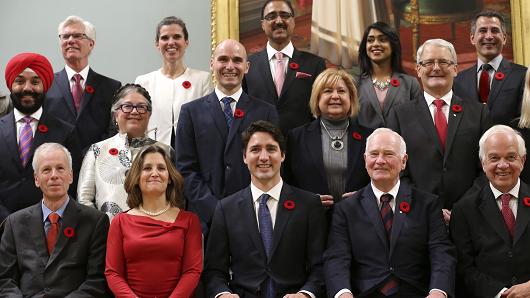
Justin Trudeau’s Cabinet is 50% Women

Canadian Prime Minister Justin Trudeau and his cabinet (CNBC)

Canadian Prime Minister Justin Trudeau and his cabinet (CNBC)

The new Canadian Prime Minister Justin Trudeau is working swiftly to make his own mark on his country: Last week, he debuted his new cabinet, which looks very different from the previous one (or most governing bodies, for that matter).

Trudeau’s cabinet is 50% women. That’s right, exactly half. Fifteen men, and fifteen women, along with Trudeau himself. Trudeau’s reasoning for his cabinet’s equality? “Because it’s 2015.” (Finally!) He also wanted a cabinet that “looked like Canada.”

But his actions aren’t just benefitting women; they’ll benefit the whole country:

The countries with the most female lawmakers have made major strides on issues such as education, labor-force participation and paid leave. [Sweden, Rwanda, and Finland] ha[ve] either a parliament or a ministry that is at least 50% female, while women make up only 19% of the U.S. Congress and only four of Obama’s 15 Cabinet members.

With this action, Trudeau sends a clear message: He respects and values women as peers and intellectual equals. And he intends to lead the twin charges of equality and diversity during his term. Incidentally, these terms have no limit. But I hope Trudeau is in power and makes needed changes for a long time to come.

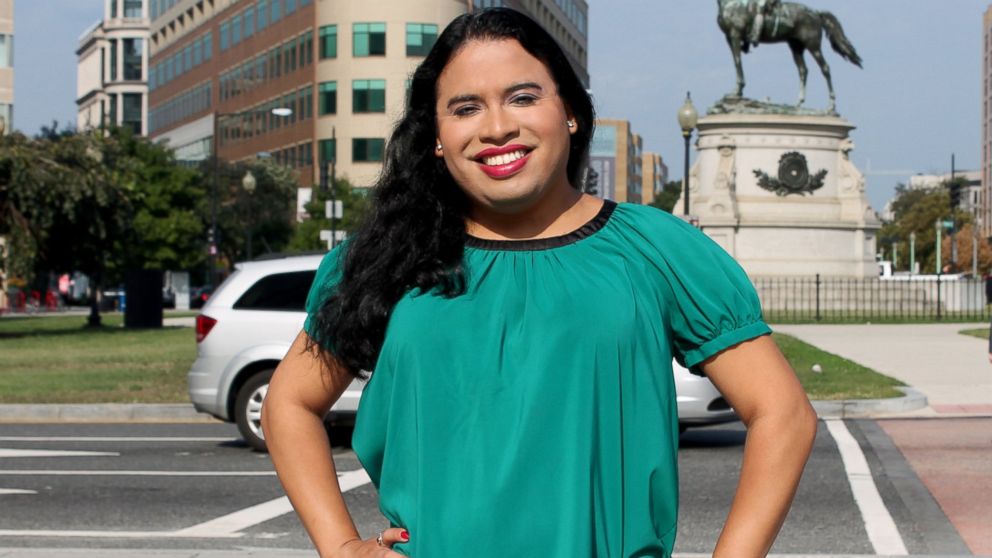
The White House Hires Its First Transgender Staffer

Raffi Freedman-Gurspan (ABC News)

Raffi Freedman-Gurspan (ABC News)

Last week, the Obama administration made a historic hiring: Raffi Freedman-Gurspan is the first transgender person hired to serve the White House. She’s not only the first transgender person, but also the first transwoman.

Freedman-Gurspan comes with a lot of experience to her new role: She had previously served as policy adviser at the National Center for Transgender Equality, and will be the recruitment and outreach director on Obama’s staff.

While the administration has hired other transgender people to other government agencies, this is the first time a transgender person will work directly with the White House.

The hiring indicates that President Obama is becoming more comfortable in openly supporting the LGBT community: Earlier this year, he spoke out about ending conversion therapy for LGBT youth.


Transgender People May Soon Serve in the Military

Soldiers (US Army)

Soldiers (US Army)

According to reports, the Pentagon is very close to lifting a ban on transgender people serving in the military. U.S. Secretary of Defense Ash Carter is in the midst of creating a task force that will examine how allowing transgender people to serve their country will affect every aspect of the service. The task force will take about six months to completely analyze what changes are needed.

Thankfully, it doesn’t sound like Ash would ever decide to keep the ban in place: He’s already denounced the policy as “outdated” and “caus[es] uncertainty that distracts commanders from their core missions.” Sounds to me like he’s already made up his mind to do so (yay!); he just needs a roadmap to implement the necessary changes.

From the Department of Defense’s press release, Ash seems like a guy who gets it:

At a time when our troops have learned from experience that the most important qualification for service members should be whether they’re able and willing to do their job, our officers and enlisted personnel are faced with certain rules that tell them the opposite. Moreover, we have transgender soldiers, sailors, airmen, and Marines – real, patriotic Americans – who I know are being hurt by an outdated, confusing, inconsistent approach that’s contrary to our value of service and individual merit.

I’m looking forward to seeing how accommodating the military is willing towards transmen and transwomen interested in serving their country to be in the near future.

The Supreme Court Rules in Favor of Same-Sex Marriage

The White House (Mashable)

The White House (Mashable)

(Yes, I know this is old news by now, but I couldn’t start blogging again without acknowledging it. If only  could’ve seen into the future!)

Friday, June 26th was a historic day that was a long time coming: The Supreme Court ruled to legalize same-sex marriages nationwide in a 5-4 decision. The decision overrules states that had previously decided not to allow same-sex marriage, and prompted many previously-against states to begin issuing marriage licenses and performing ceremonies.

Naturally, this is a wonderful decision, not just for the LGBT(QQIA+) community, but also for humanity as a whole. I think people have finally recognized that it’s time. And that it’s been time. Interestingly, there hasn’t been much resistance from state governments: Though Louisiana initially said it’d wait for federal intervention to comply, towns within the state eventually began offering marriage licenses.

As an ally, I’m glad I got to see the day, and hope this is the start of many beneficial changes.