Rome Considers Zone of Tolerance for Prostitutes

Italian prostitutes (The Telegraph)

Italian prostitutes (The Telegraph)

The Roman neighborhood of EUR is considering enacting various “zones of tolerance” around the city within which prostitution would be legal. Certain places would off-limits, such as public parks, churches and schools. This makes sense: A country-wide law dictates that cities can issue boundaries on where prostitution can and cannot occur. This is a bit of a legal loophole in Italy, where aiding prostitution is illegal (but restricting it to certain areas is fine), but paying for sex is totally cool.

Naturally, the prostitutes themselves are not happy with this, as it would cut into their business. The Catholic Church isn’t too pleased either, for obvious reasons.

There are precedents for these zones: In 2012, Montreal was mulling a similar thing, but wanted to restrict it to one street, away from the busy main thoroughfare. In 2006, the English town of Ipswich considered a tolerance zone after a spate of prostitute murders shook the community.

EUR hasn’t come (heh) to a conclusion yet, but it’ll be interesting to see what precedent this sets for the city, Italy and the rest of the world.


“Federal Agents Gone Wild:” The Department of Justice Has a Prostitute Problem

DEA chief Michele Leonhart (Girls Just Wanna Have Guns)

DEA chief Michele Leonhart (Girls Just Wanna Have Guns)

Yesterday, Michele Leonhart announced that she’d resign from her post as chief of the Drug Enforcement Agency (DEA) in early May. This comes after reports surfaced that some male employees were enjoying sex parties with prostitutes which were paid for by drug cartels in Colombia. And it had been going on for years. Conflict of interest much?

Earlier this month, Attorney General Eric Holder had to issue a department-wide memo for Department of Justice employees, reminding them that they are not allowed to solicit prostitutes under any circumstance. His point was that any employee who does this opens up himself, and the agency, to potential blackmail, extortion and leaking private information. (Seems like common sense to me.) I bet he never thought he’d have to write this kind of memo.

I tried to find if there were any other instances of this happening (since it was apparently uncovered during a routine Inspector General report), but couldn’t find anything. All stats I could find were more related to prostitution stats that the DOJ itself had reported on.

It’ll be interesting to watch how this all plays out, and what (if any) further punishments the DOJ partying employees will receive. (So far, employees who’ve confessed have only been suspended, but only up to a week-and-a-half.) It’s one thing to indulge in sex parties off the clock, but it’s another thing entirely to blur professional lines against those you’re supposed to be against (though I’m sure that was part of the appeal).


How Common Are Hermaphroditic Goats?

Hermaphrodite goat (NPR)

Hermaphrodite goat (NPR)

A recent NPR article on a hermaphroditic goat in Gaza spawned the topic for today’s blog post. The article gave this intriguing stat:

When two naturally hornless goats breed, around 1 in 5 offspring is a hermaphrodite.

I decided to look around to see if that was true. NPR didn’t hyperlink or otherwise cite their source, so I had to go at it myself.

The best thing I found was also the oldest: a 1944 study on the relationship between hornless goats (called “polled” in this case) and subsequent hermaphroditic traits. Spanning 20 years, the study examined the various couplings between polled and horned goats. It found that the horns were a recessive (weak) trait, and that 25% of goat offspring from two dissimilar goat partners (one polled and one horned, in this case) would be likely to be hermaphrodites. The study also found that goats that possessed both horns and hermaphroditic traits were rare.

Isn’t it fascinating how diverse nature is?

Aydian Dowling Could Be The First Trans “Ultimate Guy” for “Mens Health”

Aydian Dowling (Facebook)

Aydian Dowling (Facebook)

This past week has been a banner one for the trans community. First, Laverne Cox stripped down for “Allure” to help empower her various communities (black, woman, transgender). And now, fitness magazine “Men’s Health” might soon have its first transgender cover model.

Twenty-seven-year-old Aydian Dowling from Eugene, Oregon currently leads the magazine’s “Ultimate Guy” search, which searches for the man who “possesses all of the qualities that make up today’s well rounded, active, health conscious and thoughtful guy; is fit and fearless and leads by example.”

Dowling certainly meets those requirements. He began transitioning using hormone replacement therapy (HRT) in Oct. 2009, and had top surgery (which removed his breasts) three years later. In terms of leading by example, Dowling is also a fitness entrepreneur: He created YouTube channel Beefheads Fitness, which focuses on fitness for trans people. He saw an opportunity within the marketplace when he realized that nobody was filling that void, and decided to step in. Dowling also gives back by donating some profits from his clothing company to help transmen pay for top surgery.

As of Sunday night, Dowling sits atop the “Reader’s Choice” leaderboard:

'Men's Health' Ultimate Guy Contest Leaderboard April 19, 2015

‘Men’s Health’ Ultimate Guy Contest Leaderboard April 19, 2015

The rankings are based on user votes, so anyone who comes to the website can decide whether to vote or not. (As you can see, there’s some self-selection bias at play here. But in this case, it might not be such a bad thing.)

Dowling has pretty much blown every other ranked contestant out of the water at this point. Brian Taylor, currently in second place, hasn’t even received 25% of the votes that Dowling has.

The winner of the “Ultimate Guy” contest will be featured on the “Men’s Health” November 2015 issue cover. The magazine’s editors note that “the winner of the reader vote isn’t guaranteed to win the contest, but will be in the top 10 finalists.” It’s very exciting that we’re potentially watching history in the making, and that this represents a large shift in terms of (re-)defining ideas of mainstream masculinity. And we really hope that the “Men’s Health” editors award Dowling the title, if he wins the reader poll.


Thursday Trends: Young Women and #GrannyHair

Rihanna (Her Interest)

Rihanna (Her Interest)

Kylie Jenner did it. So did Rihanna and Kelly Osbourne. Of course, Lady Gaga, trendsetter that she is, rocked it back in 2010.

Grey hair.

Once upon a time, it was unseemly for women to go out sporting anything other than a full mane of brown, black, red or blonde hair. Grey was seen as unnatural and, at the same time, a little too natural. It was shoved to the side, to the back of the mind, ignoring the tell-tale side of aging.

Right now, women are embracing the color whole-heartedly, and running towards the grey instead of away from it. A recent BuzzFeed post shows how young women are riding the trend, especially seen on Instgram with the hashtag #GrannyHair.

But why now? Why is this grey hair’s big moment?

We seem to be in the midst of a “revering our elders” moment. (Real talk, though: that needs to happen every day. Call your grandparents, people!) The fashion world has been pioneering this lately. French fashion house Céline tapped 80-year-old essayist Joan Didion to be their latest model, and Saint Laurent is using 71-year-old Joni Mitchell. The major beauty players are doing the same, with 64-year-old Jessica Lange for Marc Jacobs and 69-year-old Helen Mirren for L’Oreal Paris. In this year’s Milan Fashion Week, trends skewed towards something your grandmother might don for a social event.

This makes total sense in terms of how current demographics are shifting. The baby boomer generation, born between 1946 and 1964, are turning officially “old” at a rapid clip. As of 2011, they numbered 77M+ and are “the largest generation in American history.” Baby boomers began turning 65 in 2011, and won’t stop until the end of 2029.

Here’s how CNN puts this demographic’s strength in numbers in terms of future projected growth:

The 65+ population segment is projected to double to 71.5 million by 2030 and grow to 86.7 million by 2050.

With this projected growth will come a lot of societal changes (I’ve always said that this isn’t a generation that’ll age quietly). We’re beginning to see initial impacts with how we view that generation and the ones before. For example, It used to be that you couldn’t be seen as a sexual being after a certain age, that you were out of the running in the race to make babies. And while that second part might be true, the first has been proven false by many women over “a certain age.” Case in point: see every instance where a late-night talk show host jokes about Helen Mirren. They’re always saying she’s hot (and she is!). Society has long seen older men with grey hair as sexy, and is now (finally!) coming around to the idea that older women are hot too.

Young women coloring their hair grey even has a historical precedent. In her book “Seductress: Women Who Ravished the World and Their Lost Art of Love” author Betsy Prioleau mentions that young women in the French court used to powder their hair grey to emulate their elders. (If you’ve seen Sofia Coppola’s “Marie Antoinette,” the director subtly includes this detail, noticeable in some shots.)

Overall, this trend really points to a shift in how we’re seeing aging. People seem to be more open to the fact that life doesn’t stop after a certain age. And young women are celebrating their elders with their grey hair, natural or not.

Pregnant Girls Banned from Sierra Leone Schools

Pregnant Sierra Leone woman (The Fatou Blog)

Pregnant Sierra Leone woman (The Fatou Blog)

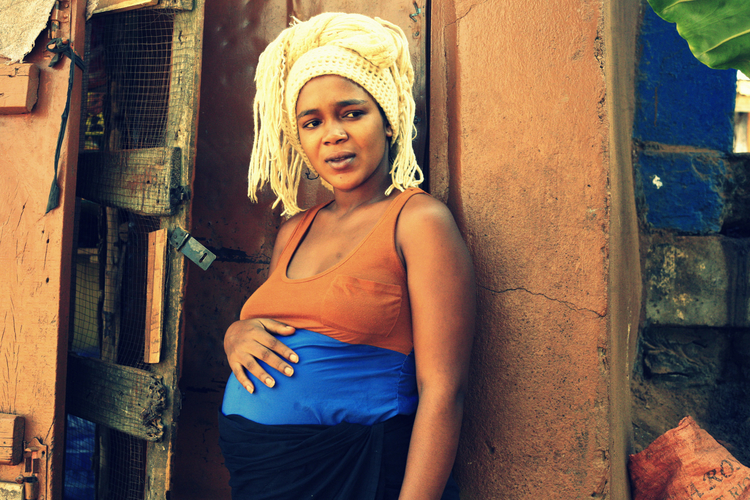
Schools in Sierra Leone closed during the Ebola epidemic are scheduled to re-open today, welcoming children eager to learn again. But the country’s Minister of Education Minkailu Bah has banned one group from returning: pregnant teen girls, claiming they’re a distraction to their peers and would hinder learning.

Incidentally, this ban isn’t new, having been in place since 2010. But it’s making headlines now.

Whether or not this qualifies as a “distraction” is another debate entirely, but teenage pregnancies within the country are becoming more common. A recent long-term study by the UNESCO HIV and Health Education Clearing House found that 33%+ of all Sierran Leonian pregnancies involve teen girls, and nearly 40%+ are involved in a “maternal death.” For context relative to the size of the country’s population, 41% of Sierra Leone citizens are under age 18. Those are some scary stats.

Sierra Leone isn’t the only country battling this issue. As a whole, Africa has the highest rates of teenage pregnancies, taking 18 of the top 20 spots in a 2013 United Nations Population Fund (UNFPA) rankings report.

The recent teenage pregnancy epidemic has been attributed to Ebola, in that girls who might otherwise be attending school are now more vulnerable to sexual violence. They may also have to survive and provide, and do so via prostitution. So there might be a bit of a substitution effect at play here.

But human rights governing bodies have taken note of Bah’s stance. The United Nations issued a statement in which stated that “education is a fundamental human right that Sierra Leone has committed itself to uphold.” The UN also reminded the country of its own Education Act, passed in 2004, which barred discrimination of those seeking education.

We’ll see how Bah’s proposed idea pans out. But the words of UNFPA’s Executive Director Babatunde Osotimehin ring true here:

Adolescent pregnancy is intertwined with issues of human rights. A pregnant girl who is pressured or forced to leave school, for example, is denied her right to education.

UVA Rape Story Retracted: Has It Happened Before?

UVA (Brohammas)

UVA (Brohammas)

Last week, “Rolling Stone” released an investigative report on its now-infamous piece “A Rape on Campus.” The report, produced jointly with the Columbia Graduate School of Journalism, delved into fact-checking the narrative. Ultimately, the investigation found many fact-checking and methodology errors (overall termed a “systematic failing”), and “Rolling Stone” retracted the piece.

I was interested to see if any other investigative journalism pieces, specifically on rape cases, had been retracted at any time. But I wasn’t able to find any. The closest things I could find were examples of victims later recanting their stories.

This has proven to be a first for the journalism world in that such an expansive feature (on such a timely, hot-button issue, no less) has been so thoroughly demolished by its fabrications. Though the story initially drew awareness to rape victims on college campuses, it ultimately ended up casting more negative light on the publication and journalist who covered it. Let’s hope that future journalists covering sexual assault stories will be scared into performing their due diligence to get all the facts right.


How Many College Sexual Assault Investigations Have Been Suspended?

UVA Campus (Brohammas)

UVA Campus (Brohammas)

Yesterday, the Charlottesville, Virginia police announced that they’re suspending their investigation of the UVA fraternity rape allegations due to lack of evidence. After reviewing records and conducting 70 interviews, investigators were unable to find key witnesses or a statement that the assault occurred.

This leads to the obvious question: How many sexual assault investigations have been suspended?

I was specifically interested in the topic in the context of colleges and universities, and searched for that. I was unable to find any conclusive data, which makes sense, as I don’t think schools would be eager to give those numbers out.

The police did say they’re leaving the investigation open, and that it could resume in the future. But I’m sure there are even fewer statistics on re-opened college sexual assault cases.


The UK Introduces “3-Parent Baby” Bill

Human embryos (Bloomberg)

Human embryos (Bloomberg)

Britain made history this week by becoming the first country to introduce a “3-parent baby” bill.

Approved by the House of Commons, the Human Fertilization and Embryology (Mitochondrial Donation) Regulations 2015 seeks to eradicate genetic diseases that are passed from mother to child via defective mitochondria. (Defective mitochondria causes diseases such as brain damage, heart failure and blindness.) The genetic diseases would then cease to be passed to future generations.

For those who aren’t up on their fifth-grade science, here’s how it works: There are two healthy parents, save for the defective mitochondria (the cells that convert food into energy). A third woman would donate her healthy mitochondria via a modified in-vitro fertilization (IVF) technique. From then on, the mitochondria are permanently altered for the better.

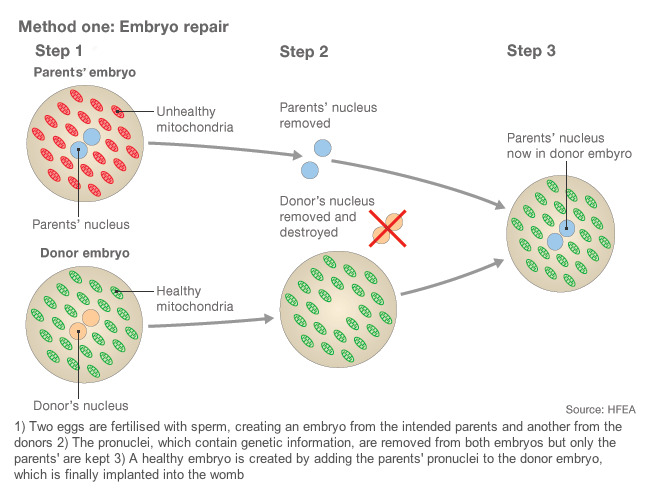
There are two ways the procedure can be executed. For visual learners, diagrams are below:

Method 1 - Embryo Repair (BBC)

Method 1 – Embryo Repair (BBC)

In the first method, the nuclei from the parents’ fertilized embryo is added to the donor’s fertilized embryo. The modified embryo is then placed into the womb.

Method 2 - Egg Repair (BBC)

Method 2 – Egg Repair (BBC)

In the second method, the nucleus from the mother’s egg is placed into the donor egg, with the healthy mitochondria.

In fact, calling a resulting baby from the procedure a “3-parent baby” is a misnomer: The donor would only give about .1% of her DNA. It would only change the portion that houses the genetic disease. Per the BBC, reproductive ethicist Dr. Gillian Lockwood notes:

Less than a tenth of one per cent of the genome is actually going to be affected. It is not part of what makes us genetically who we are. It doesn’t affect height, eye colour, intelligence, musicality.

If the measure passes through the House of Lords, the first baby to benefit from this procedure could be born next year.

NPR notes that U.S. agencies, such as the Food and Drug Administration (FDA) have also been looking into the process, since 1-4K American children are born with a mitochondrial disease (numbers per the United Mitochondrial Disease Foundation).

It’s safe to say that Britain will pave the way with how they handle this measure, and the world will be watching (and learning).

How Many States Cover Transgender Medical Care?

Estradiol estrogen pill (Open Minded Health)

Estradiol estrogen pill (Open Minded Health)

As the transgender community continues to gain visibility in mainstream culture, the issues they face will become more common. Receiving proper medical care is one such issue that will continue to gain prominence.

Last week, Oregon became the latest state to cover transgender care under Medicaid. According to NPR, services include hormone therapy (for example, giving a transwoman estrogen pills), puberty suppression and gender reassignment surgery. Other states with health coverage that cover transgender care include California, Colorado, Connecticut, New York and Vermont. (New York made the decision to cover gender reassignment surgery just last month.)

Only 14% of the United States covers transgender medical care by state. Let’s hope the population’s new visibility helps other states make the right decision to include medical care for transpeople.